Net profit surged by 186%! Accelink Technologies is cashing in on the AI computing power dividend
 08/18 2026
 523
523
On August 18, Accelink Technologies disclosed its 2026 semi-annual report, revealing that the company achieved revenue of 1.032 billion yuan in the first half of the year, a year-on-year increase of 72.91%; net profit attributable to the parent company was 148 million yuan, a substantial year-on-year increase of 186.09%, nearing the upper end of the previously announced performance forecast range.
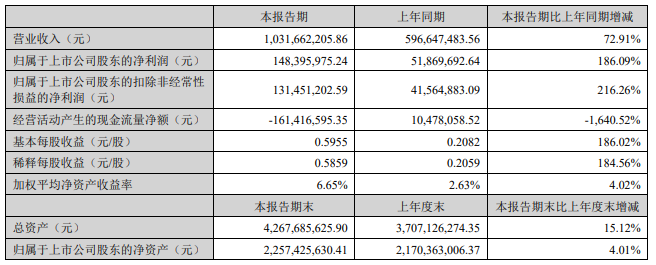
The wave of AI computing power infrastructure construction is translating into tangible financial gains across the optical communication industry chain. Accelink Technologies, leveraging its strategic positioning in the optical communication devices and thin-film lithium niobate modulator sectors, has emerged as one of the beneficiaries of this round of structural upgrades.
The most eye-catching segment in this performance report is undoubtedly optical communication devices. In the first half of the year, this segment achieved revenue of 602 million yuan, a year-on-year increase of 115.04%, accounting for 58.3% of total revenue; its gross margin surged from 26.47% in the same period last year to 39.36%.
Both production and sales volumes doubled, with production reaching 6.1679 million units, a 102.42% increase; sales reached 6.0606 million units, a 98.96% increase. Behind this simultaneous growth in volume and price is the accelerated investment in global AI computing power infrastructure and the continuous advancement of data center construction. As an upstream optical device supplier, Accelink Technologies' overseas revenue has become a significant growth driver, with foreign revenue reaching 588 million yuan in the first half of the year, a year-on-year increase of 119.34%, accounting for 57.02% of total revenue, continuously realizing the strategic value of its global layout.
The surge in optical communication devices validates the company's industrialization capabilities, while its long-term growth potential and valuation ceiling depend more on the commercialization progress of thin-film lithium niobate modulators in this cutting-edge sector. During the reporting period, thin-film lithium niobate driver modulator CDM chips for coherent transmission in long-haul backbone networks have been shipped in bulk to leading optical communication equipment companies; CDM modules have passed verification at leading companies and are undergoing small-batch production and shipment; CDM chips for data center DCI coherent sink (coherent sink : coherent sink to the edge) have received customer verification orders.
As optical modules evolve from 800G to 1.6T and even 3.2T, thin-film lithium niobate modulators, with their advantages of low power consumption and high bandwidth, are expected to see an introduction window in the 3.2T pluggable solution. A Huatai Securities research report pointed out that the competitive edge of this technological path is gradually being recognized by leading equipment manufacturers. As one of the few domestic companies to achieve industrialization and scaling (large-scale production) of thin-film lithium niobate modulator chips and modules, Accelink Technologies' strategic positioning value should not be underestimated.
However, the long verification cycle of downstream customers remains an objective constraint. As of June 30, the cumulative capacity utilization rate of the lithium niobate high-speed modulator chip R&D and industrialization project fell short of expectations, and Milan Accelink remained unprofitable in the first half of the year, reflecting that this business is still in the stages of capacity ramp-up and customer verification.
It should be noted that the reasons for the low capacity utilization rate should be viewed from two perspectives: on the demand side, thin-film lithium niobate products are still in the customer verification and introduction stage, and large-scale orders have not yet been released; on the supply side, production line debugging and yield ramp-up also take time. The combination of these two factors means that this business is still some distance away from large-scale volume production.
In terms of capacity, the company's phased layout is gradually falling into place. The "Thailand Accelink Production Base Project" was completed and commenced operations on March 31, 2026. During the reporting period, it achieved large-scale production of polarization-maintaining fiber devices and Pigtail products, with high-precision multi-channel FAU passing certification on the qualified supplier list of a major customer and undergoing continuous capacity expansion.
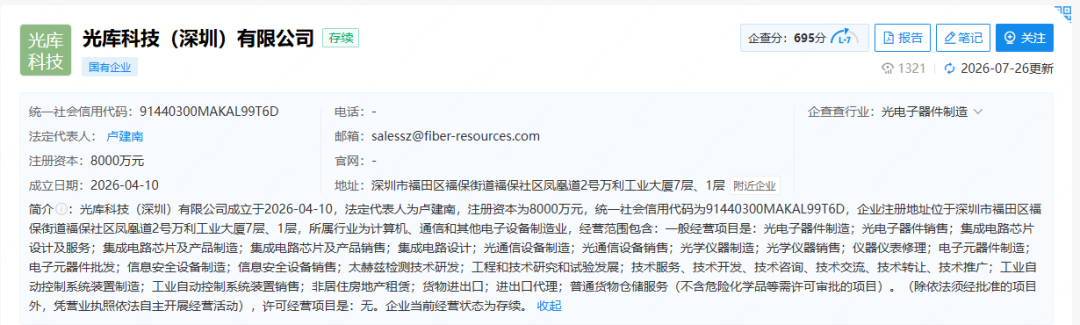
In addition, the company established Accelink Technologies (Shenzhen) Co., Ltd. in April 2026 with an investment of 80 million yuan to further expand its presence in the South China market, and the third phase of production in Zhuhai has also commenced operations in succession. The orderly release of capacity provides physical support for subsequent revenue growth and prepares the company to handle incremental orders driven by AI computing power.
From an industry perspective, the AI-driven optical communication boom cycle continues. TrendForce data shows that the global market for AI-specific optical transceiver modules will grow from $16.5 billion in 2025 to $26 billion in 2026, a year-on-year increase of over 57%.
CPO and NPO technologies are becoming important technological paths for the deployment of 1.6T and 3.2T optical modules. Accelink Technologies has developed new FAU and high-performance circulator products for AI data centers, as well as OCS equipment and M×N high-precision multi-dimensional fiber array series products for submarine optical networks, entering this track (sector).
In March 2026, the company showcased its 800G/1.6T bulk delivery capabilities at the OFC exhibition, and its submarine devices won an international innovation award.
AI computing power demand is reshaping the value distribution across the optical communication industry chain. Factors such as the commercialization progress of thin-film lithium niobate will be key variables in determining whether Accelink Technologies can transition from "cyclical dividends" to "sustained growth." OFweek Optoelectronics will continue to track the strategic value of its technological positioning and capacity layout.
-
Can the Elephant Turn Around? Volkswagen Takes Only Three Years to Reshape Its 'Soul'
-
![]()
DeepSeek Hikes Prices as 'Price Butcher' Liang Wenfeng 'Retreats'
-
![]()
Starting at 1799 yuan! Dimensity 7500 with 10,000mAh battery, who is the iQOO Z11S for?
-
![]()
BMW 5 Series Price Plummets to 280,000 Yuan: Early BMW Owners Lament 'Significant Losses'; BMW Dealers Offer 285,000 Yuan for Base Model, Financing Deals More Affordable Than Full Payment
-
![]()
Geely's Strategic Shift: Unpacking a Key Question and a Major Anticipation Post Li Shufu's Departure
-
![]()
Starting at 3399 Yuan! iQOO Neo11 Supreme Edition Launched: Featuring the Dimensity 9500M and Exceptional Battery Life
-
![]()
Live Streaming Reservation丨Avnet Ecosystem Technology Forum: Jointly Exploring New Frontiers in the AI Industry
-
![]()
FAW, in Its Third Year with a New Chairman, Anticipates Returns on Multi-Billion Yuan Investments