Why is Baidu the Ideal Partner for Building Hainan’s ‘Digital and Smart Artery’?
 03/04 2026
 823
823
On March 2, the Hainan Provincial People’s Government and Baidu Online Network Technology (Beijing) Co., Ltd. signed a comprehensive strategic cooperation agreement in Haikou.
Under the agreement, both sides will establish a strategic coordination team and a regular institutional working mechanism based on the principles of mutual benefit, open cooperation, and long-term development. They will explore areas such as the orderly cross-border flow of intelligent connected vehicle (ICV) data and the creation of an ICV industry ecosystem hub. Baidu will launch its Luobo Kuaipao autonomous driving international regional center, building a comprehensive operations hub in Hainan that integrates smart connectivity, data innovation, and cultural tourism. Additionally, they will deepen collaboration in digital economy sectors, driving Hainan’s digital transformation through intelligent computing infrastructure and AI large model applications.
Data, computing power, large models, and industry-AI integration—these are the new keywords reshaping regional economic development.
As Hainan enters its first full year of “island-wide customs clearance operations” and the inaugural year of the 15th Five-Year Plan, the focus has shifted from merely discussing tax, trade, and capital flow facilitation in the free trade port. Instead, the emphasis is on “strengthening through digitalization,” with goals to build a “technology innovation island” and a “talent hub island.”
Digital infrastructure upgrades have replaced traditional “seven connections and one leveling” as the cornerstone of economic development, with regional growth transitioning from resource dependency to “smart foundations.”
The future free trade port will evolve from a goods circulation hub into a highland for data flow and intelligent capabilities. Whoever builds this “digital artery” will secure a dominant position in the future industrial landscape.
So, why did Hainan choose Baidu amid this transformation of regional competitiveness? And what strategic opportunities does this partnership hold for Baidu?
The Hainan Blueprint: Building a Trillion-Dollar AI Ecosystem for the “45432” Vision
To understand this collaboration, one must first examine Hainan’s “45432” modern industrial system outlined for the 15th Five-Year Plan. This includes upgrading four leading industries, fostering new quality productive forces in five directions, deploying four future industries, and building two core islands.
This industrial blueprint represents a fundamental restructuring of Hainan’s economy.
The “strengthening through digitalization” mentioned here is not just about developing the digital sector but embedding digital capabilities into leading industries such as tourism, modern services, high-tech, and tropical agriculture while providing foundational support for future industries like deep-sea technology, commercial spaceflight, biomanufacturing, and embodied AI.
In other words, digitalization is no longer a standalone track but the underlying capability of the entire industrial system.
The question arises: Where will the digital foundation aligned with Hainan’s new quality productive forces development plan come from?
Breaking it down, this digital foundation must first support the free trade port’s digital transportation needs, handling massive flows of people and logistics. Second, it must enable data assetization, as Hainan’s “data processing” and cross-border data flows require high standards in data annotation, cleaning, and model training. Additionally, in the era of “talent competition,” it must provide long-term talent system development support for the thriving “talent hub island.”
In this context, Baidu’s strengths become evident.
Baidu possesses a comprehensive “chip-cloud-model-ecosystem” capability system. Kunlun Chip addresses computing power needs, the Baidu Baige platform supports high-performance computing, the Baidu Qianfan platform enables model development and deployment, and when combined with autonomous driving and “cloud-intelligence integration” solutions for industry-specific agents, it forms a complete closed loop.
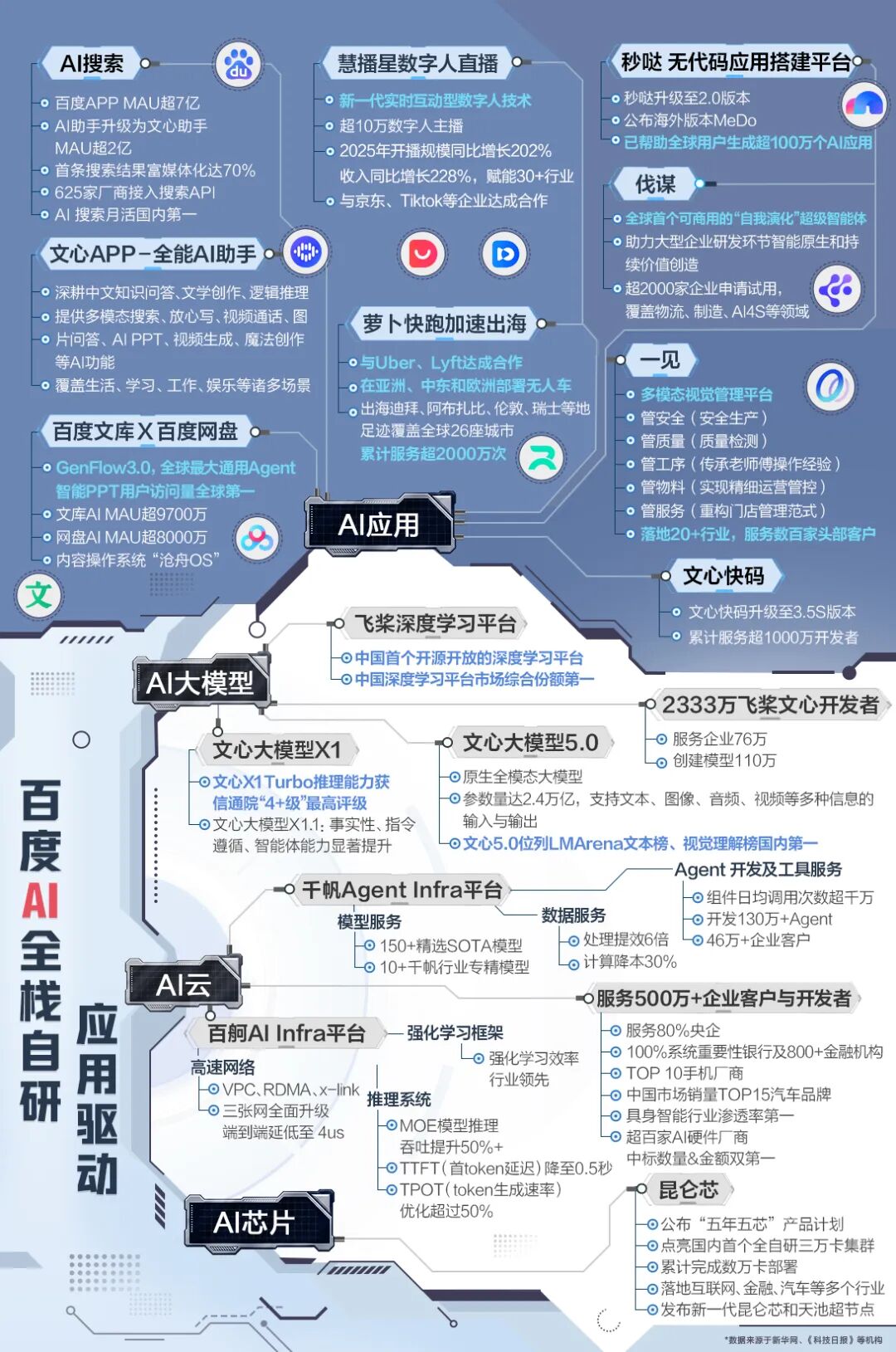
More importantly, this system has been validated through real-world business operations, meaning Hainan has found a partner that understands both technology and industrial implementation.
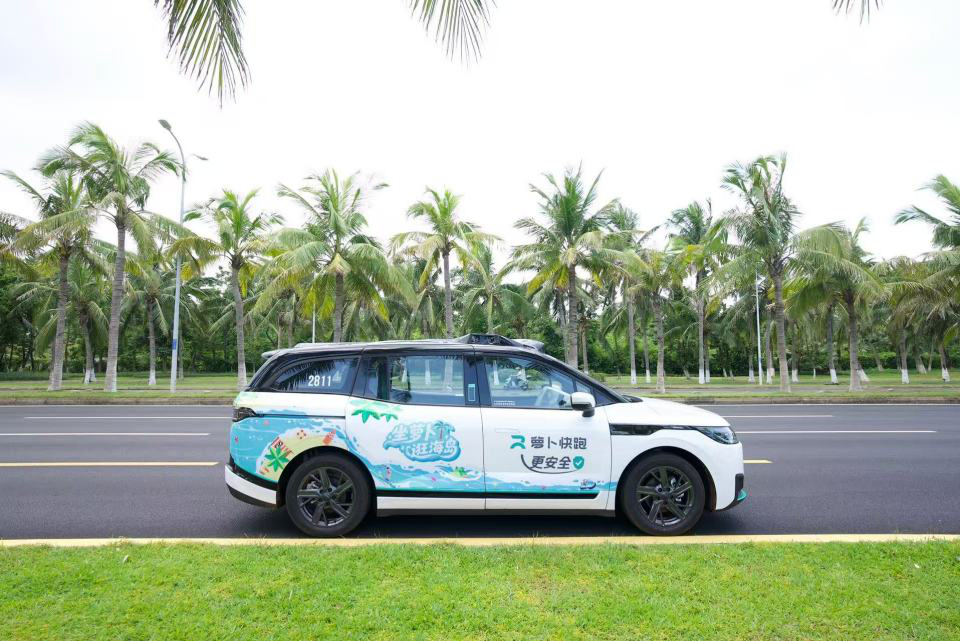
Consider transportation digitalization. As of February 2026, Luobo Kuaipao has accumulated over 20 million rides, operated in 26 cities globally, and logged over 300 million kilometers in autonomous driving, providing a solid foundation of real-world scenario data. Combined with Baidu’s mature technological system and extensive experience in vehicle-road-cloud integration pilot projects, traffic signal networked and coordinated control, autonomous driving, and AI, this represents not just a smart mobility upgrade for Hainan but also an accumulation of digital governance capabilities.
Now, consider data assetization capabilities. Baidu boasts a leading domestic data annotation ecosystem and AI-assisted annotation platform, capable of transforming vast amounts of raw data into high-quality training data, thus forming a closed loop of “large model R&D—data fine-tuning—industrial application.” This ensures Hainan can handle global high-end data processing orders for autonomous driving, medical imaging, and more.
Regarding long-term talent development, Baidu, known as China’s “Whampoa Military Academy” for AI talent, excels in both talent pool and industrial chain completeness. Baidu’s investments in industry-education integration and ecological co-construction provide support for Hainan to build a multi-tiered talent system.
Thus, Hainan’s choice of Baidu stems from considering scenarios, data, and talent, finding a digital foundation for the “45432” industrial system.
For Baidu, this partnership signals a transformation from a past internet platform company to an infrastructure-oriented enterprise in the AI era.
From Full-Stack Technology to Ecological Synergy: Making AI a Powerful Engine for Regional Economic Takeoff
In recent years, market skepticism toward Baidu has centered on one question: When will AI truly manifest in its revenue structure?
Now, financial reports provide a clear answer: Baidu’s revenue structure has reached an inflection point. Annual revenue hit 129.1 billion yuan, with AI-related revenue surpassing 40 billion yuan. In the fourth quarter, AI revenue even accounted for 43% of general business revenue.
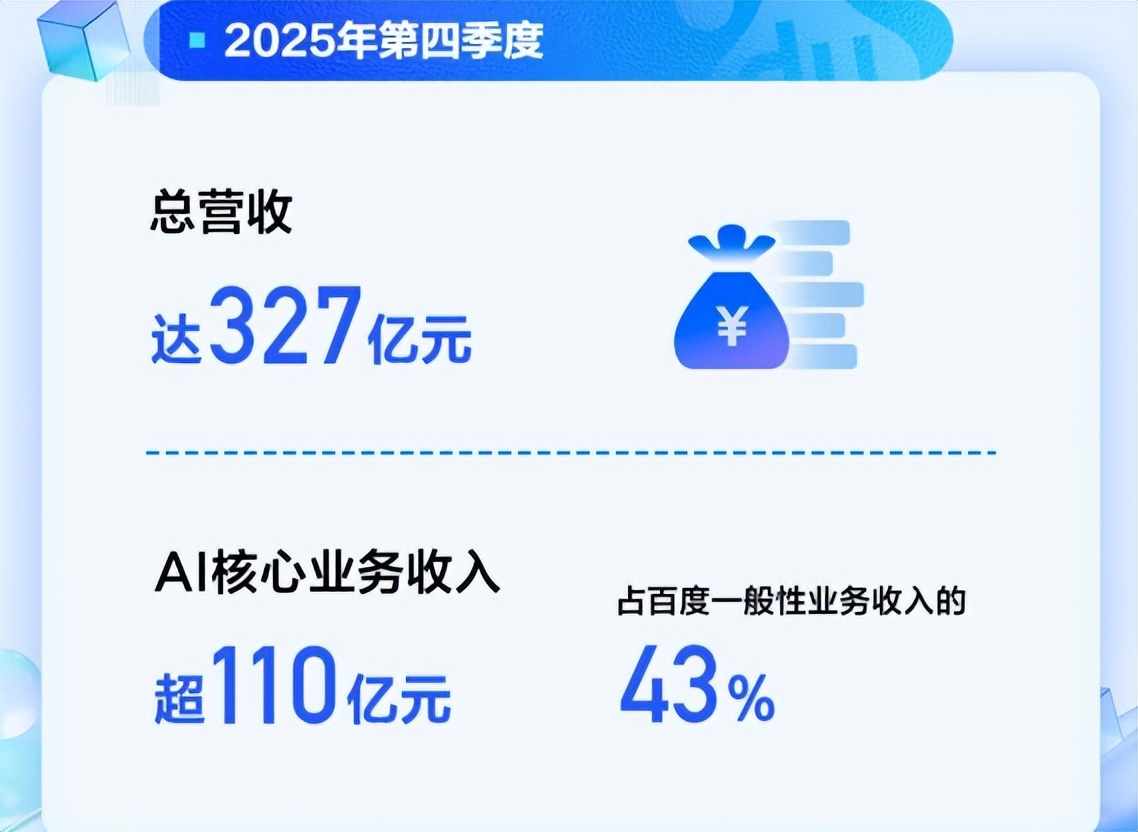
More critically, Baidu Intelligent Cloud’s growth is not about “selling servers” or “stacking computing power” but revolves around the combined output of large models, industry solutions, and high-performance computing.
Among China’s mainstream cloud providers, Baidu Intelligent Cloud has led for two consecutive years in the number of large model-related bid wins and contract value. Baidu’s AI infrastructure system has been repeatedly validated in scenarios like government services, finance, energy, and transportation.
At this stage, Baidu no longer needs just a few more industry cases but a regional-level ecological validation ground capable of supporting full-chain capabilities.
This is where the significance of cooperating with Hainan lies.
For Baidu, models can be trained here, data can be accumulated here, and applications can be scaled here, ultimately forming a closed loop of “large model R&D—data fine-tuning—industrial application.”
From an investment perspective, this cooperation essentially represents long-term technological capital accumulation.
Computing power construction requires continuous capital expenditure, data accumulation takes time, and talent development is a slow variable. However, just as Guangdong and Zhejiang provinces supported the development of internet and robotics industries for years, Hainan offers policies and space for industrial digitalization and high-end industry cultivation.
Once Baidu achieves deep regional-level ecological binding and becomes the digital foundation for Hainan’s development, it can embed itself into the growth of more strategic emerging industries, ensuring more stable commercial value release.
Placed within the broader AI investment landscape, this cooperation also addresses a widespread industry concern.
Over the past two years, the industry has faced pressure from high computing power investments and prolonged return cycles, with AI often seen as a cost center. Especially this year, with major Silicon Valley tech giants planning over $650 billion in capital expenditures, investors worry about “increasing investments with unclear returns.”
How to convert large-scale investments into sustained cash flow is an unavoidable topic for tech companies.
The construction of a regional-level digital foundation offers an answer. After becoming the digital infrastructure partner for the free trade port, Baidu’s AI business narrative changes entirely—from providing tools for enterprises to supplying foundational capabilities for a regional economy, with commercial value release revolving around the ecosystem’s overall operation.
For the first time, the AI industry clearly shows the market how a “cost center” can transform into a “core business” bound to industries.
The ‘Baidu Model’ in the AI Era: An Exponential Rise Focused on Hard Tech
Looking back, Baidu’s current structural transformation did not happen suddenly but emerged after years of investment, finally aligning with mature industrial conditions.
As early as around 2010, Baidu began systematically investing in AI, from deep learning to autonomous driving and self-developed chips—a route not fully understood by capital markets at the time. These were almost all high-investment, low-return, long-cycle sectors.
However, returns on hard tech are never linear; they follow a flat initial curve that steepens dramatically later.

From the start, Baidu sought first-mover advantages and long-term accumulation in foundational technological capabilities.
Kunlun Chip addresses computing power autonomy, Wenxin Large Model undertakes cognitive-layer capabilities, and Luobo Kuaipao continuously accumulates data in real-world road scenarios. Individually, these lines are heavy, but together, they form a complete technological closed loop.
By late 2025 and early 2026, AI revenue’s share in overall revenue rose rapidly, revealing the edge gained from this technological marathon. The cooperation with Hainan presents an opportunity for Baidu to accelerate its ascent.
Amid global tech transformations, China needs new openness samples, and Hainan actively “opens its doors,” aiming for a world-class open highland. Baidu, using chips to ensure computing power autonomy, large models to define cognitive capabilities, and autonomous driving to build real-world data entry points, fully showcases its technological ecosystem for the first time, targeting AI’s most crucial “industrial hematopoietic capability.”
This sends an important revaluation signal. The concentrated eruption of institutional openness and hard tech accumulation dividends will naturally alter long-term value expectations for Chinese tech companies. Most critically, the valuation anchor shifts from “traffic stories” to “infrastructure value.”
For years, tech companies’ value revolved around traffic scale and user growth, but in the AI era, core assets are shifting toward infrastructure capabilities. As Baidu transforms into an infrastructure-oriented enterprise, the compounding effects of hard tech gradually emerge.
Baidu founder Robin Li also stated during the earnings call that 2025 is a pivotal year for AI to become Baidu’s new core. With a clear AI-first strategy taking shape, the company is confident in its ability to create lasting value in the AI era.
Between the lines, it reveals that Baidu has grasped the future’s direction.
Hainan’s institutions and scenarios resonate with Baidu’s technology and platforms. A takeoff for the “intelligent economy” is quietly unfolding along the South China Sea coast.

Just as Beijing, Shanghai, Guangzhou, and Shenzhen vigorously developed the internet economy and aligned with global tech industries, reaping immense development dividends, Hainan and Baidu’s new story epitomizes China’s tech transition from alignment to leadership, heralding the next leap era.
Source: HK Stock Research Society
-
![]()
Net Profit Surges 13.65% Year-on-Year! Yutong Optics Reports RMB 1.782 Billion in H1 Revenue
-
![]()
Q2 Net Profit Slashes Losses by 80%! Has Costar Emerged from Its Darkest Hour?
-
AI Agents: The Paradigm Shift from 'Conversation' to 'Execution'
-
NVIDIA Takes Bold Strides to Lead in Both Hardware and Software Realms
-
![]()
It's Hard to Build Cars, Even Harder to Build Humans, and XPENG is Doing Both
-
![]()
Valuation Soars by $57 Billion: Three Entrepreneurs Born in the 1980s Forge an AI Unicorn Now Suddenly on the Market
-
![]()
How Can We Achieve the Goal of 100,000 Hydrogen Vehicles by 2030?
-
![]()
July Online Market for Consumer-Grade Sports Cameras: Robust Double-Digit Growth in Sales Volume and Value, Mid-Range Products Fuel Market Expansion