Autonomous Sweeping Vehicles Roll Out Across Qingdao: Tech-Driven ‘Cleaners’ at Work Around the Clock, Pioneering a New Era of ‘Human-Machine Synergy’ in Urban Management
 07/20 2026
 537
537
Introduction
At dawn, a compact sweeping vehicle silently glides along the greenway of Zhangcun River Park in Laoshan District, Qingdao. When it encounters pedestrians, it deftly maneuvers around them, continuing to collect fallen leaves and dust into its ‘belly’.
Since 2026, Laoshan District, Chengyang District, West Coast New Area, Pingdu City, and other regions have progressively introduced a fleet of L4-level autonomous sweeping equipment, injecting fresh technological vitality into urban cleaning efforts.
Repetitive sweeping tasks that once required sanitation workers to endure scorching heat and rain are now being handled by these ‘silent urban cleaning stewards’.
(For more details, please click: ‘68,000 Yuan! The Sunshine S100 Multi-functional Sweeping Robot ‘Three-in-One’—Can Yushu Intelligent Revolutionize the Environmental Sanitation Industry with Autonomous Driving?’)
I. Laoshan: ‘Cleaning Robots’ Demonstrate Their Capabilities at Zhangcun River Park
Zhangcun River Ecological Park, stretching approximately 2 kilometers from east to west, has become a favored leisure spot for citizens, thanks to its picturesque waterfront scenery.
However, the park’s vast expanse, heavy foot traffic, and stringent cleaning standards present challenges for traditional manual sweeping, including high labor intensity, difficulty in maintaining overall cleanliness, and arduous efforts in cleaning hard-to-reach areas.
The Laoshan District Urban Management Bureau has innovatively introduced the Fulongma SD1502-L4 intelligent sweeping robot.
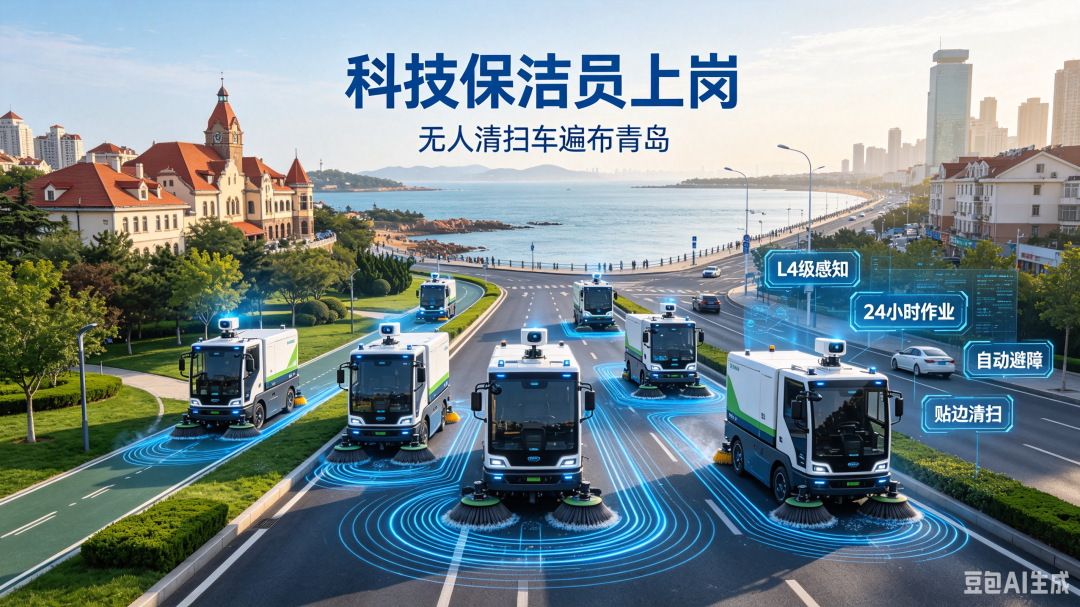
This autonomous cleaning vehicle is equipped with an array of radars, including laser, ultrasonic, and millimeter-wave, along with a high-precision positioning system, enabling L4-level autonomous driving. Multiple sensors on the vehicle work in tandem to perceive the surrounding environment 360 degrees, actively avoiding pedestrians, precisely navigating around obstacles, and autonomously completing sweeping tasks.
What’s even more remarkable is its operational efficiency. The autonomous cleaning vehicle requires three passes to sweep a pathway thoroughly: two passes along the road edges and one pass in the middle, covering a total operational distance of about 6 kilometers.
The vehicle’s operational speed is set at 2 kilometers per hour, allowing it to complete a cleaning cycle in 3 hours.
The equipment can operate autonomously during periods of low traffic and dynamically optimize its sweeping path based on garbage density. With a single charge, it can continuously operate for 6 to 8 hours, all without human intervention.
Many park visitors affectionately remark, ‘It’s like a silent urban cleaning steward, reliable and comforting.’
II. Chengyang: One Vehicle Replaces Four Workers, Operating Around the Clock Without ‘Taking a Break’
If Laoshan is the ‘appetizer,’ then the setup at Baisha River Sports Park in Chengyang District is the ‘main course.’
Recently, the Chengyang District Housing and Urban-Rural Development Bureau, in collaboration with China Overseas Property, deployed two blue-and-white autonomous sweeping vehicles at Baisha River Sports Park.
Edge sweeping, turning, and garbage collection are all executed seamlessly without any manual control. Although the driver’s seat is vacant, the operation is more precise than manual sweeping.
This vehicle is no ordinary machine. A single device can replace four cleaning personnel, maintaining a stable road cleanliness rate of over 97%.
Relying on AI perception, high-precision positioning, and centimeter-level edge-sweeping technology, the equipment can sweep closely along the road curbs, leaving no hard-to-reach areas untouched.
Even more impressive are its ‘self-sufficiency skills’: it can autonomously recharge, refill water, and dump garbage, achieving a fully unmanned closed-loop management system. It operates 24/7 without ever ‘taking a break.’
From manual sweeping to machine operation, from scheduled cleaning to round-the-clock response, Chengyang’s practice demonstrates that autonomous sweeping equipment is reshaping the fundamental logic of urban management.
The Chengyang District Housing and Urban-Rural Development Bureau plans to use Baisha River Sports Park as a starting point to gradually expand autonomous sanitation operations to more roads and scenarios.
III. Pingdu: Operating in Extreme Weather Without ‘Shutting Down,’ Addressing ‘Labor Shortages’
At the 2020 Park in Pingdu City, autonomous cleaning vehicles have begun to adapt to complex garden maintenance scenarios.
In January 2026, Pingdu City deployed two intelligent autonomous sweeping vehicles at the 2020 Park. Produced by local company Tonghui Automobile, these devices represent a perfect fusion of ‘local manufacturing’ and ‘smart sanitation.’
The vehicles are equipped with lidar, high-definition cameras, and intelligent sensors, forming a 360-degree environmental perception system.
What impresses frontline sanitation workers the most is its ‘rugged’ capability. In extreme weather conditions such as high temperatures, severe cold, rain, and wind, the equipment can replace manual labor on the front lines, reducing outdoor operational safety risks and providing a new solution to address the aging workforce and labor shortages in the sanitation industry.
‘With it, we can focus on detailed cleaning of green belts and corners,’ said a frontline sanitation worker.
The autonomous vehicles handle large-area standardized sweeping, while sanitation workers focus on detailed maintenance of green belts and corners—each playing to their strengths. This not only enhances efficiency but also shows respect for the ‘human’ element.
IV. West Coast: First Provincial License, a Key Step Towards Open Roads
If parks are an ‘open-book exam,’ then urban main and secondary roads are a ‘closed-book exam.’
The West Coast New Area has deployed 3-ton autonomous sanitation vehicles in the Xingguang Island area, obtaining the province’s first license for autonomous sanitation vehicles.
After completing full-area mapping, the vehicles have entered the stage of road testing and cleaning operations on urban main and secondary roads.
This marks a crucial step for Qingdao’s autonomous sweeping vehicles to move from enclosed parks to open roads, transitioning from pilot projects to large-scale applications.
V. Three-Year Plan: From 7 to 100 Vehicles, Qingdao’s ‘AI+Sanitation’ Ambition
The widespread adoption of autonomous sweeping vehicles in Qingdao is no accident.
In December 2025, Qingdao obtained the province’s first road test license for intelligent connected autonomous sanitation vehicles.
By May 2026, seven vehicles had been deployed in districts such as Laoshan, Chengyang, West Coast New Area, Jiaozhou, and Pingdu, with plans to reach over 10 vehicles by the end of 2026 and over 30 by 2027.
An even grander vision comes from the policy level.
In April 2026, Qingdao released the ‘Qingdao Urban Management Sector ‘AI+’ Social Governance Action Plan (2026–2028),’ outlining a ‘three-step’ goal: laying a solid foundation and creating over 12 application scenarios by 2026; expanding coverage and deploying over 100 intelligent connected sanitation vehicles, autonomous inspection vehicles, and other equipment by 2027; and achieving full-domain coverage with comprehensive application of next-generation intelligent agents across six major industries by 2028.
From 7 to 100 vehicles, from parks to main and secondary roads, from pilot projects to full-domain coverage—Qingdao’s ‘AI+sanitation’ roadmap is clear.
The promotion of autonomous sweeping vehicles is driving a profound transformation in sanitation operations: vehicles handle large-area standardized tasks, while manual labor focuses on detailed maintenance of green spaces and facilities. The low-speed operation of the equipment is also better suited for nighttime work, effectively extending urban cleaning hours. In summary, the WeChat public account ‘Autonomous Vehicles Are Here’ believes:
As autonomous sweeping vehicles quietly navigate Qingdao’s parks, roads, and communities, they are changing not just the way cleaning is done but also the entire city’s management mindset.
What do you think?
References: Reports from Peninsula Metropolis Daily, iChengyang, Qingdao Evening News, Qingdao Urban Management Bureau, Guanhai News, and other media outlets.
#AutonomousVehiclesAreHere #AutonomousDriving #SelfDriving #AutonomousVehicles
-
Observation of AI Business Models: From Token-Based Payment to Outcome-Based Payment
-
Observations on AI Business Models: From Token-Based Payment to Outcome-Based Payment
-
SpaceX Market Insight: The $1 Trillion 'Fireworks' Fizzle Out, Marking the Start of the Super IPO Gamble
-
![]()
Car Prices on the Rise: Is It Wise to Postpone Your Purchase?
-
![]()
Foxconn's Electric Vehicle Venture Hits a Snag
-
![]()
How Did They Open the Door to Europe by Attacking the Century-Old Stronghold of the Automotive Industry?
-
![]()
Qwen Still Shows Hesitation
-
![]()
Qwen: Still a Bit Short on Confidence