Beijing Unveils 'Ten Measures for Token Economy,' Creating a Comprehensive Industrial Development Blueprint for Tokenomics
 09/20 2026
 356
356
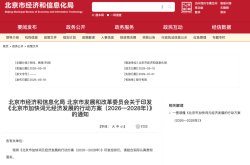
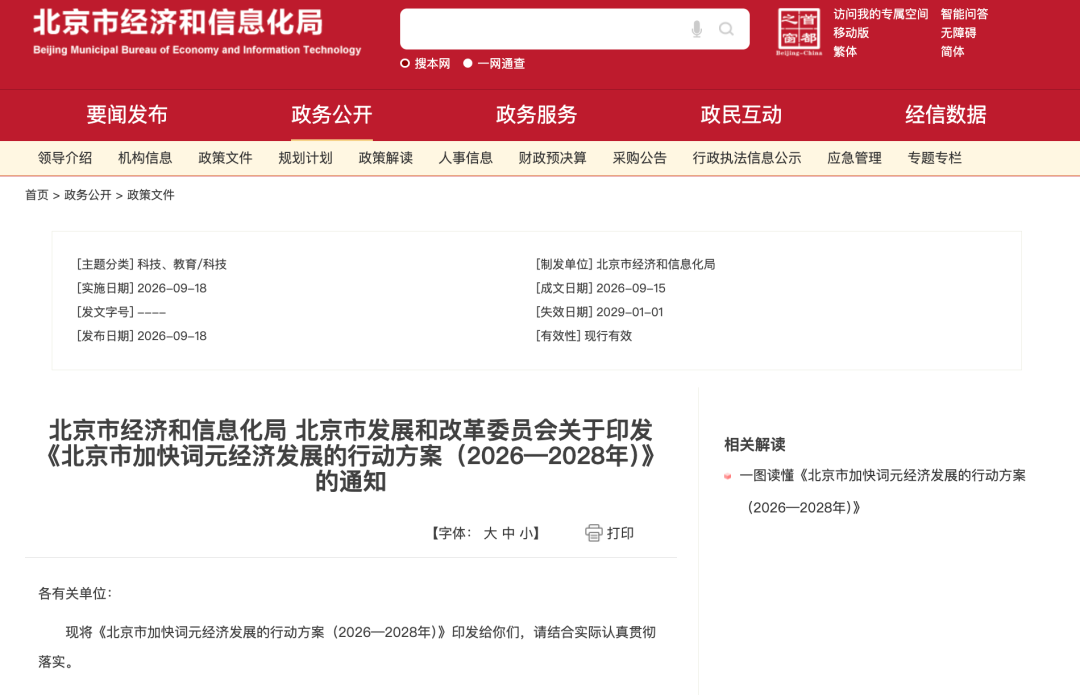
On September 18, the Beijing Municipal Commission of Economy and Information Technology, in collaboration with the Municipal Development and Reform Commission, jointly released a document with a rather lengthy title: the Action Plan for Accelerating the Development of the Token Economy in Beijing (2026–2028).
My initial reaction was puzzlement—why does 'token' deserve a dedicated special policy? However, after delving into the full text and the bureau's interpretation, I realized this is a significant move. It marks the nation's first provincial-level special policy for the token economy, encompassing ten measures across six key areas, collectively known as the 'Ten Measures for the Token Economy' within the industry.
The Commission of Economy and Information Technology projects that the entire industrial chain of the token economy could exceed RMB 1 trillion in scale during the '15th Five-Year Plan' period.
Explosive Growth in Token Utilization
Tokens, or 'Token' in English, represent the smallest computational units for large models to process information. When you interact with an AI assistant or have it generate code, tokens are being 'consumed' behind the scenes.
In March of this year, the National Data Administration officially designated 'Token' as the value anchor and settlement unit in the era of intelligence. In simpler terms, it's the 'kilowatt-hour' of the AI era—invisible yet consumed every time you utilize intelligent services.
How fast is this consumption escalating? According to the National Data Administration, the national daily average token usage stood at 100 billion in early 2024, soared to 100 trillion by the end of 2025, and surpassed 500 trillion by May of this year.
That's a 500-fold increase in just over a year. The China Telecom Research Institute predicts that annual consumption will reach 1 quadrillion in 2026 and exceed 350 quadrillion by 2030, with a compound annual growth rate of nearly 12 times.
With such exponential growth, regulating production, pricing, and quality has become imperative. This is precisely why Beijing is taking proactive steps.
Ten Measures: Constructing an 'Industrial Assembly Line'
Zhang Jinrui, Director of the Digital Industry Division at the Commission of Economy and Information Technology, provided a clear hierarchical breakdown: at the foundation of the intelligent economy lie data centers, in the middle are token factories, and at the pinnacle are various intelligent agents.
Token production involves 'transforming electricity into computing power and computing power into tokens.'
Among the ten measures, the following are particularly noteworthy:
On the production front, Beijing aims to establish 'world-class token factories.' This is not about setting up a few servers casually. The city plans to develop graded evaluation standards, incorporating intriguing metrics such as token throughput speed, first-character latency, cache hit rate, and power usage effectiveness (PUE). The issue of 'idle token production'—where computing power appears occupied but yields useless tokens—is specifically addressed. A new concept, the 'model intelligence ceiling level,' is introduced, emphasizing not just the quantity of tokens burned but their intelligence.
On the distribution front, for the first time, a token quality evaluation system will be established, along with a unified token distribution platform classified as part of the new infrastructure. Deputy Director Chen Guangming highlighted a practical challenge: the quality of content generated by the same model can vary significantly depending on the distribution channel. Future third-party evaluations will 'verify' token quality, but pricing will be determined by the market.
On the consumption front, the goal is to make intelligent agents truly practical. Beyond general-purpose scenarios like information consulting and lifestyle services, vertical industries such as industrial manufacturing, biomedicine, and education will open up new scenarios, leading to the emergence of 'industry-specific tokens.' Not all platforms need to develop their own large models; integrating their expertise into intelligent agents could be the next logical step.
Why Beijing, and What Are Regions Vying For?
Beijing boasts a robust foundation: over half of the nation's token production is concentrated in the city, with Doubao alone surpassing 180 trillion in token usage, complemented by leading model enterprises like Zhipu and Yuezhi Dark Side.
In terms of infrastructure, Beijing's intelligent computing capacity has reached over 80,000 P, with a target of 200,000 P by 2027. The Beijing No. 1 Token Factory and the first state-backed Jingsuan Token Factory are already operational.
However, Beijing is not alone in this endeavor. Regions are transitioning from 'subsidizing computing power' to 'subsidizing tokens': Chengdu released a draft token voucher policy on September 11, offering RMB 100 million annually, with enterprises receiving up to RMB 2 million in subsidies for model usage services. Chongqing is establishing four token pilot zones for industry, healthcare, and logistics. Guangzhou's Haizhu District has already launched Guangdong's first 'Token Loan.'
Banks are also joining the fray. On September 13, the first batch of 'Yiqi Token Loans' were issued in Beijing's Economic and Technological Development Zone, with six banks providing nearly RMB 2 billion in credit—where a company's token consumption is directly treated as a credit asset. Autonomous driving firm National New Energy Vehicle Technology Innovation Center and computing power service provider Shentong Guangda each received RMB 30 million.
The final two clauses of the document hint at future initiatives: innovating token financial tools and training 'token engineers' to transition traditional software engineers into roles focused on model optimization and inference acceleration.
My assessment is that this policy competition is no longer about who possesses the largest data centers but who can effectively transform computing power into usable intelligence and market it.
When tokens can be measured, quality-checked, financed, and settled, they truly evolve from a technical term into a factor of production.
Next time you chat with an AI, take a closer look—those lines of text appearing are part of a new, price-tagged business.

Image Source: Beijing Municipal Commission of Economy and Information Technology
-
![]()
A Detailed Explanation of Li Feifei's World Model Atlas: How It Impacts Physical AI Industries Such as Autonomous Driving and Humanoid Robots
-
![]()
China's Intelligent Driving Ventures Abroad Face Rivals: Europe and US's Momenta 'Wayve'
-
![]()
Has the Modular Architecture of Autonomous Driving Disappeared After the Emergence of End-to-End Systems?
-
![]()
OpenAI GPT-6 Practical Test Unveils: Tactile Sensors, a New Frontier in the Humanoid Robot Supply Chain
-
![]()
Can the Intelligent Driving Solutions for Fuel-Powered Cars Mirror Those of Pure Electric Vehicles? Why Does Momenta Craft Specialized Algorithms for Fuel-Powered Cars?
-
![]()
Beijing Unveils 'Ten Measures for Token Economy,' Creating a Comprehensive Industrial Development Blueprint for Tokenomics
-
![]()
Trident Crafted with Chinese Tech? Maserati's Electrification Drive Taps HarmonyOS, as European Automakers Leverage China's New Energy Prowess
-
Use Anthropic's Large Model with Caution: Handing Over Global User Data to US Intelligence Agencies