Liu Dayiheng’s Yunqi Debut and Alibaba’s Strategic Bet on Agents
 09/23 2026
 499
499
This year’s Yunqi Conference was brimming with insights and innovations.
Over the past year, nearly every tech conference has focused on Agents. Yet, a persistent question lingered among attendees: Can these Agents truly deliver results in real-world business environments?
The Yunqi Conference this year served as a dedicated platform to explore this very question.
After twelve years, the Yunqi Conference, traditionally held in Yunqi Town, West Lake District, relocated its main venue to the International Expo Center by the Qiantang River—the same site that hosted the G20 Summit. Yunqi Town was not forgotten; it functioned as a sub-venue, focusing on spatial computing and embodied AI.
On-site, a developer demonstrated the power of Agents by launching one directly from their phone. This Agent possessed an independent digital identity, automatically analyzing the three-day conference agenda, recommending booths and sub-forums based on the developer’s preferences, and even pre-fetching exhibit information as the developer approached specific booths. This marked the first time the Yunqi Conference embraced Agent-Native participation, enabling every attendee to bring their own Agent.
In Hall 2, dedicated to Computational Power, a large screen displayed the number of lightbulbs that could remain lit based on the Tokens consumed per AI conversation, along with the corresponding power consumption and carbon emissions. One visitor calculated that their dozens of AI interactions in a single morning had consumed several kilowatt-hours of electricity.
Hall 1, the Intelligent Pavilion, showcased the Panjiu AL128 super-node server, which housed 128 self-developed Zhenwu M890 chips from T-Head in a single machine. Staff explained that this server was optimized for large-scale model inference, enabling Agents to operate faster and more reliably. Launched in May at the Alibaba Cloud Summit, this server made its public debut at the Yunqi Conference.
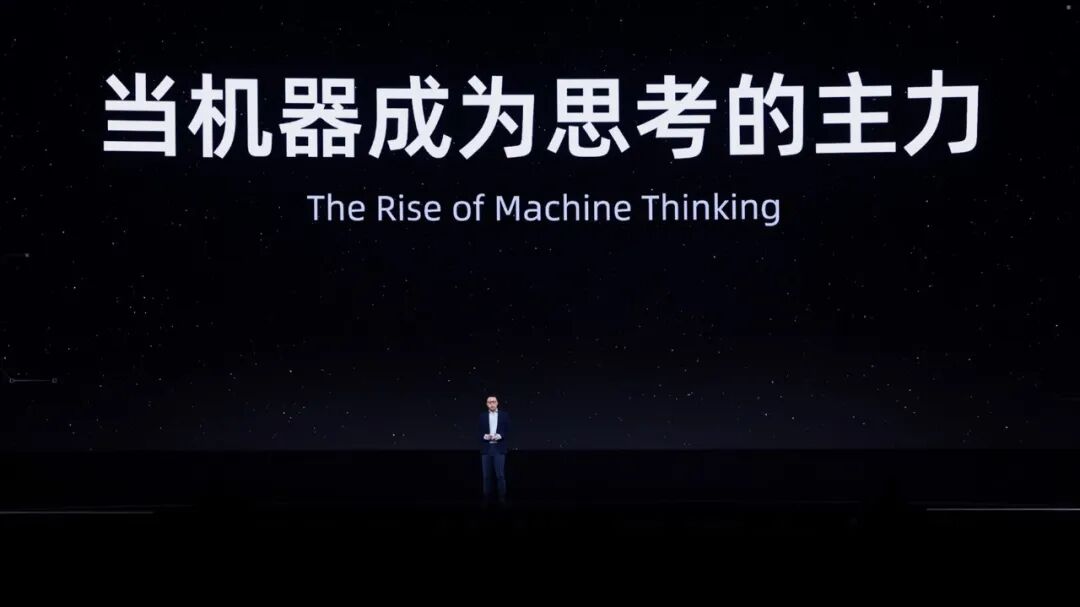
At the main forum, Alibaba CEO Wu Yongming shared a compelling set of statistics: The total volume of machine thinking is projected to surpass that of human thinking by more than 1,000 times in the future, yet it currently accounts for less than 3%.
He drew a parallel to the Industrial Revolution, noting how steam engines transformed power into a scalable commodity, leading to the invention of steam engines, internal combustion engines, and electricity, which formed the backbone of modern industries. This time, he argued, it is thinking’s turn. Wu stated that machines are becoming the primary thinkers, and intelligence is evolving into a scalable commodity.
However, he also offered a sobering assessment: The iconic product of the machine intelligence era has yet to emerge. Today’s AI coding, he said, is akin to the electric light of 1882—replacing existing tasks and aiding in programming and report writing—but it represents only the early stages of machine intelligence. Standing beneath those 400 electric lights in 1882, people could not have imagined computers, air conditioners, or washing machines sixty years later. The first step, he emphasized, is to build enough power stations and lay a sufficiently extensive grid.
01 Agents Are Starting to Deliver Results
The most notable difference at the booths compared to previous years was that Agents were no longer just for show.
In past tech expos, robots were often tasked with entertaining the crowd—mixing drinks, flipping pans, throwing punches, or performing backflips. The more dazzling the performance, the larger the crowd. This year, such spectacles were rare across the four main halls of the Yunqi Conference. While lines formed at BYD’s cockpit demo car, staff emphasized not the car’s coolness but how Feizhu and Flash Purchase’s Agents processed colloquial instructions in the background.
The real deployment examples were not at the booths but in a partnership announced in April. Green Power, an environmental company specializing in waste-to-energy, collaborated with Alibaba Cloud to create the industry’s first “intelligent control” Agent for solid waste incineration, deploying the system at a Wuhan waste plant. This Agent controlled boiler combustion, adjusting feed rates and airflow in real-time based on furnace temperature, flue gas, and load.
When the partnership was announced, it came with a set of impressive data: Over 98% automatic operation rate, a 4.05% year-on-year increase in grid-connected electricity, an 1.87% decrease in auxiliary power consumption, and a 15.21% reduction in lime consumption per ton of waste.
These figures appeared in the plant’s monthly reports, serving as concrete evidence that Agents could operate effectively in production environments.
Over the past two years, many Agents remained stuck in the Demo phase—capable of discussing the weather, writing code snippets, or generating images—but struggled in production settings faced with noise, latency, and constantly changing physical conditions. The Wuhan waste plant’s six-month operation proved that Agents could monitor operations continuously in such environments.
BYD’s cockpit case represented another direction. Previously, in-car voice assistants could only execute single-round instructions like “turn on the AC” or “navigate to the office.” The Didi Xia solution integrated multiple service Agents into the cockpit, enabling cross-application, cross-platform task coordination with a single instruction like “help me order a coffee for delivery.” Feizhu handled the order, Flash Purchase managed the delivery, and the vehicle transmitted the task to the respective services.
The common thread in these cases was that Agents were no longer just answering questions—they were completing tasks. Task completion required invoking tools, coordinating multiple services, and self-correcting when errors occurred. This was a significant departure from the traditional “question-answer” format of large models.
The Yunqi Conference encapsulated this shift in its theme: “Intelligence for Application.”
The first two words emphasized intelligence; the last two, application. Among the hundred-plus sub-forums this year, many focused on how Agents could enter production environments. The enterprise-grade Agent platform, AgentCore, was launched at a sub-forum, accompanied by a white paper outlining full lifecycle management for Agents—from construction, operation, and governance to collaboration and evaluation.
For developers, this toolchain meant revising old workflows. Previously, writing applications involved calling APIs, writing logic, and assembling interfaces. Now, it revolved around describing tasks, configuring Agents, and defining tool invocation permissions. The BaiLian platform already hosted over a hundred mainstream models, with core capabilities encapsulated as Skills and CLI tools for direct Agent invocation, eliminating the need for intermediate glue code.
02 Compute Sellers Are Now Selling Tasks
Beyond the booths, the main forum’s information was even more noteworthy.
Wu Yongming stood on the main forum stage at the Hangzhou International Expo Center. A year earlier, he had outlined a three-stage roadmap at Yunqi Town: intelligent emergence, autonomous action, and self-iteration. He stated that AGI was just the starting point, with the ultimate goal being superintelligent ASI. This year’s five-layer full-stack architecture at the Yunqi Conference effectively broke down the “autonomous action” stage into sellable products.
The five layers, from bottom to top, included T-Head’s self-developed chips, cloud infrastructure, QianWen large models, model services, and Agentic applications.
Every layer was rebuilt with Agents in mind. The chip layer featured Hall 1’s Panjiu AL128; the model service layer included QianWen Cloud, which Skill-ified and CLI-ified model capabilities; and the application layer introduced the newly launched AgentCore for Agent construction, governance, and full lifecycle management.
The core idea behind this architecture was that cloud providers would no longer just offer machines but provide a runtime for Agents to operate.
The impact on enterprise clients would become apparent during procurement. Previously, cloud adoption involved purchasing GPU hours, storage capacity, and bandwidth, with budgets based on resource consumption. Now, if procuring “an Agent to handle customer service tickets,” CFOs would need to recalculate ROI based on task completion volume, error rates, and labor substitution rates rather than machine depreciation.
Those familiar with Alibaba know a set of numbers repeatedly cited: In February 2025, Wu Yongming announced a three-year investment of over 380 billion yuan in cloud and AI hardware infrastructure, exceeding the total of the past decade. During the March earnings call, he set a commercial target: cloud and AI revenue, including model services, to surpass 100 billion USD annually within five years.
The gap between 380 billion yuan and 100 billion USD hinges on whether Agents can be sold.
The main forum also featured a new face.
Liu Dayiheng, the project lead for the Qwen large model, made his public debut, speaking right after Wu Yongming. Public records show he earned his computer science Ph.D. from Sichuan University in 2020, joined DAMO Academy’s Language Technology Lab in 2021, and participated in the development of the Qwen series models. After multiple AI organizational reshuffles at Alibaba earlier this year, the Qwen team’s management structure was overhauled. Zhou Jingren, as head of the Tongyi Large Model Business Unit, oversaw operations, while Liu Dayiheng focused exclusively on LLM projects.
This personnel shift signaled that Alibaba was transitioning from a “business unit system” to a “project lead system” for its large model team.
Qwen was no longer just a product line under the Tongyi Business Unit—it now had an independent lead and reporting line. The reason was that Agent-era models demanded entirely different capabilities than chatbot-era models. Models needed long-context task execution, tool invocation, and autonomous coding abilities—optimizations that took far longer than improving “dialogue quality” and required dedicated oversight.
Qwen3.7-Max, released in May, autonomously programmed for 35 hours without human intervention, completing and optimizing a production-grade AI computing kernel based solely on a task specification.
The Qwen3.8-Max showcased at this Yunqi Conference had evolved to 2.4 trillion parameters, activating 95B parameters per inference with a 1 million-Token context window. These numbers meant little to average users but signaled to developers that an Agent could handle programming tasks spanning hundreds of thousands of code lines without context truncation.
03 Pricing Units Have Changed
Connecting the products, people, and numbers at the conference, this year’s true industry signal was that cloud computing pricing units were shifting from “machine time” to “task completion.”
Alibaba was not alone in pushing this shift. Huawei discussed Agentic Infra at its June industry event. However, the Yunqi Conference was the first to present a complete five-layer full-stack architecture, rebuilt for Agents from chips to applications.
Why now?
Because model capabilities had reached a tipping point. Qwen3.7-Max’s ability to autonomously program for 35 hours to complete a production-grade kernel was impossible a year ago. When models could sustain multi-step tasks, the cloud’s role transformed. Previously, clouds were resource pools—you requested resources, and they were provided. Now, clouds were runtimes—you told them what to do, and they dispatched an Agent to complete the task, automatically scheduling the required compute, storage, databases, and tool invocations.
Hall 2’s Token-Watt screen highlighted another facet: Every AI conversation consumed electricity and generated carbon emissions. As cloud pricing shifted from “GPU hours used” to “tasks completed,” cost calculation methods followed suit. Customers now cared not just about compute bills but also about how many kilowatt-hours an Agent task consumed.
This change had profound implications for the competitive landscape.
Cloud providers would no longer compete solely on model benchmark scores but on Agent runtime reliability, cost, and error rates. NVIDIA, the conference’s highest-tier partner, shared the stage with Intel (Diamond) and AMD (Ruby), while Alibaba’s self-developed Zhenwu chips were displayed in the exhibition area. This “global collaboration plus self-research” approach reflected Alibaba’s open ecosystem strategy for compute power, avoiding single-supplier lock-in.
Capital markets reacted to this narrative. According to Changjiang Securities’ research report, cloud providers’ fundamentals are strengthening as the Agentic era unfolds.
However, sober voices emerged at the “For Uncomputable Value” main forum, where discussions focused on AI’s societal impact: job displacement from Agent automation, accountability for model errors, and who should bear AI’s energy costs.
Many answers would emerge in the sub-forums on the conference’s second and third days.
Thirteen years ago, the Alibaba Cloud Developer Conference moved to Yunqi Town, drawing 4,000 attendees. They brought laptops and listened to Alibaba Cloud explain cloud computing on barren land. Today, many no longer need to code every line themselves. They bring an Agent to read agendas, find booths, and record sub-forum highlights.
The venue had grown larger. The items attendees brought had changed too.
This article is original to Xinmou. For reprint authorization or business cooperation, please contact us.
— END —
-
![]()
Can Volvo Reverse Its Fortunes with a New CEO, a Wave of New Cars, and a Strengthened Alliance with Geely?
-
2026 Smartphone Market: 150 Million Fewer Units Sold, Yet Revenue Surges by 470 Billion Yuan—But Manufacturers Earn Less
-
![]()
Zhang Xinghai Breaks Silence on Huawei Cooperation Changes: Is AITO's 'Independence' a Strategic Leap or a Survival Tactic?
-
![]()
Liu Dayiheng’s Yunqi Debut and Alibaba’s Strategic Bet on Agents
-
![]()
Doubao Enters Smartphone Market, Alibaba Unveils Tablets: The AI Hardware Race Heats Up
-
![]()
Doubao Enters Smartphone Market, Alibaba Unveils Tablets: The Battle for AI Hardware Dominance Begins
-
![]()
Sports Sedans Flood the Market: How Can Young Buyers Tell the Real from the Fake?
-
![]()
AI Firms Offer Seven-Figure Salaries to Lure Talent: Headhunters Reap Big Rewards with a Single Placement