Muse is On Fire: Is This Meta's Real Turning Point or Just a False Climax?
 09/24 2026
 481
481
It has been more than two weeks since Meta's launch in the U.S. on September 8th. Dolphin Research previously provided a brief review (available on the Changqiao App), but with an increasing number of user evaluations, its popularity has continued unabated in recent days. Even today, Muse remains the TOP 1 free app on the iOS U.S. download chart.
This has directly driven the agitation in the stock prices of Muse's backend industrial chain, frontend business ecosystem, and related mapped targets. Today, Dolphin Research will first provide a detailed discussion on the product side, while an analysis of changes in the backend industrial chain will follow soon.
I. Muse's Popularity is No Surprise
The 2C Agent sector has never lacked attention, but compared to the thriving paid transactions of 2B Agents, the commercialization of lifestyle-oriented 2C Agents has yet to see a true breakthrough.
Over the past six months, major companies have quietly shifted their 2C Agent strategies, focusing internal resources on C-end workflow scenarios. Due to commercialization challenges, the progress of general lifestyle 2C Agents has visibly slowed.
Only Meta has consistently emphasized the development of personal AI lifestyle assistants. The concept of "an AI assistant for everyone" has been mentioned by management for at least two years in earnings calls. Muse represents the culmination of long-term efforts by Meta's core team, prioritized as a top-tier internal project and a key product focus for Meta this year.
Of course, this is also a direction Meta must bet on due to its lack of productivity scenarios. Otherwise, allowing new billion-user platforms like ChatGPT to capture user attention would pose a long-term threat to Meta's social ecosystem.
So why did Muse hit the mark? What are its advantages?
1. Cognitive Rewriting: Chat-Based vs. Proactive Task-Based
As a task-based personal AI assistant, Muse fundamentally differs from user perceptions of ChatGPT. While ChatGPT can handle some tasks and, paired with Codex, execute more complex workflows, most users still view it as a chatbot in non-work scenarios, limiting interactions to Q&A.
Muse, positioned as a lifestyle assistant, never aimed to be a chatbot. Its promotional materials highlight its capabilities through examples of completed tasks, introducing its functions and positioning.
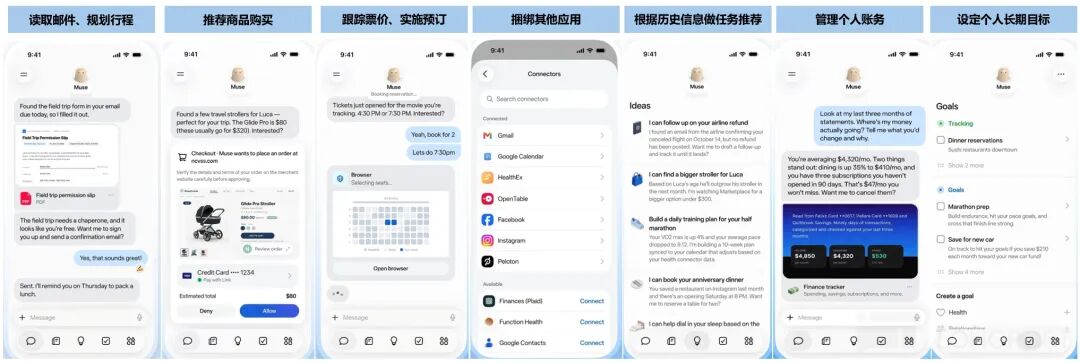
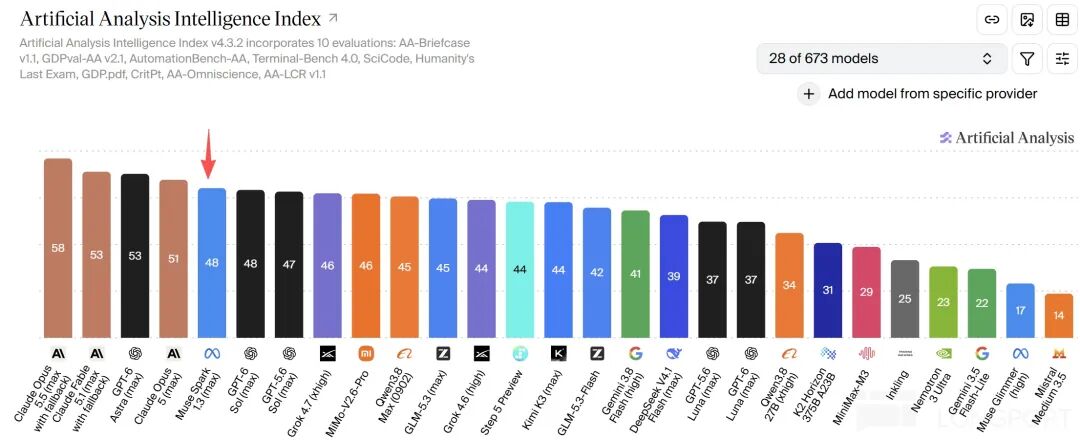
However, at its core, Muse relies on the publicly available Muse Spark large model without lightweight modifications like model fine-tuning or parameter reduction. Currently, Muse Spark 1.3 ranks among the top globally in intelligence scores, ensuring capabilities in complex instruction understanding, cross-platform operations, and multi-scenario adaptation, underpinning the product experience.
2. Balancing User Data Memory and Privacy Security
Before Muse's launch, several similar task-based AI assistants were already being tested or fully released in North America. Notable examples include Instinct and Grok bot.
Instinct, developed by a startup, launched in February and remains in invite-only testing, driving significant valuation growth in the primary market. However, compared to Meta's Muse, Instinct takes a bolder approach, with less caution on user privacy and security, broader authorization scopes, and a "smarter" experience but lacks comprehensive risk protection measures for AI autonomous decision-making.
Grok bot, launched in August, is an AI bot for task processing. Users can authorize Grok bot to access Gmail, Google Calendar, Notion, Figma, or other software like financial tools and AI code assistants to execute tasks.
Compared to Muse, Grok bot leans more toward workflow AI assistance, failing to differentiate significantly from platforms like Openclaw, which are already familiar to users.
For detailed comparisons of other metrics, refer to the following chart:

Dolphin Research believes Muse's greater advantage lies in its "long-term accumulation of user data" while maintaining a balance with "user privacy protection."
(1) User Data Accumulation
With exclusive user social data and ecological advantages, Muse enjoys three substantive differences:
a. Long-term memory: Muse can maintain contextual memory over time and continue tasks even after users close the app. Its Goals feature tracks long-term objectives, while Artifacts consolidates results into reusable itineraries, lists, and panels.
b. Real account linking: Muse connects to Gmail, calendars, OpenTable, Spotify, Amazon, and Meta's own IG, WhatsApp, and Marketplace through built-in connectors, official APIs, and browser operations.
Linking to its own social accounts grants Muse higher read permissions. After user authorization, it can directly access public or semi-public data like Instagram posts, follower data, and comments. It also supports reading WhatsApp chat histories and message content, automatically organizing social messages, extracting to-dos, and summarizing key information.
c. Proactive recommendations: Built on real account linking and long-term contextual memory, Muse can suggest tasks based on calendars, conversations, and linked accounts, forming the prototype of a proactive agent and laying the groundwork for future advertising monetization.
(2) User Privacy Protection
Privacy security and risk control systems are critical areas where AI applications may encounter issues. For a large company like Meta, compliant use of user privacy data can easily become a target for product criticism.
In mid-year, Zuckerberg announced delays in AI assistant development due to the need to resolve AI authorization risk control issues, pushing the release to September. Currently, Muse is only available in the U.S., likely due to ongoing optimizations in privacy protection and AI authorization.
To balance functional experience and privacy security, Muse isolates and protects user privacy in two main ways:
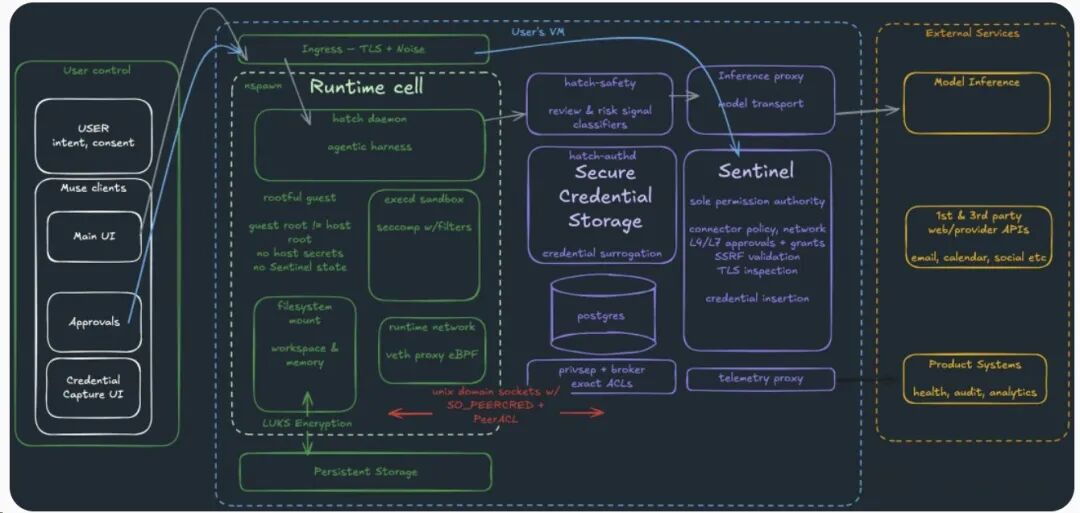
a. Isolated storage: Muse provides each user with an independent Secure VM (virtual machine), with Sentinel agents overseeing all external actions. The platform sets up dedicated secure storage zones, strictly isolating model-accessible data from core user privacy data (e.g., account passwords, payment credentials).
All data interactions and function calls with third-party platforms are transmitted via encrypted APIs to prevent sensitive data exposure to large models.
b. Tiered authorization: Reading real account data requires user authorization. For accounts within Meta's ecosystem, users can grant tiered permissions. For example, they can disable Instagram direct message reading while allowing access to public posts or turn off WhatsApp message reading.
The following is Meta's disclosed security architecture diagram.
(1) Gray line process: A normal instruction flows from the Main UI to the user's VM, where the hatch daemon (Agent core) calls external large models for thinking, then undergoes risk assessment via hatch safety (risk control review). All Agent actions and network requests in the VM are inspected by the eBPF agent via Sentinel.
(2) Blue line process: For sensitive actions like payments, Sentinel intercepts them and pushes them to the user control interface's Approvals section. After user approval, Sentinel issues permissions and retrieves payment credentials like passwords from the Secure Credential Storage vault.
Throughout this process, the Agent never sees user passwords or card numbers. However, the setup of one dedicated VM per user increases component costs.
II. How Much Incremental Value Can Muse Generate for Meta?
Currently, Muse is in public beta for U.S. users aged 18 and above, adopting tiered pricing based on Token consumption without functional limitations. Moving forward, Muse is expected to introduce commissions on merchant transaction volumes and leverage its strength in advertising displays.
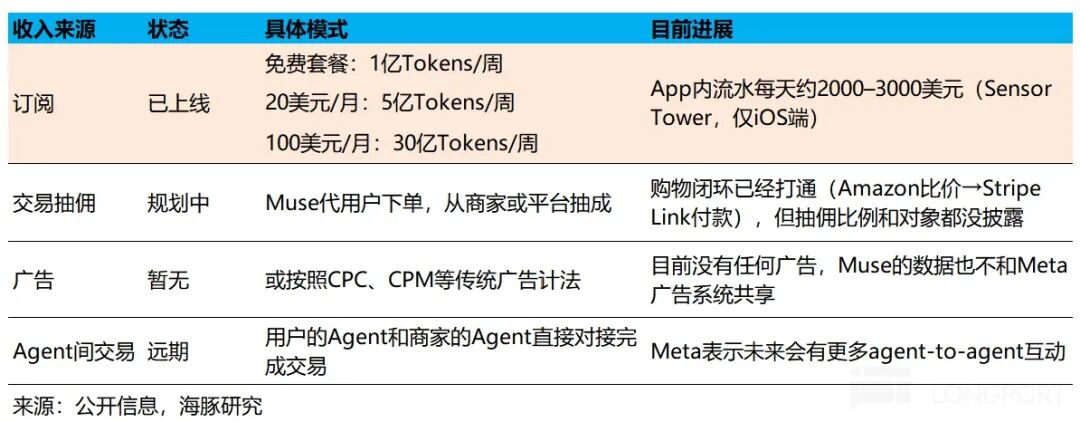
1. Subscriptions: Short-Term Optimism Unwarranted
Despite positive initial user feedback and stable subscription habits in North America, Dolphin Research remains cautious about direct C-end monetization (paid subscriptions) in the short term:
According to Sensor Tower data (iOS only), Muse currently has nearly 250,000 DAUs, with daily revenue reaching $2,000-$3,000. While these are partial test data, they provide a rough sense of payment behavior:
Over two weeks, assuming an average of $2,000 per day and a minimum subscription tier of $20 per month, the number of paying users is 1,500. If iOS accounts for 1/3 of total paying users, the full-platform paying population is 4,500. Given an average of 150,000 DAUs over the past two weeks, the payment rate is only 3%.
However, considering the minimum subscription tier and that iOS typically accounts for more than 1/3 of payments, the actual payment rate is significantly lower. For comparison, ChatGPT, covering more complex productivity scenarios and boasting 1 billion weekly active users with high stickiness, has a payment rate of only 5%.
Thus, Dolphin Research advises against overestimating subscription revenue contributions. We estimate most users will remain on the free tier (100 million Tokens per week). Even under optimistic assumptions of 3 billion users, 80% penetration, a 2% payment rate (monthly active user payment rate lower than daily), and an average ARPPU of $20 per month, this would add $11.5 billion in annual revenue—a mere 5% increase for Meta's current $250 billion revenue.
This calculation excludes underlying costs, including computing power and dedicated VM component costs, meaning subscription profits would be negligible.
2. E-commerce: Breaking Through Ecosystem Limits
From practical testing, e-commerce shopping stands out as a relatively mature scenario with potential for expanded commercialization (other top frequent use cases include financial processing, document handling, and tax filing—more productivity-oriented). This relies primarily on Muse's integration with Meta's existing products and business ecosystem.
Beyond Muse, Meta currently offers Meta Business Agent (a callable "AI shop assistant" with direct subscription access) and Meta Business Agent Platform (an API-based enterprise development platform).
Meta Business Agent functions as an on-demand "AI shop assistant," offering general capabilities like answering questions, recommending products, scheduling services, and screening potential customers. It is more suitable for small and medium-sized businesses (SMBs) and individual merchants. In Q2 2026, over 1 million SMBs used Meta Business Agent weekly via WhatsApp and Messenger.
Meta Business Agent Platform is an enterprise-grade development platform based on APIs, allowing large businesses to customize AI shop assistants according to their needs and integrate them into their systems. It targets large enterprise clients with certain IT capabilities.
Thus, integrating the 2C-focused Muse with the 2B-oriented Business Agent could connect Muse's AI assistant with merchants' AI shop assistants, forming a complete e-commerce service chain from inspiration to transaction.
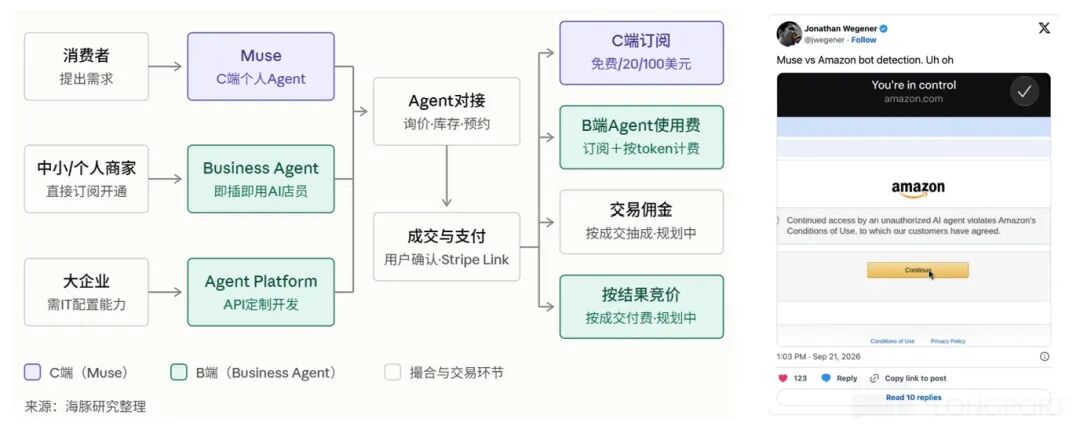
However, a clear loophole exists in this commercialization process:
Since Meta lacks its own e-commerce platform, if users have clear shopping goals and the merchants operate independent websites, a closed-loop ecosystem can form among three parties. However, for merchants on third-party e-commerce platforms, this becomes a four-party ecosystem, and whether Muse can perform access and payment actions depends on the e-commerce platform's tacit approval.
Theoretically, Muse's shopping experience intercepts users' operations on e-commerce platforms, such as searching, browsing, and placing orders, which directly impacts the advertising revenue of these platforms.
Therefore, on September 20, Amazon announced the blocking of Muse, meaning that Muse would no longer be able to perform operations such as browsing for price comparisons and placing orders on Amazon. A violation warning window would pop up on the user side (as shown above). It is worth mentioning that Amazon has imposed similar restrictions not only on Muse but also on shopping agents from OpenAI and Perplexity.
However, small and medium-sized e-commerce platforms, especially those with a high proportion of self-operated businesses, are more inclined to join Muse, essentially eyeing the super app traffic of Meta. Currently, e-commerce platforms that have joined include Shopify and Etsy, both of which are platforms with their own inventory and engaged in 1P business. Therefore, they are essentially the first major merchants themselves. Meta has a strong subjective intention to channel full social traffic into Muse, which undoubtedly represents a significant bonus for Shopify.
This loophole mainly affects transaction commission fees or advertising effectiveness in the four business models mentioned above but has a relatively minor impact on the usage of B-side agents.
If we draw an analogy to the Chinese market, Tencent's WeChat ecosystem, which possesses such private domain data along with a relatively large public domain commercial ecosystem without ecological restrictions, can be considered a perfect counterpart (Muse-Xiaowei, independent merchant-WeChat Store, Shopify-Mini Program). However, in terms of cross-service privacy authorization, Tencent may not be so aggressive in the short term.
At the same time, there are considerations regarding cost (according to research information, under simple task execution, the cost per user for Muse may reach as high as $50/month). Multiple considerations make the current experience of small and micro agents perhaps not yet 'smooth'.
3. The Incremental Value of Muse: Short-Term Repair of Valuation Sentiment
Combining the discussions in <1-2>, at least in the short term, while it is difficult to accurately estimate the real profit increase that Muse brings to Meta, the contribution is unlikely to be significant.
Whether it can create substantial room depends on Muse's subsequent user penetration and whether new product iterations can hope to increase the payment rate or even raise subscription prices. At the same time, whether Amazon's restrictions will force Meta to build its own e-commerce platform. If this step is successful, the long-term imagination space will be much larger.
In the short term:
If Muse only cooperates with Shopify, Etsy, and independent small and medium-sized merchants, assuming that by the end of next year, Muse can reach 300 million MAU, with e-commerce transaction users accounting for 30%, and based on an average annual transaction value of $500 per person (Shopify platform users spend around $200 annually, assuming a balance among Meta's high-value users), this corresponds to $45 billion in GMV.
With a 3% commission rate (comparing to the cooperation model between Shopify and OpenAI in early 2026, where OpenAI's commission rate was 4%, but this model has been canceled due to a low conversion rate), this would result in $1.35 billion in revenue.
Adding the subscription revenue from 300 million MAU, with a 2% payment rate and an average subscription fee of $30/month, this would amount to $2.2 billion, ultimately totaling only $3.5 billion. The final revenue under different MAU and GMV scenarios is as follows, but relative to Meta's current total revenue of $250 billion, the contribution is not high (0.3% to 3%).
The incremental aspects not calculated here are increases in advertising spending and usage of Business Agents. However, these are difficult to estimate, and we can continue to monitor relevant progress disclosed by management during earnings calls.
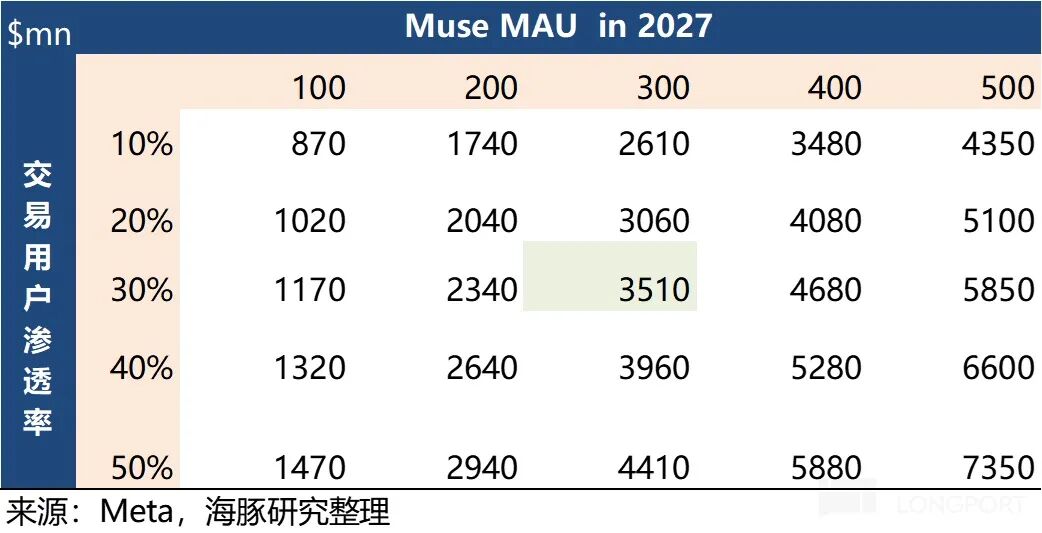
Therefore, consistent with our previous comments, we believe that in the short term, Muse's incremental contribution to Meta's EPS is negligible, but its greater significance lies in proving that Meta's AI large model R&D capabilities and product innovation vitality still exist, while also leaving room for long-term growth imagination.
- END -
// Reprint Authorization
This article is an original piece from Dolphin Research. Reprinting is only allowed with authorization.
// Disclaimer and General Disclosure Notice
This report is intended solely for general comprehensive data purposes, designed for general reading and data reference by users of Dolphin Research and its affiliated institutions. It does not take into account the specific investment objectives, investment product preferences, risk tolerance, financial status, or special needs of any individual receiving this report. Investors must consult with independent professional advisors before making investment decisions based on this report. Any person making investment decisions using or referring to the content or information mentioned in this report must bear their own risks. Dolphin Research shall not be held responsible for any direct or indirect liabilities or losses that may arise from the use of the data contained in this report. The information and data contained in this report are based on publicly available sources and are for reference purposes only. Dolphin Research strives to ensure but does not guarantee the reliability, accuracy, and completeness of the relevant information and data.
The information mentioned or views expressed in this report shall not, under any jurisdiction, be considered or construed as an offer to sell securities or an invitation to buy or sell securities, nor shall it constitute advice, solicitation, or recommendation regarding relevant securities or related financial instruments. The information, tools, and materials contained in this report are not intended for or proposed to be distributed to jurisdictions where such distribution, publication, provision, or use of the information, tools, and materials would contravene applicable laws or regulations or result in Dolphin Research and/or its subsidiaries or affiliated companies being subject to any registration or licensing requirements in such jurisdictions, or to citizens or residents of such jurisdictions.
This report merely reflects the personal views, insights, and analytical methods of the relevant creators and does not represent the stance of Dolphin Research and/or its affiliated institutions.
This report is produced by Dolphin Research, and the copyright is solely owned by Dolphin Research. Without the prior written consent of Dolphin Research, no institution or individual shall (i) make, copy, reproduce, duplicate, forward, or create any form of copies or replicas in any manner, and/or (ii) directly or indirectly redistribute or transfer to other unauthorized persons. Dolphin Research reserves all relevant rights.
-
![]()
Wan Gang and Zhu Huarong: How to Transform, Upgrade, and Achieve Resilient Growth Amid Declining Sales
-
![]()
New Technologies Are Swiftly Integrated into Vehicles, Spawning a Cluster of Electrical Issues in Car Bodies
-
![]()
Luxury Car Market Sees Sharp Decline: Porsche Prices Plummet by 300,000 Yuan?
-
Yaopi Glass's Revenue Stagnates in the First Half of the Year, Net Profit After Non-Recurring Gains and Losses Drops More Than 70%: Effectiveness of Technological Transformation Remains to Be Verified
-
![]()
Why Does Hungary's New Energy Industry Policy 'Waver Between Two Paths?'
-
![]()
Why Is Chery Reshuffling Its Executives Now—For Globalization or Luxury Ambitions?
-
Retail Industry Evolution: From Instant to AI-Driven Retail
-
![]()
Leapmotor's Dual 'Time Advantages': Technological Leadership, Capital Support