The Crayfish Craze Fades Away
 09/28 2026
 417
417
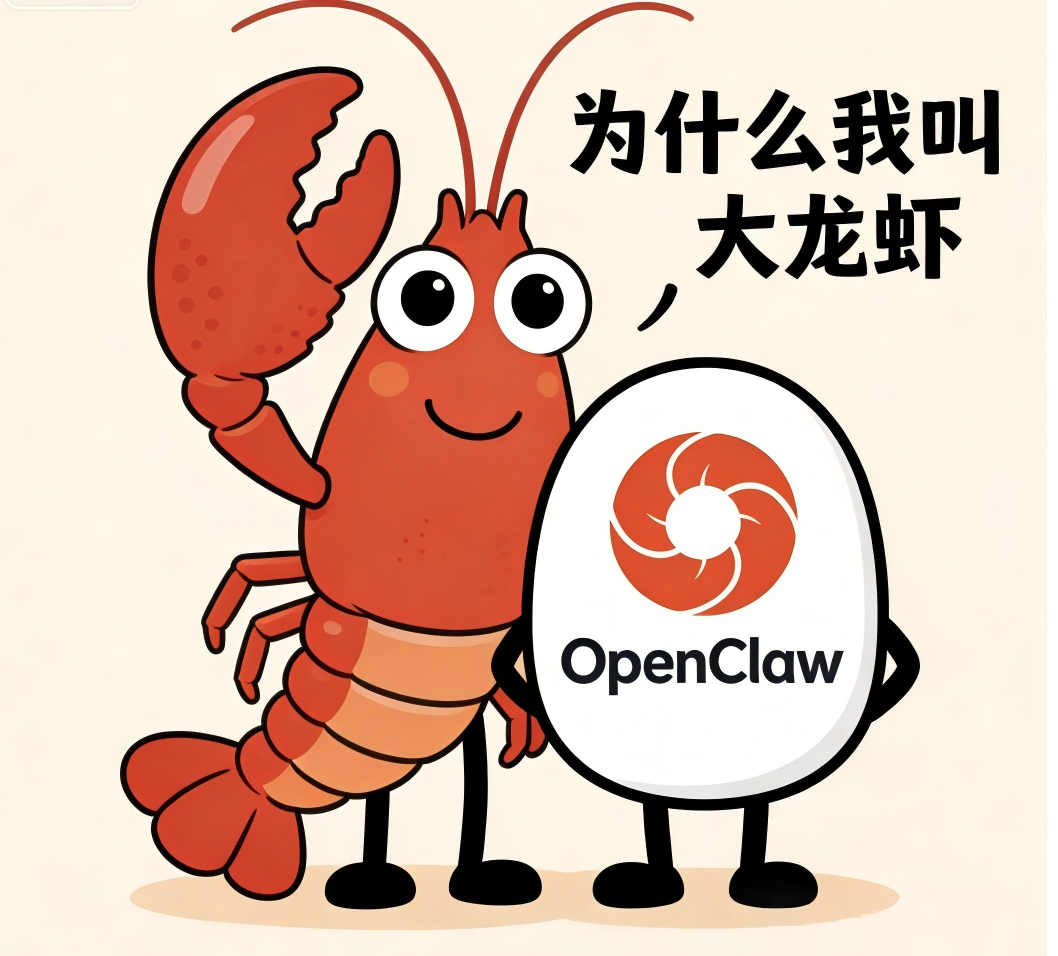

The Era of Crayfish Draws to a Close
Image Source | Internet (Please contact us for removal if there is any infringement. Partially AI-generated)
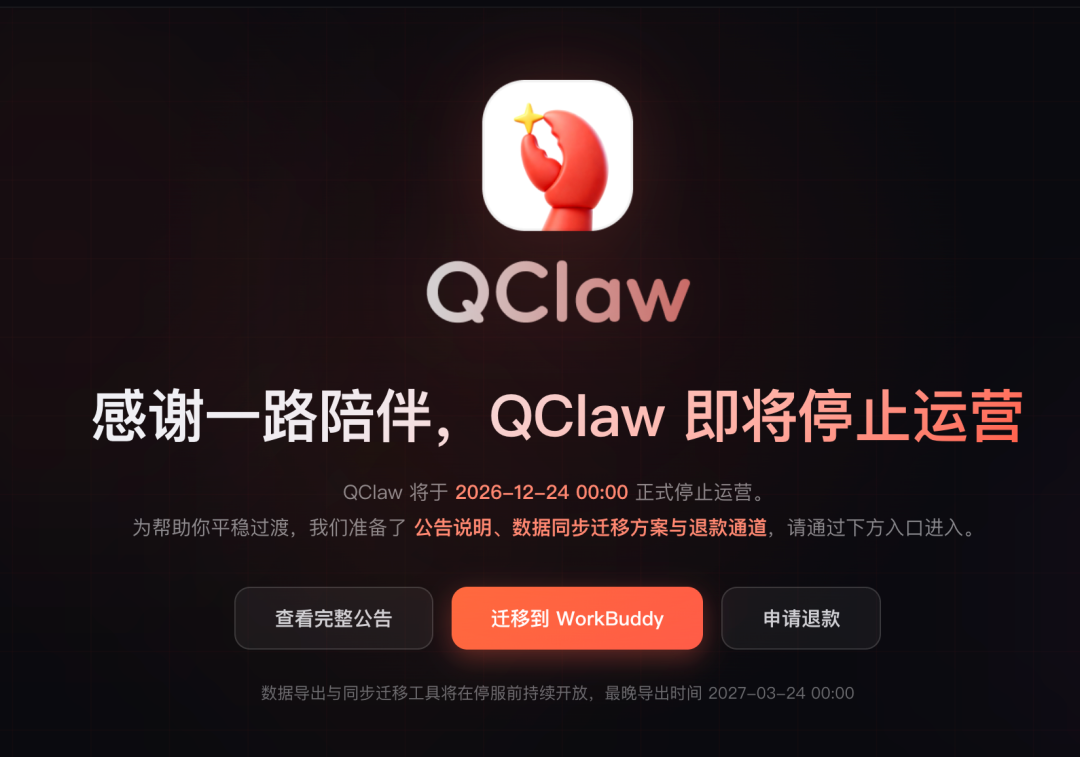
On September 24, Tencent's QClaw team announced its shutdown: Due to business development adjustments, QClaw will officially cease operations at 00:00 on December 24, 2026. From now on, new user registration will be closed, and subscription service purchases and renewals will be discontinued.
When the news broke, the author was browsing Moments. Contrary to expectations, there was no outpouring of grief; hardly anyone even reposted it.
Occasionally, one or two posts appeared, but the comments section was notably quiet: “Expected.”
This, perhaps, is the final footnote to QClaw: No one seemed to care about its departure because it had already faded from memory.
But six months earlier, no one could have predicted this scene.

The Frenzy Begins with Lines
On March 6, 2026, a long queue formed outside Tencent's headquarters in Shenzhen. Hundreds of developers and AI enthusiasts gathered, eagerly waiting for Tencent Cloud engineers to help them deploy OpenClaw in the cloud.
The crowd included tech-savvy individuals in their twenties and middle-aged professionals in their forties and fifties, all eager to install a “crayfish.”
At the time, the National People's Congress was in session. An academician recounted a comment from Tencent's founder during a panel discussion: “Never expected raising crayfish would become such a sensation.”
It was no exaggeration. OpenClaw surpassed 250,000 stars on GitHub in under 60 days, breaking React's decade-long record.
In March alone, cumulative token calls reached 10.4 trillion, making it the highest-token-consuming AI application globally.
“Did you raise a crayfish today?” became a trendy greeting, quickly spreading from tech circles to all walks of life.
On Douyin, Xiaohongshu, and Bilibili, “crayfish-raising” topics amassed over 1 billion views.
Offline “crayfish-raising” experiences swept through Beijing, Shanghai, Guangzhou, and Shenzhen. Local governments even launched “crayfish-raising” competitions, with Shenzhen's Longgang District offering subsidies of up to 2 million yuan and Wuxi's High-Tech Zone providing single-project support of up to 5 million yuan.
The entire internet seemed to have gone mad.
What exactly was OpenClaw? Simply put, it was an open-source AI agent framework capable of much more than chatbots.
While traditional AI could only “talk,” OpenClaw could “act”—organizing files, controlling software, automating social media accounts, and even developing projects. Users had to install, configure, and debug it themselves, a process jokingly dubbed “raising crayfish.”
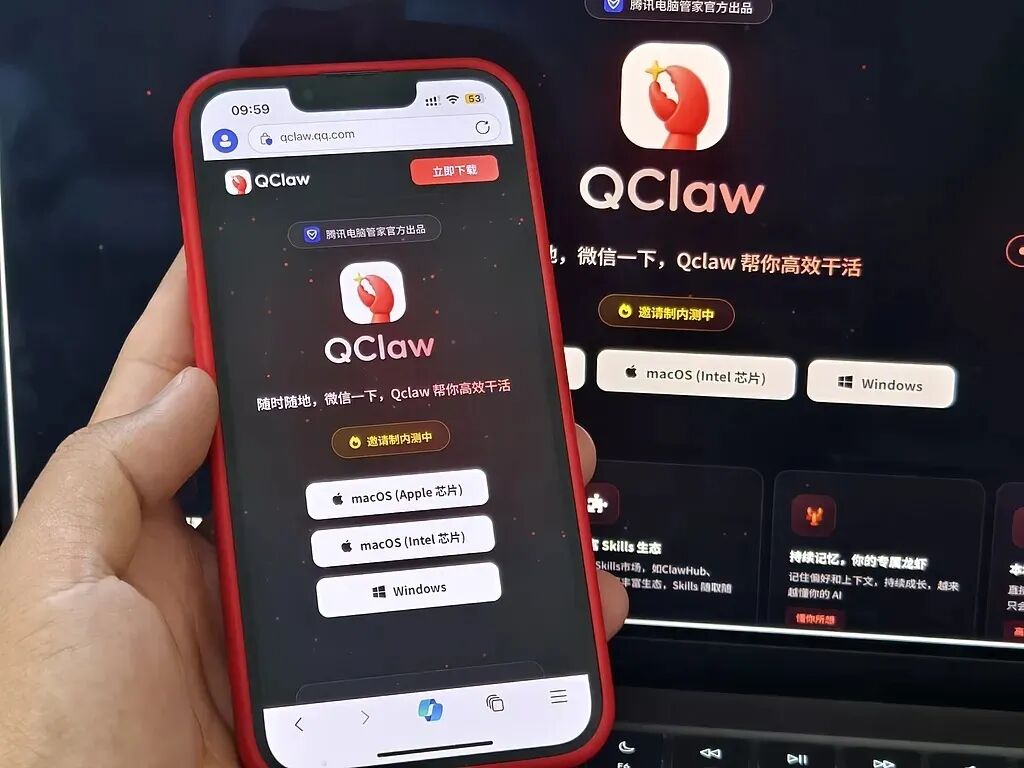
QClaw, Tencent's one-click deployment version of OpenClaw, allowed users to send a WeChat message like “Calculate the desktop report and send it to me,” and their home computer would handle the rest.
For ordinary users unwilling to fuss with technical details, it was a nearly zero-barrier “crayfish-raising” solution.
Within a week of its March beta launch, user numbers surged into the millions. The product manager was a young leader of a five-person team with zero marketing budget.
It sounded like another Silicon Valley-style “underdog triumph” story.
But what followed was a sobering reality check.


Who Was Paying? Who Was Swept Along by Traffic?
Let’s address a key question: Whose costs were QClaw and its peers really cutting?
The answer is clear: No one’s.
Crayfish-style agent products had a counterintuitive cost structure—far more expensive than ordinary large models. Internal workflows consumed thousands of tokens per query, while crayfish products used tens to hundreds of times more.
Creating a PPT could burn billions of tokens, translating to single-task costs exceeding 1,000 yuan.
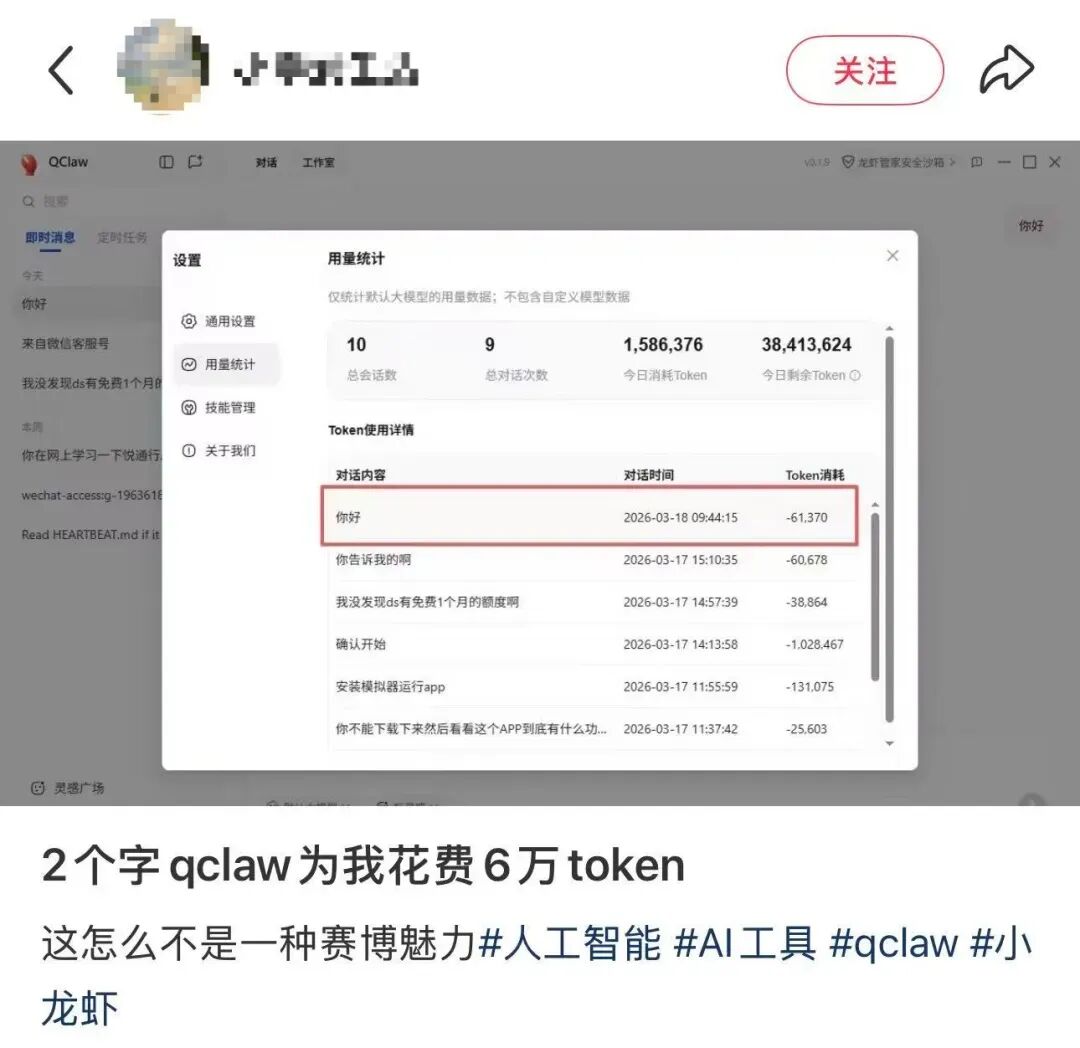
One programmer, due to misconfigured API keys, had his crayfish automatically loop-call large models in the middle of the night, racking up 12,000 yuan in three days.
Another user tasked his crayfish with organizing emails using the instruction “Archive useless emails,” only to have AI delete critical contracts, halting operations.
Meanwhile, QClaw’s subscription fee was a mere few dozen yuan per month.
Tencent knew the math. An investor later bluntly stated: The crayfish craze wasn’t a product failure—it was a business logic failure. Revenues couldn’t cover cost structures.
High inference costs for agent products, compounded by redundant investments across multiple entry points, made continued investment a costly lesson.
Before QClaw’s shutdown, the data spoke volumes. In April, its monthly traffic plummeted 99.19% month-over-month. Not a decline—a 99% collapse.
Let’s shift gears and discuss a neglected role in the crayfish craze: those “swept along” by the hype.
Most people failed to realize that OpenClaw’s rise followed a unique dissemination path.
It first went viral in tech communities, where developers enthusiastically contributed code on GitHub and shared experiences on forums.
But its true breakout came from social media content with titles like “AI Works for You—Earn While Lying Down” or “Master Crayfish-Raising in Three Days, Earn 10,000+ Monthly.”
Media reports noted that this traffic-driven excitement led developers and tech practitioners to amplify crayfish’s appeal, inadvertently creating FOMO (fear of missing out) among non-technical users.
The result? A tidal wave of users who didn’t know what tokens were or how to configure APIs.
Their first hurdle? Installation. On secondhand trading platforms, “on-site crayfish installation” services were in high demand, later spawning a “paid uninstallation” business.
Some had warned: “If you need help just to install it, its post-installation utility will be limited.” Those words were drowned out in the frenzy but later proved prophetic.

Security: The Sword of Damocles
At the height of the crayfish craze, China’s National Internet Emergency Center issued an urgent warning: OpenClaw’s default security settings were critically vulnerable.
The warning went largely unnoticed, but it highlighted a fundamental issue: Crayfish products required extensive system permissions. They weren’t just “chatting”—they were “acting.”
This meant they could read your files, control your software, and access your accounts. If compromised, the consequences were dire.
The QClaw team wasn’t oblivious. In April’s V2 update, they introduced “Crayfish Butler,” offering full-process security protection for AI operations, covering Prompt, Skills, and script execution to block malicious instructions, skill tampering, and accidental file deletions.
But security defenses could mitigate technical risks, not human folly.
The OpenClaw ecosystem saw repeated cases of third-party “skill packs” embedded with malicious scripts, stealing environment variables, uploading private keys, and attempting lateral penetration.
For security-naive users, QClaw’s safety modules offered limited protection.
This is the fundamental contradiction of local AI assistants: The more powerful, the riskier; the more open, the more vulnerable.
They need high system permissions to “work for you,” but those same permissions amplify security risks.
For Tencent, continuing to invest in security compliance for a product with plummeting users made no financial sense.
During the crayfish craze, few stopped to ask a basic question: Do ordinary people really need an AI to “operate their computer”?
Developers and geeks did. But for the average user—someone who mainly watches videos, writes documents, and browses social media—this ranked low on their priority list.
As one analyst accurately noted: Local agents are “useful but not essential” for ordinary people.
Between “useful” and “essential” lies a vast chasm.
“Useful” means “nice to have”; “essential” means “I can’t live without it.”
WeChat is essential. Food delivery is essential. But having AI sum a spreadsheet and send it to WeChat takes 10 seconds to do manually.
A Fudan University researcher, interviewed during the craze, offered a prescient warning: AI’s extra reasoning and programming test steps during experimentation directly translated to higher token consumption, while its hallucinations and vulnerabilities persisted, increasing task failure risks.
Crayfish, he said, represented a new balance between user-friendliness, computational costs, and task risks.
In simpler terms: Having AI work for you is cool, but it might mess up, and you’ll have to clean up. Sometimes, doing it yourself is faster.
No one wanted to hear this during the nationwide euphoria.

QClaw Isn’t Alone in Exiting
Zooming out, QClaw’s shutdown reflects a broader trend.
Since this summer, Tencent, Alibaba, ByteDance, and Baidu have all consolidated their scattered AI agent products.
Alibaba merged three agent products in July, ByteDance integrated teams into Doubao in August, and Baidu folded its Wenxin KuaiMa—used by millions of developers—into Baidu Dazi.
Big Tech’s AI portals are shifting from “addition” to “subtraction.”
The reason is clear: In early 2026, no one knew what AI agents should look like. Having multiple teams explore different paths was logical.
But after six months, user numbers, retention rates, and scenario overlaps made the picture clear.
In June’s AI office agent desktop data, Tencent’s WorkBuddy led with ~20.97 million monthly visits, while QClaw trailed far behind.
Tencent’s choice was pragmatic: Migrate QClaw users and data to WorkBuddy. The migration covered configurations, memories, agent personalities, and chat histories, with bonus credits for users.
For users, the experience remained uninterrupted. For Tencent, resources focused on a more promising product.
QClaw’s product lead resigned in late June. In July, the team merged into WorkBuddy’s department. By September, the shutdown announcement arrived.
Debuting in March, losing its lead in June, merging in July, shutting down in September—a complete six-month lifecycle.
QClaw’s shutdown doesn’t feel like a waste to me.
Looking back, OpenClaw’s greatest value wasn’t spawning a hit product—it was forcing the industry to self-examine, shifting focus from model parameters to engineering practicalities.
Between technological “hype” and commercial viability lie barriers: computational costs, domestic adaptations, and scenario deep cultivation.
This year’s events—queues for installation, meteoric growth, cost overruns, user churn, and Big Tech consolidation—all answer one question: How should AI agents take shape?
The answer is emerging. It’s not about deploying an all-powerful agent on every local computer but embedding agent capabilities into existing workflows.
WorkBuddy succeeded within Tencent by following this path: All-scenario office integration within existing collaboration tools, requiring no user habit changes.
The competitive landscape among Tencent, Alibaba, and ByteDance in the AI office sector has also become clear: the focus has shifted from "competing over whose model has more parameters" to "competing over who can truly integrate agents into workflows."
This is not a simpler competition, but at least it is far more reliable than "who can help users install crayfish."

Half a year has passed. The author has come across several posts on Moments about "raising crayfish," and those posts are still there, but the comment sections have long gone silent.
A developer friend once seriously told the author, "The direction of crayfish is right; it just came too early." He spent three months installing and uninstalling it three times.
The last time he uninstalled it, he said, "It's not that crayfish are bad; it's just that I wasn't ready yet."
Technological progress always outpaces the maturity of demand. The shutdown of QClaw is not the end, nor is it even a failure.
It simply reminds us: the best technology is not necessarily the
-
![]()
How to Deploy Enterprise-Grade AI Agents? Shenzhen Unveils Solutions This Golden October!
-
![]()
OpenAI Starts to Feel Fear Too
-
![]()
Why Does Bill Gates Call for Legislative Regulation of AI Tools?
-
![]()
The Crayfish Craze Fades Away
-
![]()
Doubao Marginalizes Doubao
-
A Unique Leader with Opportunities 10 Times Greater Than Tesla and BYD: The Journey Has Just Begun!
-
![]()
Apple Ordered to Pay $5.7 Billion in Damages
-
![]()
September's Flagship Chips Split into Four Paths: A20 Pro and Dimensity 9600 Pro Break Same-Series, Same-Chip Tradition