Apple Ordered to Pay $5.7 Billion in Damages
 09/28 2026
 333
333
The screen of a phone can be seen, but its vibrations are remembered by the fingers.
Buttons have feedback, incoming calls have alerts, and pressing them feels like pressing a real button. These details are rarely discussed in daily life, but in court, they have become a patent dispute worth over $5.7 billion.
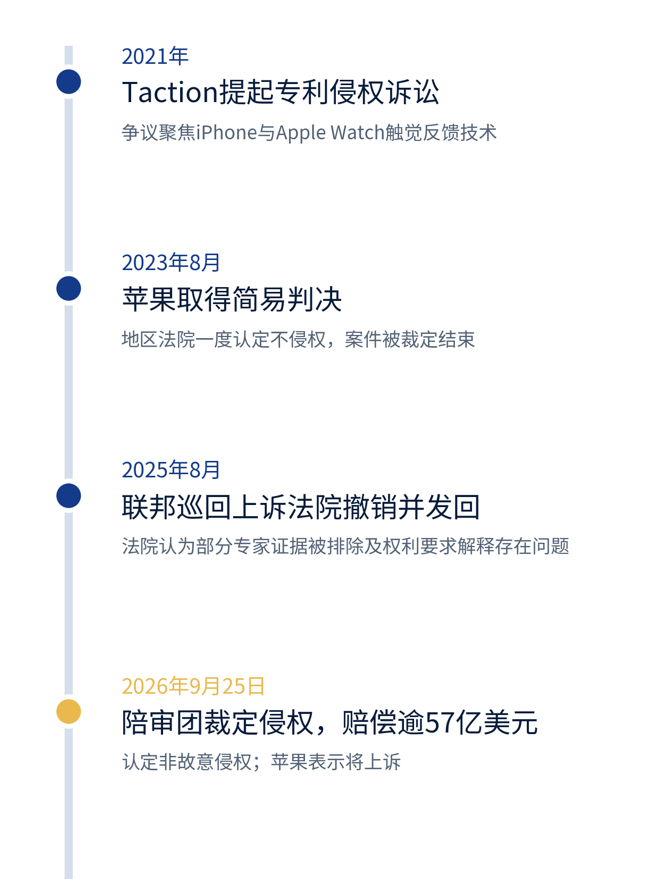
On September 25, a jury in the U.S. District Court for the Southern District of California ruled that certain iPhone and Apple Watch products from Apple infringed upon two haptic technology patents held by Taction Technology, awarding damages exceeding $5.7 billion.
The jury also determined that the infringement was not willful. Taction's attorney stated that the ruling upheld patent rights, while Apple expressed strong disagreement with the ruling and the damages awarded, asserting that its Taptic Engine is fundamentally different from Taction's technology, and vowed to appeal.
First, let's clarify the boundaries: This is a jury ruling, not the end of the litigation.
Apple has clearly stated its intention to appeal, and the damages and infringement findings may still be reviewed, adjusted, or overturned in subsequent proceedings.

A Patent Lawsuit That Has Lasted Over Five Years
Taction sued Apple in 2021, with the dispute involving two U.S. patents describing vibration transducers that can be perceived through haptic feedback.
Apple's Taptic Engine is responsible for enabling devices to simulate actions like clicks and presses with delicate haptic feedback.
Whether the two technologies fall within the scope of the patent claims is the question the court must answer. It is not a simple comparison of whether a phone vibrates or not.
The case had already been reversed once before.
In 2023, the district court supported Apple's motion for summary judgment; however, in August 2025, the Federal Circuit Court of Appeals vacated the judgment and remanded the case, citing issues with how expert testimony was handled and how patent claims were interpreted in the original trial.
The appellate court did not find Apple guilty of infringement at that time but merely concluded that the case should not have ended in the manner it did. The current jury ruling represents the factual findings after the retrial.
Why Is $5.7 Billion So Staggering?
Smartphones sell in large volumes, and if patent claims cover multiple product models and sales years, even a seemingly low per-unit licensing fee can accumulate to a substantial amount.
Damages estimates also revolve around issues such as licensing rates, applicable products, and time periods. The specific amount is not calculated by multiplying the cost of a single component by sales volume, nor does it mean the jury found that Apple copied the entire technology for its phones.
Another key detail is "non-willful infringement." This does not mean no damages are owed, but it means the jury did not find that Apple knowingly infringed the patents and proceeded anyway.
As a result, the case is more about disputes over patent scope and reasonable licensing fees than punitive rulings for malicious conduct. During the appeal, patent interpretation, expert evidence, and damages calculations are likely to become focal points.
This incident also sheds light on a hidden aspect of the consumer electronics industry: Product differentiation increasingly lies in invisible areas. Whether it's chips, imaging, materials, heat dissipation, or interactive feedback, improvements in any area can create a competitive advantage in user experience; however, unclear patent boundaries in any area can also turn into litigation risks years later.
A patent is not a trophy that goes to whoever makes a product first. The key still lies in what the patent claims state, what the product actually uses, and whether the evidence aligns accordingly.
iPhone Prices Are High, but Per-Unit Profits Are Not Publicly Disclosed
Disassembling a phone reveals components such as chips, screens, cameras, storage, batteries, casings, and haptic motors. Taking the iPhone 16 Pro as an example, Apple's announced starting price in the U.S. is $999; TechInsights estimates the hardware bill of materials (BOM) cost at approximately $550.
The difference between these two figures, $449, cannot be called gross profit.
The retail price does not represent Apple's actual per-unit revenue, nor does the BOM cover costs such as assembly, logistics, distribution, after-sales service, research and development, software, marketing, and tariffs.
Apple does not disclose the gross margin for the iPhone separately.
In its 2025 fiscal year, Apple reported total revenue of $416.2 billion, with iPhone revenue accounting for $209.6 billion, roughly half; however, the financial statements group the iPhone, Mac, iPad, wearables, etc., under the "Products" segment, disclosing a gross margin of 36.8% for this segment. The gross margin for the Services segment is 75.4%.
After combining hardware and services, the company's overall gross margin is 46.9%. Therefore, using Apple's consolidated gross margin to estimate how much profit a single iPhone generates is incorrect.
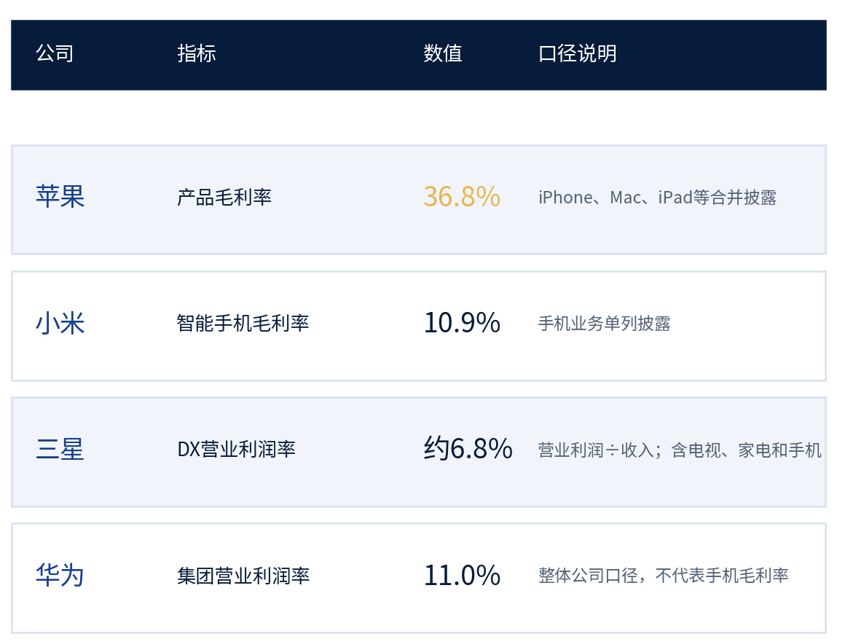
Horizontally, Apple's Products segment demonstrates strong profitability, but publicly available data does not support the claim that "Apple's smartphone gross margin is 36.8%."
Xiaomi's 2025 annual report discloses a smartphone gross margin of 10.9%; Samsung discloses revenue and operating profit for its DX division, which, based on the two figures, has an operating profit margin of approximately 6.8%, but this division also includes televisions and home appliances; Huawei discloses an overall operating profit margin of 11% for 2025, which is not specific to smartphones.
Gross margin and operating profit margin are not the same metric, nor do they cover the same business scope. The table is suitable for observing disclosure differences but not for directly ranking profitability.
This Damages Award Is Still Subject to Change
$5.7 billion is equivalent to approximately 2.7% of Apple's iPhone revenue for its 2025 fiscal year and is a figure significant enough to feature in capital market narratives. However, this is merely a scale comparison and does not mean the amount has already been paid in cash or represents the final Take effect amount.
Apple has stated its intention to appeal, and the final outcome will depend on subsequent court proceedings. The jury's finding of non-willful infringement also indicates that this is not a judgment against Apple's entire business model but rather a dispute centered on two patents, specific products, and a specific time period.
For Apple, what truly warrants caution is not that its phones vibrate a little more but that as product innovations become finer, intellectual property boundaries grow denser.
Large companies can turn a minor user experience into a global standard, but they must also integrate patent searches, licensing negotiations, and supply chain ownership reviews into product development earlier.
For the industry, this ruling serves as another reminder: Innovation does not only happen at product launches. Much patent value lies in seemingly insignificant components, and it only becomes apparent when products are distributed globally and sales volumes surge.
Consumers focus on feel, companies on experience, and courts on patent claims and evidence. All three perspectives ultimately converge on the same question: Whose technology is responsible for that vibration?
What are your thoughts on this topic? We welcome you to share your insights in the comments section in a civil and rational manner.
Disclaimer: This article is solely for financial hotspot analysis. Data and information are sourced from publicly available queries, company announcements, and Huitongshun IFinD. The views expressed are for reference only and do not constitute any investment or consumption advice.
#FinancialHotspots #InDepthAnalysis #BusinessFinance #InvestmentBankingCircle #ListedCompanies #PrimaryMarket #IPO #AI Thank you for your patience in reading. Feel free to click "Like" as you go.
-
![]()
Doubao Marginalizes Doubao
-
A Unique Leader with Opportunities 10 Times Greater Than Tesla and BYD: The Journey Has Just Begun!
-
![]()
Apple Ordered to Pay $5.7 Billion in Damages
-
![]()
September's Flagship Chips Split into Four Paths: A20 Pro and Dimensity 9600 Pro Break Same-Series, Same-Chip Tradition
-
![]()
Starting from 279,800 Yuan! Yijing X9 Emerges as a Strong Contender in the 300,000 Yuan Home SUV Market | Mingjing Pro
-
![]()
US Large Models Also Start a Price War
-
![]()
How Should Consulting Firms Position Themselves in the Era of Large Language Models?
-
![]()
Luo Yonghao Publicly Takes Aim at Dongfang Zhenxuan