Queen of Chips Teams Up with AI Godmother to Take on Nvidia's Huang
 09/30 2026
 333
333
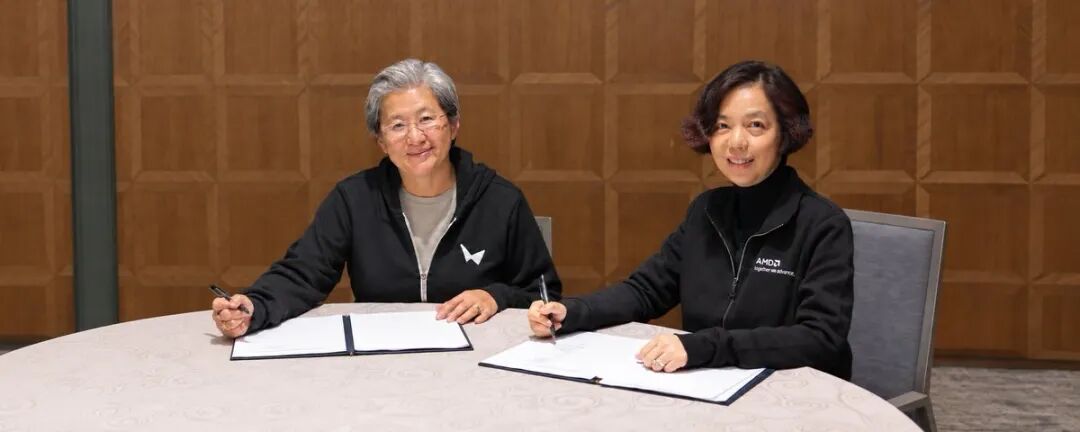
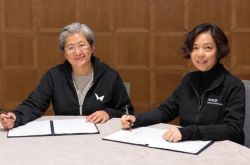
Today, the photo above has gone viral in the AI community.
AMD's CEO Lisa Su and AI pioneer Li Feifei are seated at the same table, both smiling broadly.
An interesting detail: Lisa Su is wearing World Labs attire, while Li Feifei is dressed in AMD gear.
On September 28 (U.S. time), AMD officially announced the acquisition of World Labs, founded by Li Feifei, for $8.2 billion in an all-stock deal, roughly equivalent to 55 billion RMB.
This marks AMD's second-largest acquisition in history, following its $50 billion purchase of Xilinx in 2022.
Li Feifei will serve as AMD's Executive Vice President and Chief Scientist, reporting directly to Lisa Su. This is the first time AMD has created a Chief Scientist role.
Today, let's break down what AMD gains, what Li Feifei gains, the impact on Nvidia, and the trends this reveals about AI development.
This move has been brewing for some time.
As early as World Labs' Series B funding round, AMD's investment arm had already invested, when the company was valued at just over a billion dollars.
In 2025, the two companies began deep technical collaboration, jointly refining model training and inference on AMD GPUs—tackling dirty, detailed work like distributed training, memory management, operator fusion, and quantization together.
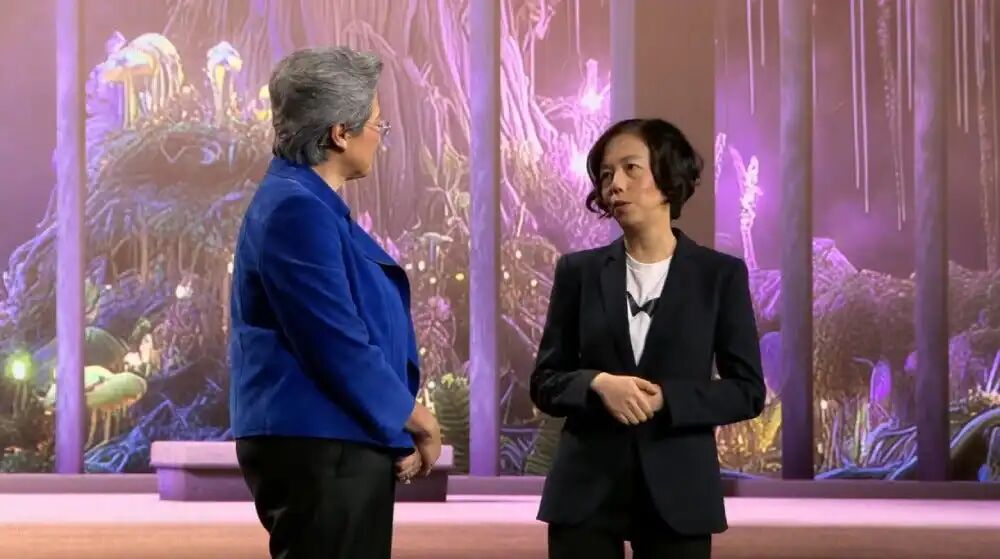
At CES 2026, Lisa Su invited Li Feifei onstage to demonstrate their work in front of the world.
Notice the pattern: investment, then collaboration, then joint appearances, and finally acquisition.
Two years of preparation.
Let's talk about World Labs.
World Labs aims to make AI truly understand our 3D world through what it calls spatial intelligence, or world models.
Feed a world model a photo, video, or even a sentence, and it generates a 3D world you can walk through and interact with.
World Labs has released two main products:
One is the "Marble" world model, which can ingest text, images, videos, and 3D layouts to generate high-fidelity, persistent 3D worlds.

When Marble generates a world, it outputs two things simultaneously: Gaussian splats for human visualization, and collision meshes for physics engines.
This means the worlds it creates don't just look real—they have actual physical structures that can interact with you.
World models are also crucial for robotics development.
By generating thousands of realistic scenes with depth, lighting, and geometric data, robots can be trained in various poses before deployment in the real world—a technique called domain randomization.
In July, World Labs acquired SceniX, a company specializing in robot training within virtual worlds.
Then on September 1, World Labs unveiled "Atlas," a multimodal model. Given a 2D image, Atlas can predict what the scene would look like from another angle.

This novel view synthesis problem has stumped computer vision for years.
Atlas combines generative models with multi-view geometry, breaking through sparse reconstruction challenges.
It handles 3D reconstruction, video viewpoint switching, pixel-level camera control, and can directly replicate real-world scenes as robot training environments.
Li Feifei once said something that captures the essence of World Labs: "This universe isn't made of text—it's made of real things."
Now about Li Feifei herself.
In AI circles, she's known as the "Godmother of AI." Her career essentially charts the history of modern AI.
In 2000, as a new graduate student, she pondered how to make machines see.
This was during the AI winter—few believed she could succeed. Yet in 2009, she undertook the massive task of annotating hundreds of millions of images, creating ImageNet.
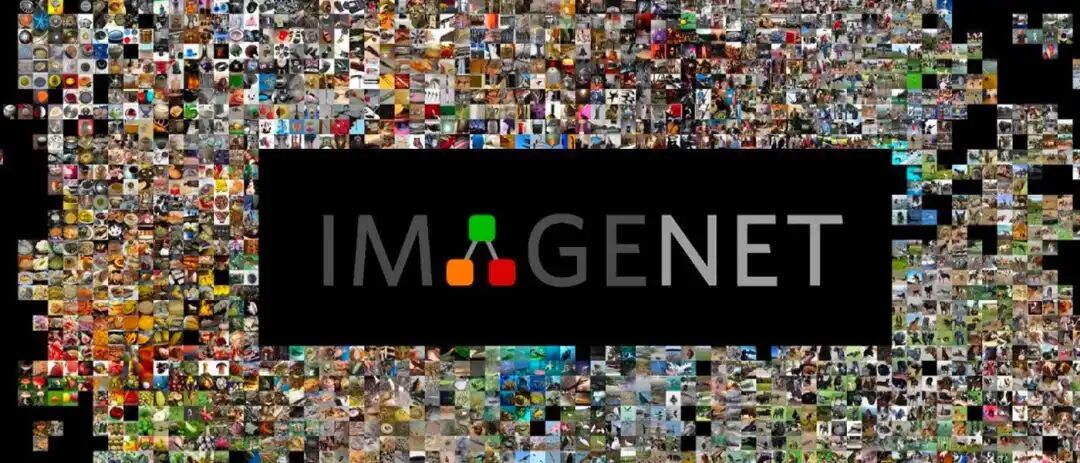
This massive annotated dataset, combined with neural networks and GPUs, ignited AI's visual capabilities.
By 33, she was a tenured Stanford professor. She's served as VP at Google, Chief Scientist of Google Cloud AI, and founding director of Stanford's Institute for Human-Centered Artificial Intelligence (HAI).
Yet this academic powerhouse left stability behind to found a startup in 2024, only to bring her entire team into AMD two years later.
What does AMD gain from this?
When Lisa Su took over in 2014, AMD was bleeding money—a true turnaround challenge. She transformed it into Nvidia's toughest competitor.
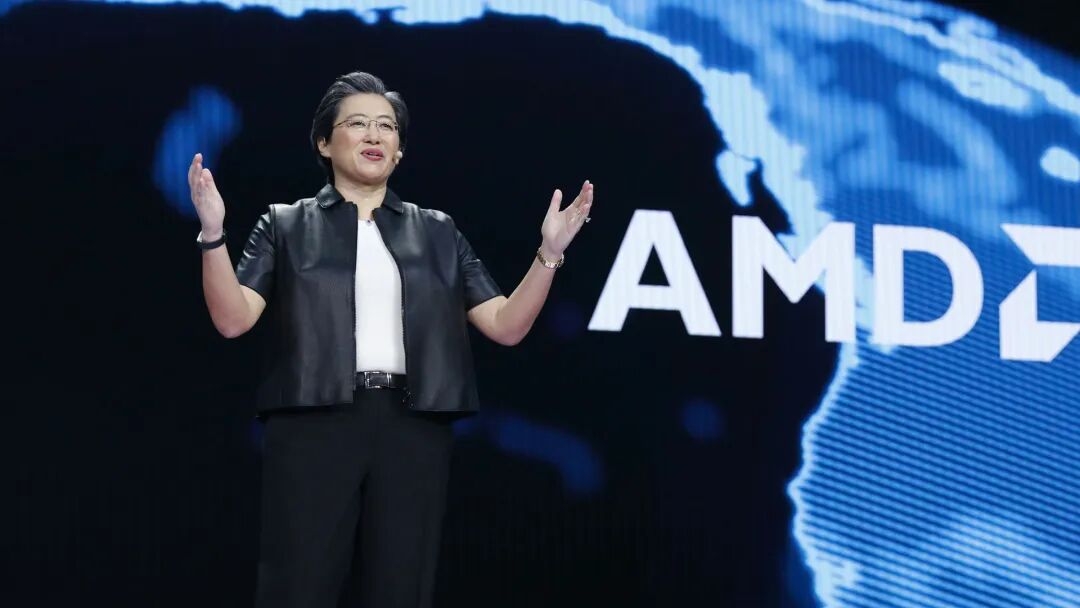
AMD's Q2 2026 earnings were impressive:
$11.5 billion revenue—a record. Data center revenue hit $6.7 billion, doubling year-over-year (107% growth) and accounting for 58% of total revenue.
Hardware highlights include the new Instinct MI400 series, with the MI455X matching Nvidia's Blackwell in memory capacity and bandwidth, and the MI430X targeting HPC and sovereign AI.
CPU lineup features 6th-gen EPYC processors, while software saw the launch of ROCm.ai.
Most significantly, AMD introduced Helios—a rack-scale AI platform integrating GPUs, CPUs, and networking into a single cabinet. Already in mass production, shipping began in Q3 with volume ramping in Q4.
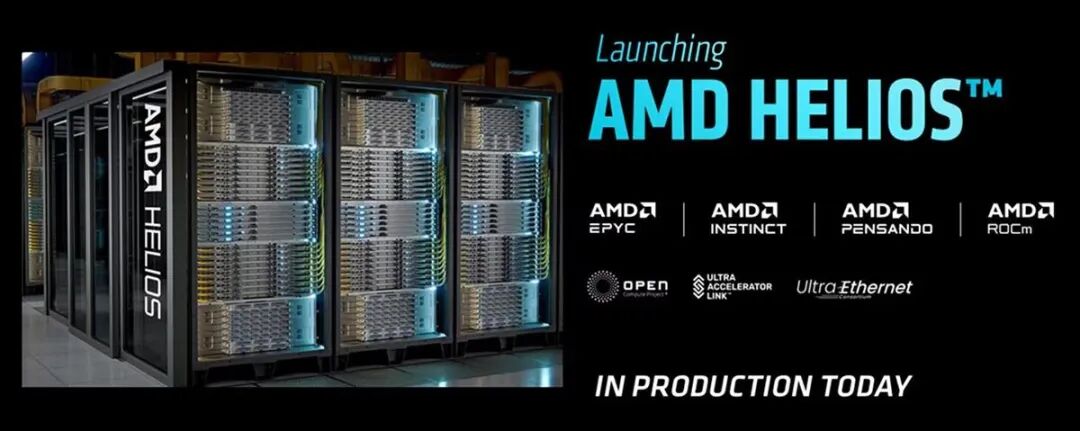
This rack standard was co-developed with Meta. The customer list is stellar: OpenAI, Meta, Anthropic, Microsoft, Oracle. Anthropic alone plans to deploy up to 2 gigawatts of MI450 on Helios.
Su has promised a new rack platform annually.
But let's be real: In data center AI accelerators, AMD still trails Nvidia by a wide margin.
The gap isn't in individual chips—it's in software and ecosystem. Nvidia's CUDA has tied developers worldwide for over a decade. That's its real moat.
So why spend $55 billion on World Labs?
I've thought about this.
Chip architectures decided today won't hit data centers for 2-3 years. By the time customer needs become clear, you're already behind.
The world's top model teams are researching what AI will need next—whether it's memory bandwidth, latency, or interconnects. Their answers directly shape future chip designs.
Bringing such a team in-house installs a radar at the very start of the R&D chain.
You could say AMD acquired its own customer to better build AI chips.

There's another layer.
Training used to dominate AI costs—Nvidia's stronghold. But inference is becoming increasingly important.
When models run in AI applications, robotics, or autonomous vehicles, they're constantly inferring—competing on latency, efficiency, and cost per token. World models, robotics, and physical AI are all inference-heavy workloads.
This is AMD's opportunity to gain ground.
Industry analysts agree. Patrick Moorhead called this a talent and model insight acquisition, not a revenue play—AMD's buying the people who'll run models on its chips someday. Citigroup analysts cite three motives: acquiring top engineers, securing a position in physical AI, and building end-to-end systems.
Now back to Nvidia's Huang.
In the short term, AMD has much catching up to do.
Nvidia's ecosystem is formidable: CUDA, Cosmos world models, Omniverse industrial simulation, edge computing with Jetson Thor, backed by industrial giants like FANUC, KUKA, Medtronic, and Yaskawa.
An interesting detail: In March 2026, World Labs was still listed among Nvidia's ecosystem partners in official materials.
But the long term changes things.
Previously, customers had only Nvidia's complete solution for physical AI—pricing and Rhythm (timing) set by Nvidia alone.
Now AMD bundles world models, ROCm, and Instinct to offer an alternative.
With options on the table, negotiation dynamics shift. Nvidia's pricing power will erode.
Physical AI's landscape remains wide open—AMD's bet makes strategic sense.
Talent is shifting too. With Li Feifei at AMD, top researchers and engineers will take notice.
Huang isn't idle. In December 2025, Nvidia acquired most of AI inference chip company Groq for ~$20 billion. In September 2026, it bought Hugging Face for $12.93 billion—an open-source community with 18 million developers and 200,000 enterprises.

Huang emphasized the platform would remain open, not forcing Nvidia hardware usage.
One bought Groq + Hugging Face, the other bought World Labs.
Both giants compete for first insights into model directions.
But this race has many players.
Wayve, working on autonomous driving world models, raised $1.5 billion this year at an $8.6 billion valuation, backed by SoftBank, Microsoft, Nvidia, plus automakers like Mercedes and Nissan.
Figure, the humanoid robot company, signed a $3.5 billion computing deal in early September (expandable to $6 billion), locking in 100,000 of Nvidia's next-gen GPUs.
Then there's Yann LeCun, who left Meta late last year to found AMI Labs, raising over $1 billion for world models.
China's even more aggressive—by mid-2026, it had over 140 humanoid robot companies, accounting for 80%+ of 2025 global shipments.
The world's brightest minds are converging here.
In her open letter, Li Feifei quoted Tennyson: "Come, my friends, 'tis not too late to seek a newer world."
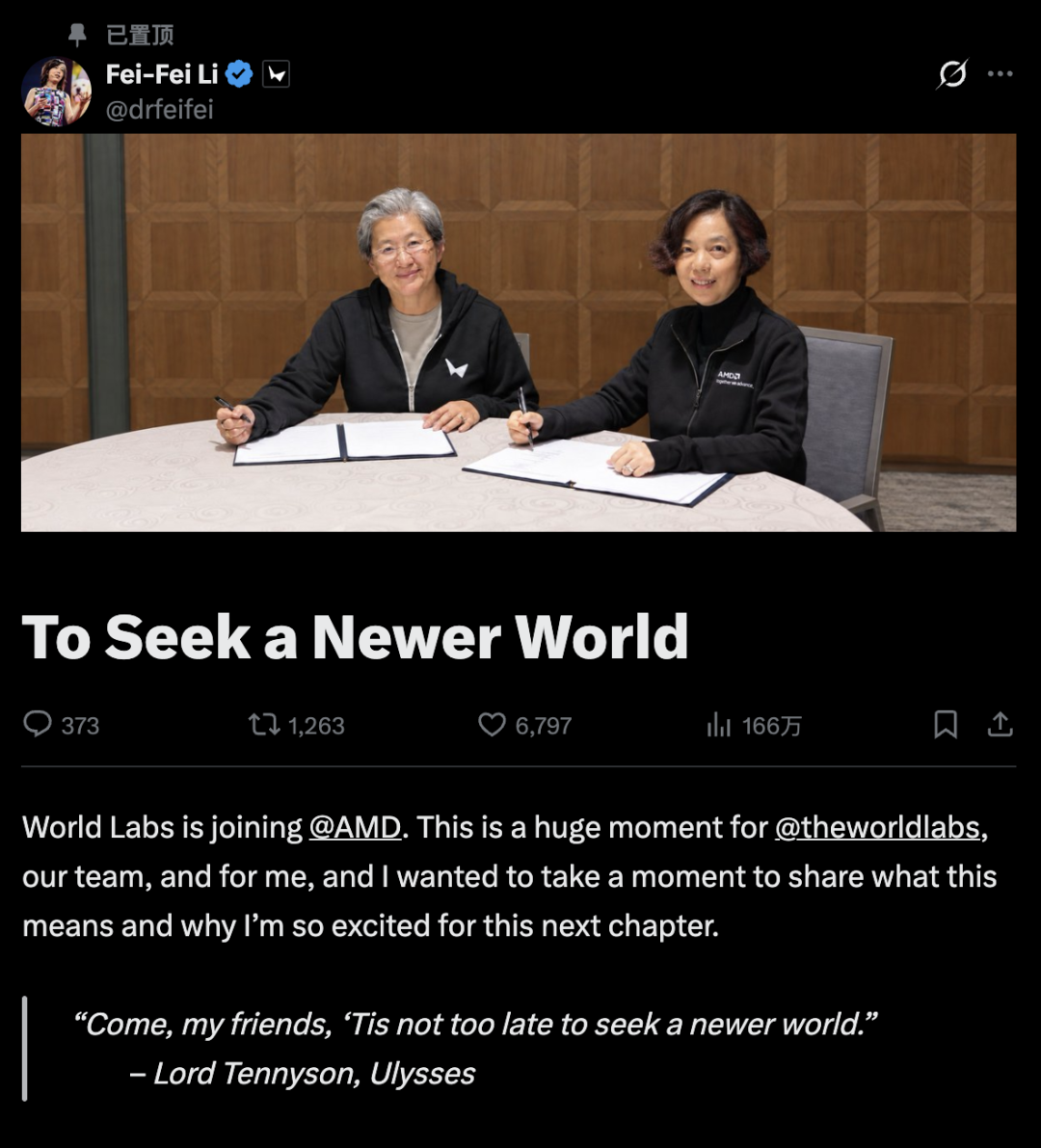
She brings 70 dreams into AMD, while Su invests $55 billion to buy her hardware company a ticket to the physical world.
What lies beyond that door will only become clear when these models run on AMD chips at scale.
Share your thoughts in the comments!
If this was helpful, please like, share, and recommend the article. Follow "AI Robot Tea House" for more.
-
![]()
The RSI Craze Hits Embodied AI: Ideals, Realities, and an Unreachable Endpoint
-
![]()
Queen of Chips Teams Up with AI Godmother to Take on Nvidia's Huang
-
![]()
Changsha Offers a 'New Solution' to China's Robot Industry
-
![]()
Extreme Stock Surge! GAC Group and FAW Group's Bold Move Outshines Merger
-
New Retail: A Brand-New Launch
-
![]()
Li Xiang Seeks to Replicate Xiaomi’s ‘Open Ecosystem’ Model, While CATL Aims to Be the ‘Huawei’ of the Battery Sector
-
![]()
AITO Unveils New Model: Pre-Sales Launch on September 30 with Native L3 Autonomous Architecture
-
![]()
Starting at 118,800 Yuan! Lynk & Co Unveils New Car Model: Official Release Set for September 28