Li Xiang Seeks to Replicate Xiaomi’s ‘Open Ecosystem’ Model, While CATL Aims to Be the ‘Huawei’ of the Battery Sector
 09/30 2026
 566
566
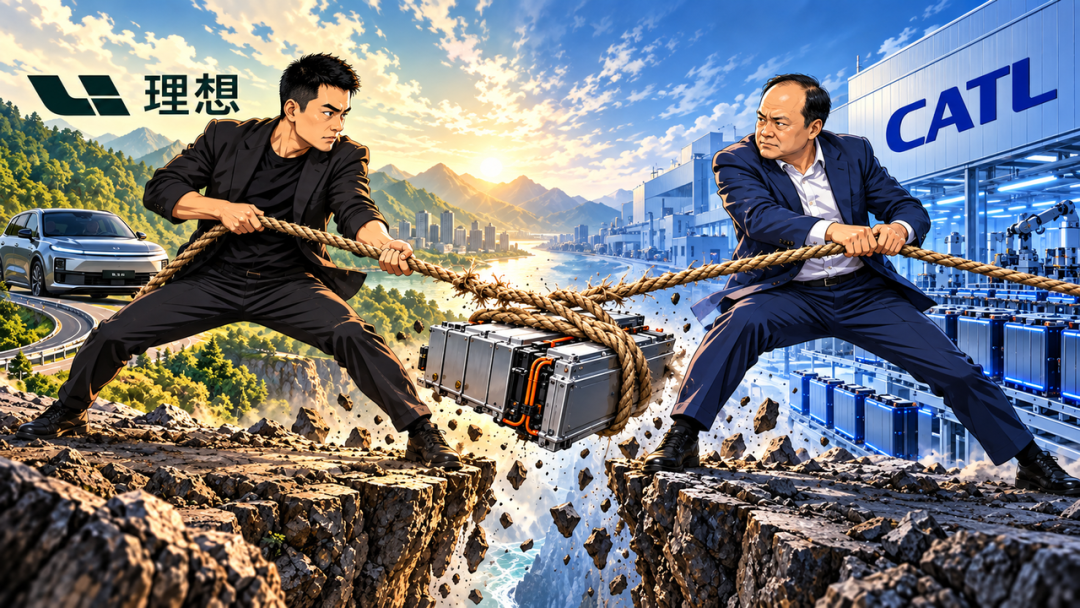
The Goal Isn’t to ‘Sideline CATL’—But to Dismantle the ‘Black Box’
Li Xiang Finally Addresses Speculation About ‘Reducing Reliance on CATL’
On September 28, Li Xiang responded to external debates surrounding Li Auto’s in-house battery development. In his view, framing automakers’ self-developed batteries as a replacement for CATL reflects a narrow, zero-sum mindset.
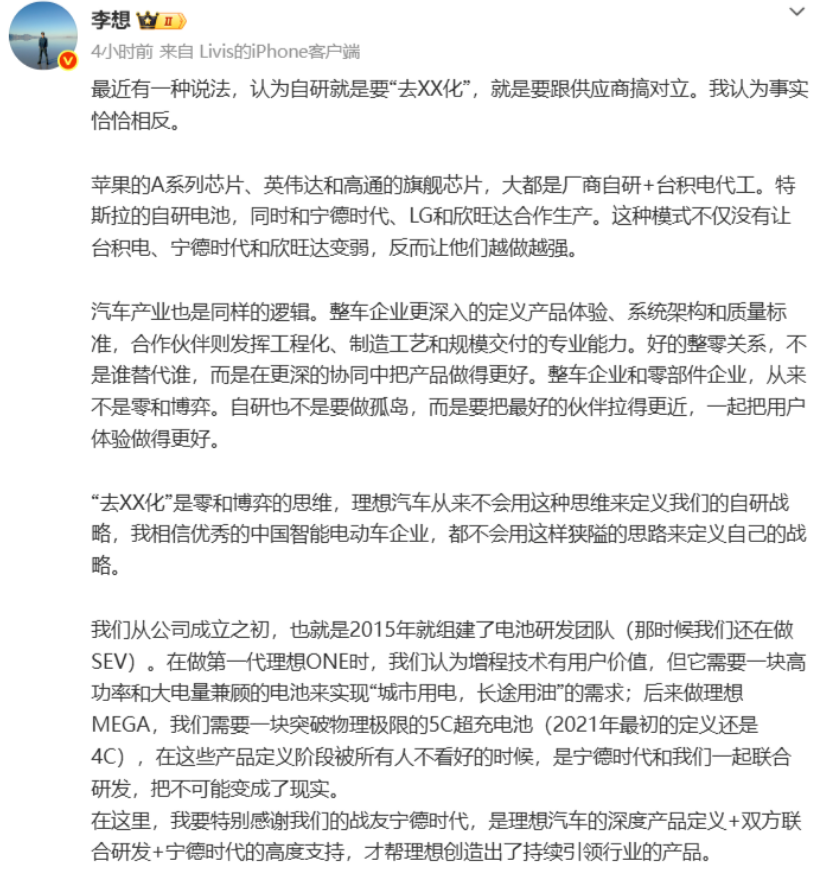
Li Auto’s pursuit of in-house battery technology isn’t about excluding CATL from its supply chain—quite the opposite.
Li Xiang specifically praised CATL as a “trusted partner.” From the Li ONE to the MEGA’s 5C ultra-fast-charging batteries, many ambitious performance targets were first set by Li Auto, then jointly refined with CATL, and ultimately realized through CATL’s engineering and manufacturing expertise.
While sincere in denying intentions to “sideline CATL,” Li Xiang outlined three reasons Li Auto must persist with in-house battery development: anticipating unmet user needs, seamlessly integrating batteries into vehicle systems, and accessing full lifecycle battery data.
In essence, Li Auto plans to continue sourcing batteries from CATL and remains open to collaboration. However, a paradigm shift is underway: capabilities once monopolized by battery makers are now being claimed by Li Auto. The automaker seeks control over product definition, system integration, and data, while outsourcing manufacturing to CATL, Sunwoda, or other suppliers.
This is no longer a simple debate over “reducing reliance on CATL.” Instead, it’s about transforming the power battery supply chain into an open, transparent model—turning all battery manufacturers into modular “contract workers.” On the other side, CATL is clearly unwilling to remain a mere component supplier for others.
One side envisions an open supply chain; the other aspires to be the system-level platform of the battery industry. What Li Auto and CATL are truly competing over isn’t just battery orders but who gets to define next-generation automotive batteries.
01 Li Xiang Aims to ‘Open Up’ the Battery Supply Chain
Li Xiang’s goal may not be to independently produce batteries that outperform CATL’s, but to transform batteries from a supplier’s “black box” into an open system that Li Auto can define, modify, and switch suppliers for.
If achieved, this would fundamentally alter Li Auto’s control over the battery supply chain. After all, as long as power batteries remain a supplier-provided “black box,” automakers’ influence over critical components remains limited.
Material selection, cell design, fast-charging capabilities, trade-offs between lifespan and safety, and even next-generation product timelines largely depend on battery manufacturers.
For ordinary automakers, this may not be an issue. But for Li Auto, which sells hundreds of thousands of vehicles annually while striving for highly integrated smart vehicles, it means one of its most important and costly components is not fully under its control.
Li Xiang now aims to reclaim this capability.
From this public statement, Li Auto intends to control user needs, product definition, vehicle system integration, and full-lifecycle battery data, while leaving large-scale manufacturing to CATL or other battery enterprises.
Li Auto may not need to become a battery manufacturer itself but wants to decide why batteries are designed a certain way, what performance targets they must meet, and how next-generation products will evolve. Production can then be assigned through competitive supply chain bidding.
This open OEM model is not new. Over the past decade, Xiaomi has masterfully implemented this approach in China’s tech industry.
From the outset, Xiaomi never attempted to internalize its entire supply chain. Screens, cameras, storage, structural components, and assembly could all be outsourced.
What Xiaomi truly controlled was product definition.
Pricing, material selection, hardware configuration, screen choice, system design, and target consumer segments were all determined by Xiaomi. Supply chain-related tasks were delegated wherever possible, with multiple suppliers competing for the same components to avoid over-reliance on any single vendor.
The result? Suppliers increasingly resembled interchangeable modules. The most technologically mature, cost-effective, or next-generation-compliant supplier would be chosen, with others adjusted accordingly.
As the supply chain matured and standardized, Xiaomi’s control over it strengthened.
By 2025, this model had supported a massive hardware ecosystem. While smartphone gross margins—constrained by black-box components like Qualcomm chips—stood at just 10.9%, IoT and consumer product margins, driven by open supply chain control, reached 23.1%.
To some extent, Li Xiang now seeks to replicate this logic with batteries. Li Auto’s introduction of second-tier battery enterprises aims not to oust CATL but to transition CATL from a dominant technical authority into just one participant in a broader supply system.
Today, CATL can supply some models; tomorrow, Sunwoda could supply others. As long as product standards, system architecture, and data remain under Li Auto’s control, the manufacturer becomes secondary.
The benefits for Li Auto are nearly self-evident.
When only CATL could provide a battery solution, it naturally held stronger bargaining power. But if Li Auto defines the product and multiple suppliers can meet the same specifications, procurement becomes a competitive process.
Regarding supply chain security, production issues, price fluctuations, or technological shifts at one supplier would not bind Li Auto, avoiding a repeat of the 2020 scenario where automakers desperately competed for CATL batteries.
More critically, this shifts product development timelines. Previously, battery makers created new cells first, with automakers adapting their products accordingly. With Li Auto controlling definitions, the sequence reverses: Li Auto first determines required range, fast-charging capabilities, size, and cost for next-generation models, then tasks suppliers with meeting these demands.
In short, whoever controls definitions truly controls the product.
For a brand like Li Auto, supply chain openness is advantageous. However, for suppliers subjected to this process, the outcome tends to differ.
The smartphone industry has already demonstrated this dynamic, with Foxconn’s partnership with Apple serving as a prime example.
Apple outsources massive manufacturing to external suppliers but tightly controls chips, operating systems, industrial design, product definition, and user ecosystems. Meanwhile, Foxconn—one of the world’s largest electronics manufacturers—reported 2025 revenue of NT$8.1 trillion but operated at just 6.15% gross margin, less than half its operating margin, and a net margin of only 2.34%.
In the even more mature PC industry, this trend is starker.
Compal, a leading global notebook ODM, provides design, manufacturing, and assembly for international PC brands, with nearly all whole machine design and production outsourced to ODMs like itself. Despite continuous improvements via automation, structural optimization, and operational efficiency, Compal’s 2025 gross margin stood at just 5.6%.
Without Foxconn, Apple could not deliver products at such scale; without ODMs like Compal, global PC brands could not maintain today’s efficiency.
When product definition, users, and brands reside with clients, suppliers—no matter how critical—increasingly find themselves competing on manufacturing efficiency, cost, and yield while struggling to control final profit distribution.
Moreover, CATL today is far from an ordinary manufacturer. It controls material systems, cell design, fast-charging technology, safety architectures, and battery system capabilities. Often, automakers develop products around CATL’s battery capabilities.
If Li Xiang succeeds, CATL’s worst-case scenario may not be losing Li Auto as a client but becoming the ‘Foxconn’ of the power battery industry.
CATL is clearly unprepared to accept this role. Instead, it aims to become the ‘Huawei’ of the battery industry.
02 CATL Seeks to ‘Integrate’ Automakers Into Its Ecosystem
If Xiaomi’s logic is to transform the supply chain into replaceable “open modules,” CATL seeks to emulate Huawei by using technological prowess to become an irreplaceable “closed system”—a business model repeatedly validated by Huawei over decades.
The classic example lies in telecommunications equipment.
Operators could procure base stations, transmission equipment, core network gear, and software separately, but Huawei’s strength has never been selling individual components. Instead, it combines wireless access, transport, core networks, and even operational capabilities into holistic solutions.
As early as 2018, Huawei’s 5G solution covered core networks, transport, wireless access, and terminals, with “end-to-end” capabilities as its core selling point. For operators, this eliminated the need to integrate dozens of devices from different vendors, offering a pre-defined technological architecture instead.
The trade-off? Once Huawei’s technology leads and its systems prove superior, clients become increasingly dependent on this ecosystem. Huawei does not rely on low prices to modularize suppliers but on technology to make its modules irreplaceable.
Huawei has replicated this approach in the automotive industry.
Today, Huawei is no longer just a chip or software vendor but an integrated intelligent service provider covering ADAS, smart cockpits, vehicle control, in-car optics, and cloud services. By April 2025, its intelligent automotive solutions division employed approximately 8,000 R&D personnel with cumulative investments exceeding RMB 40 billion.
Seres' AITO brand epitomizes this model.
On the surface, Seres manufactures vehicles while Huawei provides technology and channels, with clear division of labor. However, as collaboration deepened, Huawei's involvement expanded into intelligent driving, smart cockpits, distribution, marketing, and even brand perception.
This model helped Seres achieve rapid brand ascension but also created dependency. As suppliers' capabilities grow, automakers find it increasingly difficult to extricate themselves from such ecosystems.
21st Century Business Herald previously cited insiders stating Huawei's dominance in its partnership with Seres, with ongoing negotiations and disputes behind the scenes. According to industry estimates of the 'Huawei Inside' model, Huawei's channel fees and technology licensing costs could account for roughly 10% of a vehicle's retail price.
Subsequent events validated these tensions.
On September 15, Huawei's HiCar and AITO simultaneously announced adjustments to their collaboration model. While AITO remains within the HiCar ecosystem, product definition, design, branding, marketing, distribution, and after-sales services are now led by Seres, with Huawei Terminal shifting from full process leadership to enabling participation.
The announcement immediately raised concerns among consumers about whether AITO's product competitiveness would decline post-transition and the extent of Huawei's continued involvement. Such worries underscore how Huawei has become integral to AITO's product strength and brand identity.
This illustrates what happens when a supplier becomes dominant: automakers seeking independence must risk technical degradation, brand dilution, channel inefficiency, and even sales volatility.
Today’s CATL is following a remarkably similar path. It no longer satisfies itself with manufacturing cells to automakers’ specifications.
From Qilin batteries and Shenxing ultra-fast-charging cells to Xiaoyao dual-core batteries, CATL continuously defines next-generation power battery standards. Its 2025 Xiaoyao dual-core battery even integrates different chemical systems into a single pack, with CATL independently handling material selection, system architecture, and performance trade-offs.
Beyond batteries, CATL is expanding its reach.
In 2024, CATL launched its Panstone chassis, extending its business from battery packs to vehicle chassis. Meanwhile, its Choco battery swap system evolved from standardized swap batteries into a comprehensive ecosystem covering vehicles, batteries, swap stations, and energy networks. By 2026, CATL plans to cover nearly 190 cities with its ultra-fast swap network, co-building energy infrastructure with Changan, Chery, GAC, Seres, and other automakers.
CATL’s ambition clearly extends beyond being a battery OEM for automakers. It seeks control over materials, cells, packs, chassis, energy replenishment, and even the full battery lifecycle from production to retirement.
Ultimately, Li Xiang envisions Li Auto defining batteries while CATL manufactures them; CATL insists that next-generation battery standards should originate from itself. This is the true conflict between the two sides.
One aims to create a Xiaomi-style “open ecosystem” supply chain; the other strives to become an indispensable “Huawei” in the automotive industry.
- END -
-
![]()
The RSI Craze Hits Embodied AI: Ideals, Realities, and an Unreachable Endpoint
-
![]()
Queen of Chips Teams Up with AI Godmother to Take on Nvidia's Huang
-
![]()
Changsha Offers a 'New Solution' to China's Robot Industry
-
![]()
Extreme Stock Surge! GAC Group and FAW Group's Bold Move Outshines Merger
-
New Retail: A Brand-New Launch
-
![]()
Li Xiang Seeks to Replicate Xiaomi’s ‘Open Ecosystem’ Model, While CATL Aims to Be the ‘Huawei’ of the Battery Sector
-
![]()
AITO Unveils New Model: Pre-Sales Launch on September 30 with Native L3 Autonomous Architecture
-
![]()
Starting at 118,800 Yuan! Lynk & Co Unveils New Car Model: Official Release Set for September 28