Musk Changed the Name Again, But This Time It's No Simple Matter
 10/08 2026
 430
430
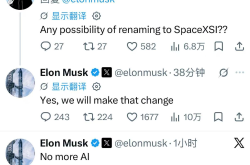
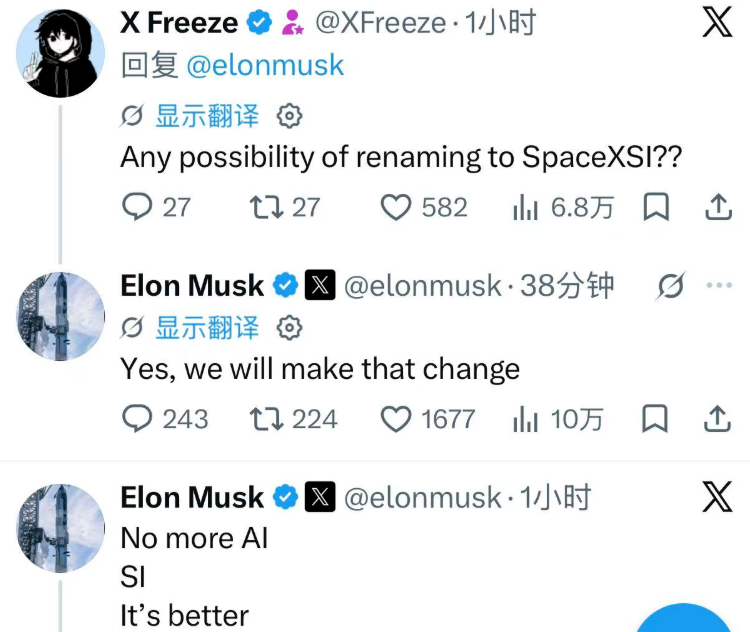
On October 4, 2026, a user asked Musk on the X platform: Will SpaceX AI be renamed SpaceX SI?
Musk responded succinctly: 'Yes, we will make that change.' 'No more AI—it's SI now. That's better.'
For most companies, a name change might just be brand news. But when it comes to Musk, and at this moment in October 2026, it's worth dissecting carefully.
Because what's at stake here is not just a name, but the restructuring of the entire tech industry's narrative framework.
From AI to SI: What Exactly is Changing?
Let's first comb, sort out, organize, arrange, streamline (sort out) the timeline.
On September 29, U.S. President Trump signed an executive order requiring federal agencies to fully replace 'Artificial Intelligence (AI)' with 'Superintelligence (SI)' in official documents, public communications, and policy texts. The rationale: current frontier technologies' capabilities 'far exceed merely imitating or automating specific aspects of human intelligence,' and SI 'more accurately captures the capabilities of this rapidly advancing technology.'
On the same day, Musk, Jensen Huang, and four other tech titans signed what Trump called a 'morally binding' agreement at the White House. Musk had a slip of the tongue at the event—he said 'AI' before quickly correcting himself to 'SI,' which Trump immediately endorsed.
Jensen Huang also swiftly adopted the new terminology, stating at an event that data centers are becoming 'superintelligence factories.'
Then, on October 4, Musk confirmed that SpaceX AI would be renamed SpaceX SI.
From the White House to Silicon Valley, from policy documents to corporate brands, a discourse reconfiguration around the term 'AI' is accelerating.
But here's an easily overlooked fact: In academic contexts, 'superintelligence' is a rigorously defined concept, typically referring to intelligence that surpasses human cognitive abilities across a broad range of domains. By this standard, today's large models are far from qualifying as superintelligence.
So, AI becoming SI doesn't mean machines have suddenly upgraded overnight. What's truly changing is how humans position machines—shifting from 'what can machines do for us' to 'what if one day they can do things humans haven't even figured out yet?'
The name changes, and so do the questions.
Musk's 'Triple Pivot'
To understand this rename, we need to trace SpaceX AI's evolution.
In July 2023, Musk founded xAI as an independent AI company, with its core product being the Grok large model. In February 2026, SpaceX acquired xAI in an all-stock deal, valuing the merged entity at $1.25 trillion. That May, Musk announced xAI would no longer operate independently but would fully integrate into SpaceX, renaming it SpaceX AI. The brand switch officially took place in July.
Now, SpaceX AI has become SpaceX SI.
From xAI to SpaceX AI to SpaceX SI, this naming trajectory reflects three strategic pivots in Musk's AI vision: from an independent AI company, to an AI engine for SpaceX's aerospace ecosystem, and finally to a 'superintelligence' vanguard aligned with political discourse.
Each step was deliberate. The first rename embedded AI capabilities into a unified roadmap for rockets, satellites, and computing infrastructure. The second rename fully aligned with the White House's narrative, strengthening policy synergy with the Trump administration.
Why is Musk doing this? Look at what SpaceX is building. SpaceX has migrated its AI training tasks to the Colossus 2 supercomputer and plans to open computing power services to more AI companies. More critically, SpaceX is advancing its 'Orbital Data Center' plan—Musk claims that 'within 2-3 years, generating AI computing power in space will be the most cost-effective method.'
SpaceX's computing expansion is equally aggressive: by the end of Q2 2026, available AI computing power reached 1.4 gigawatts, set to exceed 2 gigawatts by year-end, with a 2027 target of nearly 10 gigawatts. Musk even declared that AI would account for 99% of SpaceX's value within five years.
This is no longer just a rocket company. SpaceX is transforming into a superintelligence infrastructure platform with AI at its core and aerospace as its carrier (carrier). In this context, calling it 'AI' indeed feels inadequate—at least narratively.
Where Are the Industrial Opportunities in the SI Era?
The rename is just a signal flare; the real focus should be on industrial-level changes.
An interesting perspective comes from a October 1 essay by two OpenAI employees. They proposed an economic framework: frontier intelligence and 'the ability to turn ideas into reality' are complementary goods. They termed the latter 'institutional intelligence'—an underappreciated, execution-layer intelligence.
As they put it: 'Geniuses design monuments; institutions lay the stones.' Galileo's telescope required just two lenses and a tube, while the James Webb Space Telescope cost ~$10 billion and involved 300 institutions across 14 countries.
Their core argument: even with superintelligence, a civilization of a billion Einsteins would still need most people mining quarries and managing accounts. Superintelligence's 'superpower' lies precisely in its willingness to take over that massive execution apparatus.
This points to an emerging industrial direction: AI System Integration (AISI).
This isn't traditional software system integration. While traditional SI connects software systems, AISI connects AI models to workflows, human decision-making, and governance systems. In simpler terms: no matter how smart AI is, someone still needs to help companies 'install' it.
The market is already responding. OpenAI established a deployment company, partnering with 19 investment firms and consultancies to drive enterprise AI integration. Anthropic formed a joint venture with private equity giants like Blackstone, adopting Palantir's 'forward-deployed engineer' model to directly embed engineering resources into enterprises. Google Cloud is assembling FDE teams, planning to hire hundreds of engineers.
The 2026 tech landscape is shifting from the 'Model Era' to the 'Orchestration Era.' Foundation models remain the industry's knowledge core, but value is migrating toward deployment, tuning, and governance. The AI-specific SI and consulting market, though currently small (~$9.7 billion in 2025, ~$11.9 billion in 2026), is growing rapidly and expected to accelerate over the next decade.
Don't Let the Name Fool You
For all the hype, chill (calmness) is warranted.
First, the name change doesn't equal realization. As a Titan Media analysis bluntly stated: 'The rename has happened, but superintelligence's arrival requires separate technical evidence.' Today's large models have indeed advanced rapidly in reasoning, generation, and coding, but they still fall far short of 'surpassing humans' in hypothesizing autonomously, reasoning across domains, or truly understanding the physical world.
Second, risks remain. The core danger of superintelligence lies in alignment failure and loss of control—if AI's goals misalign with human values, even slight deviations could amplify into catastrophic consequences when scaled by capability. An Anthropic researcher even believes the probability of AI causing human extinction within 10 years exceeds 10%. Whether these projections are overly pessimistic is debatable, but maintaining risk awareness amid industry frenzy isn't a bad thing.
Third, can a name change address 'AI fatigue'? Since 2026, anti-AI sentiment has surged in the U.S., with polls showing over 70% support for stricter AI regulation and opposition to new large data centers near communities. Replacing 'artificial' with 'super' and packaging 'intelligence' as more futuristic might dissipate some negative associations narratively. But a name change won't solve real issues like power consumption, privacy protection, or job displacement.
In Closing
Musk's rename, viewed in a broader context, feels like a footnote to the 2026 tech industry.
This year, AI investment logic shifted from 'tech hype' to 'commercial proof.' AI is extending from the digital to the physical world, with robots, autonomous driving, and edge AI hardware becoming new market vectors. Among global venture capital deals, AI's share rose from 53% in 2025 to 77% in H1 2026.
Against this backdrop, the discourse shift from AI to SI is less about technological leaps than the industry searching for new narrative anchors. The name changes, but the real questions remain: What can AI actually do? Who is responsible for its actions? And how should its benefits and risks be distributed?
Musk says 'SI is better.' Whether it is depends not on the name, but on what comes next.
-
![]()
World Model Track: Who's Consolidating, Who's Breaking Through?
-
![]()
AI Self-Generation: The Dawn of a New Era
-
![]()
Musk Changed the Name Again, But This Time It's No Simple Matter
-
![]()
National Day Visits Surge Threefold, Yet Orders Remain Low: The Awkward Night for Travel AI
-
![]()
Porsche Unexpectedly Unveils New Model: Launching September 30, Priced at 700,000 RMB!
-
![]()
Lei Jun Expresses Gratitude to 'Young Enthusiasts' Online, Netizens Comment: 'Future Core Car Buyers Are Already in the Bag'
-
![]()
Only 84,000 Yuan! Honda Unveils New Car: Launching for Sale on October 6
-
![]()
Starting at 1.59 Million? Aston Martin Officially Unveils New Model: On Sale from October 4th