World Model Track: Who's Consolidating, Who's Breaking Through?
 10/08 2026
 470
470
Produced by | RoboIsland
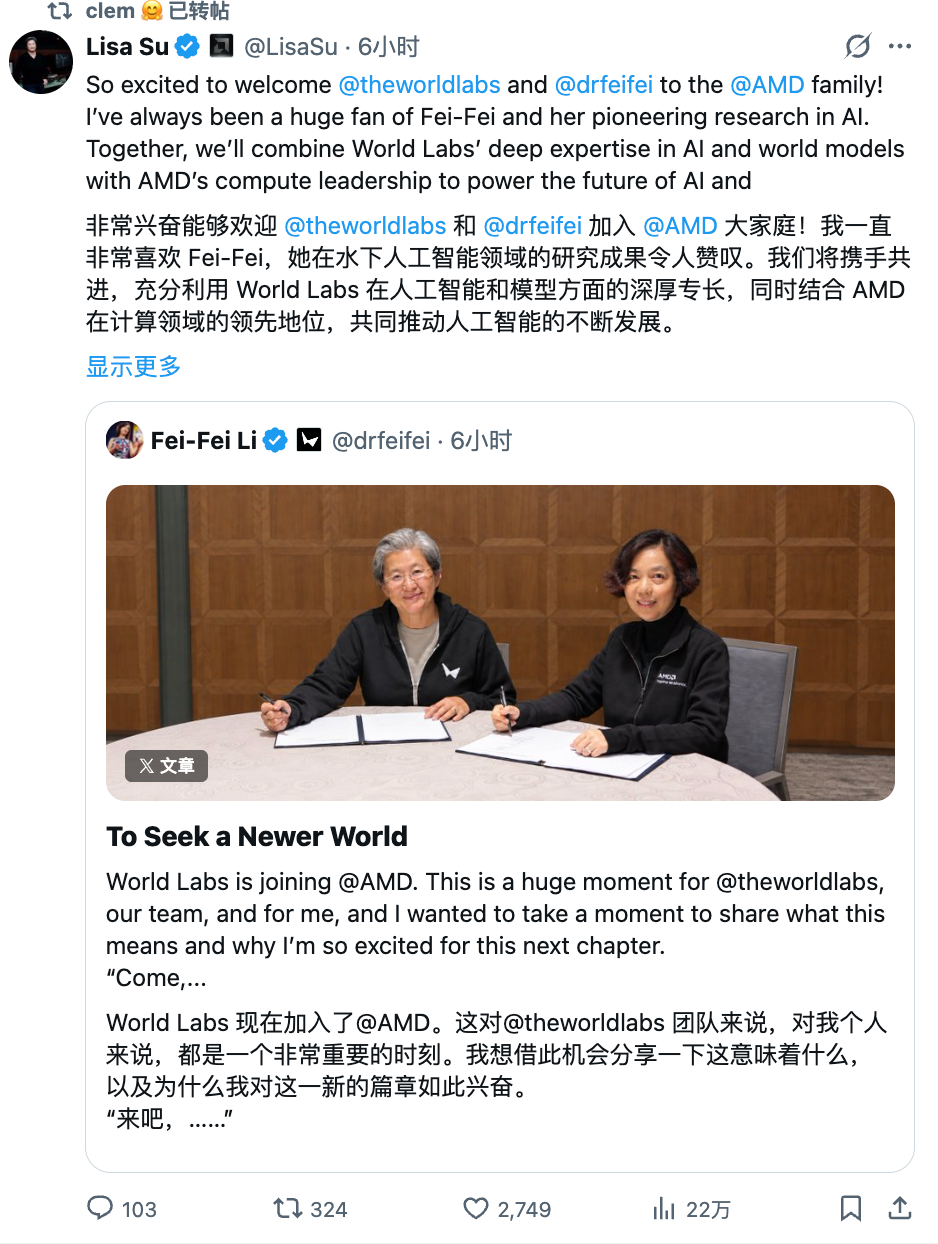
On September 28, chip giant AMD announced the acquisition of World Labs for $8.2 billion in an all-stock transaction. The company, established just over two years ago with around 70 employees, launched its first commercial product, Marble, less than a year ago, and released its next-generation model, Atlas, less than a month before the deal was announced.
On the day of the announcement, AMD's stock price closed down 3.61%. What were the market's concerns? How could a lab with no revenue and an unproven technological path be worth $8.2 billion? How was this valuation calculated? Some even speculated that the deal was a transfer of benefits.
At CES 2026, Lisa Su invited Li Feifei to the keynote stage, where they jointly showcased World Labs' products. At that time, Su was an early investor in World Labs, and Li was the entrepreneur.
Nine months later, this investor-entrepreneur relationship evolved into a CEO-chief scientist partnership, with Li Feifei set to become AMD's Executive Vice President, reporting directly to Lisa Su. In this transaction, AMD served as both the buyer and a shareholder of the acquired company.
AMD was not alone in its move. Around the same time, NVIDIA acquired Hugging Face, the world's largest open-source model community, for approximately $12.9 billion; Qualcomm acquired Modular, an AI-native software platform developer; and SpaceX acquired Anysphere, an AI programming assistant. Chip giants were to do something simultaneously without prior consultation (coincidentally) extending their reach into the model layer.
Why is AMD willing to spend $8.2 billion on a lab with almost no revenue? Why are chip companies suddenly vying for model companies? What does this competition mean for China's domestic chip manufacturers? Can companies like Moore Threads adopt the same strategy?
1. An $8.2 Billion Ticket
The AMD-World Labs acquisition is expected to close by the end of 2026, pending regulatory approval and other customary closing conditions.
An all-stock acquisition means the acquirer does not need to raise substantial cash; AMD can simply pay with newly issued shares. As of June 27, 2026, AMD had $5.086 billion in cash and cash equivalents, which would be insufficient to cover the $8.2 billion deal in cash.
AMD has not yet determined the number of shares to be issued. The number will be calculated based on the daily volume-weighted average price of AMD's stock over the 10 consecutive trading days preceding the closing, with the valuation period ending two trading days before the closing.
In other words, the $8.2 billion represents the currently disclosed total transaction value, with the final dilution to be determined closer to the closing. Every fluctuation in AMD's stock price before closing will alter the true cost of the deal.
This acquisition easily recalls AMD's largest deal in history. On February 14, 2022, AMD completed its acquisition of Xilinx for approximately $50 billion, setting a record in the chip industry.
However, when announced in October 2020, the deal was valued at $35 billion. Due to significant stock price increases for both AMD and Xilinx over 16 months, the final transaction value surpassed $50 billion.
Since the $8.2 billion is a tentative price, why is this deal considered difficult to value? The difference between the two large acquisitions lies in buying the present versus buying the future.
Xilinx is a global leader in FPGA chips, with mature product lines, a stable customer base, and a clear financial model. The cash flow from acquiring Xilinx could be calculated, with clear costs, revenues, and payback periods. Additionally, after the acquisition, AMD gained an FPGA chip segment alongside its CPU and GPU offerings, better positioning itself to compete with NVIDIA and Intel in the data center market.
World Labs is entirely different. The company has never disclosed revenue figures, lacks a price-to-earnings ratio or price-to-sales ratio, and is difficult to value. The funds can only be recorded as two things on the balance sheet: intangible assets and goodwill.
The most immediate risk is goodwill impairment. Goodwill must undergo annual impairment testing. Before the technological path for world models is clarified, how can goodwill be preserved? How many years will World Labs need to prove its technological approach?
Currently, some industry practitioners point out the risk of World Labs being "eliminated" by general-purpose large models, whose 3D capabilities are rapidly improving. If Atlas's technological path is deemed invalid within AMD or if general-purpose large models catch up in 3D capabilities, the $8.2 billion investment could be heading in the wrong direction.
So why is AMD proceeding? Because it cannot afford to wait—AMD has almost no presence in physical AI.
NVIDIA has already built a complete technology stack in physical AI, offering customers a one-stop solution from training compute to simulation environments to robot brains, with extremely high migration costs afterward. However, AMD's previously available models were limited to text and video, lacking a world model product for understanding the physical world.
Physical AI models must handle object positions, distances, motion, and physical constraints in three-dimensional space. The spatial intelligence research at World Labs can not only fill AMD's gap but also ensure that every computational bottleneck encountered by the World Labs team during the development of the next-generation Atlas model at AMD directly translates into specific chip design requirements—requirements that are earlier and more accurate than any market research.
Whoever can anticipate the next-generation workload can allocate transistor budgets effectively.
Moreover, given the chip industry's unique rhythm, with a three-to-five-year timeline from design to mass production and architectures taking two to three years to deploy in data centers, if chip companies wait for model companies to present new demands before adapting hardware, they will always be a step behind.
In her official statement, Lisa Su said that building a computing platform for the next generation of AI requires a deep understanding of how models evolve, and Li Feifei and the World Labs team bring research leadership and model expertise.
So, to summarize with the perspective of tech analyst Patrick Moorhead, the essence of this deal is an acquisition of "talent and model insights." AMD is acquiring developers who will run models on future chips.

Image Source: Tencent Technology
The rationale behind World Labs' sale is relatively straightforward. When news of the deal emerged, netizens joked that Li Feifei had "achieved a major result." Some experts pointed out that her company, after more than two years, had only produced demos and had not yet figured out how to build world models properly.
While such criticism is sharp, it reflects a reality: rather than continuously seeking compute power and hardware resources independently, world model startups might fare better by being acquired by chip companies.
The spatial intelligence Li Feifei truly aims to develop requires long-term, unrewarded investment. Since world models must process video, multi-view perspectives, 3D geometry, and real-time interactions, training and inference demand far more compute than large language models. NVIDIA feeds Cosmos with its own chips, and Google uses TPUs for Genie—orders of magnitude beyond what independent players can match.
Moreover, NVIDIA's open-weight approach with Cosmos directly reduces the commercial viability of independent model players. By the time they develop a good model, competitors have already released comparable offerings for free.
2. Leading Chip Companies Complete Capital Alignments
The significance of AMD's acquisition of World Labs lies more in signaling a broader trend: chip giants are now vying for model companies.
While the acquisition logics differ—for example, NVIDIA's ~$12.9 billion acquisition of Hugging Face secures the entry point by controlling where developers begin their model selection, ensuring that regardless of the final model choice, it runs on NVIDIA chips—or AMD's approach of bringing the most knowledgeable AI figure, Li Feifei, in-house to involve the model team early in chip design.
Both point to the same conclusion: the AI chip competition is shifting from who can provide more compute power to who can earlier understand the compute requirements of the next generation of AI.
This conclusion is reshaping the entire world model landscape. After these acquisitions, major players in the world model track are nearly all tied to a compute giant, leaving neutral world model companies as a rarity.

Image Source: Time Magazine
RoboIsland has compiled several scenarios facing independent world model companies today. First, those seeking acquisition but failing. Decart, an Israeli world model startup, can render interactive gaming environments at 20 frames per second with zero latency using its flagship product, Oasis.
In August 2026, Anthropic was reported to be negotiating an acquisition of Decart for around $6 billion, but by September 8, Bloomberg reported that Anthropic had formally terminated these talks.
Second, those explicitly rejecting acquisition. General Intuition, spun off from gaming video platform Medal, trains world models using over 2 billion gaming video clips. Its CEO confirmed rejecting an acquisition offer from OpenAI, reportedly worth up to $500 million, opting instead for independent financing at a valuation exceeding $2 billion.
This is currently the only known independent world model company to explicitly reject acquisition by a tech giant. Its independence is premised on sufficient funding from investors like Jeff Bezos and Eric Schmidt, eliminating the need for a forced sale.
Third, those balancing between giants. Runway, originally an AI video generation company, completed a $315 million Series E funding round in 2026, with participation from both NVIDIA and AMD. It has not sold itself but maintains balance between the two camps.
However, the durability of this balance is questionable. As NVIDIA and AMD intensify competition in the world model track, companies accepting strategic investments from both will face increasing pressure to choose sides.
Fourth, those navigating among giants. In February 2026, Odyssey ML secured investment from NVIDIA's NVentures. In its $310 million Series B funding, investors included Amazon, AMD Ventures, and others.
The intriguing aspect is that when these cases are viewed collectively, the root cause is that independent world model companies cannot find their place in the closed loop of data competition.
How does this loop operate? Compute power determines data, data determines models, and models determine definition rights—while compute power remains in the hands of chip giants.
Expanding on this: only companies with compute power can collect data. World model training and simulation are compute-intensive, often requiring multi-GPU parallelism for real-time high-definition rendering; without sufficient compute, even data collection and preprocessing cannot proceed. Only companies with data can train models. Training data for physical AI is extremely scarce—there is no ready-made "physical internet." Only companies with models can define requirements. When model teams begin incorporating hardware characteristics into early architectural considerations, and chip teams start understanding model evolution directions, the relationship shifts from adaptation to co-definition.
What does definition right entail? During world model training, whether memory bandwidth or interconnect bandwidth takes priority; how to design 3D reconstruction operators to fully leverage specific hardware's parallel architectures; what cluster topology suits the communication patterns of physical simulation.
If CUDA ecosystem defines these answers, other chip manufacturers must follow suit.
Independent startups are stuck at every stage of this loop: without compute, they cannot collect data; without data, they cannot train models; without models, they cannot participate in definition. Unless they secure sufficient funding to establish barriers at some stage, they will ultimately be acquired or marginalized.
3. An Alternative Path for Moore Threads and Others
AMD's acquisition of World Labs essentially supplements its existing compute foundation with a model layer. Domestic chip manufacturers face a different landscape.
Take Moore Threads as an example. Its MTT S5000 uses a 7nm process, while NVIDIA's latest Blackwell architecture has entered the 4nm or even more advanced node. This process gap largely determines the single-card compute ceiling, and world models demand as much compute as possible.
This process gap means domestic chips must rely on cluster scaling and software-hardware co-optimization to compensate.
Meanwhile, at the software ecosystem level, most world model training frameworks, operator libraries, and communication primitives grow within the CUDA ecosystem.
If a model team migrates training code from CUDA to a domestic chip, the re-optimization entails engineering costs measured in months, contrasting with model iteration cycles measured in weeks or even days.
Few domestic teams are truly engaged in foundational world model R&D. If chip manufacturers do not proactively establish collaborations, these teams might abandon domestic chip routes due to prohibitively high migration costs.
Image Source: Tencent Technology
A misjudgment by AMD might cost $8.2 billion and years of strategic opportunity. If domestic chips absent (are absent) in this direction, they risk losing the chance to participate in the next generation of compute competition.
Domestic chip manufacturers lack AMD's acquisition capacity but can pursue partnerships. Moreover, partnerships are not merely a secondary option—in some dimensions, they are more effective than acquisitions. Acquisitions lock in ownership; partnerships lock in collaboration depth.
With AMD's acquisition of World Labs, Li Feifei's team becomes AMD employees, with research directions subject to AMD's roadmap. In contrast, Moore Threads' joint research with Jijia Vision and full-stack native training with Peking University's EvoPhys team allow technical alignment while preserving independence.
For world models, where technological paths have not yet converged, maintaining parallel explorations across multiple routes may hold more value than unifying under a single company's roadmap.
However, binding also has its vulnerabilities. Without the constraints of equity relationships, model teams can switch to other computing platforms at any time.
The path of binding is progressing through three levels.
The first level is proving that it can run. In February 2026, Pony.ai and Moore Threads reached a strategic cooperation to engage in in-depth collaboration on the training and optimization of Pony.ai's World Model and virtual driver system, advancing training adaptation and validation based on the MTT S5000 training and inference integrated AI computing card and the KUAE Intelligent Computing Cluster. This marks Pony.ai's first large-scale application of domestic AI computing power in key training and simulation processes.
The significance of this level does not lie in the performance metrics but in verifying feasibility, breaking the cognitive inertia that domestic chips cannot train cutting-edge models.
The second level is proving that it can train stably. The 5D World Model, EvoPhys-World, developed by Peking University's EvoPhys team, completed full-stack native training on Moore Threads' MTT S5000. Full-stack native training means that every step, from start to finish, is completed on domestic chips.
The fundamental difference between training a world model and a language model lies in the need for continuous and consistent three-dimensional states. If a language model training crashes, it can simply restart from a checkpoint and continue. However, if the state is inconsistent during world model training, the generated scenes will exhibit structural breaks when the perspective switches.
The third level is proving that it can define. The 4D World Model, MoWorld, developed by Moxin Technology, with approximately 14 billion parameters, was trained, compressed, and deployed on Huawei's Ascend NPU super node, achieving real-time inference at up to approximately 50 frames per second. The inference cost is only 30% of that of a GPU solution of the same scale.
Moxin Technology and Huawei's relevant teams conducted model training and inference optimization around the Ascend NPU, forming a closed loop where models propose computing requirements, chips support large-scale deployment, and scenario feedback drives iteration.
This level represents the embryonic form of definition rights, where model teams begin to incorporate hardware characteristics into early architectural design considerations, and chip teams start to understand the direction of model evolution.
Whether this small step in binding can pave the way for a broader path depends on three conditions. First, whether the technical route of world models will converge into a relatively stable architectural form within the next two to three years. Second, whether the software stack of domestic chips can evolve from a compatibility layer to a native layer. Third, whether world model companies are willing to incorporate hardware characteristics into early architectural design considerations rather than considering deployment only after training is complete.
If any of these three conditions are not met, binding will remain at the level of mere functionality and will not reach the level of definition.
IV. Conclusion
AMD paid $8.2 billion for a ticket, while domestic chip manufacturers are attempting to board the ship in another way.
The price of the ticket is high, but what lies behind it—the right to define the next generation of computing power needs—is truly expensive.
Cover image source: Game of Thrones
Featured image source: X account
Disclaimer: The content of this article is for reference only and does not constitute investment advice. Investors who act on it do so at their own risk.
Copyright of RoboIsland. Reproduction without authorization is prohibited.
-
![]()
World Model Track: Who's Consolidating, Who's Breaking Through?
-
![]()
AI Self-Generation: The Dawn of a New Era
-
![]()
Musk Changed the Name Again, But This Time It's No Simple Matter
-
![]()
National Day Visits Surge Threefold, Yet Orders Remain Low: The Awkward Night for Travel AI
-
![]()
Porsche Unexpectedly Unveils New Model: Launching September 30, Priced at 700,000 RMB!
-
![]()
Lei Jun Expresses Gratitude to 'Young Enthusiasts' Online, Netizens Comment: 'Future Core Car Buyers Are Already in the Bag'
-
![]()
Only 84,000 Yuan! Honda Unveils New Car: Launching for Sale on October 6
-
![]()
Starting at 1.59 Million? Aston Martin Officially Unveils New Model: On Sale from October 4th