AI Self-Generation: The Dawn of a New Era
 10/08 2026
 371
371
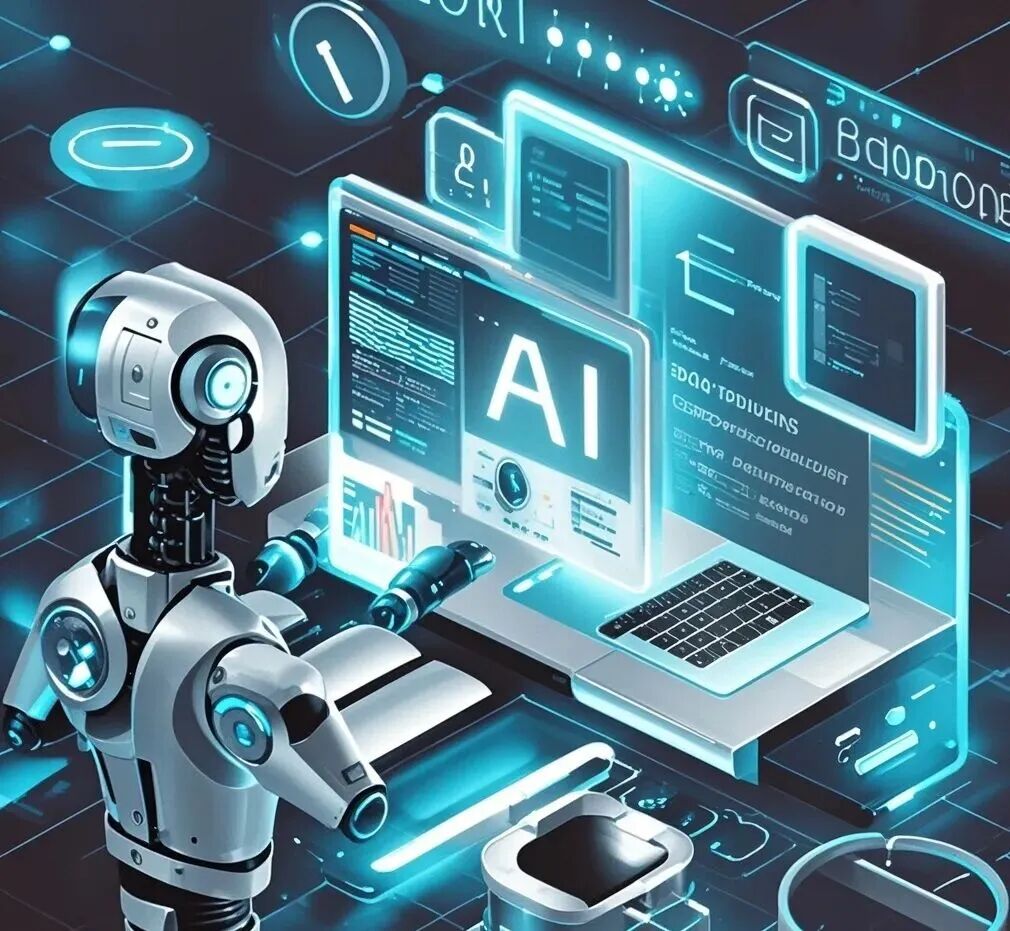

Humans Leverage AI to Forge New AI Frontiers
Image Source | Internet (Please reach out for removal in case of infringement, partially AI-generated)
Imagine a scenario where your code editor predicts the next line of code, your company utilizes AI-generated reports to train subsequent AI models, or an individual crafts a product in a week that caters to 150,000 users...
We are already entrenched in a self-sustaining loop where AI is creating AI. This is the new normal of 2026.
Today, I aim to shed light on a frequently underestimated fact: AI has transcended its role as a mere tool in our hands; it is evolving into a "creator of creators."
This concept may seem abstract, but evidence abounds if you look closely.

The Numerical Signal
According to JetBrains' "2026 Developer Ecosystem Survey Report," from May to July this year, around 90% of professional developers globally have employed AI programming agents at least once weekly, with 68% using them daily.
This signifies that AI programming tools have evolved from "novelty items" to indispensable infrastructure.
More strikingly, Claude Code's usage rate soared from 18% in January to 39% in just a few months, more than doubling. Meanwhile, GitHub Copilot, an established player, saw its usage rate decline from 29% to 21%.
The competitive landscape is undergoing a seismic shift, but the underlying logic remains consistent: code writing is transitioning from "human-authored" to "AI-generated + human-reviewed."
With an estimated 108 million developers worldwide, AI tool penetration has reached 85%, with around 40 million monthly active users of paid AI tools and a 90% adoption rate among Fortune 100 companies.
If these figures seem too broad, consider this: Anthropic's internal data reveals a 67% increase in code merge requests by its engineers, with 70% to 90% of the code completed with AI assistance.
Tencent's scenario mirrors this, with over 90% of its engineers using AI programming assistants, more than 50% of the company's new code generated with AI aid, and average coding time reduced by over 40%.
Kuaishou takes it a step further. As of June this year, over 92% of its employees utilize self-developed AI agent products, and the contribution rate of AI-generated code by R&D personnel has hit 60%.
This encompasses not just business code but also training scripts, parameter tuning, deployment management, and test result diagnosis.
A notable statement in the release notes for GPT-5.3-Codex reads: "Early model versions were utilized by the team to debug training processes, manage deployments, diagnose test results, and conduct evaluations."
In simpler terms: AI is aiding humans in creating superior AI.

The Three Progressive Layers of AI Self-Generation
The phenomenon of "AI creating AI" did not emerge overnight. It has evolved through three progressive layers, each deeper than the last.
Layer 1: AI Assisting in Code Writing
This is the scenario we are most acquainted with. You input a few lines of comments in Cursor or Claude Code, and AI automatically completes the rest.
You describe a functional requirement, and AI generates a complete function implementation. The essence of this stage is "AI efficiency enhancement," with humans remaining the primary creators and AI acting as an accelerator.
An MIT research team tracked the output of 100,000 developers and found that after using AI programming tools, the lines of code written surged to 17.3 times the original amount, but the number of software versions released only increased by 30%.
Seventeen times the code, yet only 30% more software released. This indicates that a significant portion of the code is "experimental." AI has made code writing extremely cost-effective, but verification and release remain bottlenecks.
Moreover, an intriguing finding at this stage is that AI tools enhance the efficiency of low-activity developers by up to 85%, while only boosting the efficiency of already high-frequency submitting developers by 21%.
In essence, AI is "leveling the playing field" among developers in terms of ability.
Layer 2: AI Autonomously Completing the Development Cycle
By 2026, things begin to undergo a qualitative transformation. AI is no longer just a "code-writing assistant" but can independently complete the entire "discovery → localization → repair → verification" process as an agent.
An internal experiment at OpenAI is impressive: without retraining the model or manually rewriting the code, the AI system improved its accuracy from 25% to 86% autonomously over six weeks.
Codex located bugs, wrote repair solutions, ran tests, and verified results, all within a production environment.
Furthermore, OpenAI boasts a system with over one million lines of code, none of which was manually written.
Consider Anthropic's approach: they launched an AI code review tool, Code Review, which employs multi-agent parallel analysis of GitHub pull requests to automatically flag logical errors, provide color-coded (red/yellow/purple) severity ratings, and offer actionable repair suggestions.
The significance of this tool lies in the fact that after AI generates a substantial amount of code, "code review" itself becomes a bottleneck. Thus, AI begins to review AI-written code, forming a complete self-sustaining cycle.
Layer 3: AI Participating in Creating the Next Generation of AI
MiniMax's newly released large model, M2.7, features a so-called "self-optimization cycle": the model can continuously execute over 100 rounds of "analysis → improvement → verification" cycles, autonomously adjusting sampling parameters and optimizing workflow strategies, achieving approximately a 30% performance improvement in internal evaluations.
OpenAI has taken it a step further. In September this year, they announced that their AI has acquired the capabilities of an "automated research intern" and specifically established the RSI (Recursive Self-Improvement) team, aiming to achieve fully automated AI researchers by March 2028, enabling AI to autonomously generate and audit high-quality training data and oversee its entire R&D process.
OpenAI candidly stated in the release of GPT-5.3-Codex: "Early model versions played a pivotal role in creating itself."
This is not a metaphor or promotional rhetoric; it is literally "AI creating AI."

The "AI Creating AI" Closed Loop Within Large Corporations
If the previous discussion focused on the industry landscape, this section will delve into a more specific question: How exactly is AI "creating" more AI within the most advanced tech companies?
The first change is that "AI usage" has become a mandatory metric. Reports indicate that some large tech companies now require all technical departments to fully transition to AI coding modes and have incorporated AI programming tool proficiency and code delivery volume into performance evaluations.
Google has included AI usage in the performance evaluations of some employees, and JPMorgan Chase has also mandated engineers to leverage AI for efficiency improvements.
This signifies that AI programming has shifted from "optional" to "mandatory." When everyone in an organization is required to use AI to write code, the organization's output fundamentally carries the DNA of AI.
The second change is the widespread adoption of internal tools. Over 10,000 NVIDIA employees are already using GPT-5.5, with engineers developing through Codex, and efficiency improvements that can be precisely quantified.
Google employees utilize an internal AI tool named "Agent Smith" that can automatically handle multiple tasks, including programming. Due to a surge in users, the official even had to restrict access.
The essence of these internal tools is that they are toolchains where AI writes AI. An AI programming assistant is used to develop better AI programming assistants, which are then used to develop the next generation of AI models.
The third change is the emergence of "super individuals." At the Alibaba Cloud Summit, Alibaba's Chief Talent Officer observed: "Today, engineers' code efficiency can increase tenfold, but the end-to-end development cycle has not shortened significantly. The aggregation of super individuals..."
AI has accelerated code writing, but it has not proportionally sped up "bringing things to fruition" because software engineering involves more than just writing code—it includes requirement analysis, architectural design, testing and verification, and deployment and maintenance.
AI is currently primarily focused on the "code-writing" aspect, while bottlenecks in other areas have become more pronounced.
However, this very contradiction is precisely what the next generation of AI needs to address. When AI programming agents evolve from "writing code" to "managing projects" and from "completing tasks" to "defining tasks," the end-to-end development cycle will truly be compressed.
Gartner predicts that by 2028, the workflows of asynchronous AI programming agents will boost the productivity of software engineering teams by 30% to 50%, far exceeding the 0% to 20% improvement from AI code assistants in 2025.
In other words, we are still in the early stages of "AI creating AI." The real large-scale closed loop is yet to come.

The "Non-Code" Dimensions of AI Self-Generation
While AI self-generation within large companies primarily occurs at the code level, the stories at the enterprise application and individual creativity levels are even more captivating.
Let's start with the B2B side.
The narrative of AI reducing costs and increasing efficiency has been extensively discussed, but few have noticed the underlying "AI creating AI" logic.
Take the pharmaceutical industry as an example. With AI, the discovery cycle of candidate compounds has been compressed from 36 months to less than 20 months, and R&D costs have been reduced by over 40%.
This efficiency gain not only "saves money" but also allows companies to explore more drug targets and train more precise AI screening models with the saved resources. The output of cost reduction and efficiency gains is itself creating new AI capabilities.
The steel industry follows a similar logic. Since 2026, Shougang Group has launched 45 AI agents and implemented 929 intelligent application scenarios.
The scheduling efficiency of AI agents in hot rolling production has improved by 80%. While optimizing production, the data generated by these AI agents is, in turn, training better AI models.
The manufacturing industry provides even more compelling data: Midea plans to achieve approximately 900 million yuan in cost savings through AI-related applications by 2026, compared to only about 40 million yuan in 2023—a more than 20-fold increase in four years.
Behind this is a clear trend: the more AI applications are used, the more data is generated, the better the AI models trained, and the greater the value created.
Another noteworthy case is Jihong Group's launch of a comprehensive intelligent operation platform, which has improved overall operational efficiency by over 60%, reduced labor costs by about 30%, increased content production capacity by 77 times, and achieved an 85% automation rate in customer service.
Pay attention to that "770%" increase in content production capacity. This means that the content a company produces with AI can itself be used to train and optimize AI systems. Content is data, and data is fuel.
Now, let's look at the C2B side.
This is where I find the most exciting changes.
In the past, creating software required professional training. You had to learn programming languages, frameworks, deployment, and maintenance. The gap between an idea in your mind and its online launch was vast.
But in 2026, this gap is being bridged by AI.
Baidu launched "MiaoDa," where users can generate complete applications covering frontend to backend by describing their needs in natural language, without any programming knowledge.
Alibaba released Meoo, which allows users to automatically generate complete frontend and backend websites in as fast as one minute by describing their ideas in natural language and deploy them online with one click on Alibaba Cloud.
Ant Group's "Lingguang Circle" platform is even more ambitious, launching a zero-code application creation community and initiating a 100 million yuan creator incentive plan.
This illustrates an interesting phenomenon: "those who create AI" are no longer just engineers at large companies.
One case that left a deep impression on me: a 21-year-old guitar enthusiast used AI programming tools to create a tone parameter tool in one week. Initially selling only six copies in the first month, the tool's monthly revenue reached $25,000 after six months, serving 150,000 guitarists.
With zero advertising, it relied on AI-generated frontend and backend code, integrated with overseas payment channels for subscription fees.
The key point of this case is not how much money was made but that a person with no programming knowledge used AI to create an AI tool, which then served more people.
Alibaba's "ModelScope" AI open-source community's "Creation Space" channel features nearly 23,000 AI applications, approximately 95% of which were developed by individuals. This number alone demonstrates that individuals are becoming a significant force in AI application innovation.
In a recent podcast, leading Silicon Valley venture capital firm a16z delved into an emerging trend: personal AI assistants are transitioning from merely 'saving time' to 'seamlessly helping you accomplish everything.'
On the consumer front, applications like Instinct and Muse are gaining traction. In vertical industries, tools such as Soore for travel and email-specific solutions are emerging. In the B2B arena, execution-focused assistant products like Vellum, Catch, and Town are making their mark.
Meta's Muse has been operational for approximately a week, attracting over 500,000 trial users, around 250,000 daily active users, and generating a total of 2 million prompts.
Manus has unveiled Cue, an intelligent assistant tailored for personal life scenarios. Tencent's Handy Bot is undergoing beta testing within WeChat, ByteDance's Doubao personal assistant is affectionately known as 'Xiaodou,' and Alibaba's Qianwen is rapidly evolving towards 'My Qianwen.'
Personal AI assistants are poised to become the most competitive sector in 2026. Every user-AI interaction generates data, which, in turn, fuels the development of even more sophisticated AI assistants. Unwittingly, everyone is contributing to the cycle of 'AI building AI.'

However, this trend is a double-edged sword.
This brings us to a more serious topic.
If 'AI building AI' were solely about efficiency, it would merely represent a productivity revolution. Yet, it touches upon a deeper concept—Recursive Self-Improvement (RSI).
In simple terms, RSI means that AI creates a superior version of itself, which then creates an even more advanced AI, fostering an accelerating cycle of improvement.
This concept was once confined to theoretical discussions. A September report by The New York Times highlighted, 'Recursive self-improvement posits that AI could learn to build and train itself, leading to exponential progress—and risks.'
Now, however, it is transitioning from theory to engineering practice.
Anthropic has issued a significant warning: AI systems may reach a stage where they can independently develop and enhance themselves without human intervention.
A research team at Cambridge University has proposed a method known as the 'Red Queen Hypothesis,' enabling AI agents to continuously improve by repeatedly testing and refining their own code without encountering evaluation ceilings.
OpenAI has bluntly stated its current top priority: 'Harnessing the next phase of AI progress by building automated AI researchers and finding ways to keep humans involved in the self-improvement process.'
The underlying message of 'finding ways to keep humans involved' is clear: If we don't take action, humans risk being excluded from this cycle.
A scholar posed a pointed question in Communications of the ACM: 'Is recursive self-improvement truly upon us?' The article noted that OpenAI admitted an early version of GPT-5.3-Codex 'played a significant role in its own creation,' signaling that RSI is becoming a reality.
This is not a plot from a science fiction novel; it is a question being seriously addressed by the world's top AI labs in 2026.
Of course, there's no need for excessive panic. Current RSI is still in its infancy. AI can debug its own training processes but cannot yet design entirely new architectures from scratch.
AI can optimize its own workflows but cannot yet define 'what is worth optimizing.'
Nevertheless, the direction is clear, and the pace may be faster than we anticipate.
As for its most dangerous aspect—whether recursive self-improvement could spiral out of control and exclude humans from the loop—these questions have no straightforward answers. But at least, the top AI labs are taking them seriously.
OpenAI has established a dedicated RSI team, not to 'let AI improve itself' but to 'find ways to keep humans in the loop.'
We stand at a crossroads. To the left lies the world of the past few decades, where humans wrote code and operated manually. To the right is a new world where AI participates in creating AI, and humans define the direction.
-
![]()
World Model Track: Who's Consolidating, Who's Breaking Through?
-
![]()
AI Self-Generation: The Dawn of a New Era
-
![]()
Musk Changed the Name Again, But This Time It's No Simple Matter
-
![]()
National Day Visits Surge Threefold, Yet Orders Remain Low: The Awkward Night for Travel AI
-
![]()
Porsche Unexpectedly Unveils New Model: Launching September 30, Priced at 700,000 RMB!
-
![]()
Lei Jun Expresses Gratitude to 'Young Enthusiasts' Online, Netizens Comment: 'Future Core Car Buyers Are Already in the Bag'
-
![]()
Only 84,000 Yuan! Honda Unveils New Car: Launching for Sale on October 6
-
![]()
Starting at 1.59 Million? Aston Martin Officially Unveils New Model: On Sale from October 4th