Securing a More Expensive Sum, Manus Returns to Beijing
 10/09 2026
 488
488

Tide Surge AI Editorial Team
Securing over $500 million in new financing, its valuation soars to $4 billion, setting a new record for AI Agent valuations in China.
On the morning of October 8, Manus' parent company, Butterfly Effect, announced the completion of its financing round, led by Boyu Capital and IDG Capital, with existing investors Tencent, Sequoia China, and ZhenFund continuing to participate.
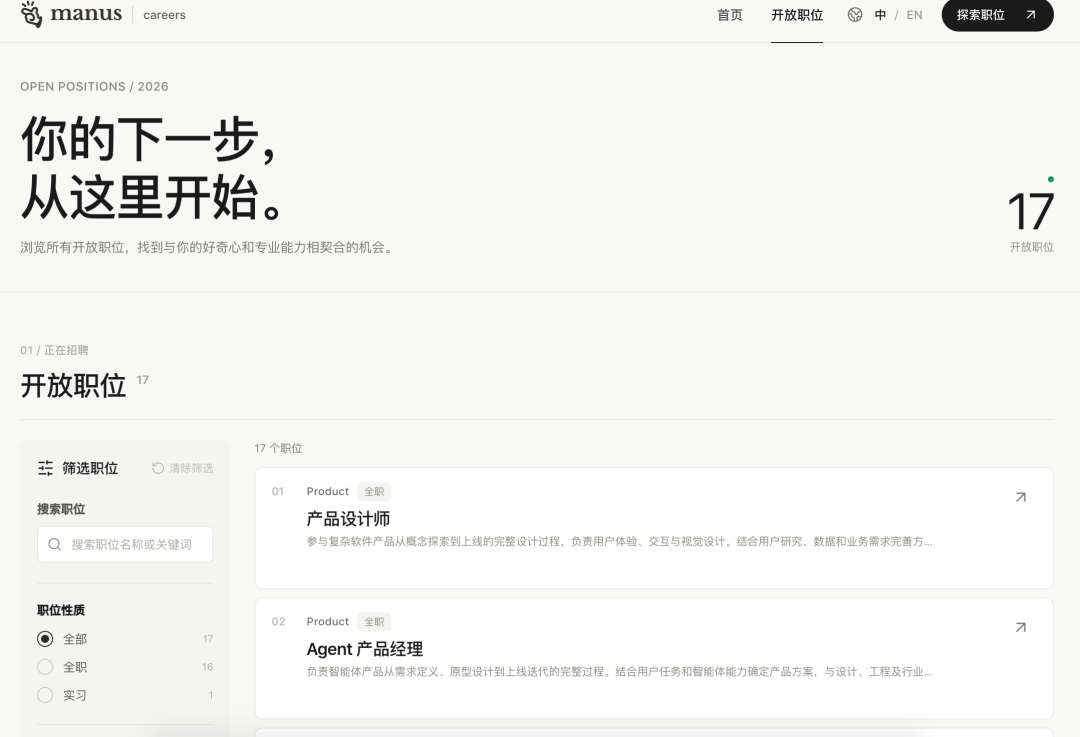
On the same day, the company's Chinese recruitment page listed 17 open positions, with 16 specifying Beijing as the work location.
Founder Xiao Hong, using the alias "Xiaohong," reposted the financing announcement with just two words: Forward.
He also revealed that after posting a recruitment message on September 28, the company received over a thousand resumes within a day.
Placing these events on the same timeline reveals a complete trajectory.
Nine months ago, in December 2025, Meta announced its acquisition of the company; four months later, in April 2026, the National Development and Reform Commission stated it had decided to prohibit foreign investment in the Manus project, requiring the acquisition to be unwound; five weeks ago, on September 1, Manus just announced its return to independent operations, separating from the U.S. company that had intended to acquire it.
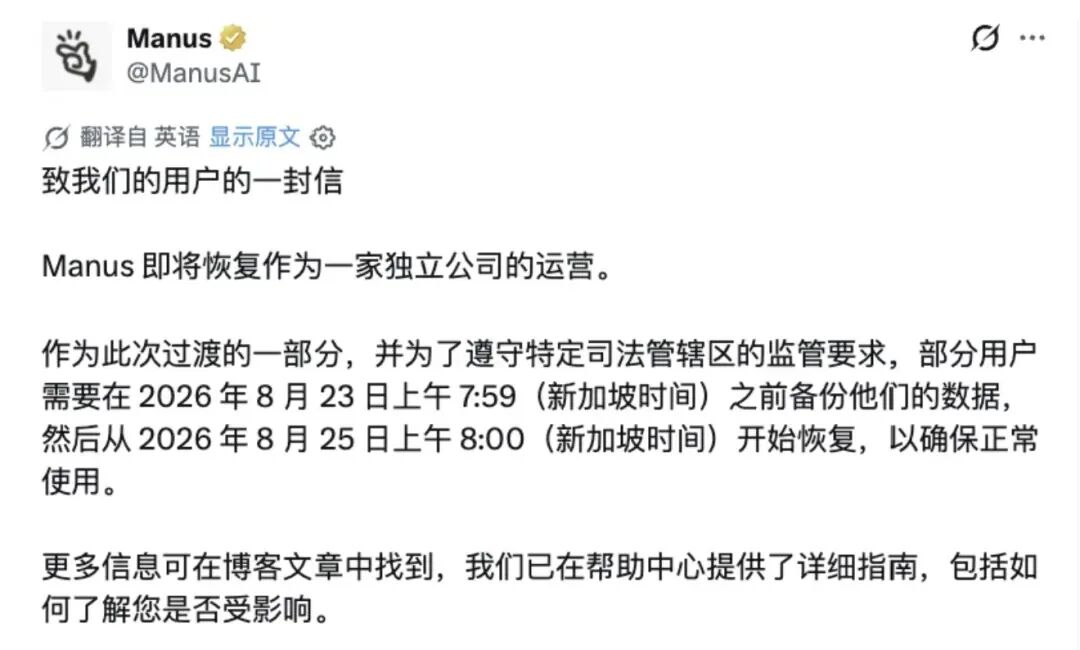
The dismantled company secured more expensive funding than its previous round within five weeks.
When Bloomberg reported on the preparations for this financing round last month, it noted that Manus' valuation was expected to double to around $4 billion in this round, a figure that would make it China's highest-valued AI agent company. This round did not disclose specific valuation figures, nor the contributions from each investor or the use of funds.
Financing data agency Dealroom previously analyzed three potential uses for the funds: buying back equity from Meta, separating Manus' technology from Meta's systems, and working capital for independent operations.
Setting a record for the largest single financing round among domestic AI agent startups does not guarantee a smooth path ahead. As it regroups and re-enters the fray, the market may have already quietly transformed.
The Hype is Just Right, and So is the Money
Investors have not withdrawn due to regulatory intervention.
Dan Wang, Head of China at Eurasia Group, told CNBC that this financing round indicates the short-term impact of the Meta case has been contained, and investors' willingness to bet on Manus as an independent company reflects renewed confidence in the commercial potential of AI agents.
This assessment does not seem out of place in today's market.
Since last winter, the personal AI assistant track (track) has been accelerating, with evidence of this acceleration concentrated in September.
An open-source project called OpenClaw was the first to bring agents from demos into daily use. Its creator, Peter Steinberg, was recruited by OpenAI in February this year to lead next-generation personal agents.
On September 8, Meta launched its personal agent, Muse, which surpassed 730,000 downloads in the U.S. within its first five days; on September 29, OpenAI announced Dots, an agent that runs constantly in the background, at its developer conference.

Another player in the same track (track) is Instinct, which Tide Surge AI previously covered in the article "The AI Assistant Battle Begins: The Most Valuable Non-Big Tech Contender Has Only 14 Employees."
With just 14 employees, the company's valuation surged from $2.5 billion in its August Series B round to $10 billion in its late-September Series C round—a fourfold increase in a month. Its product, which lacks even a standalone app, operates via text messages.
The fastest-growing valuations among these companies all stem from the same approach: delegating decision-making to agents capable of browsing the web, sending emails, and making payments autonomously.
CNBC's coverage of Manus' financing round was blunt: investor appetite for agent startups has not waned, even as foundational models advance increasingly rapidly and price competition intensifies.
Manus is arriving at just such a moment.
The Information reported in June this year on its revenue trajectory: at the time of its acquisition by Meta, the company's annualized revenue was approximately $100 million, rising to $400-500 million by the end of June this year—a four- to fivefold increase in less than a year.
The shape of this curve explains the $4 billion valuation better than any pitch deck.
One detail in the investor list for this financing round is worth noting.
The Wall Street Journal reported in mid-September on the financing preparations, mentioning that in addition to the eventual participants Boyu Capital and IDG Capital, potential investors included CATL. However, the final announced list did not include the company.
Foreign media have also positioned the company more coldly.
CNBC described it as a cautionary tale caught between Chinese and U.S. regulatory regimes: once seen as a model for Chinese startups going global, it has now become one that same kind (peer) companies most hope to avoid emulating.
Manus products launched in China in early 2025, and after securing investment from U.S. venture firm Benchmark, the team relocated to Singapore. Meta announced its approximately $2 billion acquisition in December last year, but the National Development and Reform Commission subsequently halted the deal on grounds of prohibiting foreign investment in the Manus project. By the time of the halt, Meta had already begun integrating Manus' team and technology into its own systems.
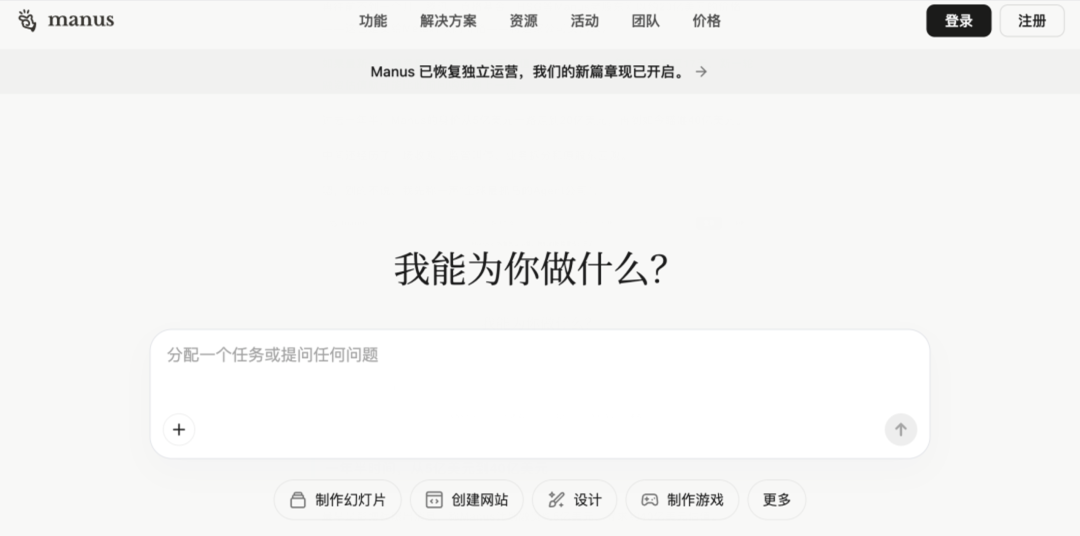
Matthias Hendrichs, a global AI company advisor based in Singapore, offered a perspective: the deep integration between Manus and Meta will not disappear simply because the transaction is unwound—you can separate the two companies, but you cannot make engineers forget what they have learned.
The same applies to Meta. Muse, which Meta launched in early September, follows the path of the company it once acquired but was forced to release.
Returning to Beijing, Starting with 17 Positions
On the same day the financing announcement was made, Butterfly Effect's Chinese recruitment page listed 17 open positions: 16 full-time roles and one internship.
These positions were evenly distributed: seven in engineering, six in product, two in partnerships, and two in operations, covering areas such as large language model algorithms, agent development and evaluation, product design, user growth, and business analysis. Except for the internship, all 16 full-time positions were based in Beijing.
The company's Chinese roots have always been present.
Public records show that Beijing Butterfly Effect Technology Co., Ltd. is registered in Sujiatuo Town, Haidian District, Beijing, with Xiao Hong as its legal representative.
In mid-2025, the company relocated its headquarters and core team to Singapore while downsizing its Chinese team.
Now, regaining independence, its first priority is to rebuild its team in Beijing.
When announcing recruitment on September 28, Xiao Hong also wrote, "I once thought our journey would end with just a footnote, but now it seems we may have the chance to write a chapter. It would be wonderful to have you all along."
Rebuilding the team is currently easier than developing products.
On the evening of September 28, the company stated via its WeChat official account that it was assembling a team to develop products for the domestic market, with steady progress in partnerships with domestic model vendors and ecosystem partners. The announcement did not disclose the name of the domestic product, its launch timeline, or the identities of its partners.
The October 8 financing announcement similarly did not provide updates on these three points.
Overseas, product updates have been rapid.
On September 28, the newly independent Manus released version 2.0, featuring a self-developed Agent framework called Cascade, along with updates to its video editor, game development, cloud computer, and automation modules.
On the same day, it launched Cue, a standalone personal agent application. Each agent in Cue has its own email address, phone number, wallet, and computer, enabling it to send messages, make payments within preset budgets, and answer user calls while leaving call summaries in the app.
Users can also group multiple agents in a chat, allowing them to hand off tasks—for example, one agent finds venues and screens lists, then passes the materials to another to draft documents, with the user making the final decision.
The three companies have converged in form over the past two months: Meta's Muse includes an isolated computer for browser-based operations; OpenAI's Dots has its own cloud computer; Manus' Cue equips each agent with an identity and computer.

These products are currently available to overseas users, while domestic versions are still in the team-building stage.
Han Lin, Head of China at Asia Group, prioritized the current tasks. He told CNBC that Manus' more urgent priorities are proving its scale, profitability, and whether its equity and business structures comply with Beijing's regulatory requirements. Going public could be a longer-term option but is not the immediate priority.
This prioritization means the $4 billion valuation must be re-proven domestically, and the most critical pieces of evidence are still missing.
The company had already been laying the groundwork for a public listing.
The Information reported in June that Manus considered establishing a joint venture entity in China to pave the way for a Hong Kong listing. The Wall Street Journal's September report mentioned that after severing ties with Meta, the company was evaluating various financing options, including a public listing. TechCrunch provided more specifics: the company is planning a structural reorganization to prepare for a Hong Kong listing.
These actions align with what Han Lin said about equity and business structures—the former refers to the path, the latter to the thresholds.
Competition will not wait indefinitely.
Meta's Muse launched in early September, integrated with Meta's own account system and backed by a distribution channel of hundreds of millions of users, targeting the very path Manus once pursued. For a company newly extricated from a cross-border transaction, how it handles equity and business structures will directly impact whether its domestic products can launch smoothly.
Tide Surge AI Perspective
In the previous round, the buyer was Meta at a $2 billion price; this round's funding comes from domestic capital, with the company not disclosing its valuation, though Bloomberg previously reported it had doubled to $4 billion.
Regulators dismantled one transaction but not the underlying business. Overseas media portray it as a cautionary tale, while domestic capital treats it as an independent asset to be acquired.
What justifies this valuation? The revenue curve, which grew four- to fivefold in less than a year. Capital is betting on the slope of this curve, not the success or failure of a single transaction. What Dan Wang mentioned earlier—that the short-term impact has been contained—translates to this: for the market, the factors to consider are listed in the second section. Questions about the domestic product's name, launch timeline, and domestic model partners remain unanswered.
The 17 recruitment positions offer a clue: shortages in algorithms, evaluation, and growth indicate the domestic product line is being built from scratch, not by rebranding the overseas version.
Three things merit attention next: the domestic product's debut timeline, the list of domestic model partners, and whether this new cohort can deliver a viable product within a year.
The $4 billion valuation has already been paid; now it's the company's turn to deliver results.
-
![]()
Blockbuster! Wang Chuanfu Appointed as BYD's Chairman, Sets Four-Year Goal to 'Reach for the Sky'
-
![]()
Blockbuster! Alibaba and ByteDance Launch Urgent Mystery Projects as Battle Looms
-
![]()
Why Does Apple Opt for Aluminum in Its Phone Cases? Beyond Lightness and Heat Dissipation
-
![]()
Securing a More Expensive Sum, Manus Returns to Beijing
-
![]()
Why Hasn’t eSIM Gained Traction in China Despite Years of Promotion?
-
![]()
How Much Internet Speed Boost Can Huawei's 'Pinhao Network' Offer on High-Speed Trains?
-
![]()
Why Did Axisystems Only Earn 29.09 Million Yuan After Selling 420,000 Automotive Chips in Six Months?
-
![]()
Chery’s Globalization 3.0: What Exactly Does It Entail?