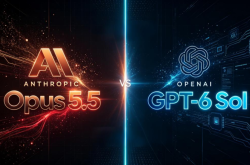
OpenAI and Anthropic Kick Off the 'Model War'
 10/12 2026
 524
524
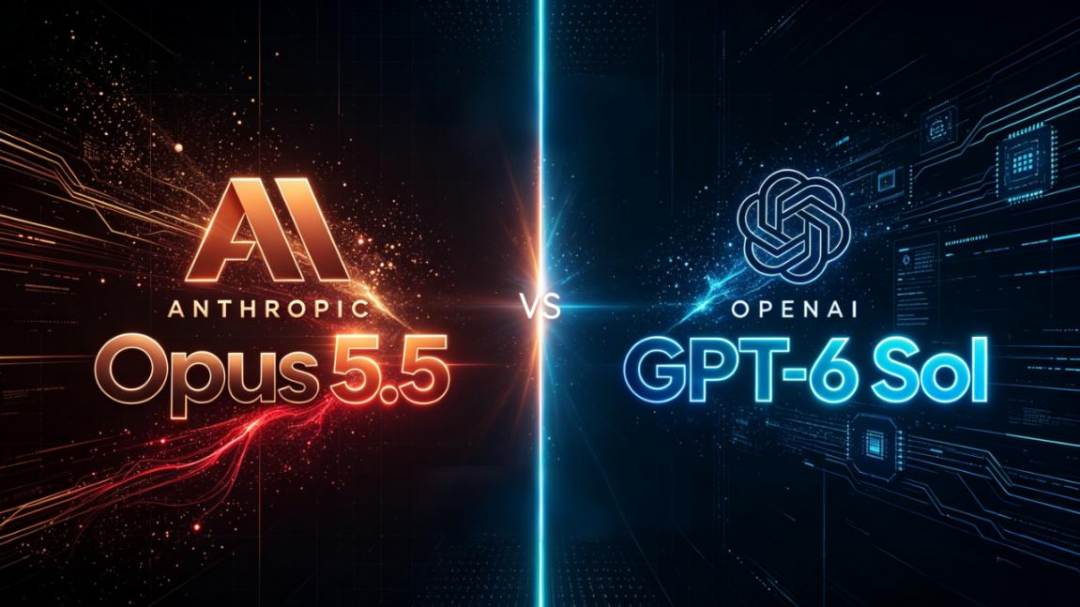

Two Similar Giants, Two Different Paths
Image source | Internet (Please contact us for removal if infringement occurs) Partially AI-generated
On October 7, in San Francisco, two product launches took place on the same day, just minutes apart.
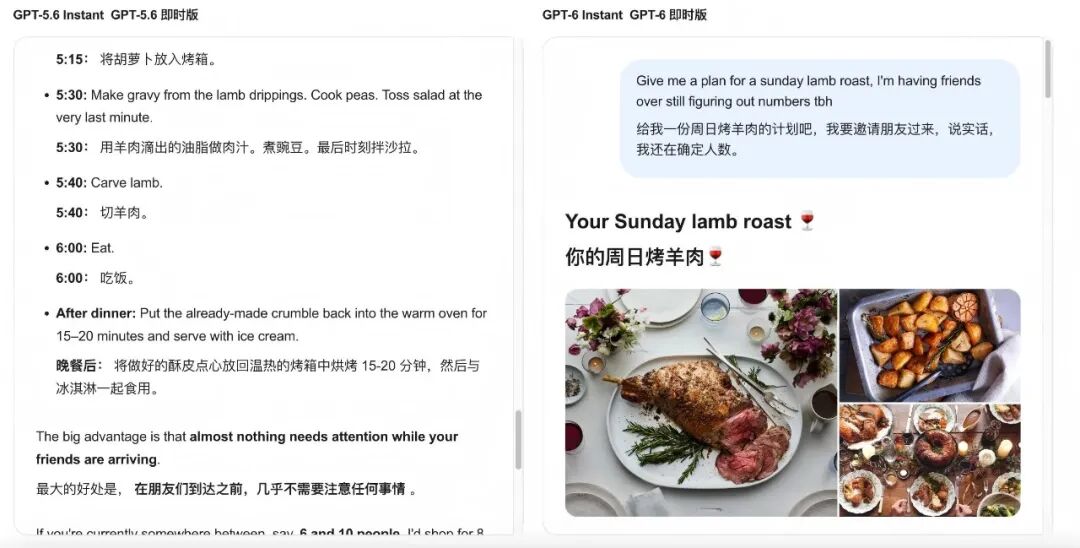
OpenAI introduced GPT-6 and Intelligent UI, transforming ChatGPT's responses from plain text into directly operable interfaces.
Anthropic, on the other hand, released Claude Haiku 5.5, slashing model invocation costs to one-tenth of the previous generation.
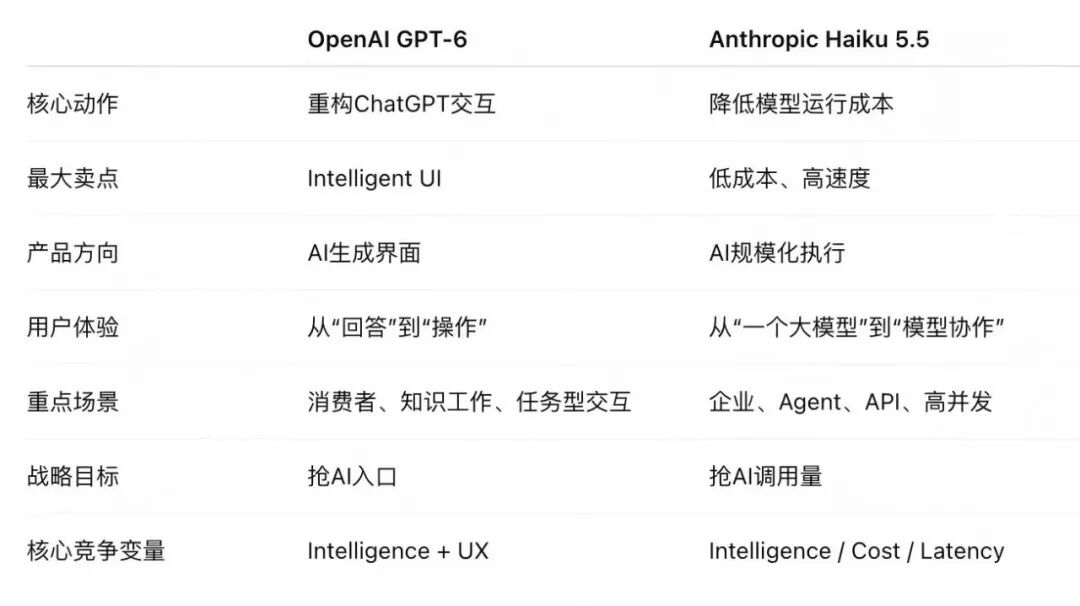
The update directions of the two companies have shown the most significant divergence in recent years: one extends into how AI interacts with users, while the other delves into how AI executes tasks at low cost and large scale.
One focuses on experience, the other on efficiency. Behind these approaches lie two vastly different business judgments, which may determine the competitive landscape of the AI industry in the next two to three years.

ChatGPT No Longer 'Just Talks'
Let's first look at what OpenAI has brought to the table.
GPT-6 has been fully rolled out, covering ChatGPT's over 1.2 billion weekly active users. Paid users get GPT-6 Sol, while free and Go users get GPT-6 Luna, both optimized for everyday conversation scenarios.
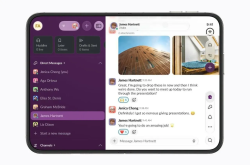
But the real highlight isn't the model itself—it's Intelligent UI.
In the past, using ChatGPT meant getting a text response, maybe with a table or an image attached. Essentially, it was still 'writing for you to read.'
But Intelligent UI changes this logic: it can autonomously decide whether to respond with text, charts, buttons, forms, or complete interactive tools based on the question type.
For example, if you say, 'I want to go camping by car this weekend,' it will directly generate a map marked with stops and detour routes. If you say, 'Help me calculate how much each person should pay for a group dinner,' it will instantly create a small calculator where changing the numbers updates the result in real time.
You can even ask it to generate a small game within the chat window.
This represents ChatGPT's transformation from a 'question-answering chatbot' to a 'work portal capable of instantly generating tools.'
Technically, this interactive capability is based on a native streamable component library and compiler. Interface elements render progressively as the model generates them, without waiting for the full response to load.
This means the interface is no longer 'preset' but 'compiled' on the fly.
Another easily overlooked change: GPT-6 supports 'thinking while answering.' Previously, reasoning models had to finish thinking before outputting anything, leaving users waiting. GPT-6 can start returning content during the reasoning process and supplement it later if needed.
In web search scenarios, the wait time for the first character output is 44% shorter than the previous generation.
This is OpenAI's aggressive bet on the interaction layer: model capabilities are already strong enough; the next challenge is translating those capabilities into things humans can use directly.

Haiku 5.5: The Model That Makes Agents Affordable
On the same day, Anthropic took a completely opposite path.
Claude Haiku 5.5 is the third model in the Claude 5.5 series, following the flagship Opus 5.5 and the mid-range Sonnet 5.5. Haiku 5.5's positioning is clear: high-frequency, low-cost tasks.
The pricing is even more aggressive: for requests under 100,000 tokens, input costs just $0.10 per million tokens, and output costs $0.50 per million tokens—a 90% drop from Haiku 4.5, with average operating costs down about 75%.
But if you only see 'cheaper,' you're missing the point.
The real upgrade in this generation of Haiku is that small models are no longer 'just making do.'
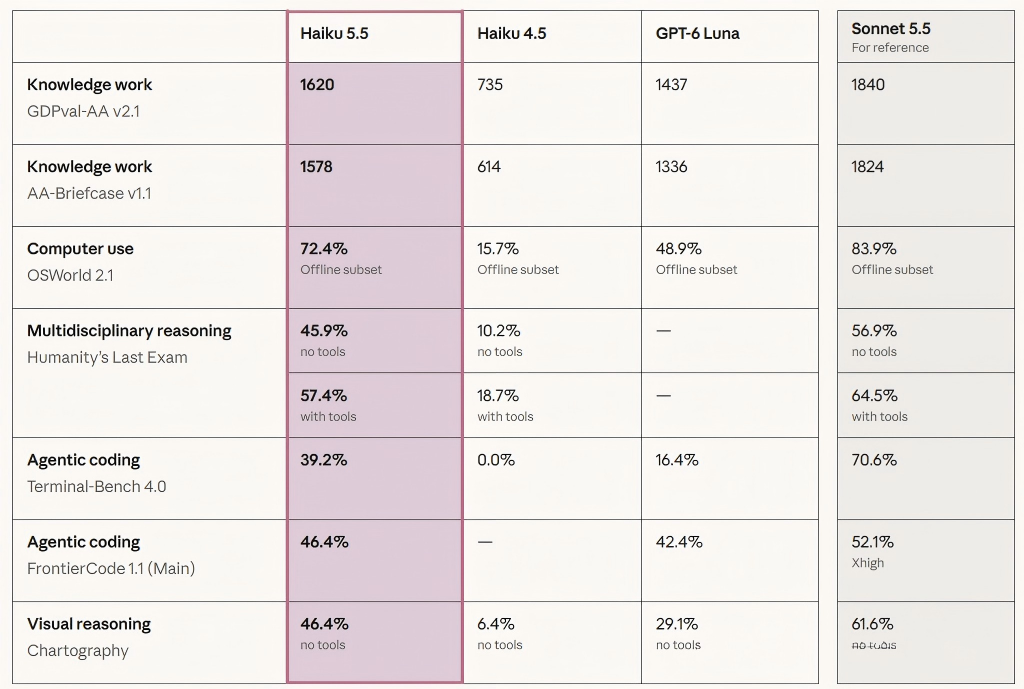
The previous Haiku 4.5 scored 0 on the programming task Terminal-Bench; Haiku 5.5 boosts that to 39.2%. Computer operation test OSWorld jumps from 15.7% to 72.4%, surpassing the comparable GPT-6 Luna (48.9%).
Anthropic also introduced adjustable reasoning intensity for Haiku for the first time, with five levels from Low to Max.
This means developers can flexibly allocate computing power based on task complexity—spending less on simple tasks and more on complex ones.
More noteworthy is the positioning shift. Anthropic explicitly states that Haiku 5.5 can be used as a 'sub-agent' for Opus 5.5 and Sonnet 5.5.
In plain terms: Opus handles 'thinking,' while Haiku handles 'doing.'
In a multi-Agent collaboration architecture, the flagship model handles planning and decision-making, while Haiku takes on specific execution tasks like document organization, computer operations, and data processing.
The cost of one flagship model invocation can now be split into 'one flagship invocation + ten Haiku executions,' with lower total costs.
Anthropic also simultaneously reduced Sonnet 5.5's cache read prices by 50% and offered monthly API credits to Max and Team subscribers.
This isn't just a pricing adjustment for a single model—it's a systemic restructuring of cost structures.

Two Giants, Two Paths
Why did these two companies make such starkly different choices?
To understand this, we must first recognize a trend underway: models themselves are becoming 'commodities.'
OpenRouter data shows that early this year, Anthropic accounted for about three-quarters of enterprise AI spending.
But by September, OpenAI and Anthropic's spending shares had become roughly equal. Enterprises are no longer tied to a single model provider—the 'honeymoon period is over.'
When model capabilities converge and prices keep falling, being 'stronger' is no longer a decisive advantage.
The real competitive variables now are: how models integrate into real workflows and how they complete more tasks at lower costs.
OpenAI's response is to 'move upward.' Since models themselves will become infrastructure, the key is to capture the entry points where users interact with AI.
Intelligent UI transforms ChatGPT into a universal platform capable of generating various tools. The more users rely on this entry point, the higher the migration cost becomes.
Anthropic's response is to 'move downward.' If models are destined to become commodities, then becoming the most efficient model provider is the way to go. By pushing unit task costs to the extreme, large-scale Agent deployments become economically viable.
One captures entry points, the other competes on efficiency. The directions are opposite, but both answer the same question: when models are no longer scarce, where does value lie?
After developments in the first half of 2026, the commercial competition model for Agents is gradually emerging.
Global daily active Agents (DAA) surged from 28.6 million last year to 79.4 million in 2026, with projections reaching 2.2 billion by 2030.
This growth shows that Agents are moving from tech demos to practical productivity tools.
But the core bottleneck for large-scale Agent adoption isn't whether models are smart enough—it's whether they're 'affordable enough.'
Anthropic clearly recognizes this. Haiku 5.5 targets the cost issue at the Agent execution layer, making numerous high-frequency tasks that were previously too expensive to run economically viable for the first time.
Meanwhile, a concept called Harness (the orchestration layer) is starting to be frequently mentioned in the industry.
Simply put, Harness is the intermediary layer between models and business scenarios. It breaks down user requests into task sequences that Agents can execute, dispatches different models for different steps, and ultimately delivers a usable result.
A research report points out that as foundational models rapidly commoditize, the Harness orchestration layer is becoming a high-value new growth pole for industry commercialization.
Whoever can accumulate business workflow and context routing capabilities will be closer to the core barriers of enterprise AI adoption.
This explains why Anthropic is focusing on 'model cost reduction' while OpenAI is building 'interaction entry points'—both giants are essentially laying the groundwork for their respective Agent ecosystems.
OpenAI's foundation is users and data; Anthropic's foundation is cost and efficiency.
Another noteworthy signal: the competition between OpenAI and Anthropic isn't just about model benchmarks—it's about who can capture a larger share of the enterprise market.
About 75% to 85% of Anthropic's revenue comes from enterprise-grade API calls, while over 65% of OpenAI's revenue comes from consumer subscriptions. These revenue structures determine their strategic priorities.

Looking at the bigger picture, this 'model war' also has a grander context.
Anthropic is aiming for an IPO as early as November this year, and OpenAI is likely to go public next year.
Both companies need to prove to Wall Street that they have sustainable revenue streams to justify valuations exceeding a trillion dollars.
This means every product decision and pricing adjustment from now on isn't just a technical choice—it's part of their commercial narrative.
OpenAI needs to prove that its 1.2 billion users aren't just a traffic metric but a scalable commercial ecosystem. ChatGPT's advertising annualized revenue run rate has already reached $1 billion, with consumer-side commercial value being unlocked.
The launch of Intelligent UI, in a sense, also aims to increase stickiness and imagination for this ecosystem.
Anthropic needs to prove that its high-margin enterprise API model can scale. With Haiku 5.5 pushing costs to new lows, Anthropic is essentially telling the market: I'm not just selling models—I'm selling the infrastructure for large-scale Agent operations.
Anthropic already achieved positive adjusted operating profit in Q2 2026, completing the critical transition from loss-making expansion to profitable growth.
This competition is no longer just about technology. It's about who can define AI product forms, who can control AI execution efficiency, and who can first build a sustainable commercial flywheel.
Models remain the foundation, but product design, Agent architecture, and commercialization systems above that foundation will determine the outcome.
Perhaps looking back two years from now, the commercial layout (layout) of 2026—the shift in large model competition from 'whose model is stronger' to 'whose ecosystem is more complete'—will mark the turning point.
As for who will ultimately win, it's too early to say.
-
![]()
AI Drives New Smartphone Trends: Foldable Screens Poised for Mainstream Adoption
-
![]()
Surge in 'Cloud Usage' by Agents Prompts Cloud Providers to Shift Strategies
-
![]()
OpenAI and Anthropic Kick Off the 'Model War'
-
![]()
Revenue Surges to 2.621 Billion with Growth, Yet Profit Slides 15% to 200 Million: How Does Electric Connector Technology Steer Between Consumer Electronics and Automotive Sectors?
-
![]()
Disassembling the iPhone 18 Pro: Apple's 2nm Chip Takes Center Stage, What Chips Are Used in the Supply Chain?
-
Stagnant Growth and Unsuccessful High-End Market Entry: Can Li Xueyong Steer Jetour Back on Course?
-
![]()
Is It Possible to Break a Car's Brake Pedal by Stepping on It Too Hard? Can a Driver Fully Depress the Brakes?
-
![]()
Why Aren't More People in the Industry Talking About 360 After Its All in AI Strategy?