Revenue Surges to 2.621 Billion with Growth, Yet Profit Slides 15% to 200 Million: How Does Electric Connector Technology Steer Between Consumer Electronics and Automotive Sectors?
 10/12 2026
 507
507
Produced by Zhineng Zhixin
In the first half of 2026, Electric Connector Technology's revenue soared to 2.621 billion yuan, marking a 3.82% year-on-year increase. However, its net profit attributable to shareholders dipped to 206 million yuan, a 15.12% decrease from the previous year. This disparity between revenue and profit mirrors the trend observed at Sukerda and is a prevalent phenomenon in the connector industry during the first half of the year.
Electric Connector Technology is not solely reliant on automotive connectors; consumer electronics connectors contributed 1.239 billion yuan in revenue, accounting for 47.29%, whereas automotive connectors brought in 882 million yuan, representing 33.64%. Nearly half of the revenue still originates from consumer electronics, such as mobile phones.
The automotive business's 8.67% growth rate is modest, and the domestic substitution of high-speed connectors represents the most significant variable. R&D investment reached 221 million yuan, constituting 8.44% of revenue, the highest among peers. This short-term profit pressure will ultimately determine whether the company can seize the market segment currently dominated by foreign players, who hold a 92% market share.
Part 1: Financial Snapshot: Revenue Rises, Profit Falls
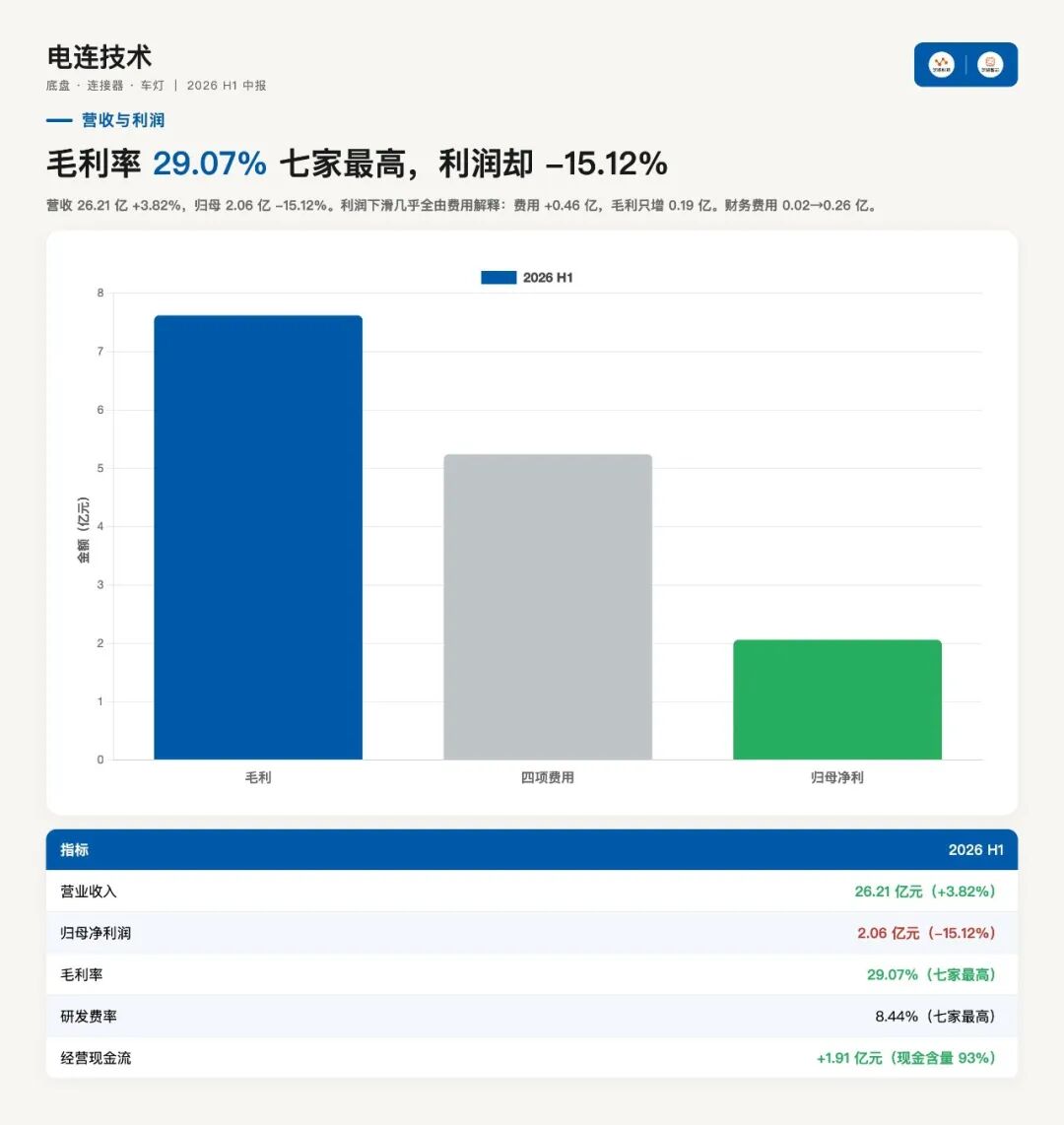
Electric Connector Technology's semi-annual report reveals a numerical paradox.
◎ Revenue reached 2.621 billion yuan, up 3.82% year-on-year, indicating modest growth.
◎ Net profit attributable to shareholders was 206 million yuan, down 15.12% year-on-year, a significant double-digit decline.
Revenue flourishes while profit falters. This scenario is not uncommon in the connector industry during the first half of the year, with Sukerda following a similar pattern. A detailed examination of the three financial statements elucidates the sources of income and expenditure.
◎ Operating costs amounted to 1.859 billion yuan, yielding a gross profit of 762 million yuan and a gross margin of 29.07%, slightly down from 29.41% in the same period last year. At 29.07%, this gross margin is the highest among the seven companies, surpassing the second-place Baolong Technology by 6.6 percentage points.
◎ On the expense front, sales expenses were 83 million yuan, administrative expenses were 194 million yuan, financial expenses were 26 million yuan, and R&D expenses were 221 million yuan, totaling 524 million yuan. These four expenses amounted to 478 million yuan in the same period last year, reflecting an increase of 46 million yuan this year.
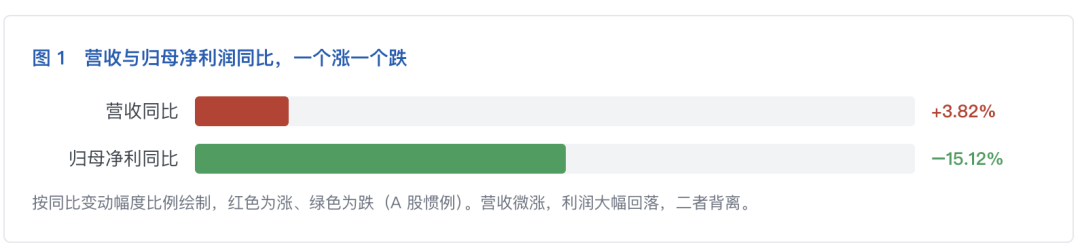
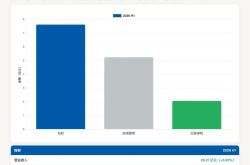
Depicted according to the proportional year-on-year change, red signifies growth, and green indicates decline (a common convention in A-share markets). Revenue exhibits slight growth, while profit experiences a significant decline, diverging from each other.
Financial expenses surged from 2 million yuan to 26 million yuan, an increase of 24 million yuan. The company holds 1.032 billion yuan in cash and has no short-term borrowings. The specific composition requires verification from the financial expense notes and is beyond the scope of inference in this article.
R&D expenses of 221 million yuan, accounting for 8.44% of revenue, represent the highest proportion among the seven companies, aligning with the company's investment in high-speed connectors.
Gross profit of 762 million yuan minus the four expenses of 524 million yuan leaves 238 million yuan;
After accounting for a credit impairment reversal of 3 million yuan, an asset impairment loss of 6 million yuan, and net investment income of 1 million yuan, the operating profit totals 235 million yuan. With income tax of 16 million yuan, the net profit is 217 million yuan. After deducting the minority shareholder's gain/loss of 11 million yuan, the net profit attributable to shareholders is 206 million yuan.
In the same period last year, gross profit of 743 million yuan minus expenses of 478 million yuan left 264 million yuan, with an operating profit of 282 million yuan and net profit attributable to shareholders of 243 million yuan.
◎ Operating profit decreased by 47 million yuan this year, with expenses increasing by 46 million yuan, nearly entirely explaining the difference. Gross profit increased (from 743 million to 762 million yuan), but because expenses rose even more, profit declined instead.
◎ The 15.12% drop in profit is almost entirely attributable to increased expenses. With the highest gross margin among the seven companies, the unit profitability of the main business has not weakened; what has weakened is the pace of R&D investment. This industry-leading gross margin has been offset by another industry-leading R&D expense ratio.
◎ Consumer electronics connectors generated 1.239 billion yuan, accounting for 47.29%. The semi-annual report did not disclose the year-on-year growth rate, but it can be inferred from the total volume that it has declined.
◎ Automotive connectors generated 882 million yuan, accounting for 33.64%, up 8.67% year-on-year. Others generated 500 million yuan, accounting for 19.07%, up 29.25% year-on-year, representing the fastest-growing segment.
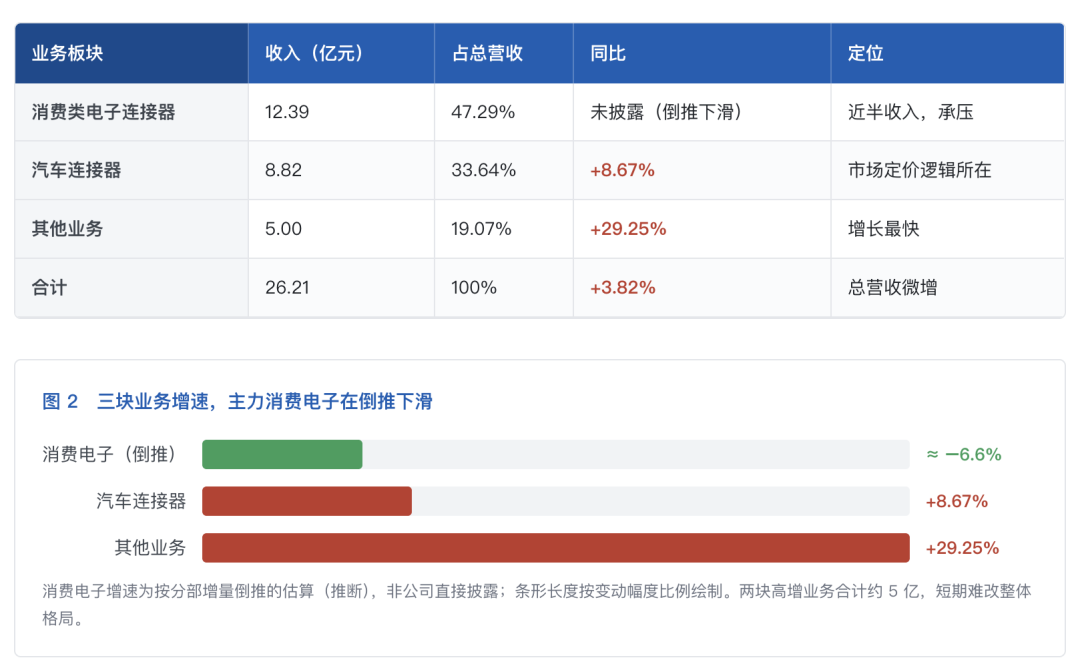
In summary, revenue increased by only 3.82%, with consumer electronics either declining or remaining flat.
Inferring from the disclosed segmental increments in the semi-annual report: Revenue increased by 96 million yuan, with automotive connectors increasing by approximately 70 million yuan and others by approximately 113 million yuan, totaling 183 million yuan. This implies that consumer electronics connectors decreased by approximately 87 million yuan, a decline of about 6.6%.
By region:
◎ Domestic revenue was 2.182 billion yuan, accounting for 83.26%, up 13.08% year-on-year;
◎ Overseas revenue was 439 million yuan, accounting for 16.74%, down 26.23% year-on-year.
Overseas revenue dropped from approximately 595 million yuan to 439 million yuan, a decrease of 156 million yuan. The semi-annual report did not explain the reason.
With domestic revenue up 13.08% and overseas revenue down 26.23%, the combined revenue increased by only 3.82%, with growth entirely dependent on the domestic market and the overseas market dragging it down.
Part 2: Electric Connector Technology's Stance in the Connector Industry
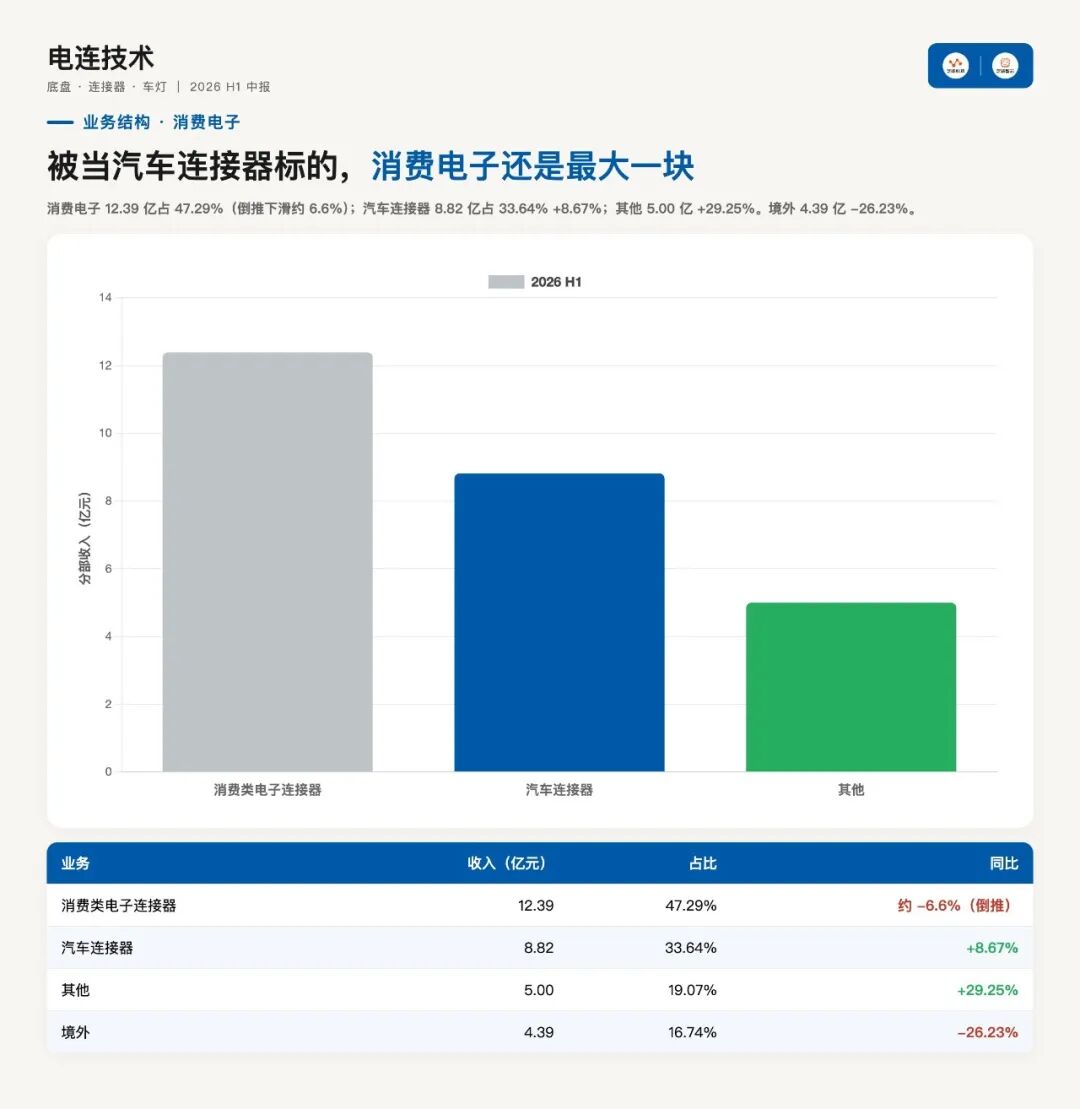
Within the connector industry, Electric Connector Technology boasts the highest gross margin and R&D expense ratio among the seven companies, yet its profit has still declined. This company is utilizing its current profits to foster future domestic substitution.
The 47.29% share of consumer electronics connectors is an unavoidable topic. The market's valuation logic for Electric Connector Technology primarily focuses on automotive connectors due to their high growth rate, vast market space, and compelling narrative.
However, nearly half of the revenue comes from consumer electronics, which is intertwined with the prosperity of smartphones and wearables, experiencing sluggish growth and uncertain gross margins.
From a risk perspective, consumer electronics have a diversifying effect. The automotive business is influenced by vehicle production and sales and annual price reductions, with passenger vehicle production and sales down 6% in the first half of 2026; consumer electronics have their own cycle, and the two are not entirely synchronized.
High-Speed Connectors: The Rationale and Variables of Domestic Substitution
Connectors are categorized into low-voltage, high-voltage, and high-frequency high-speed types.
◎ Low-voltage connectors are utilized for car lights, windows, and sensors, with a low entry barrier;
◎ High-voltage connectors serve the three electric systems, withstanding voltages from 60V to 1000V and currents from 10A to 600A;
◎ High-frequency high-speed connectors are responsible for data transmission, supporting smart cockpits and autonomous driving.
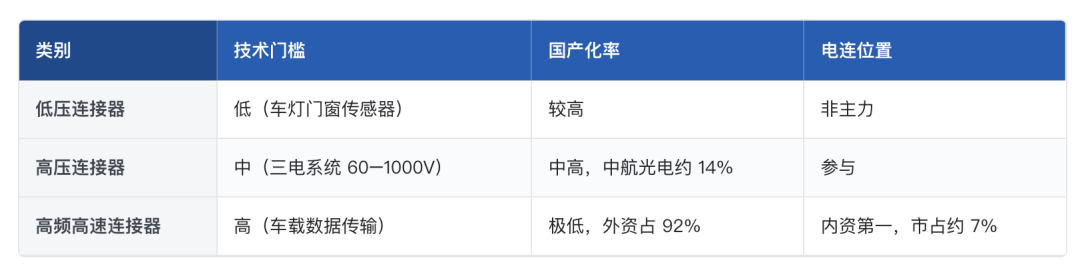
The domestic substitution rates vary significantly. The domestic substitution rate for high-voltage connectors is relatively high, with AVIC Optoelectronics holding about a 14% market share; the domestic substitution rate for high-speed connectors is extremely low, with foreign players holding 92% of the market.
Electric Connector Technology is the domestic leader in high-speed connectors, holding about a 7% market share. Its products cover FAKRA, Mini-FAKRA, HSD, and Ethernet connectors.
The in-vehicle communication architecture is transitioning from FAKRA/HSD to Mini-FAKRA/Ethernet, with Mini-FAKRA supporting 15GHz bandwidth and 28Gbps rates, and Ethernet connectors reaching 25Gbps. This shift provides domestic manufacturers with an opportunity to restart the race.
In terms of market space, the Chinese automotive connector market was about 67.4 billion yuan in 2025 and is expected to grow to 71.3 billion yuan in 2026. Connectors for new energy vehicles are expected to grow from 58 billion yuan in 2025 to 144.3 billion yuan in 2030, with a compound annual growth rate of 20%.
Electric Connector Technology's position: It is the domestic leader in high-speed connectors, but its absolute market share is only 7%, with foreign giants like TE Connectivity, Amphenol, and Molex ahead.
The growth logic is that the high-speed connector market, dominated by foreign players at 92%, will gradually undergo domestic substitution. The speed of this process depends on the willingness of domestic automakers to localize their supply chains.
Customer Structure Determines the Substitution Pace
Electric Connector Technology's main customers are domestic brands such as Geely, Great Wall Motors, BYD, and Changan. Foreign connectors have long been tied to joint ventures and foreign automakers, providing domestic manufacturers with opportunities primarily from domestic brands, especially given their aggressive configurations in intelligence.
◎ The positive aspect is that domestic brands are advancing quickly in intelligence, leading to increased usage and higher specifications of high-speed connectors, allowing suppliers to grow along with them.
◎ The negative aspect is that domestic brands are more aggressive in cost control than joint ventures, with more direct pressure on annual price reductions.
The number of connectors per vehicle indicates the market size. A vehicle uses 800 to 1000 connectors, ranging from low-voltage connectors for car lights and windows to high-voltage connectors for battery packs and motor controllers, and then to high-speed connectors for cameras, radars, and domain controllers. The value per vehicle ranges from several hundred yuan in traditional vehicles to several thousand yuan in smart electric vehicles.
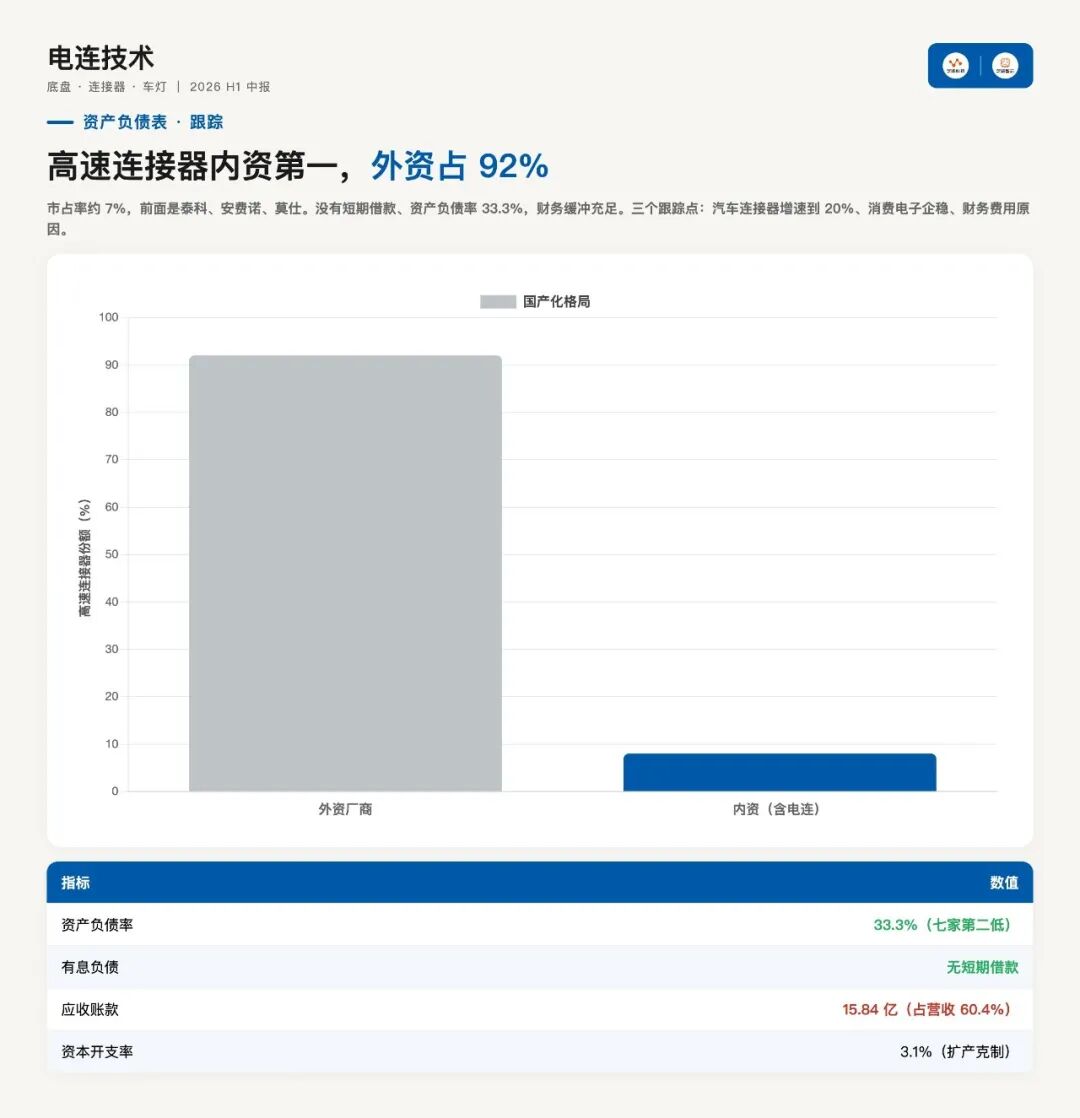
Electric Connector Technology's opportunity lies in high-frequency high-speed connectors. With foreign players holding 92% of the market, there is ample room for substitution, and the pace depends on two variables:
◎ First, how quickly domestic brands upgrade the specifications of high-speed connectors,
◎ Second, whether Electric Connector Technology can produce stable and reliable products for in-vehicle Ethernet connectors above 10Gbps.
The company has invested 221 million yuan in R&D, accounting for 8.44% of revenue, the highest among the seven companies. This investment is primarily directed here.
An R&D expense ratio of 8.44% for a company with 2.6 billion yuan in revenue is a significant burden, putting short-term pressure on profits but determining in the long run whether it can capture the 92% substitution space.
Summary
With the highest gross margin among the seven companies, profit is consumed by expenses. Consumer electronics face pressure, while automotive connectors and domestic substitution determine the direction.
-
![]()
Surge in 'Cloud Usage' by Agents Prompts Cloud Providers to Shift Strategies
-
![]()
OpenAI and Anthropic Kick Off the 'Model War'
-
![]()
Revenue Surges to 2.621 Billion with Growth, Yet Profit Slides 15% to 200 Million: How Does Electric Connector Technology Steer Between Consumer Electronics and Automotive Sectors?
-
![]()
Disassembling the iPhone 18 Pro: Apple's 2nm Chip Takes Center Stage, What Chips Are Used in the Supply Chain?
-
Stagnant Growth and Unsuccessful High-End Market Entry: Can Li Xueyong Steer Jetour Back on Course?
-
![]()
Is It Possible to Break a Car's Brake Pedal by Stepping on It Too Hard? Can a Driver Fully Depress the Brakes?
-
![]()
Why Aren't More People in the Industry Talking About 360 After Its All in AI Strategy?
-
![]()
Li Auto’s September Insurance Registrations: 31,000 Vehicles, with L6 Outpacing i6 to Secure Top Position