Changsha’s Emerging Powerhouse in Computing: Cancels RMB 3 Billion Contract!
 10/13 2026
 543
543
On the evening of October 12, Xingyun Technology revealed that its wholly-owned subsidiary, Shenzhen Xingyun, had terminated a previously signed computing power service agreement worth RMB 3.053 billion with a VB client.
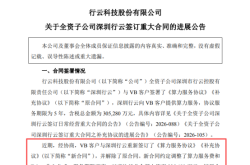
The primary driver behind this move was the client’s pressing need to expand its computing power service orders. According to the announcement, the revised contract introduces adjustments to computing power service fees and Token revenue sharing, while keeping the service period unchanged. The total agreement value has now risen to RMB 3.357 billion.
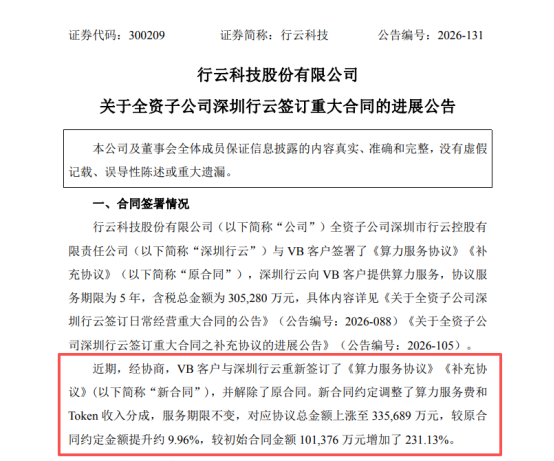
This isn’t the first time the contract has been revised. Earlier this year, the initial agreement was valued at RMB 1.014 billion, involving the delivery of 128 computing power units. By the end of July, the VB client sought to expand its business operations, doubling the number of units to 256 and raising the unit price. Consequently, the contract amount soared to RMB 3.053 billion, marking a 201% increase from the original.
The October 12 version marks the third iteration, now valued at RMB 3.357 billion, representing a 9.96% increase from the previous version and 2.3 times the original amount.
In just six months, the same computing power contract has escalated from the RMB 1 billion range to the RMB 3.3 billion range. The numerical surge mirrors the pricing patterns observed during peak market conditions.
On October 13, at the market close, Xingyun Technology’s stock price surged by over 9% during intraday trading, eventually closing at RMB 35.75, up 6.56% for the day. Its total market capitalization reached RMB 33.2 billion, with a price-to-book ratio just over 35 times and a trailing price-to-earnings ratio still negative.
However, a more noteworthy detail in this adjustment than the price hike itself is the new contract’s fee structure. The charges for the remaining 216 units are now split into two parts: the fixed service fee has been reduced by 11.11%, while the fixed Token revenue sharing has surged by 210%. Through this strategic increase and decrease, Xingyun Technology clearly signals its intent to diversify revenue streams beyond computing power rentals, incorporating Token sharing.
Soochow Securities previously predicted that computing power leasing companies are transitioning from bare computing power rentals to model services or Token revenue sharing—essentially shifting from selling computing power to selling Tokens. Xingyun Technology’s inclusion of Token revenue sharing in a major commercial contract has led many media outlets to label it as the first A-share stock with Token revenue sharing, as it is currently the only company to formally announce this mechanism through an exchange and incorporate it into a contract.
The announcement explicitly states that the Token revenue sharing is a fixed amount and does not fluctuate with the client’s actual Token business revenue. In other words, Xingyun Technology receives a locked-in, monthly fixed sharing that remains unaffected by the client’s actual usage. For Xingyun, this provides certainty but also limits the potential for additional future earnings.
So, why is the client willing to continuously increase prices? The most direct answer lies in delivery. The announcement states that Shenzhen Xingyun has already delivered 40 units, and the VB client has acknowledged its performance capability, leading to negotiations on increasing the prices of existing orders based on market conditions and service quality. This is a five-year long-term contract, providing guarantees for the next five years.
The contrast is striking. Financial reports reveal that Xingyun Technology’s full-year revenue in 2025 was only RMB 145 million, and in the first half of 2026, it was RMB 254 million. Its predecessor was Youkeshu, a cross-border e-commerce company that once teetered on the brink of delisting before renaming itself Xingyun Technology in February this year.
Now, the computing power orders it holds, with a five-year framework order scale of RMB 16.004 billion as of September 21, include clients such as V customer, VB customer, VC customer, as well as leading central enterprises and top-tier large model manufacturers.
A company with less than RMB 200 million in revenue last year is now charging ahead with over RMB 10 billion in orders, with its stock price surging 555% year-to-date, transforming from a delisting candidate to a rising star in computing power in the eyes of institutions.
Supporting these expectations is its performance. On October 8, the company issued a forecast for the first three quarters, projecting a net profit attributable to shareholders of RMB 240 million to RMB 290 million, turning a year-on-year loss into a profit. The third quarter alone contributed RMB 228 million to RMB 278 million in profit, five to seven times higher than the second quarter’s RMB 34 million.
Behind the term “rising star,” the announcement itself lists two risks. The first is procurement and supply, with the timely arrival of equipment and accessories subject to supply and demand, policies, and supply chain impacts. The second is funding, as the total contract amount is substantial, with significant procurement and operational expenses and rapid asset expansion. If financial institution credit falls short of expectations, contract performance progress may be compromised.
Xingyun Technology has left a loophole in the contract: it retains ownership and control of the hardware, which can be transferred to financial leasing companies or used for mortgage or pledge financing. This shifts some of the pressure from heavy assets to off-balance-sheet and financing channels. No matter how impressive the orders look on paper, ultimately, it depends on whether the company can secure financing and deliver the goods.
More substantial than signing additional billions in contracts, Xingyun Technology’s real transformation over the past six months is that it has moved from a computing power plus Token revenue sharing business model on PowerPoint slides to formal contracts, also securing endorsement from state-owned assets on the production capacity side.
-
![]()
Who is Taking Away the Profits of Car Companies: Battery or Intelligent Driving?
-
![]()
Tencent Successively Discontinues Two AI Agents
-
![]()
Has the Brake Pedal of JAC Motors Really Broken? The Market Will Teach Every Automaker with 'Fatal Flaws' a Lesson
-
![]()
Changsha’s Emerging Powerhouse in Computing: Cancels RMB 3 Billion Contract!
-
![]()
Production Capacity Can’t Keep Up with Orders! This Optical Enterprise Soars 449% on Debut
-
![]()
Q3 Report | Yuanjie Technology's Net Profit Expected to Surge Fivefold, Transitioning from 'Shortage Dividends' to 'Delivery Challenges'
-
![]()
The Computing Power Price War Hits Silicon Valley
-
![]()
The AI Office Sector is Forming a 'Three-Pillar' Landscape