Q3 Report | Yuanjie Technology's Net Profit Expected to Surge Fivefold, Transitioning from 'Shortage Dividends' to 'Delivery Challenges'
 10/13 2026
 427
427

Author|Ren Tianqin
Editor|Chen Xiaoran
Quarter-on-Quarter Profit Growth Stalls
The AI computing boom has finally reached the upstream optical chip sector.
In the third quarter of 2026, Yuanjie Technology (688498.SH) continued to see revenue growth, with profit surging year-on-year but stalling quarter-on-quarter.
The business is gradually shifting from 'shortage dividends' to a 'delivery capacity test.'
Quarter-on-Quarter Profit Growth Stalls
On October 13, Yuanjie Technology released its Q3 2026 earnings preview.
Quarterly revenue is expected to reach RMB 650 million to RMB 700 million, up 264.56% to 292.60% year-on-year; net profit attributable to shareholders is expected to reach RMB 403 million to RMB 453 million, up 578.85% to 659.70% year-on-year; core net profit (excluding non-recurring items) is expected to reach RMB 400 million to RMB 450 million, up 678.44% to 775.74% year-on-year.
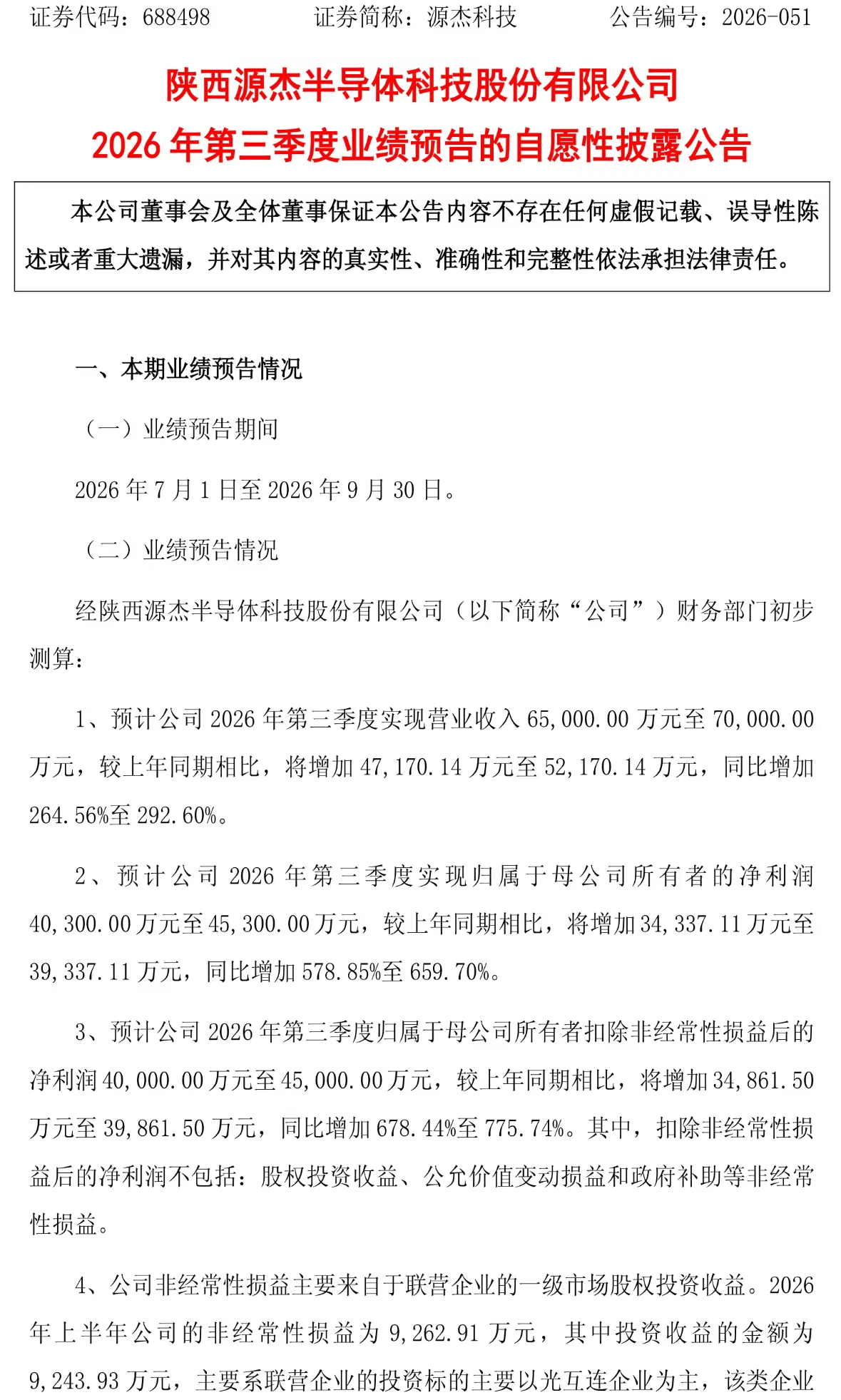
Image Source: Yuanjie Technology Announcement
At first glance, these are impressive results. In the same period of 2025, Yuanjie Technology's net profit attributable to shareholders was just RMB 59.6289 million, while the lower bound of Q3 2026 profit already exceeds RMB 400 million.
More notably, non-recurring items had minimal impact in Q3 2026, with profits primarily driven by core operations rather than investment gains.
However, a closer look reveals a different picture.
In Q2 2026, Yuanjie Technology reported revenue of RMB 570 million and net profit attributable to shareholders of RMB 428 million. Based on the preview range, Q3 revenue grew approximately 14% to 23% quarter-on-quarter, while net profit attributable to shareholders remained flat, declining by about 6% to rising by about 6%. In other words, the company is selling more, but profits are not surging accordingly.
The Q2 2026 net profit margin reached 75.04%, while Q3 is estimated at approximately 62% to 65% based on the preview. While still remarkable, this is no longer as steep as in Q2.
The real question for the market is no longer whether Yuanjie Technology can achieve high growth this year, but how long such exceptionally high profitability can last.
The announcement clearly attributes growth to continued expansion in data center business, strong demand for CW laser chips, and a higher proportion of high-margin products.
At the same time, scaling operations have diluted costs. This includes both the value of product upgrades and temporary dividends from supply-demand tensions, which should not be conflated.
A Single Chip
Yuanjie Technology originally relied heavily on the telecom market. Its 2.5G and 10G laser chips served access networks and mobile communications, with relatively stable demand and intense competition.
After the rise of AI data centers, Yuanjie Technology swiftly shifted its focus to high-speed optical communications. The product truly transforming its profit statement is the CW continuous-wave laser chip.
CW chips do not modulate data themselves but provide a stable light source for silicon photonics engines. In the 800G and 1.6T eras, optical modules must not only be faster but also control power consumption, size, and cost, making silicon photonics solutions more attractive and boosting demand for external CW light sources.
This transition goes beyond mere 'sampling.'
In the first half of 2026, Yuanjie Technology's data center business revenue reached RMB 774 million, up 640.29% year-on-year, accounting for about 83.69% of total revenue; telecom business revenue reached RMB 148 million, up 48.63% year-on-year.
70mW and 100mW CW chips have entered mass production, with 100G EML chips also starting bulk deliveries.
In the first half of 2026, Yuanjie Technology achieved revenue of RMB 925 million and net profit attributable to shareholders of RMB 607 million, up 351.40% and 1212.20% year-on-year, respectively. Data centers are no longer a secondary growth driver but the primary source of revenue and profit.
Yuanjie Technology's strength lies in its established IDM (Integrated Device Manufacturer) system, covering chip design, epitaxy, wafer fabrication, and processing testing. Unlike standard components, optical chips require long customer validation cycles and strict demands on power, coupling efficiency, temperature adaptability, and reliability.
Once integrated into a top client's supply chain, short-term replacement is unlikely, but manufacturers must consistently maintain yield and delivery stability.
This is Yuanjie Technology's most valuable asset today—not just proposing a silicon photonics story but already generating revenue from high-power CW chips and converting scarce capacity into profits.
The problem lies precisely here. With data center business accounting for over 80% of revenue, performance increasingly relies on a few high-demand products. Fluctuations in customer purchasing patterns, product validation, wafer yields, or capacity ramp-ups will quickly reflect in quarterly profits.
After the Dividends
Industry demand remains strong for now. Yuanjie Technology stated in its 2026 interim report that while 800G optical modules are shipping at scale, 1.6T products saw significant volume growth in the first half of 2026, with silicon photonics penetration continuing to rise in 1.6T solutions.
Citing LightCounting forecasts, the report noted that the global Ethernet optical module market is expected to grow 35% year-on-year in 2026, reaching USD 18.9 billion, with double-digit growth likely from 2027 to 2030, potentially surpassing USD 35 billion by 2030.
This creates a rare window for domestic optical chipmakers. Historically, high-speed laser chips were dominated by overseas manufacturers, but with rapid downstream order growth and relatively cautious expansion of overseas indium phosphide capacity, optical module makers naturally seek more local suppliers.
Yuanjie Technology, having completed validation and mass production first, is capturing not just industry expansion but also a larger share of supply chain localization.
However, 'shortages' are never a permanent moat.
High profits are attracting more manufacturers to expand production, with domestic peers' CW and EML products also undergoing validation and volume shipments. Yuanjie Technology's 2026 interim report already disclosed plans for 'new capacity expansion,' indicating preparations for increased supply.
Over the next one to two years, supply growth is almost certain. Once the supply-demand gap narrows, chip prices, customer bargaining power, and gross margins may normalize.
Today's net profit margin exceeding 60% is better viewed as a result of peak industry conditions rather than a sustainable norm for years to come.
Technological routes are also evolving. While silicon photonics and pluggable modules remain dominant for now, CPO and NPO are advancing in higher bandwidth density scenarios. They may not eliminate CW light sources but could alter light source quantities, packaging forms, and value distribution.
Yuanjie Technology must continue investing in higher-power CW chips, 200G-class high-speed chips, and next-generation products to maintain its lead in customer validation.
Thus, the most valuable takeaway from Yuanjie Technology's Q3 results is not just 'fivefold profit growth.'
On one hand, CW chips have completed a commercial closed loop from product to revenue to profit; on the other hand, while revenue continues to rise, stalling quarter-on-quarter profit growth suggests the most lucrative phase of growth may not be infinitely replicable.
Beyond growth rates, three questions matter more: Can high-power products like 100mW sustain volume shipments? Can new customers convert into stable orders? Can gross margins hold after capacity expansion?
Yuanjie Technology has proven it seized this round of AI optical interconnect opportunities. The next test is whether it can turn temporary scarcity into long-term competitiveness amid peer expansion, technological shifts, and customer price pressures.
-
![]()
Has the Brake Pedal of JAC Motors Really Broken? The Market Will Teach Every Automaker with 'Fatal Flaws' a Lesson
-
![]()
Changsha’s Emerging Powerhouse in Computing: Cancels RMB 3 Billion Contract!
-
![]()
Production Capacity Can’t Keep Up with Orders! This Optical Enterprise Soars 449% on Debut
-
![]()
Q3 Report | Yuanjie Technology's Net Profit Expected to Surge Fivefold, Transitioning from 'Shortage Dividends' to 'Delivery Challenges'
-
![]()
The Computing Power Price War Hits Silicon Valley
-
![]()
The AI Office Sector is Forming a 'Three-Pillar' Landscape
-
![]()
The 'Proxy War' Ignited by Meta Muse Has Both ByteDance and Tencent on Edge
-
![]()
As AI Heats Up, Computer Sales Face Challenges