Valuation Soars to $50 Billion: Is Moonshot AI Paving the Way for a Hong Kong IPO?
 10/14 2026
 529
529
Produced by Leida Finance. Authored by Zhou Hui. Refined by Meng Shuai.
On the brink of its Hong Kong Initial Public Offering (IPO), Moonshot AI, a frontrunner among China's AI large model firms, is actively 'clearing the path'.
On October 12, IT Home, citing Reuters, reported that Moonshot AI's leadership is in negotiations with shareholders to settle legal disputes with shareholder Recurrent.ai (Recurrent Intelligence) prior to the IPO.
It has come to light that Recurrent.ai and certain investors have alleged that Moonshot AI's CEO, Yang Zhiling, and Chief Technology Officer, Zhang Yutao, made misleading statements to Recurrent's investors, personally benefited at Recurrent's expense, and are now seeking compensation equivalent to 10.5% of Moonshot AI's original shares.
Just earlier in October, Bloomberg, drawing on insider sources, revealed that Moonshot AI is advancing its plans for a Hong Kong listing in the first quarter of the upcoming year. The company has secured its final pre-IPO funding, with its valuation soaring to an estimated $50 billion.
Simultaneously, Moonshot AI's commercialization efforts are gaining momentum. Insider sources disclosed that Moonshot AI's Annual Recurring Revenue (ARR) exceeded the $1 billion milestone in August.
On September 11, Bloomberg further reported that, buoyed by the success of the Kimi K3 model, Moonshot AI aims to multiply its annualized revenue to $2 billion by the year-end.
Fascinatingly, should Moonshot AI successfully list on the Hong Kong stock exchange, it will engage in a 'mentor-apprentice duel' with Zhipu, hailed as the 'pioneer global large model stock'.
It's noteworthy that Zhipu's founder, Tang Jie, was Yang Zhiling's professor during his undergraduate years at Tsinghua University. Tang once lauded Yang as the 'most exceptional and talented student he had encountered in recent times'.
Valuation Skyrockets to $50 Billion, with 'Path Clearing' Efforts Underway Before IPO
On October 12, IT Home, again citing Reuters, reported that Moonshot AI's executives are in talks with shareholders to resolve a legal dispute before the IPO, where the shareholder has accused company leaders of misconduct and is seeking redress.
Based on a letter from Recurrent.ai's (Recurrent Intelligence) legal representatives to Moonshot AI's investors, dated March 11 and obtained by Reuters, Recurrent.ai, an AI software developer, and some of its investors accused Moonshot AI's CEO, Yang Zhiling, and CTO, Zhang Yutao, of misleading Recurrent's investors and enriching themselves at Recurrent's cost.
The letter highlighted that in 2022, following Zhang Yutao's resignation as a director of Recurrent, she acquired a 'substantial stake' in Moonshot AI, a fact 'deliberately concealed' from Recurrent's shareholders.
Furthermore, the letter alleged that servers containing crucial large language model data were unauthorizedly transferred from Recurrent to a Moonshot AI subsidiary, though no evidence was provided to support this claim.
In response, Recurrent and its investors are demanding compensation equivalent to 10.5% of Moonshot AI's original shares. According to Reuters, Recurrent had acquired a 9.5% stake in Moonshot AI at its inception.
Regarding these allegations, Moonshot AI declined to comment, while Recurrent remained unresponsive, as per IT Home.
Tianyancha data reveals that Recurrent.ai's affiliate, Beijing Ruikelun Intelligent Technology Co., Ltd., established in 2016, is a member of Recurrent Intelligence. The company's de facto controller is Chen Qicong.
Presently, Yang Zhiling serves as the company's director and manager, with Zhang Yutao as a director. Chen Qicong, Yang Zhiling, and Zhang Yutao each hold a 27.19% stake in the company and are its beneficial owners.
Rewinding to November 2024, a report by 36kr's Waves indicated that Yang Zhiling and Zhang Yutao faced arbitration from some investors of Recurrent Intelligence, a company they had co-founded. These investors included GSR Ventures, EM Ventures, Boyu Capital, Huashan Capital, and Wanwu Capital.
Sources close to the matter told Waves that the arbitration might have been triggered by Yang Zhiling, Zhang Yutao, and others initiating funding and establishing Moonshot AI before securing waivers from several Recurrent Intelligence investors.
At that time, David Morrison, the attorney representing Moonshot AI, stated that 'the matter lacks both legal and factual basis' and that they would defend against it legally.
In December of the same year, Yang Zhiling also publicly responded that he had obtained signed consent from every director and completed all necessary procedures before embarking on his new venture.
Notably, in early September of this year, according to LatePost, Moonshot AI confidentially submitted its A1 filing to the Hong Kong Stock Exchange, officially commencing the Hong Kong IPO process.
In early October, Bloomberg, citing insider sources, reported that Moonshot AI had completed its final pre-IPO private funding round, with a valuation of approximately $50 billion, and planned to go public in Hong Kong in the first quarter of the next year.
The sources also disclosed that Moonshot AI intends to raise up to $5 billion in this transaction and has appointed Bank of America Group as the lead coordinator, with China International Capital Corporation, Deutsche Bank, and Goldman Sachs Group as the sponsor banks.
Some analysts believe that while the aforementioned disputes are unlikely to derail Moonshot AI's IPO plans, the unresolved controversy with Recurrent may raise governance, ownership, and disclosure concerns for potential investors, complicating the listing process.
ARR Exceeds $1 Billion, Launches 'Moon Landing Plan'
Behind Moonshot AI's valuation surge to $50 billion lies its remarkable commercialization achievements.
In mid-July, Moonshot AI officially unveiled its new-generation large model, Kimi K3. According to its official website, Kimi K3 is the first open-source model to reach a 2.8 trillion parameter scale.
Built on KDA Hybrid Linear Attention and Attention Residuals technology, the model inherently supports visual understanding and boasts a context window of 1 million Tokens.
In the frontend development rankings updated by Arena on July 16, Kimi K3 secured the top spot with a high score of 1679, surpassing Claude Fable 5's 1631 and GPT-5.6 Sol's 1618.
According to Artificial Analysis, Kimi K3 costs an average of $0.94 to complete a task, placing it in the same league as GPT-5.6 Sol's $1.04 and only half of Opus 4.8's cost.
With its outstanding performance, Kimi K3 swiftly attracted a vast user base and even encountered a 'computing power shortage' at one point.
On July 19, the Kimi team announced that since the launch of Kimi K3, it had received overwhelming support but also faced unexpected computing power challenges. User requests had surged beyond the team's projections in the past 48 hours, nearing the limits of the existing cluster's capacity.
To ensure the experience of existing subscribers, the Kimi team decided to halt new C-end user subscriptions from that day onward, allocating all available computing power to serve existing subscribers and safeguard their full rights without compromise.
According to a September 11 report by Bloomberg, thanks to the 'groundbreaking' success of the Kimi K3 model, Moonshot AI plans to multiply its annualized revenue to $2 billion by the year-end, further intensifying competition with rivals such as Anthropic and Zhipu.
Prior to this, insider sources had revealed that Moonshot AI had informed investors that its ARR had surpassed the $1 billion mark in August, a significant leap from $300 million in June.
Additionally, in late August, reports surfaced that Moonshot AI was negotiating revenue-sharing agreements with Microsoft, Amazon, and Google, having these U.S. cloud providers host the Kimi K3 model and share revenue based on model usage. According to the reports, Moonshot AI was seeking a revenue-sharing ratio of up to 30%.
Notably, on September 10, Moonshot AI officially launched its 'Moon Landing Plan', exploring avenues to extend model monetization to on-site delivery.
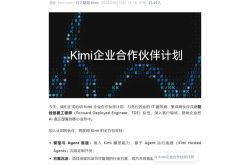
A post on Moonshot AI's Kimi official WeChat account stated that the plan involves collaborating with IT service providers and integrators from various industries to establish a team of Forward Deployed Engineers (FDEs) who will work on-site with clients to facilitate genuine AI deployment in their core businesses.
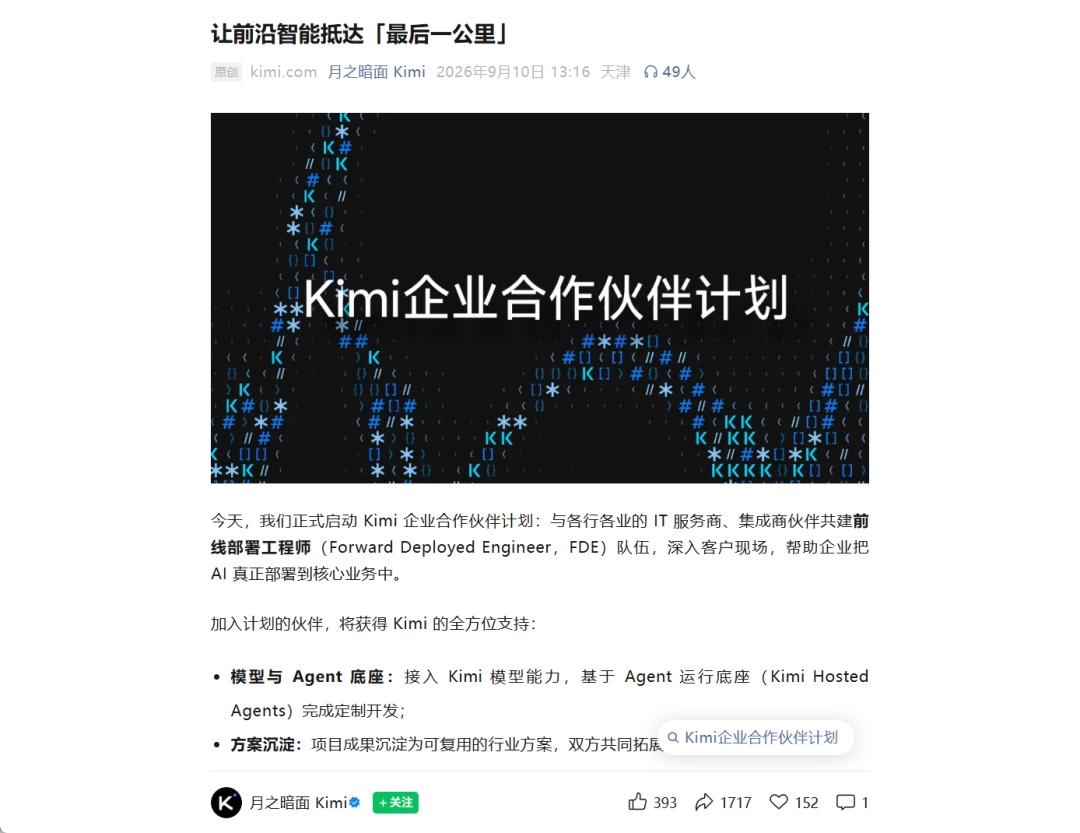
It's reported that the FDE model was pioneered by U.S. big data company Palantir, and Moonshot AI is the first large model company in China to adopt the FDE model for AI end-deployment.
According to Moonshot AI, partners such as Teamsun, Kingsoft Cloud, Yakang Inc., AsiaInfo Technologies, and Chinasoft International have already joined the 'Moon Landing Plan'.
Backed by Two AI Titans, Will the Tsinghua Mentor-Apprentice Duo Clash in Hong Kong?
Leida Finance observed that if Moonshot AI proceeds with its public listing as planned, it will directly compete with Zhipu, dubbed the 'pioneer global large model stock'.
Interestingly, Zhipu's founder, Tang Jie, was Yang Zhiling's professor during his undergraduate studies at Tsinghua University. Despite their mentor-apprentice bond, they have now become rivals in the AI landscape.
According to China Entrepreneur, during his sophomore year, Yang Zhiling, an outstanding student, joined Tang Jie's laboratory and swiftly became a core member, proposing a series of optimization algorithms that enhanced computing performance by dozens of times and were adopted by companies such as Tencent, Sina, and Huawei.
At Yang Zhiling's defense for the Tsinghua Special Scholarship, Tang Jie, as his recommending mentor, commented, 'Without a doubt, Yang Zhiling is the most exceptional and talented student I have seen in recent years.'
After completing his undergraduate and master's degrees at Tsinghua, Yang Zhiling pursued his Ph.D. at Carnegie Mellon University's (CMU) Language Technologies Institute (LTI), under the supervision of Russ, a senior professor in CMU's Machine Learning Department.
'He possesses great ambitions and always takes on the toughest challenges,' Russ said of Yang Zhiling, praising his technical pursuit, independent thinking, and strong autonomy and execution. 'Zhiling's research is primarily his own ideas, which he swiftly implements after discussing with me.'
In 2019, Tang Jie co-founded Zhipu. Four years later, Yang Zhiling, after completing his studies abroad, founded Moonshot AI, and the mentor-apprentice duo both ventured into the domestic large model arena.
In January 2026, Zhipu took the lead in listing on the Hong Kong stock market. In the first half of the year, Zhipu reported revenue of 954 million yuan, a year-on-year increase of 399.74%, and a net loss attributable to the parent company of 2.071 billion yuan, a year-on-year narrowing of 11.9%.
According to Zhipu, as of the end of August, the company's ARR reached $1.6 billion (August revenue multiplied by 12). Using a more aggressive calculation (recent weekly revenue multiplied by 52), its ARR would exceed $2 billion.
At an investor conference call on September 16, Zhipu further raised its year-end ARR target from the previous $2.4 billion to $3 billion, a 25% increase. Meanwhile, management revealed that the company's full-business ARR had reached $1.8 billion.
In terms of products, on August 26, Zhipu officially launched and open-sourced GLM-5.3-Flash, the first native multimodal model in the GLM-5 series.
According to Zhipu, GLM-5.3-Flash scored 57 in the globally authoritative Artificial Analysis Intelligence Index (AA Comprehensive Intelligence Index), entering the global cutting-edge model capability range and matching Anthropic's most popular model, Claude Opus 4.8. In Zhipu's self-developed Z.ai Code Bench perceptual evaluation, its programming performance was comparable to Claude Opus 4.8.
On September 18, Zhipu announced the launch of GLM-5.3-FlashX, with its API fully open. The new version's inference speed can reach up to 200 Tokens/s, five times faster than the existing GLM-5.3-Flash.
According to IT Time, citing Nomura Securities, Moonshot AI plans to launch Kimi K3.1 in mid-October, focusing on enhancing the model's ability to continuously perform long-duration tasks through agents.
Additionally, Moonshot AI is training an even larger model with an estimated 5 to 6 trillion parameters, the previously rumored Kimi K4.
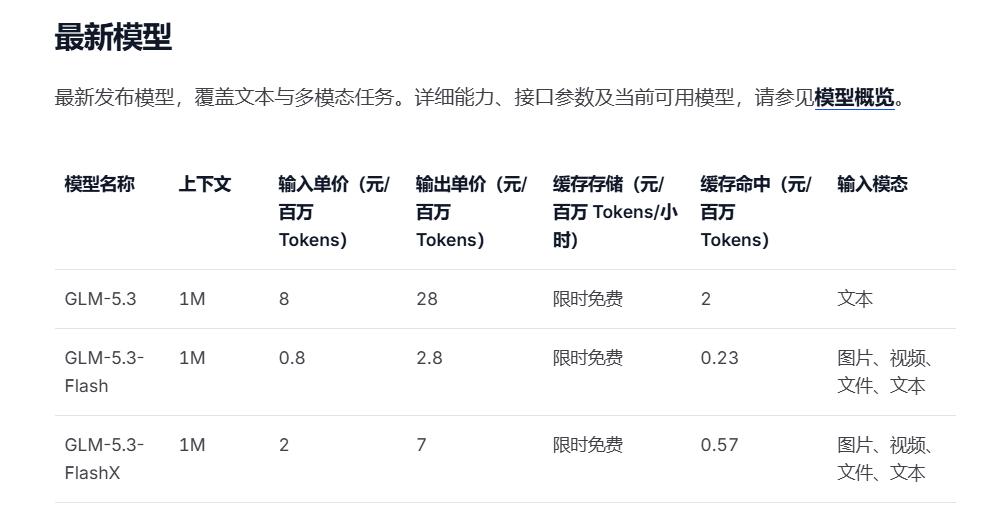
In terms of API pricing, Zhipu and Moonshot AI have adopted vastly different strategies. Zhipu has opted for price cuts: as a product comparable to Claude Opus 4.8, GLM-5.3-Flash is priced at just 1/40th of the former's cost.
Official website information shows that GLM-5.3-Flash costs 0.8 yuan/million Tokens for input, 2.8 yuan/million Tokens for output, and 0.23 yuan/million Tokens for cache hits.
The higher-performing GLM-5.3-FlashX is priced 2.5 times that of GLM-5.3-Flash.
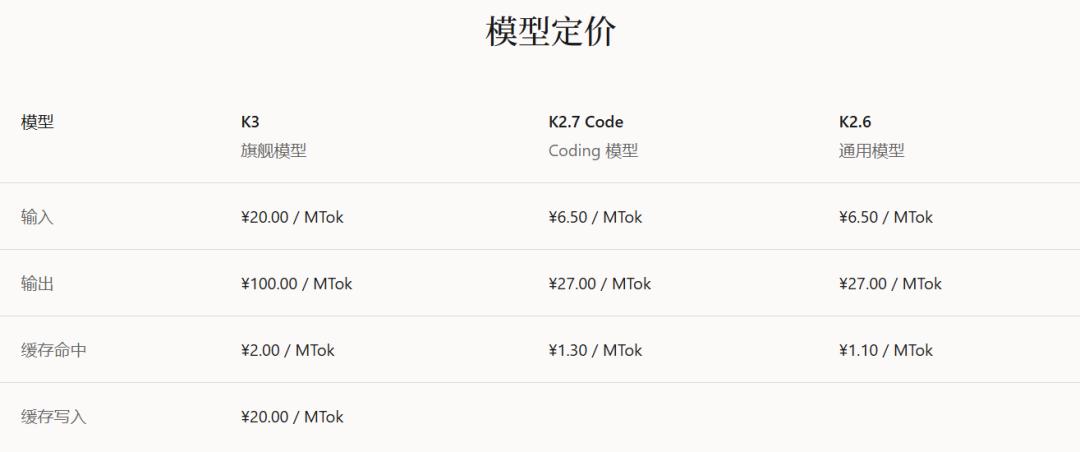
In comparison, Moonshot AI's API pricing is relatively higher, with its K3 flagship model costing 20 yuan/million Tokens for input, 100 yuan/million Tokens for output, 2 yuan/million Tokens for cache hits, and 20 yuan/million Tokens for cache writes.
Whether Tang Jie and Yang Zhiling, the mentor-apprentice duo, will face off in Hong Kong and what sparks will fly between their companies in the large model arena remains to be seen. Leida Finance will continue to follow the unfolding story.
-
![]()
Why Does Jingneng Look Abroad for Chips After Installing 300,000 Modules in Vehicles?
-
![]()
Hello World: Key Highlights of Hello's Revolutionary Generative Driving World Model
-
![]()
Final Verdict: 'Golden September' Falters, 'Silver October' Loses Luster as Domestic Auto Market Remains Under Pressure
-
6G on the Brink of Commercialization: The Interplay of Policy, Technology, and Market Forces
-
![]()
Valuation Soars to $50 Billion: Is Moonshot AI Paving the Way for a Hong Kong IPO?
-
![]()
A pure electric range of 1,008 kilometers: BYD's Da Han officially hits the market, priced between RMB 235,900 and RMB 275,900
-
![]()
Vehicle Exports Set to Top 10 Million Units, CAAM: Auto Market 'Cooling Down Domestically, Heating Up Internationally'
-
![]()
25+ Chinese Brands Make Their Debut at the Paris Auto Show! China's Automobile Industry Embarks on a Systematic Global Expansion, Shifting the Offensive and Defensive Dynamics Between Chinese and Euro