Vehicle Exports Set to Top 10 Million Units, CAAM: Auto Market 'Cooling Down Domestically, Heating Up Internationally'
 10/14 2026
 427
427
The anticipated 'Golden September' has notably underperformed. With 'Silver October' now in the rearview mirror, it remains uncertain whether the annual market trend can be reversed.
On October 12, the China Association of Automobile Manufacturers (CAAM) officially released automobile market data for the first three quarters and September, summarizing the overall market situation as follows: 'In the first three quarters, China's automobile production and sales experienced slight declines, with the market generally showing a trend of being 'cooler domestically but hotter internationally.'
'Due to the impact of multiple factors, the domestic automobile market continues to face pressure and has not shown significant improvement. Despite a complex and severe external environment, exports have maintained rapid growth, demonstrating strong resilience. New growth drivers continue to emerge domestically, with the sales share of new energy vehicles steadily increasing.'
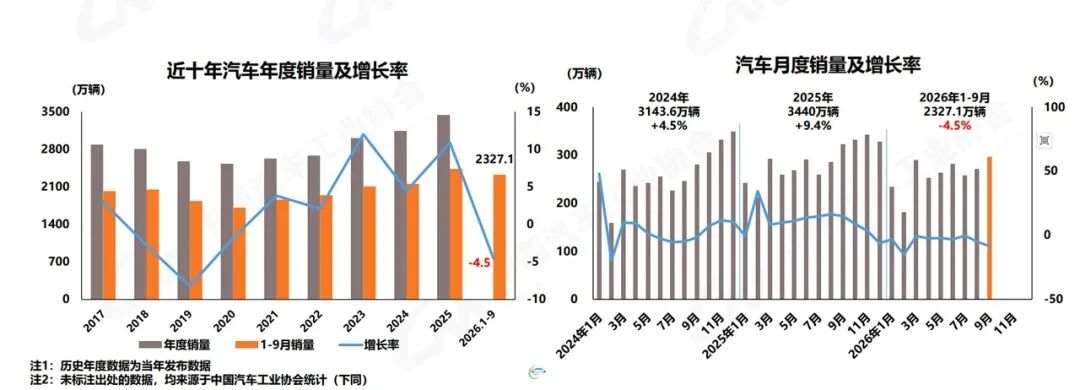
CAAM data reveals: In September, automobile production and sales reached 2.99 million and 2.956 million units, respectively, marking an 11.4% and 9% month-on-month increase but an 8.7% and 8.4% year-on-year decrease. From January to September, automobile production and sales totaled 23.246 million and 23.271 million units, respectively, both down 4.5% year-on-year.
Despite numerous trending automobile-related topics during the National Day holiday, such as long queues for charging on highways and a broken brake pedal during testing, online buzz does not necessarily translate to market prosperity. The CAAM noted in its data release: 'Looking ahead to the fourth quarter, the industry is expected to maintain stable operation. Exports are projected to continue growing, with the annual total likely exceeding 10 million vehicles. RMB 250 billion in funds for replacing old consumer goods with new ones has been fully allocated, and existing policies will further enhance implementation effectiveness. Combined with local and corporate promotional activities, the decline in domestic market sales is expected to narrow.'
From a positive perspective, domestic market sales are expected to rebound in the remaining two and a half months. However, from another angle, the annual market trend is likely to be characterized by declines.
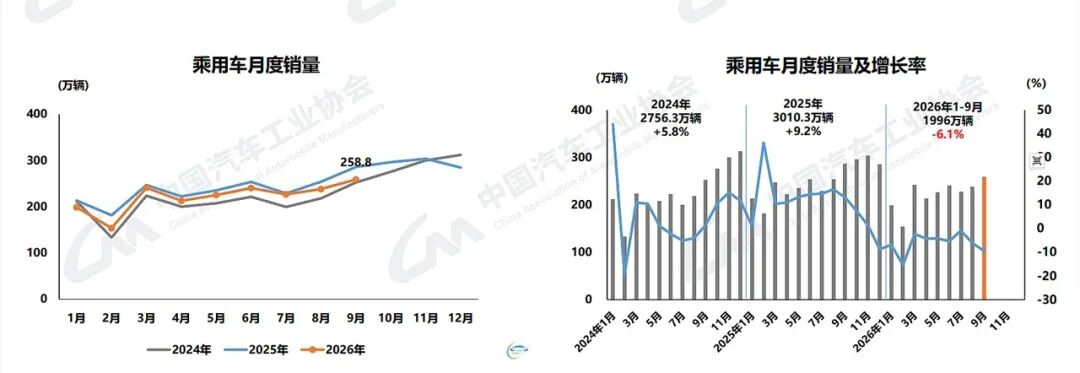
The 'cooling down domestically' is evident in the data: In September, domestic automobile sales reached 1.904 million units, up 11.9% month-on-month but down 26% year-on-year. From January to September, domestic automobile sales totaled 15.066 million units, down 22.4% year-on-year.
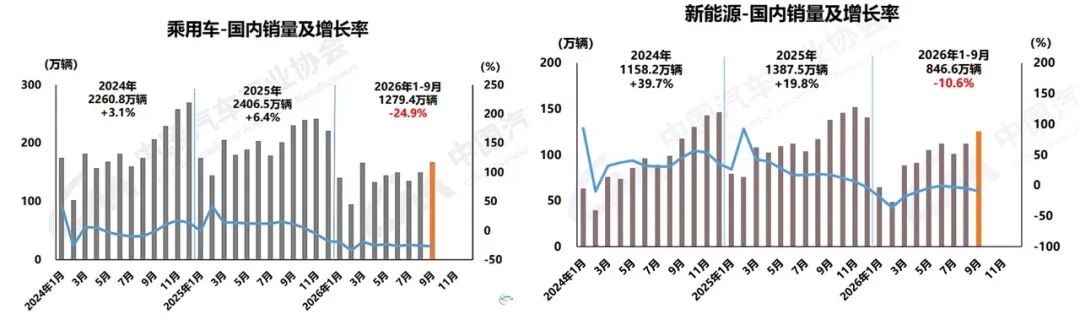
Compared to the overall market, the domestic passenger vehicle market is even less optimistic: In September, domestic passenger vehicle sales reached 1.668 million units, up 11.7% month-on-month but down 27.4% year-on-year. From January to September, domestic passenger vehicle sales totaled 12.794 million units, down 24.9% year-on-year.
This indicates that the cumulative sales of the passenger vehicle market in the first three quarters have dropped by more than one-fifth.
Contrasting with the trending topic of 'holiday highway charging difficulties,' CAAM data shows that traditional fuel vehicles continue to decline: Overall, in September, domestic sales of traditional fuel vehicles reached 652,000 units, up 11.7% month-on-month but down 45.3% year-on-year. From January to September, domestic sales of traditional fuel vehicles totaled 6.599 million units, down 33.6% year-on-year.
In the domestic passenger vehicle market, in September, domestic sales of traditional fuel passenger vehicles reached 526,000 units, a year-on-year decrease of 473,000 units, up 10.1% month-on-month but down 47.3% year-on-year. From January to September, domestic sales of traditional fuel passenger vehicles totaled 5.127 million units, a year-on-year decrease of 3.014 million units, down 37% year-on-year.
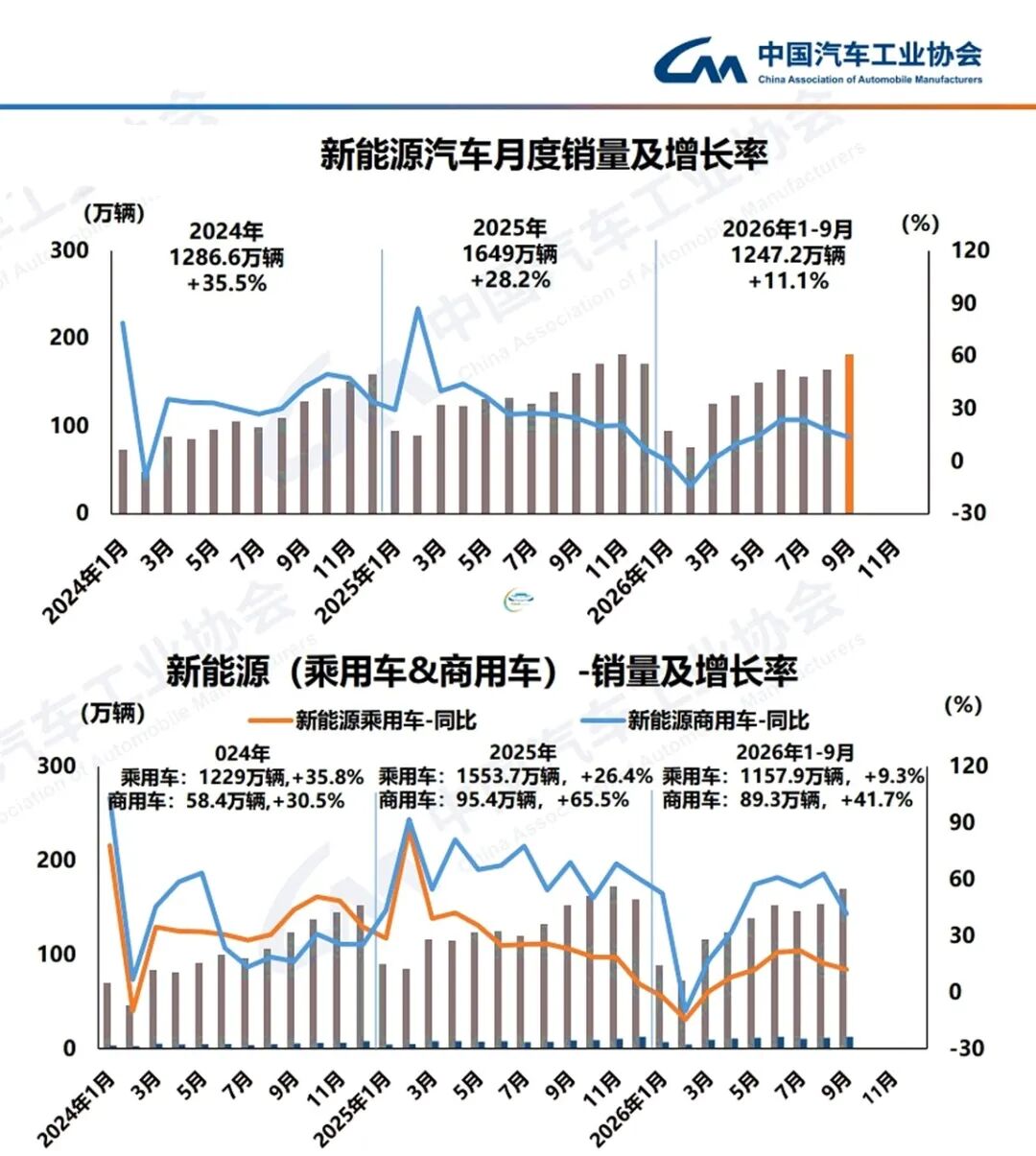
Compared to traditional fuel vehicles, new energy vehicles are undoubtedly becoming the mainstay: In September, production and sales of new energy vehicles reached 1.814 million and 1.823 million units, respectively, up 12.2% and 13.6% year-on-year. From January to September, production and sales of new energy vehicles reached 12.483 million and 12.472 million units, respectively, up 11% and 11.1% year-on-year, with new energy vehicle sales accounting for 53.6% of total new vehicle sales.
Examining the new energy passenger vehicle market data: In September, domestic sales of new energy passenger vehicles reached 1.142 million units, up 12.5% month-on-month but down 12.1% year-on-year. From January to September, domestic sales of new energy passenger vehicles totaled 7.667 million units, down 13.9% year-on-year. The CAAM's data on the sales share of new energy vehicles indicates that they account for more than half of new vehicle sales, but a comparison of monthly and cumulative sales data reveals that new energy vehicle sales have more than doubled.
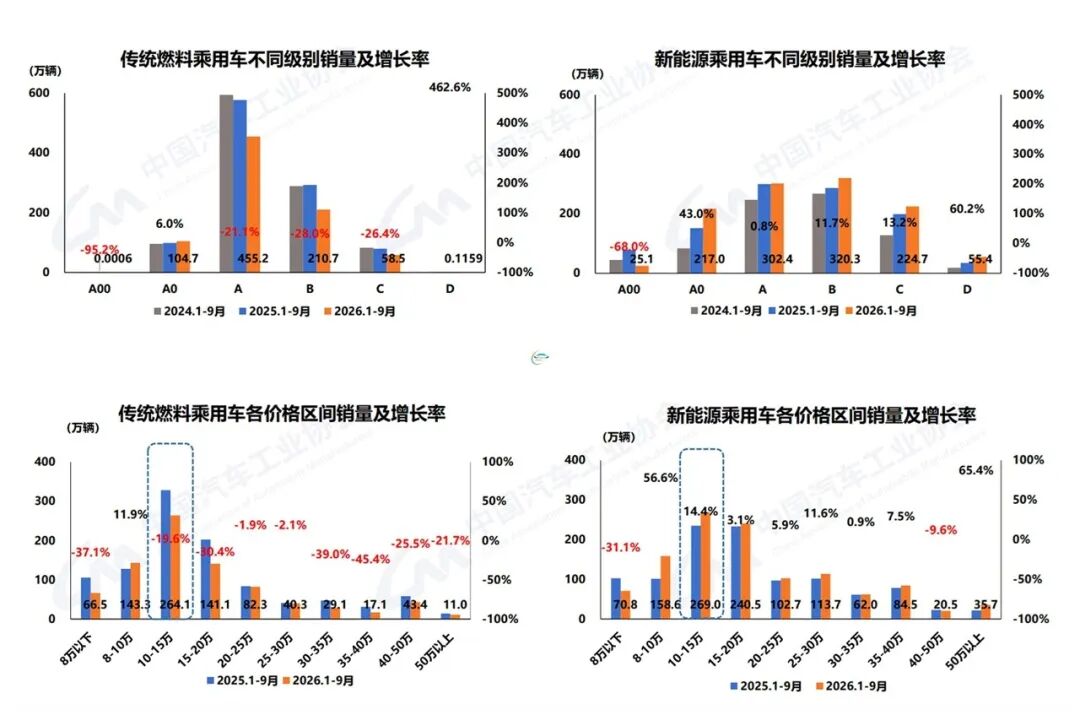
Clearly, traditional fuel vehicles can no longer 'hold the hearts' of domestic consumers, at least for the vast majority. From a comparison of different vehicle classes and price ranges, traditional fuel passenger vehicles are generally declining, while new energy vehicles are generally on the rise.
However, for both traditional fuel and new energy passenger vehicles, the A00-class market is not optimistic, with the fastest decline rates.
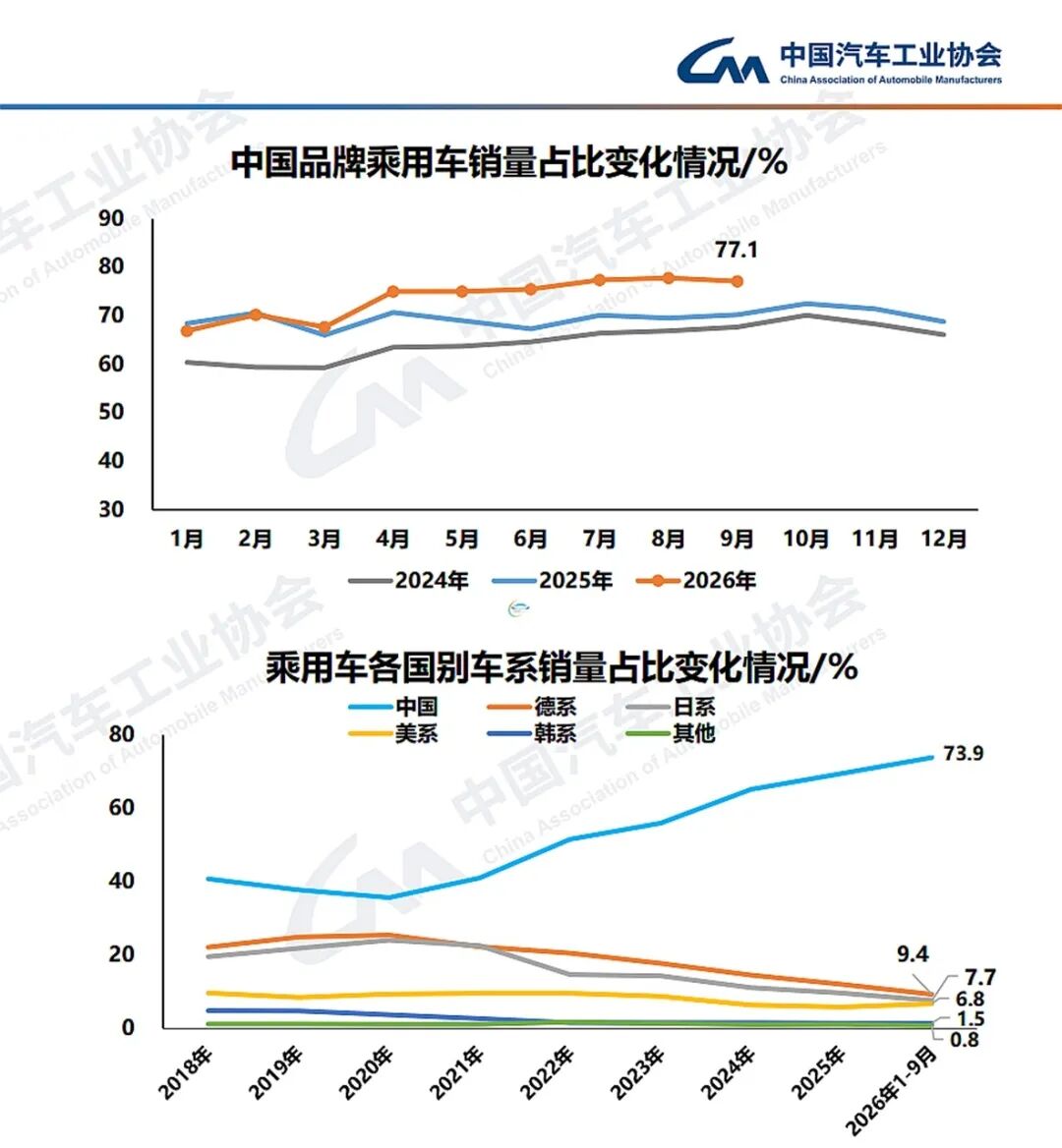
The market trends for vehicles from different countries are also clearly distinct: In September, sales of Chinese brand passenger vehicles reached 1.996 million units, down 0.6% year-on-year, but their sales share increased by 6.9% year-on-year to 77.1%. From January to September, cumulative sales of Chinese brand passenger vehicles reached 14.743 million units, up 0.6% year-on-year, with their new vehicle sales share increasing by 4.9% year-on-year to 73.9%.
Despite the overall market decline, the market share of Chinese brand passenger vehicles continues to grow, and the increase is quite significant. Under unfavorable market conditions, the market shares of other countries' vehicle brands are correspondingly compressed.
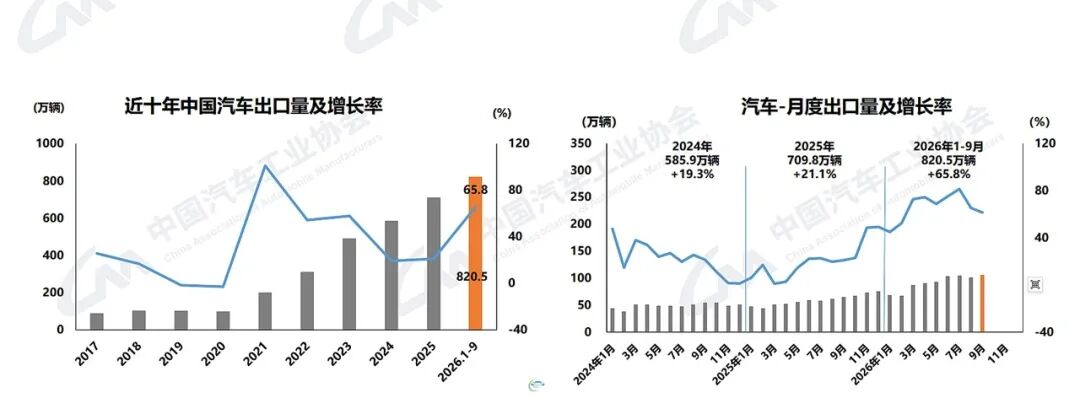
The 'heating up internationally' is the most promising aspect of the current data: In September, automobile exports reached 1.053 million units, up 4.2% month-on-month and 61.4% year-on-year. From January to September, automobile exports totaled 8.205 million units, up 65.8% year-on-year.
Amid the overall growth in vehicle exports, new energy vehicle exports are 'the brightest spot.' CAAM data shows: In September, exports of new energy vehicles reached 571,000 units, up 8.6% month-on-month and 1.6 times year-on-year. Exports of traditional fuel vehicles reached 482,000 units, down 0.6% month-on-month but up 12% year-on-year. From January to September, exports of new energy vehicles totaled 4.006 million units, up 1.3 times year-on-year. Exports of traditional fuel vehicles totaled 4.2 million units, up 31.6% year-on-year. Among these, in September, exports of passenger vehicles reached 919,000 units, up 3.2% month-on-month and 64.2% year-on-year. From January to September, cumulative exports of passenger vehicles reached 7.167 million units, up 70.6% year-on-year.
At the time of the data release, the CAAM also specifically mentioned: 'The '15th Five-Year Plan' for the Development of the Intelligent Connected New Energy Vehicle Industry has been officially released, providing top-level guidance for the development of the intelligent connected vehicle industry during the '15th Five-Year Plan' period. The plan focuses on addressing key core technologies, cross-sector integration of vehicles, roads, and clouds, optimizing industrial structure, improving industry governance, and international layout. It will help stabilize market expectations, address shortcomings in the industrial chain, accelerate the cultivation of new quality productive forces, promote the industry's transition from scale growth to quality improvement, facilitate the collaborative development of the automobile industry with information and communication, transportation, and energy industries, and enhance the global competitiveness of Chinese brands.'
-
![]()
Vehicle Exports Set to Top 10 Million Units, CAAM: Auto Market 'Cooling Down Domestically, Heating Up Internationally'
-
![]()
25+ Chinese Brands Make Their Debut at the Paris Auto Show! China's Automobile Industry Embarks on a Systematic Global Expansion, Shifting the Offensive and Defensive Dynamics Between Chinese and Euro
-
After Analyzing Data from Freelance Platforms, I Found It's Increasingly Challenging for Average Individuals to Earn Extra Income
-
QianWen Go Ventures into Personal Assistant Space, Revealing Another Side of Alibaba's Ecosystem Strengths
-
![]()
Who is Taking Away the Profits of Car Companies: Battery or Intelligent Driving?
-
![]()
Tencent Successively Discontinues Two AI Agents
-
![]()
Has the Brake Pedal of JAC Motors Really Broken? The Market Will Teach Every Automaker with 'Fatal Flaws' a Lesson
-
![]()
Changsha’s Emerging Powerhouse in Computing: Cancels RMB 3 Billion Contract!