Why Does Jingneng Look Abroad for Chips After Installing 300,000 Modules in Vehicles?
 10/14 2026
 348
348
On October 12, a major cross-border chip collaboration created waves across the industry.
Jingneng Microelectronics, a rising star in power semiconductors under Geely Technology Group, proudly announced its partnership with Wolfspeed, a U.S. silicon carbide giant. Jingneng will prioritize integrating Wolfspeed's silicon carbide (SiC) bare chips into its next-generation power modules.
A quick look at Jingneng's achievements might impress you. Since mass delivery began in 2025, the company has installed over 300,000 silicon carbide power modules in vehicles. With three production lines running at full capacity, its current annual production capacity reaches 900,000 units, with monthly sales exceeding 50,000.
So, why would a Chinese leader, capable of large-scale module production and projected to be the world's largest supplier in the SiC main drive inverter segment by April 2026, seek support from a U.S. chip manufacturer as it moves toward the next-generation high-voltage platform?
The situation becomes even more puzzling when we consider Wolfspeed's financial standing: Just five days before the collaboration (on October 7), the U.S. company secured a conditional loan commitment of up to $1.5 billion over 30 years from the U.S. government. However, whether the final agreement is signed and funds disbursed depends on meeting several conditions. Prior to this, Wolfspeed underwent Chapter 11 restructuring in 2025; in the latest Q4 2026 fiscal year, its GAAP gross margin was a disappointing negative 25%.
Why would a Chinese company with 300,000 installed modules partner with a U.S. company just emerging from bankruptcy and still facing negative margins?
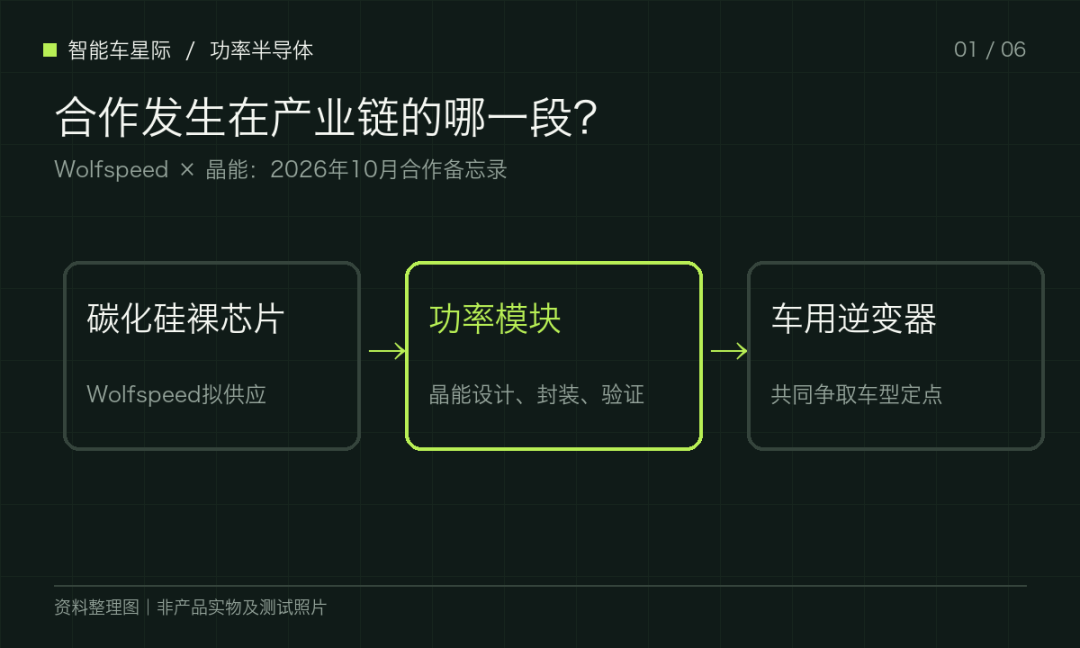
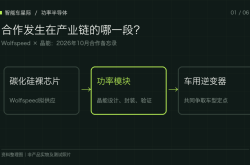
▲ Illustration of the Collaboration Path | Source: Gasgoo, October 12, 2026
The Illusion of 300,000 Installed Modules
To understand this collaboration, it's essential to grasp how the heart of an electric vehicle—the inverter—is manufactured.
Power devices control the switching of electric current. The higher the current, the greater the heat generated. Silicon carbide (SiC) has become the material of choice for 800V/900V high-voltage electric drives due to its ability to significantly reduce losses, allowing automakers to optimize battery size, range, and heat dissipation.
However, this business operates within three highly specialized tiers: bare chip manufacturing, power module packaging, and vehicle inverter integration.
Jingneng's collaboration with Wolfspeed focuses on the intermediate power module segment. This involves packaging the chips, soldering copper clips, ensuring insulation and heat dissipation, and then delivering them to automakers. Jingneng's 300,000 installed modules and 900,000 annual production capacity showcase its established capabilities in module design, packaging, and mass delivery.
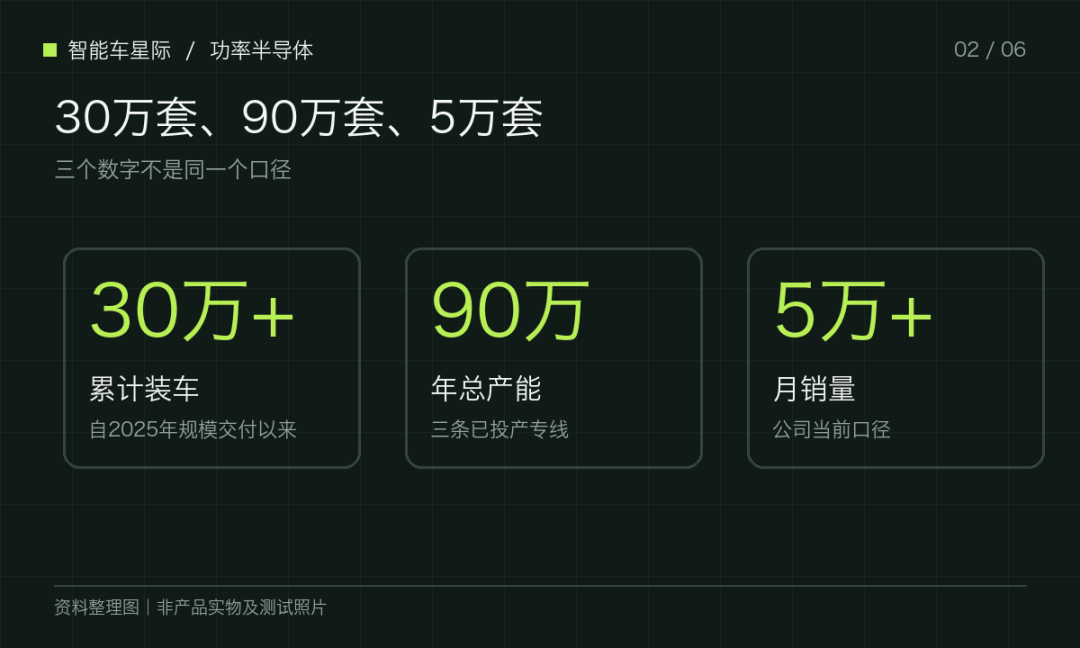
▲ Scale Data | Source: Geely Technology Group Disclosures
Yet, this masks a reality: while modules are designed and packaged domestically, the bare chips within them still require independent selection. Jingneng Group is also exploring chip design; the introduction of Wolfspeed does not imply it lacks other chip technologies or sources. Chip manufacturers must invest heavily to build wafer fabrication plants and continuously improve crystal growth processes and yields.
For this new module, Jingneng has chosen to incorporate Wolfspeed's bare chips, leveraging its 200mm silicon carbide manufacturing capabilities. Both parties must still complete technical adaptation and vehicle model designations.
200mm Wafers: A Lofty Goal and Cost Challenge
Jingneng's interest in Wolfspeed lies not in its bankruptcy history but in its 200mm (8-inch) silicon carbide wafer technology.
Silicon carbide is notoriously difficult to cut, with extremely low yields. The circular area of a 200mm wafer theoretically increases by about 78% compared to the traditional 150mm, meaning more chips can be sliced from a single wafer.
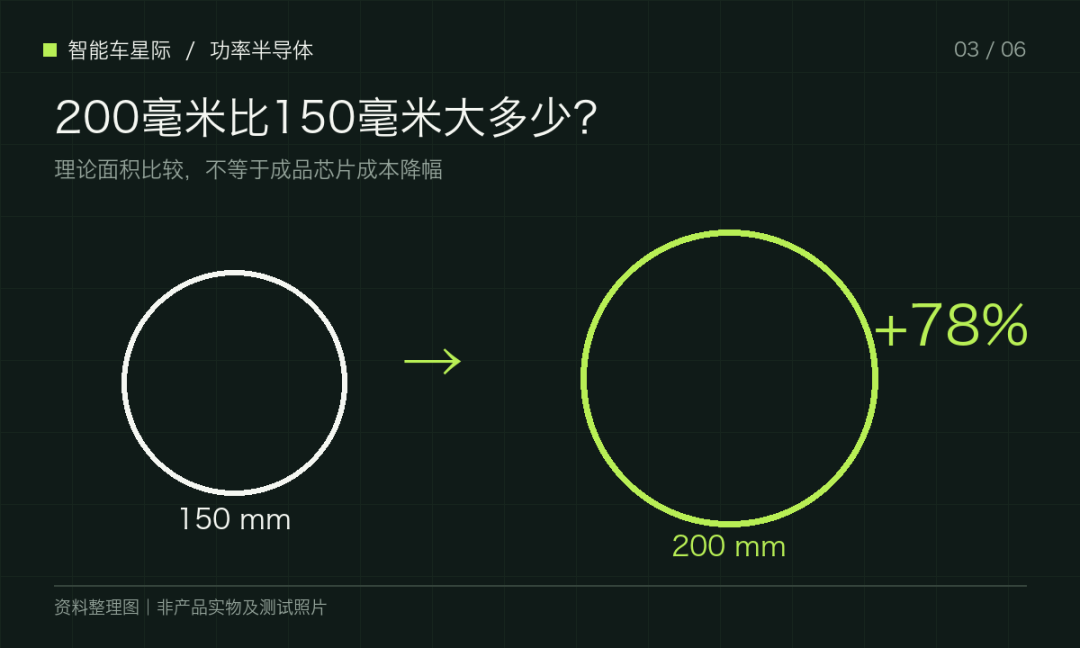
▲ Area calculated based on diameter squared; does not represent actual yield or cost reduction magnitude
To regain control over mass production costs, Wolfspeed has been aggressive: announcing the commercialization of 200mm materials in 2025; launching fifth-generation MOSFET devices and automotive-targeted 1200V bare chips in 2026, followed by the release of new 200mm high-end power substrates in September. As for the 300mm single-crystal wafers disclosed in January 2026, they remain laboratory R&D projects with no short-term commercial prospects.
Jingneng's calculations are precise: if Wolfspeed can enhance the effective chip output and yield of its 200mm production line, unit costs can decline, enabling Jingneng to compete for next-generation designations from Chinese automakers with more cost-effective modules.
However, this is merely a perfect theoretical scenario. The cost of a 200mm factory is astronomical, with edge utilization rates and process defects capable of eroding profits at any moment. No matter how loudly the technological milestones are touted, if yields remain low, costs will stay prohibitively high.
The Negative 25% Gross Margin Challenge
The technological vision is compelling, but the financials are harsh.
Once the undisputed leader in silicon carbide materials, Wolfspeed was dragged down by a frenzied expansion cycle and completed restructuring under Chapter 11 in the U.S. in 2025. Even in Q4 2026, its performance remained concerning: quarterly revenue of approximately $150 million, a GAAP gross margin of negative 25%, a net loss of $145 million, and quarterly operating cash flow of negative $54 million.
What does a negative 25% gross margin signify? It means that the total GAAP revenue for the quarter did not cover the corresponding cost of sales, which includes factors such as insufficient capacity utilization. It does not imply that every chip is sold at a loss. Cash, cash equivalents, and short-term investments at period-end were approximately $1.1 billion.
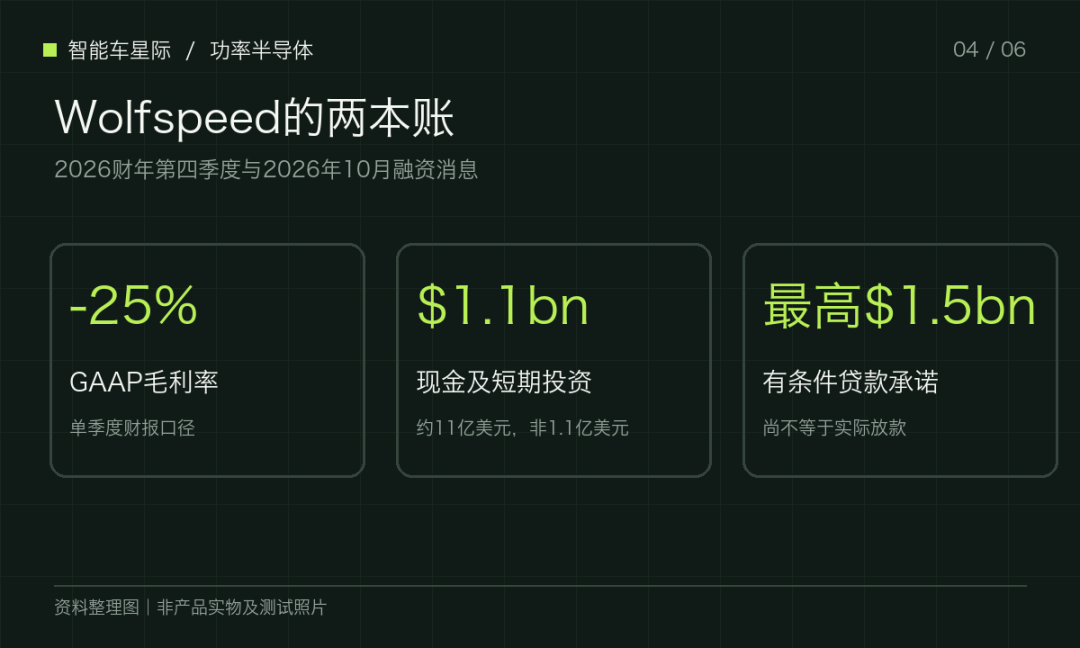
▲ Financial and Loan Metrics | Source: Wolfspeed Financial Reports and October 7, 2026, Announcement
On October 7, the U.S. government offered a conditional loan commitment of up to $1.5 billion over 30 years, but this does not equate to disbursement. Formal agreements, due diligence, approvals, and other conditions remain pending. If financing is implemented in batches, Wolfspeed must also issue warrants to the U.S. government as stipulated.
This poses a significant dilemma for Chinese supply chain managers. Japan's Renesas serves as a cautionary tale: in 2023, Renesas signed a decade-long wafer supply agreement with Wolfspeed; by 2025, Wolfspeed's bankruptcy restructuring forced Renesas to publicly confirm related financial losses.
No matter how advanced the chips, if upstream supplies are suddenly cut off due to financial crises or political clauses, automakers' entire production lines could halt. The ambiguous phrase "prioritize its technology and commercial solutions" in Jingneng and Wolfspeed's memorandum is far from an exclusive lifeline; it's merely a backdoor left amid intense negotiations.
Onsemi on One Side, Wolfspeed on the Other: Geely's Strategic Backup
At this point, some might ask: Didn't Geely Automobile Group just announce an expanded collaboration with Onsemi in April 2026, integrating EliteSiC technology into Geely's 900V high-voltage hybrid platform? Now, with Jingneng seeking Wolfspeed, isn't this contradictory?
On the contrary, this is the automaker's most astute "backup game."
International giants like Onsemi and Infineon operate under the IDM model (covering chips to modules). As an automaker, Geely Automobile purchases complete solutions from these giants for stability. Meanwhile, Jingneng, under Geely Technology Group, insists on being an independent "module manufacturer," procuring bare chips from the market for flexibility and ultimate cost control.
Jingneng must prove it's not a vassal of any chip giant but a "puzzle master" capable of freely combining different chips and heat dissipation structures from the market to achieve the lowest total cost.
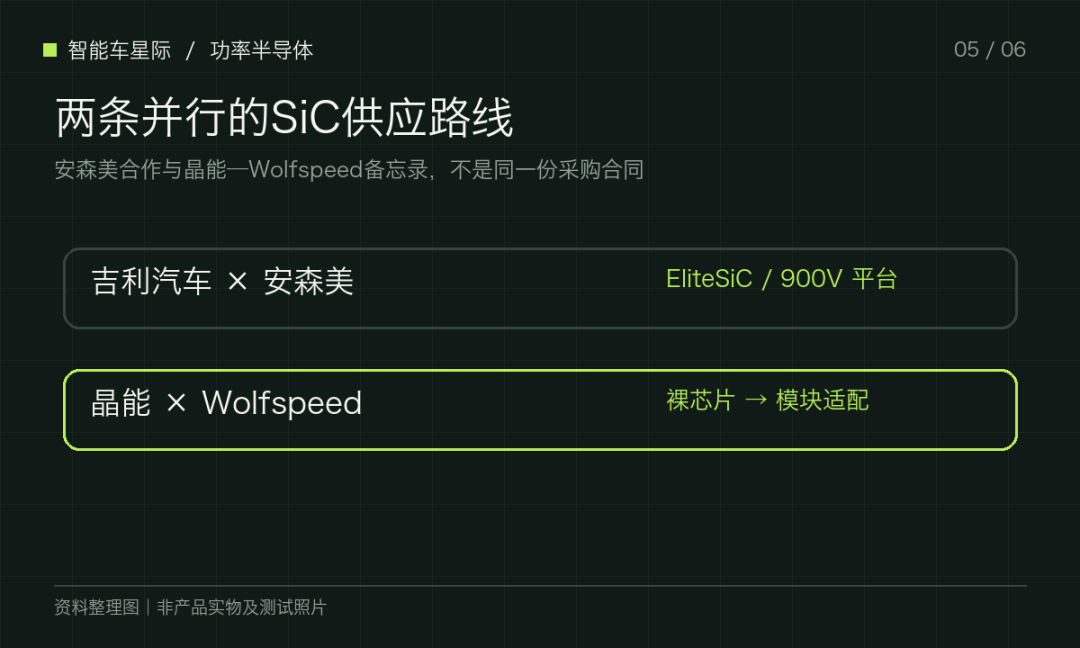
▲ Two Collaboration Routes | Source: Onsemi Announcements, Gasgoo
300,000 Modules Are Just the Beginning
Whether it's boasting about "300,000 installed modules" at product launches or the U.S. government's "conditional loan commitment of up to $1.5 billion," these are merely pieces in this high-stakes game.
In the world of automotive-grade power modules, parameters must undergo rigorous reliability verification before securing vehicle model designations. For a module to be installed, it must endure countless rigorous tests, including high-low temperature cycling, humidity, vibration, and insulation safety.
Jingneng and Wolfspeed's memorandum targets "designations for high-voltage platforms of leading domestic automakers." This indicates they are still "salespeople" without final mass production contracts.
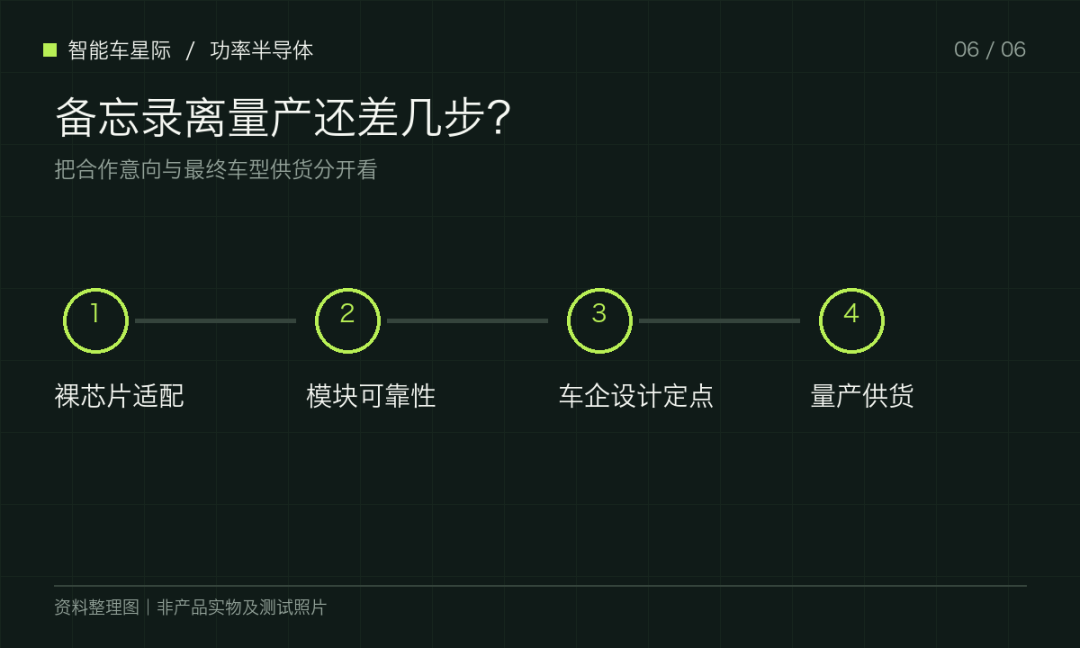
▲ Collaboration Progress Illustration | Source: Gasgoo
When a domestically produced power module is placed on an automaker's negotiating table, but its core bare chips still bear U.S. labels and even U.S. government loans, will you prioritize its "national origin" or its ability to deliver an absolutely reliable mass production commitment?
Smart Car Interstellar · Frontline Observations on the Smart Car Industry
Smart Car Interstellar
How would you weigh cost, performance, and long-term supply? Welcome to discuss in the comments section.
Reference Sources
J01 | Gasgoo obtained the collaboration memorandum on-site
J02 | Geely Technology Group's Jingneng business and production line disclosures
J03 | Wolfspeed's October 2026 announcement of a conditional $1.5 billion loan
J04 | Wolfspeed's September 2026 upgrade to 200mm materials
J05 | Wolfspeed's Q4 2026 fiscal year financial results
J08 | Wolfspeed's 2026 Gen5 MOSFET release
J09 | Wolfspeed's automotive-grade 1200V bare chip catalog
J10 | Wolfspeed's 2025 restructuring completion announcement
J11 | Wolfspeed's 2025 restructuring application announcement
J12 | Wolfspeed's 2026 Renesas equity issuance passes review
J13 | Renesas and Wolfspeed's 2023 decade-long wafer procurement
J14 | Renesas's 2025 restructuring loss disclosure
J15 | Renesas's 2025 annual major changes explanation
J16 | Onsemi's further collaboration with Geely in 2026
-
![]()
Why Does Jingneng Look Abroad for Chips After Installing 300,000 Modules in Vehicles?
-
![]()
Hello World: Key Highlights of Hello's Revolutionary Generative Driving World Model
-
![]()
Final Verdict: 'Golden September' Falters, 'Silver October' Loses Luster as Domestic Auto Market Remains Under Pressure
-
6G on the Brink of Commercialization: The Interplay of Policy, Technology, and Market Forces
-
![]()
Valuation Soars to $50 Billion: Is Moonshot AI Paving the Way for a Hong Kong IPO?
-
![]()
A pure electric range of 1,008 kilometers: BYD's Da Han officially hits the market, priced between RMB 235,900 and RMB 275,900
-
![]()
Vehicle Exports Set to Top 10 Million Units, CAAM: Auto Market 'Cooling Down Domestically, Heating Up Internationally'
-
![]()
25+ Chinese Brands Make Their Debut at the Paris Auto Show! China's Automobile Industry Embarks on a Systematic Global Expansion, Shifting the Offensive and Defensive Dynamics Between Chinese and Euro