Intent Economy Fails to Displace China’s Attention Economy
 10/15 2026
 430
430
The Personal Agent (PA) has emerged as a new focal point in AI, with the intent economy—represented by PA—posing a significant challenge to the internet’s attention economy.
Globally, both tech giants and startups are vying for entry points into the PA market, with a consensus that the intent economy will eventually replace the attention economy. Beyond Meta Muse and OpenAI Dots, a host of startups, including Instinct, Cue, Fambot, Poke, Skye, and Town, have also entered the fray.
In China, however, PAs are almost exclusively developed by major internet and smartphone companies, with startups largely absent from the scene. The prevailing market view is that the intent economy is an extension of the attention economy, with major companies continuing to dominate the intent economy through PA products, effectively sidelining startups.
The differences between the Chinese and foreign markets can be examined through the service chain of PA.
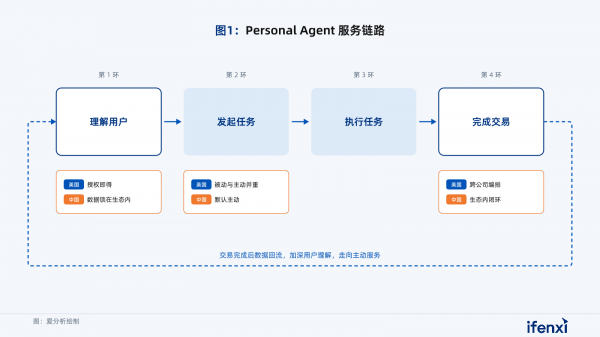
Figure 1: Personal Agent Service Chain
The first link involves understanding the user. PA needs to know who the user is, what they need, their social relationships, and a range of other information. This requires users to authorize access to a variety of personal life data, such as instant messaging, social media, personal notes, and credit card bills.
The second link is task initiation. These tasks may arise from direct user requests, such as ordering a cup of coffee or responding to work messages, or they may be proactively proposed by PA, such as ordering groceries based on the user’s recent health and budget.
The third link is task execution, where PA utilizes Agent tools to complete the tasks.
The fourth link is transaction completion, where PA handles actions like placing orders and making payments on e-commerce platforms.
After tasks and transactions are completed, the data flows back to the first link to further understand the user, forming a closed loop. As more data is accumulated, PA products gradually transition from passive to proactive services.
Significant gaps exist between China and foreign countries in understanding users, initiating tasks, and completing transactions, shaping entirely different competitive landscapes and ecosystems.
01 Chinese PA Startups Face Barriers Due to User Data
The first link, understanding users, heavily relies on user data.
Abroad, users’ life data is not confined to the ecosystems of major companies. Bills, itineraries, calendars, etc., are scattered across emails, banks, and various vertical apps. Once user authorization is obtained, this data becomes accessible, putting overseas startups on a similar footing with major companies in understanding users.
For example, Instinct’s core user data comes from emails, calendars, and credit cards. Its founder, Shinn, considers the moment when users first entrust their cards, passwords, and sensitive documents as key indicators. Meta and OpenAI must also overcome this user trust barrier. Recently, OpenAI has focused on obtaining user authorization for various associated accounts to better understand and analyze users, thereby enhancing the service quality of Dots.
In China, the situation is reversed, with data locked within the ecosystems of major companies.
Major companies, as winners in the attention economy, occupy a significant amount of user time. Within the ecosystems of internet giants, there is chat data, wallet payment data, and transaction order data. The same applies to smartphone giants, which, based on their mobile operating systems, also possess a vast amount of user context data.
However, startups cannot access the data within these major company ecosystems. Even with user authorization, the data fields they can obtain are not comprehensive, effectively sealing the fate of PA startups.
02 No User Time, No Proactive Services
The second link, task initiation, also differs significantly between China and overseas.
Task initiation can be either passive user requests or proactive PA requests. Abroad, both coexist, with startups focusing on user requests and major companies on proactive services. Instinct’s typical scenario involves user-requested flight and hotel bookings, with travel GMV accounting for over 50%. Muse’s typical scenarios include proactive grocery shopping based on recipes, proactive itinerary and to-do reminders, and briefing push notifications, all of which are proactive services.
In China, the market assumes that only proactive services have potential, with passive services lacking imagination. Tencent’s upcoming Handy Bot primarily focuses on price comparison shopping and itinerary monitoring, similar to Muse.
However, the foundation for PA to provide proactive services is user time, which represents the attention economy. Sufficient user time not only accumulates user data but, more importantly, stimulates user demand.
In most cases, user demand is triggered by the environment. For example, watching videos may stimulate purchasing demand, while chatting with friends may spark travel demand. Muse, based on data from Instagram and WhatsApp, can easily provide proactive services that align with user needs, and the same applies to other internet and smartphone giants.
In contrast, startups lack user attention and can only offer passive services in the early stages. Only by accumulating sufficient user authorizations and historical service records can they potentially offer proactive services. Overseas PA startups are taking the passive service route, while in China, the lack of market space for passive services leaves no opportunities for PA startups.
03 Killing the Attention Economy Only Possible When Attention and Transaction Closed Loops Separate
The fourth link, transaction completion, reveals the biggest difference between China and overseas.
Abroad, user time in the attention economy is concentrated on Meta and Google, while transactions are concentrated on leading e-commerce platforms and independent merchant platforms, with both ends belonging to different companies. PAs that undertake user intent must operate across ecosystems, necessitating their growth outside the ecosystems of major companies, thus providing opportunities for startups.
In China, the structure is the opposite, with both attention and transaction closed loops in the hands of major companies. Douyin’s content stimulates purchasing desire, its e-commerce platform handles orders, and Douyin Pay completes transactions. WeChat’s social interactions build trust, while WeChat Pay and Mini Program e-commerce handle payments. Therefore, PAs naturally grow within the ecosystems of major companies, leaving no opportunities for startups.
Regardless of location, everyone believes that the core of traffic will shift from time to intent, with intent becoming the most critical factor. Abroad, this means intent will replace time as the unit of traffic measurement, and the attention economy represented by advertising will decline. In China, this represents a commercial transformation within the ecosystems of major companies, with intent becoming a new core indicator and transactions represented by intent replacing advertising as the new monetization model.
Revenue from the intent economy can only come from transaction commissions, with users paying nothing and merchants paying a commission on completed transactions. The intent economy inherently conflicts with the advertising business model. As Instinct’s founder, Shinn, said, “Users are not commodities. If Personal Agents influence users to buy things they don’t want, it would be a very dangerous world.” Therefore, Instinct’s product goal is to be free for life, refusing advertising and deriving all revenue from a unified commission on merchants.
Smartphone manufacturers share a similar perspective. OPPO’s Senior Vice President, Liu Zuohu, believes that advertising models focused on exposure and traffic generation will become a thing of the past.
Therefore, when Chinese major companies develop PAs, it is essentially a defensive move against the replacement of the advertising-driven attention economy. For domestic companies, PAs are first and foremost a defensive tool, followed by an offensive weapon.
04 Strategies of Chinese Major Companies in PA
Following the release of Muse, domestic major companies quickly followed suit.
Alibaba recently announced the launch of its Personal Agent product, “Qianwen Go!”, embedded within the Qianwen APP, with an experience application page already live. ByteDance is rushing to develop Doubao Personal Assistant, named Xiaodou. Tencent’s internally code-named Handy Bot is planning to launch a standalone app.
The strategies of major companies in PA are determined by their core assets.
Alibaba is suited for a transaction-closed-loop PA: Using e-commerce, payment, and life services as the execution foundation, it directs user intent directly to product selection, ordering, and service fulfillment, making PA the intelligent entry point for its proprietary transaction ecosystem.
ByteDance is suited for a content-stimulated PA: Leveraging Douyin’s content and recommendation scenes, it discovers and stimulates demand from content consumption, then converts interest into search, decision-making, and transactions, allowing PA to fulfill demand within the content ecosystem.
Tencent is suited for a social-service-oriented PA: Relying on WeChat’s messaging touchpoints and Mini Program services, it connects user conversations, friend relationships, and service calls, completing transaction closed loops within the WeChat ecosystem.
After major companies make their moves, the space and window of opportunity for startups will further narrow. Chinese PA startups already have two fatal flaws: they cannot access user data, and passive services during the cold start phase lack market space.
With major companies collectively entering the market, they further squeeze the survival space for startups. The positions left for startups in the PA track are more likely to be providers of specific standalone capabilities.
For example, completing the transaction closed loop for PA also requires the construction of trustworthy infrastructure. Trustworthiness is reflected in two aspects: one is the PA’s ability to execute tasks effectively, and the other is whether its proactive service capabilities always remain within controllable, authorizable, and traceable boundaries. The latter requires the construction of various infrastructure elements, such as payment protocols and standards, and security standards.
-
![]()
How Much Gap Can HelloRobotaxi's World Model Bridge?
-
![]()
Total Investment Reaching Around 557 Million Yuan! Construction Commences for the Su Da Weige SVG Micro-Nano Optical Manufacturing Excellence and Innovation Center
-
![]()
Why Did a Low-Profile Optical Acquisition Ripple Through the Semiconductor and Defense Sectors?
-
![]()
Agent Safety: A New Benchmark for Financial AI
-
![]()
Tencent AI Leader Yao Shunyu Seated Beside Pony Ma
-
![]()
Intent Economy Fails to Displace China’s Attention Economy
-
![]()
Two PhDs Teach AI, Earn 670 Million Yuan Annually, Valued at 20.7 Billion Yuan
-
![]()
Over 20 Chinese Auto Brands Debut at Paris Auto Show, Signaling a New Era of Overseas Market Endurance