How Much Gap Can HelloRobotaxi's World Model Bridge?
 10/15 2026
 431
431

Source: Advanced Smart Driving, Publicly Available Online Information
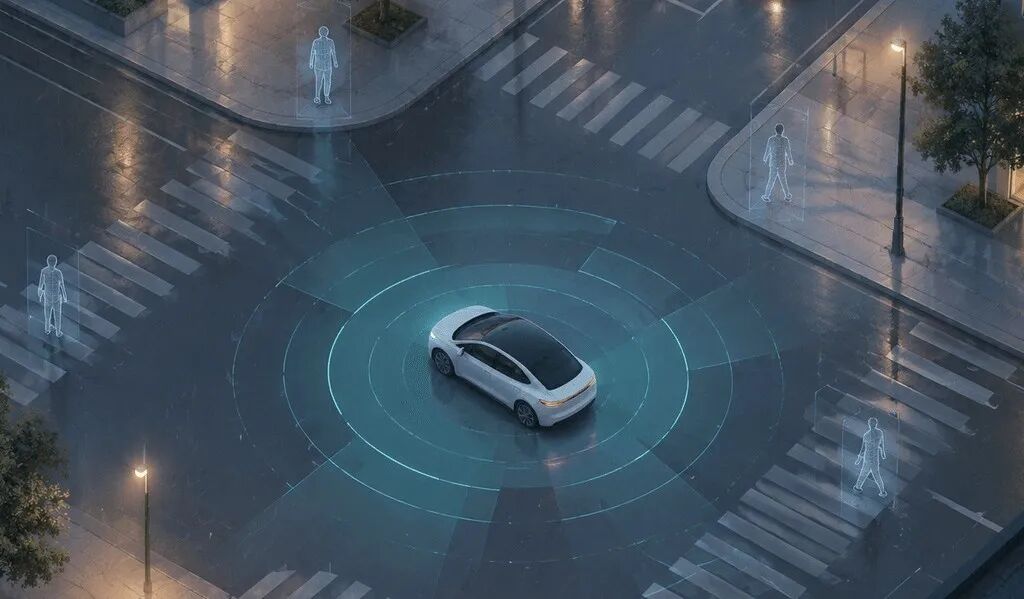
According to reports from multiple media outlets including Jiemian News, on October 13, HelloRobotaxi officially launched its generative driving world model, HelloWorld. According to official introductions, the model supports generating corresponding multi-view videos and LiDAR observations by describing requirements in natural language or directly editing vehicles, pedestrians, and motion trajectories. From inserting crossing pedestrians to switching between rainy, snowy, daytime, and nighttime conditions, developers can construct scenarios around specific needs, expanding long-tail situations that are difficult to fully cover in real-world data collection.
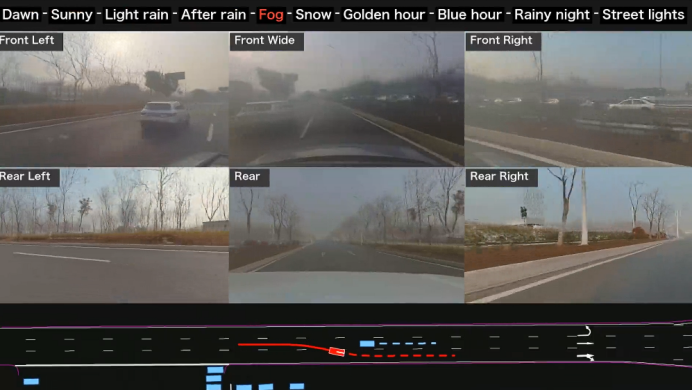
Why is Hello Building a World Model? The answer lies in the timeline.
Founded Zaofu Intelligence in June 2025, launched its first model in September, began mass production in July 2026, and completed $100 million in financing in September. In 15 months, it went from zero to mass-produced vehicles. However, road test mileage, complex scenarios, and safety redundancy cannot be achieved through capital and speed alone. The world model is essentially Hello's use of generative AI capabilities to shorten this accumulation process.

HelloWorld: Where Does the Data Come From?
HelloWorld is part of Hello's "Daoyu" 10-billion-parameter large model system. Developed jointly by HelloRobotaxi and Alibaba Cloud's Qwen team, it covers cloud capabilities including data mining, world model simulation, and the VLA Cloud Driver base. HelloWorld is responsible for data generation and simulation verification, providing scenario data for end-to-end model training.
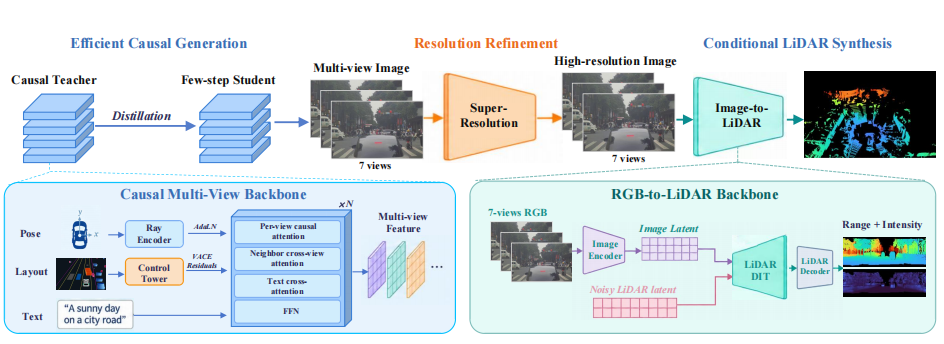
According to public information, HelloRobotaxi's core technology team has over 500 members, with an average age of 27, characterized by an "AI-native" architecture without historical baggage, adopting a data-driven end-to-end large model approach. According to Hello's plan, by 2026, it aims to establish a high-quality dataset containing no fewer than 10 million clips. Given the limited real-world road test mileage, the generative world model becomes a tool to supplement data gaps.
This direction is not unique to Hello. According to public information, XPENG released X-World based on video diffusion generation technology, Xiaomi introduced the Xiaomi Auto World Model, and Waymo built virtual environments with Google DeepMind's Genie 3. Waymo claims its world model can simulate extreme weather like tornadoes and scenarios such as vehicles encountering wildlife.
Hello's distinction lies in its closer integration of the world model with its industrial shareholder structure. Alibaba Cloud provides the computational foundation, CATL supplies the electrified chassis and energy, and Ant Group contributes travel operation scenarios and the payment ecosystem. This four-way collaborative framework is rare among autonomous driving startups.
However, the uniqueness of the technical architecture does not automatically translate into engineering implementation advantages.

Mass Production Progress and Safety Incidents
One month before the HelloWorld release, HelloRobotaxi completed a new round of financing of approximately $100 million, with a post-investment valuation nearing $3 billion. The funds will be used for a 10,000-card cluster computing platform, AI large model end-to-end technology iteration, and the construction of a high-quality data supply chain system.
From Zaofu Intelligence's founding in June 2025 to the mass production launch of its first factory-installed model, the HR1, at Guangzhou's Dongfeng Nissan Huadu plant in July 2026, HelloRobotaxi completed the mass production path that other players took years to achieve in just 15 months. The HR1 is equipped with 8 LiDAR sensors and 13 cameras, with computing power exceeding 2200Tops, and the current production scale has surpassed 100 units.
This speed is related to Hello's business situation. The growth of its shared two-wheeler business has slowed, with cumulative net losses approaching 5 billion yuan from 2018 to 2020, and the gross margin of the shared two-wheeler business was only 6.7% in 2020.
In 2025, the Beijing Municipal Transportation Law Enforcement Corps launched an investigation into Hello for illegally over-deploying shared bicycles, and CCTV's "3·15" Gala exposed illegal speed limit removals at its electric bike rental business locations. Against this backdrop, Robotaxi carries not only the function of business expansion but also relates to Hello's new narrative in the capital market. In March 2025, its founder acquired the listed company Yong'an Bike, seen as a key step in a "backdoor listing," with Robotaxi involvement being a crucial part of the plan.
Rapid progress comes with safety challenges.
On December 6, 2025, a Hello L4-level Robotaxi in Zhuzhou, Hunan, hit a pedestrian at a crosswalk, with one person being run over. The incident occurred shortly after HelloRobotaxi launched commercial operations in Zhuzhou, directly leading to a complete halt of related businesses in Zhuzhou, Liyang, and other locations. As of September 2026, operations in Zhuzhou have yet to resume.
Chen Liteng, an analyst at NetEase E-Commerce Research Center, commented, "The business quickly completed the setup from 0 to 1, but safety verification and scenario generalization capabilities have not matched the pace of commercialization. The internet-style rapid expansion mindset conflicts with the long-cycle, safety-focused nature of the autonomous driving industry."

Scale Gap with Leading Players
Hello is not the first company to encounter these issues. The challenges for later entrants will only be greater.
According to company disclosures, Baidu's Apollo Go had a fleet size of 3,500 units by the first quarter of 2026, with 3.2 million fully driverless orders and total orders increasing by over 120% year-on-year. Pony.ai's global Robotaxi fleet has surpassed 1,700 vehicles, achieving positive profit per bike (per-vehicle profitability) in Guangzhou and Shenzhen. WeRide's global L4 fleet is around 3,400 vehicles, with over 1,800 Robotaxis, and the average daily orders per vehicle in China exceeded 21 in the second quarter.
Hello's HR1 has surpassed 100 units in production and plans to initiate regular operations in Guangzhou and Shenzhen first. Compared to leading players, there is still an order-of-magnitude gap.
Meanwhile, the economic model for Robotaxi is improving. Pony.ai's seventh-generation autonomous driving kit has seen a 70% reduction in material costs compared to the previous generation, with a target total vehicle cost of under 230,000 yuan for the 2027 version; Baidu's Apollo Go sixth-generation driverless car has reduced its per-vehicle cost to just over 200,000 yuan. UBS predicts that the per-kilometer operating cost of Robotaxi will drop to 2.1 yuan in 2026, on par with traditional ride-hailing services.
Leading players are beginning to validate the sustainability of their economic models, while later entrants still need to address cost structure issues. Yu Qiankun, co-founder and CTO of HelloRobotaxi, has stated that Hello has built a six-fold safety redundancy architecture and a dual-line data closed-loop system. Whether these investments can be absorbed within the per-vehicle economic model remains to be seen.
Guo Tao, a senior AI expert, commented that this is a typical latecomer catch-up strategy of exchanging capital for time. The business is still in the technical verification and commercial trial operation stage, and the safety incident reminds the industry not to pursue expansion speed alone. Technical stability and the construction of a safety redundancy system need to advance in tandem with deployment scale.

Safe Operation is Key to Implementation
After the Zhuzhou incident, HelloRobotaxi's preparations for landing in multiple cities are still progressing. Shenzhen, Changsha, Wuhan, and Hong Kong are advancing examinations and preparations for implementation, while Guangzhou and Changzhou have obtained road test permits. However, city access approvals are becoming more cautious.
Chen Liteng pointed out that safety incidents have affected regulatory trust, and city pilot approvals will become more cautious. Constraints such as insufficient road test mileage accumulation compared to leading players, inadequate Vehicle supply chain (vehicle supply chain), and talent reserves still exist.
The competition in autonomous driving ultimately hinges not on who releases more dazzling technology but on who can maintain a sufficiently low accident rate over a sufficiently long period. World models can generate large amounts of simulation data, but simulation data cannot replace the complex interactions on real roads; large model parameters can be stacked, but the refinement of the safety redundancy system requires the accumulation of engineering experience.
Hello's industrial shareholder structure—Ant's scenarios and payment ecosystem, Alibaba's computing power and cloud services, and CATL's energy and chassis—provides it with unique resource collaboration advantages. However, resource collaboration solves the issue of "whether it can be done" but not "how well it can be done."
The release of HelloWorld demonstrates Hello's technical execution in the field of generative AI. However, technical execution does not equal safety execution, which requires the accumulation of road test data, repeated verification of safety boundaries, and systemic reflection and improvement capabilities in the face of incidents.
For HelloRobotaxi, the priority deployment plan in Guangzhou and Shenzhen in the second half of 2026 will be a critical test. Whether the 100-unit HR1 fleet can accumulate sufficient safe operation data in real urban environments and whether the gap with leading players in the per-vehicle economic model can gradually narrow will provide answers that are more indicative of Hello's true position in this race than HelloWorld's technical parameters.
The world model is a tool; safe operation is the true test.
- End -
Disclaimer:
Any works by this official account note (noted) as "Source: XXX (non-Smart Vehicle Technology)" are reprinted from other media, with the purpose of transmitting and sharing more information. It does not represent this platform's endorsement of its views or responsibility for its authenticity. Copyright belongs to the original author. If there is any infringement, please contact us for deletion.
-
![]()
How Much Gap Can HelloRobotaxi's World Model Bridge?
-
![]()
Total Investment Reaching Around 557 Million Yuan! Construction Commences for the Su Da Weige SVG Micro-Nano Optical Manufacturing Excellence and Innovation Center
-
![]()
Why Did a Low-Profile Optical Acquisition Ripple Through the Semiconductor and Defense Sectors?
-
![]()
Global Relocation of Computing Power: Who’s Copying Ulanqab?
-
![]()
Agent Safety: A New Benchmark for Financial AI
-
![]()
Tencent AI Leader Yao Shunyu Seated Beside Pony Ma
-
![]()
Intent Economy Fails to Displace China’s Attention Economy
-
![]()
Two PhDs Teach AI, Earn 670 Million Yuan Annually, Valued at 20.7 Billion Yuan