Grassroots Actors, the First Casualties of AI | Wave Trends
 10/27 2026
 375
Editor | Yang Xuran
October 23, 2026, is destined to be a memorable milestone for China's film and television industry.
On this day, the country's first AI-produced full-length film for theatrical release, "Sanxingdui: Tales of the Future," which has obtained a screening license from the National Film Administration, officially premiered in cinemas nationwide. The 100-minute hyper-realistic film features entirely original digital characters, with no live actors appearing on screen.
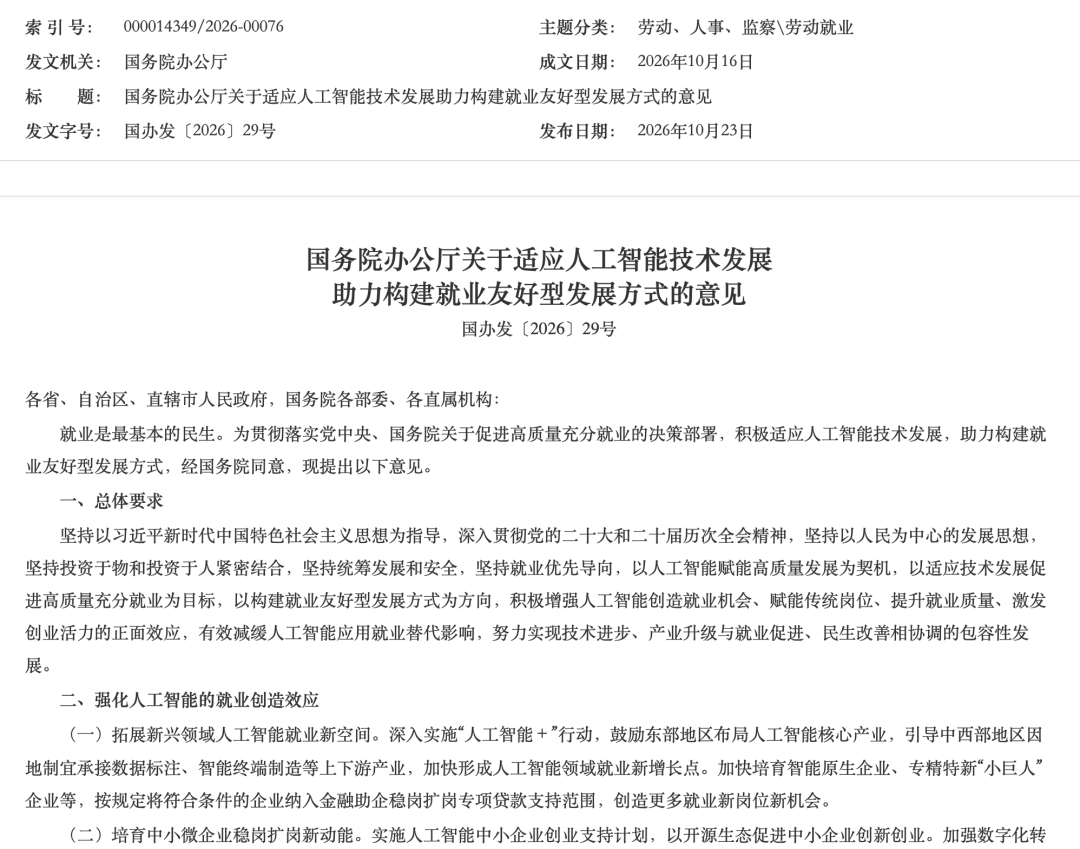
Also on this day, the General Office of the State Council issued the "Opinions on Adapting to the Development of Artificial Intelligence Technology to Foster an Employment-Friendly Development Model," which explicitly calls for "effectively mitigating the employment displacement impact of AI applications" and "carefully managing the scope, intensity, and pace of AI applications in labor-intensive industries to minimize the impact on workers."
On one side, AI has officially obtained its 'identity card' in the theatrical market, with virtual characters created by generative AI moving from short videos and mini-dramas on small screens into the core arena of traditional film and television. On the other side, top-level policy design has begun sounding the alarm on AI-driven employment displacement.
Caught in between, the acting industry, with millions of practitioners, is undergoing a brutal reshuffling, with AI drawing a clear line of disruption across the sector.
Above this line lies the complex art of performance, relying on life experience, emotional depth, and improvisational expression. Below it lies standardized performance labor that can be broken down, described, and repeated.
The vast majority of grassroots performers find themselves below this line, bearing the brunt of the technological wave.
This article is a in-depth piece from the Wave Trends content team. Feel free to follow us across multiple platforms.

The Chill
Even A-list celebrities at the pinnacle of the film and television industry are feeling the chill.
In July 2026, Golden Bell Award-winning actor Mark Chao admitted in an interview with *People* magazine that he had only received 10 script offers in the first half of the year, a stark contrast to his peak days when he would receive that many in a single month.
Similar anxieties plagued Jia Nailiang. In June 2026, he faced questions from netizens during a livestream about why he was focusing on live commerce instead of acting, bluntly stating, "There are no roles available." This classically trained actor, once a recipient of the Huading Award, described his awkward predicament: "Not qualified for elder roles, not young enough for idol parts," with fewer and fewer directorial offers coming his way.
A notable scene of celebrities collectively "job-hunting" unfolded at the Weibo Movie Night in June 2026. Stars like Dong Zijian, Liu Haoran, and Cheng Xiao were less concerned with awards or red carpets, instead frequently courting directors and producers on site, "hoping for more work opportunities."
If top-tier actors still have the spotlight to advocate for themselves and seize opportunities, then extras and grassroots performers in the lower echelons of the industry often lack even a voice.
The most dramatic changes occurred in Hengdian. In the first quarter of this year, the number of short drama productions in Hengdian plummeted by three-quarters year-on-year, with previously in-demand studios now facing vacancy rates approaching 80%.
During the peak in 2025, extras would line up at the Actors Guild before dawn, with more job offers than they could handle. By 2026, the guild's entrance often stood empty. Official data shows that while over 150,000 "Hengdian drifters" are registered, only 700 to 800 effective job notices for general extras are released daily.
China Newsweek reported in August that over 60% of grassroots actors have been virtually without income since the Spring Festival, with some switching to food delivery, others returning to their hometowns, and some setting up street food stalls in Hengdian itself.
More notably, the short drama industry, once a booming sector just two years ago, has seen a dramatic downturn.
Previously, top short drama actors could command daily salaries ranging from 50,000 to 100,000 yuan, with mid-tier actors earning a stable 1,500 to 2,000 yuan per day. However, by 2026, daily salaries for top actors had plummeted to around 10,000 yuan, while mid-tier actors saw their pay slashed to 500 to 800 yuan. The pace of industry contraction has far exceeded expectations, with one leading short drama company that signed over 200 actors in 2025 having terminated contracts with more than half by 2026, leaving most remaining actors in a semi-unemployed state.
As live actors continue to exit the stage, AI actors are striding confidently into the spotlight.
In March 2026, Youku Media, known for producing hit live-action dramas like *Home* and *The Nine-Fold Purple*, suddenly announced the signing of two AI digital artists, Qin Lingyue and Lin Xiyan, simultaneously launching the AI drama series *Qinling Bronze Mysteries*. These digital artists not only have their own film and television works but also maintain social media accounts on platforms like Douyin and Xiaohongshu, updating daily life and accepting business collaborations just like human artists.
Subsequently, companies like Yuxiao Media followed suit, signing AI actors and introducing digital artists into the film and television production system on a large scale.
The number of AI-powered short dramas in China has exploded. Data released by the China Network Audio-Visual Association shows that in the first quarter of 2026, approximately 128,000 micro-short dramas were released industry-wide, of which 122,000, or over 95%, were AI-generated.

The Crush
The primary factor enabling AI to nearly take over the short drama industry in just one year is undoubtedly cost.
Previously, the production model for traditional live-action short dramas was well-established: a typical production cost ranged from 500,000 to 1 million yuan, with a standard crew of 40 to 50 people and a production cycle of two to three months from casting, set construction, filming to post-production.
Technological advancements have shattered these cost barriers. In the industry, even the lowest-end assembly-line AI short dramas can now produce 80 episodes with a budget of 3,000 to 5,000 yuan, a team of three people, and a production time of just five days. High-quality AI short dramas typically cost 100,000 to 200,000 yuan, with a production cycle of 7 to 14 days and teams of only 3 to 8 people.
The wildly popular *Zhanxiantai Live-Action AI Version* earlier this year provides clear numbers: a 12-person team, a 30-day production cycle, and 100,000 yuan in computing costs, resulting in a total production cost just one-fourth that of a comparable live-action short drama. When factoring in hidden costs like actor scheduling, location rentals, and reshoots, AI's cost advantage becomes even more pronounced.
Behind this cost collapse lies technological progress that has crossed critical usability thresholds.
From late 2025 to early 2026, mainstream video generation models achieved collective breakthroughs in character consistency, lip-syncing, and camera work. They can now reliably produce content in genres like fantasy, post-apocalyptic, and period pieces, with visual quality reaching "short drama usable" standards.
With technology no longer a barrier, capital and platforms naturally gravitate toward more efficient, lower-cost production methods.
The inherent "fragility" of live-action short dramas also makes them vulnerable to AI disruption. Since their inception, short dramas have faced criticism for formulaic plots, stereotypical performances, and functional character roles.
In most short dramas, character functions are nearly fixed: villains exist to be arrogant and humiliated, subordinates to nod in agreement, elders to pressure about marriage, and bystanders to exclaim and stir up trouble. These characters require no complex inner lives or layered emotions—they simply need to stand in designated spots, deliver designated lines, and fulfill a plot twist or punchline.
Such short dramas essentially reduce acting to mechanical, repetitive labor. In AI's logic, this labor can be clearly broken down into three modules—actions, expressions, and dialogue—that can be standardized and infinitely repeated. "Standardized description" is precisely what generative AI excels at.
When a character's entire value lies in delivering three lines and making an angry expression, using AI or a live actor makes virtually no difference to audiences but can save producers over 90% in costs.
Under such circumstances, replacement becomes almost inevitable.

The Space
To resist AI encroachment, practitioners must focus on the actor's craft. Complex performances above the disruption line remain exclusively human territory.
Current AI can precisely execute basic emotions like frowning, tears, laughter, and anger, as well as standard actions like walking, turning, and fighting on command.
However, it struggles to replicate the layers of complex emotions or capture the nuances of improvisational reactions. It cannot accurately perceive the inner turmoil beneath Shu Rou's calm expression upon learning of her husband's remarriage, nor replicate Xu Fu's emotional outburst after witnessing his friend's death. These represent the true barriers of acting as a profession.
This logic applies across industries. The disruption line drawn by AI targets standardized, repetitive labor—not the professions themselves.
Take the translation industry. Before generative AI, translating standard business letters, product manuals, and daily news constituted the primary income source for vast numbers of junior translators. Today, AI's accuracy in translating standardized texts exceeds 95%, with costs less than one-tenth of human translation per thousand characters and delivery efficiency dozens of times higher.
The *2026 China Translation Industry Development Report* released by the Translators Association of China shows AI's significant substitution effect on junior translators. However, the report also notes that over 40% of companies still require mid-to-senior-level translation talent, with "high-level professionals becoming even scarcer due to their irreplaceability."
Consider the customer service industry. Gartner research shows that by 2026, conversational AI will have reduced call center labor costs by approximately $80 billion. Standardized roles handling order inquiries, password resets, and basic consultations now face substitution rates of 85% to 90%.
Yet simultaneously, human agents handling high-end complaints, complex disputes, and customized needs have not diminished—they've become even more critical, tasked with resolving issues beyond AI's capabilities and managing more complex user emotions.
While technology eliminates low-end labor, it raises thresholds for higher-level professions. In a sense, AI doesn't just take jobs—it screens for talent.
For actors and other professionals genuinely threatened by AI, this may represent the worst of times. But above the disruption line, certain things will always remain beyond technology's reach.
-
[Insight] The airbag control unit (ACU) is a core component of automotive passive safety systems, with numerous market participants in China.
-
![]()
Grassroots Actors, the First Casualties of AI | Wave Trends
-
Anthropic's Nasdaq Rush: The AI Wealth Creation Narrative Faces Reality Check
-
![]()
Another Surge in Prices to Blame! Mid-Range Smartphones in 2026 Fall Short: Telephoto Cameras Vanish, Main Cameras Degrade
-
![]()
Can AI-Generated Actors Outshine Human Stars? Hollywood is Deeply Split
-
China’s AI is Dominating: Token Usage Hits 48% of Global Total, 4.5 Times That of the U.S.?
-
![]()
Doubao and GPT Compete for FDE Roles with Million-Dollar Salaries: What Makes This 'Most Valuable Work Badge' So Expensive?
-
China Manufactures 35.8% of Global Automobiles, Outpacing the Combined Output of the U.S., Japan, India, Germany, and South Korea!