Behind Qoder: Alibaba Cloud's Application Dilemma
 10/30 2026
 451
The news of tech blogger Huang Fengda leaving Qoder has been publicly reported. On X, this Qoder team member thanked his partners who worked on the product and explored AI programming together, then lamented: "It's really too hard to make a good product at Alibaba." In his view, more challenges come from "beyond technology."
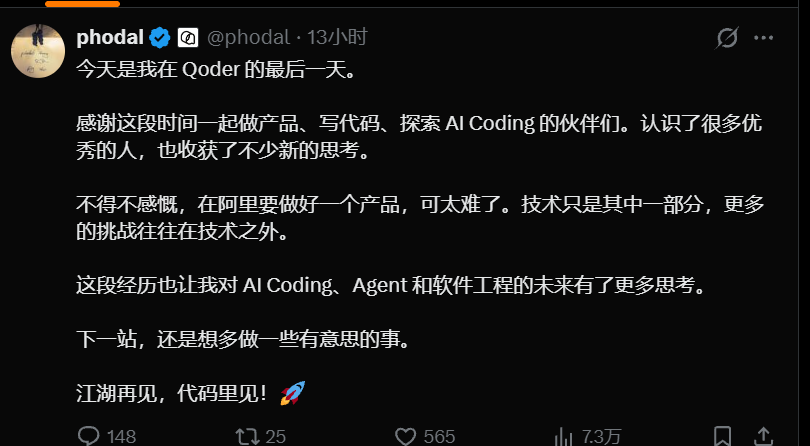
Huang Fengda talked about the difficulty of making a good product in his farewell post
By the time he left, Qoder had already built a business with enterprise customers. At the September 2026 Yunqi Conference, Qoder disclosed that the product's annualized recurring revenue had reached $100 million. Official data from May showed that enterprise customers contributed 70% of revenue.
With achievements in commercialization, the product's boundaries are still being adjusted.
At the end of the year, Qoder made the Quest standalone window the core design of the new version, letting users define tasks and direct agents to work within it. Five months later, this window entered the retirement and migration process. In the September announcement, Alibaba Cloud arranged two migration routes for QoderWork: development-related scenarios are recommended to use the Qoder desktop version, and office scenarios are recommended to use Qwen Office.
With product adjustments, the entry points, accounts, and purchasing relationships for users have also changed.
It's impossible to trace the connection between the issues phodal mentioned and the product itself, but Qoder is actually facing a business choice: after the product expands, who will take over the work of existing users in the long term. The cooperation between Alibaba Cloud and DingTalk once publicly presented another side of this issue—applications can help the platform grow, and they also have their own customers and business. In other words, whether the dilemma of the cloud-DingTalk integration will reappear in Qoder.
01 Programming tools begin to compete for the entire workbench
Qoder's initial promise to developers was relatively easy to understand.
It can read code repositories, help users understand projects, and then hand over complete development tasks to agents through Quest. Developers come in with existing projects and clear requirements, and finally check whether the modifications can be delivered.
Users quickly brought this type of capability into more work. In September 2026, Zhang Liaoyuan, head of Qoder at the ATH business group, said at the Yunqi Conference that more than 30% of the product's users are no longer professional developers, and more than half of the tasks are not directly related to writing code.
Code can generate web pages, and can also organize data and process documents. For many people, programming is just one step in completing work.
However, using the same underlying technology, the final deliverables may be completely different. When engineers ask agents to process data, they may also need to check the program, run tests, and then merge the code into the project; when operations staff process the same data, they may just want to get a table they can continue editing. The former needs to preserve a maintainable program, while the latter needs to continue completing a report.
Huang Fengda discussed this issue in an August article. He extended the agent's work objects to documents, slides, and 3D models, advocating that humans and AI collaborate around continuously changing artifacts. If a user manually edits a slide, the agent must understand the new content and state in the next round of work; chat logs alone can no longer restore the entire work process.
The work after generating files thus entered the product scope. Users will modify, review, return, and continue modifying. Supporting these operations means the product must save versions, understand human changes, and bring them into the next execution.
Peers are also extending their service scope. In September 2025, Cursor added Plan Mode in version 1.7, letting users check and modify the plan before starting execution. In September 2026, it launched the beta version of Projects, where a coordinating agent assigns tasks and lets project knowledge sync across different execution environments.
Planning before execution and delegating complex tasks now have multiple providers. Competition further extends to the follow-up work of projects: after one modification is completed, can the accumulated knowledge continue to be used, and where does the next round of tasks begin.
Qoder expanding its target audience is not just facing the demand for generating files. Supporting one more file format is often just the beginning. After users put real work into it, the product also takes on subsequent modifications and collaboration. The feature list can grow quickly, but serving a type of user is a long-term expense.
02 Migrating entry points also affects purchasing decisions
On September 8, Alibaba Cloud released an adjustment announcement for QoderWork, announcing that the product will gradually cease operations, with the final shutdown date being September 5, 2027. The announcement left users migration time and also listed two continuation options.
For scenarios such as R&D, testing, design, and product, migration to the Qoder desktop version is recommended. The original account and subscription benefits can be retained, task records, skills, and memory support import, and enterprise organization permissions and configurations also have arrangements for continuity.
For office scenarios such as document generation, data analysis, information research, and web page creation, migration to Qwen Office is recommended. The desktop version supports importing chat records, skills, and scheduled tasks, but it uses an independent account and benefits system, and users must re-register; credits are not interoperable, original benefits are refunded according to the process and then purchased separately, and organizational data must also be migrated separately.
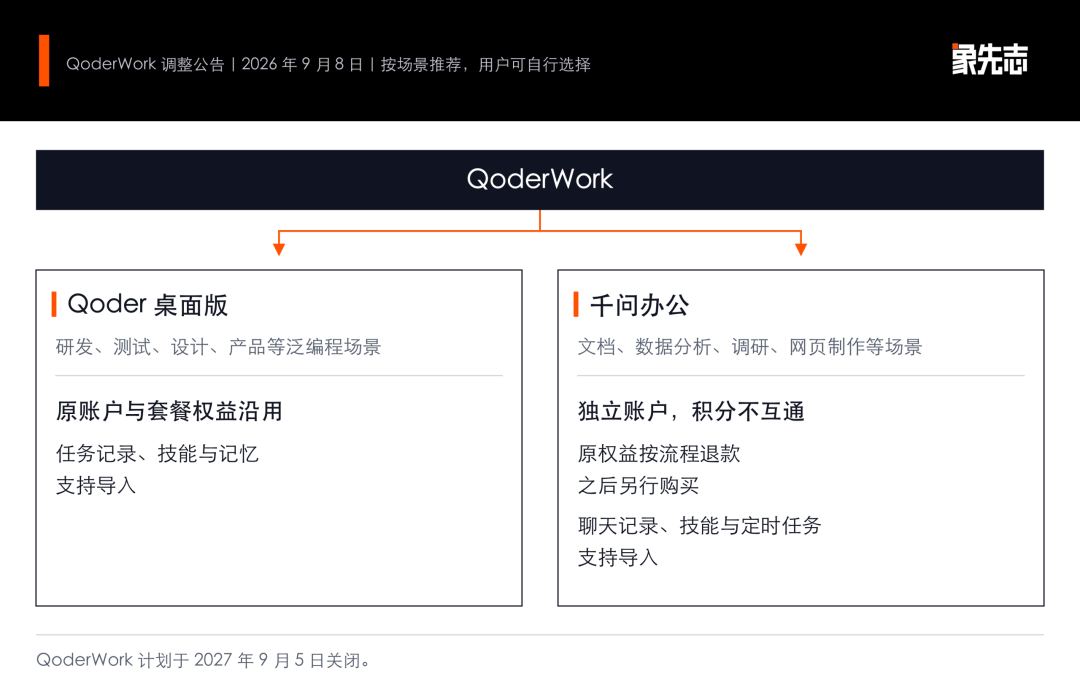
The QoderWork announcement provided two recommended migration routes
The all-new Qoder desktop version launched at the end of August is still expanding some of its office capabilities. On September 18, ten days after the migration announcement was released, the version update added conversation-based website building, supporting preview, publishing, and management of websites on the desktop, as well as direct editing and saving of PPTX files.
Web page creation was listed among the scenarios recommended for migration to Qwen Office, while the new Qoder is also improving the same type of capability. "Office" and "general programming" still overlap in actual functions, so the division of labor in the announcement cannot simply be explained by what the two products can each do.
The migration route also determines whether the original subscription can be directly retained. Choosing Qoder allows continuation of original benefits; choosing Qwen Office requires converting the purchasing relationship. The functions still exist, but the way users continue to use them has changed.
Development and office work may indeed be suitable for different products. The two types of work have different emphases on permissions, context, and delivery methods, and designing them separately may improve the experience. For users who choose Qwen Office, registration, refunds, and organizational data migration are the time costs they must pay before obtaining the new service. These steps are also part of the cost of product adjustment.
The change to Quest is closer to an entry point migration. The official retirement date for the standalone window is October 15, while capabilities such as the editor and Agent of the old IDE continue to be retained, and task-oriented users can move to the new Qoder and continue using their accounts and benefits. However, historical data still must be imported, and mobile remote connections must be re-established.
During the same period, Claude was doing another kind of integration.
On September 16, Anthropic announced the merger of Chat and Cowork. The announcement explained that users often are unsure which entry point a task should be placed in, and work started in one place is also difficult to continue in another. It promised to retain original projects, tasks, connectors, and skills after the merger, allowing users to continue working in the same conversation.
This integration still retained the Code label and also left some limitations, for example old Cowork tasks are temporarily not included in search. Professional work retains an independent entry point, while general tasks share existing accumulation as much as possible—this is the trade-off Anthropic made this time.
TRAE is also reorganizing its products. The current China version enterprise documentation announced that TraeCode and TraeWork are merged into the all-new TRAE, extending services around engineers to requirements analysis, testing, and technical documentation, while retaining both Agent and IDE working modes.
Peer adjustments show that Agent products are still searching for the appropriate form. As products are re-divided, users also rearrange their own work accordingly.
03 Selling cloud and selling software have two business standards
In August 2023, DingTalk announced that it would no longer be managed by Alibaba Cloud and would further develop independently. Caijing previously pointed out that under the cloud-DingTalk integration strategy, DingTalk, as an upper-layer software platform, bore the task of driving Alibaba Cloud resource consumption.
But after stumbling around outside, DingTalk still returned to Alibaba Cloud.
The cloud business sells basic resources, while DingTalk relies on software subscriptions and continuous services; the business logic and assessment standards of the two differ. The arrangement after independence reported was that the two sides would continue to cooperate in an equal and market-oriented manner, with Alibaba Cloud still a sales channel and technical support, while DingTalk would prioritize developing its own business.
This cooperation had clear common interests. Alibaba Cloud provided operating conditions and customer channels, and DingTalk turned cloud resources into services customers use directly. After the adjustment, cooperation continued, and the software business also had a clearer business position.
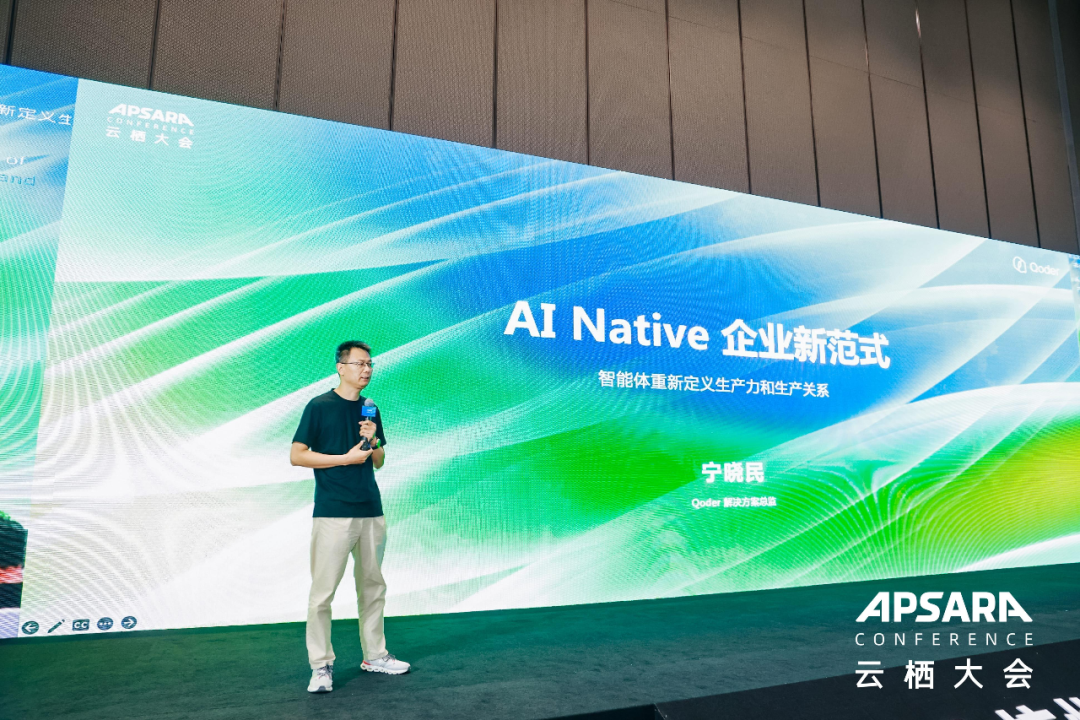
At the 2026 Yunqi Conference, the Qoder team introduced enterprise-oriented agent applications
When enterprises purchase work software, they also bring the platform opportunities to reach customers and provide cloud-based operating services. This kind of cooperation can expand the application's market.
Qoder product line president Ding Yu has long worked in cloud infrastructure. In a public interview, he said the team invests the most in infrastructure, specifically including joint optimization of models, context, and Harness. Harness organizes agents to call tools and execute tasks; how much model capability can be realized is directly related to this execution system.
Therefore, infrastructure experience can be transformed into product advantages. With better model adaptation and more reliable execution, users have the opportunity to reduce rework. Technology and product experience share a common goal here.
Platform cooperation also has work it cannot replace. A shared execution system can support multiple applications, and the cloud marketplace can provide procurement channels, but which product the subscription a user has already purchased belongs to and where historical projects migrate are still determined by specific service arrangements.
The QoderWork announcement actually explained this issue. Both routes have products to take on tasks, but only one route allows benefits to be directly retained. For users who choose Qwen Office, migration includes a refund and a new purchase. Changes in product division of labor thus entered the customer's procurement process.
The history of the cloud-DingTalk integration shows that when applications cooperate with platforms, the software business's own operating goals also affect organizational arrangements. Looking at Qoder today, discussing Alibaba Cloud's application capabilities requires looking at what technology and channels have brought, and also at how product adjustments handle already-established customer relationships.
After enterprises purchase, teams will configure permissions, accumulate projects, and also invest time in learning the software.
QoderWork plans to close on September 5, 2027. There is still time for users to choose where to go before that date. But Alibaba Cloud's software dilemma actually remains—previously it was cloud-DingTalk, later Qoder, and whether Qwen Office will be next is also unknown.
-
![]()
When Every Company Dons the AI "Hat"
-
![]()
Toy Giant ZURU Moves China HQ to Shenzhen's China Resources Tower with 30,000 sqm Lease
-
![]()
SDD Spec-Driven Development Tutorial — The More Features You Add, the More AI Starts "Making Things Up"
-
![]()
Xpeng MONA's Three Models Overlap in Price Range of 119,800 to 176,800 Yuan, Beginning to Compete with Themselves
-
![]()
Avatr Cancels Launch Event: Carmakers Spend 8.12 Million Yuan on a Grand Show, Yet 87% of New Cars Peak in Their First Month
-
![]()
XPeng Robotaxi Cleared for Full-Area Demonstration Operations in Guangzhou — the Real Test Has Only Just Begun
-
![]()
BYD Enters the Million-Employee Era: The World's Largest Automaker by Headcount
-
![]()
Tesla's Q3 Earnings: Profits Halved, Yet the Stock Rose—Here's Why