67 Billion! Zhang Yiming Solidifies His Position as China's Richest Person
 10/30 2026
 560
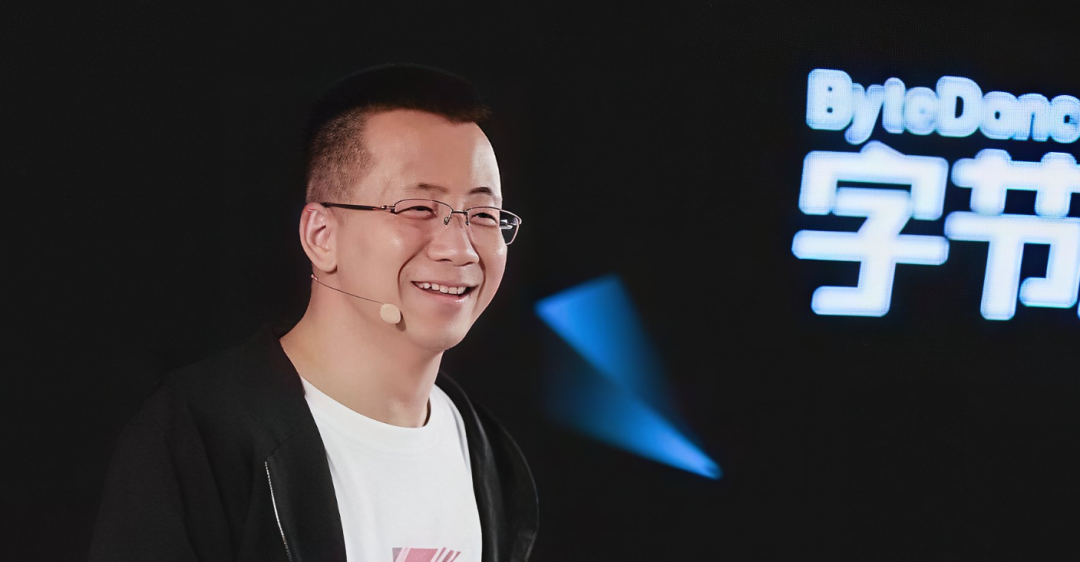
A gain of 200 billion yuan in a single year has once again placed Zhang Yiming at the top of China's wealth rankings.
The 2026 Hurun Rich List was released recently. Zhang Yiming, aged 43, has topped the list for the second time with a fortune of 67 billion yuan, setting a new wealth record for China's richest person.
Hurun attributed this round of growth to ByteDance's progress in its AI business and the company's rising valuation. Wealth was calculated as of September 1, and the ranking reflects estimates at that point in time.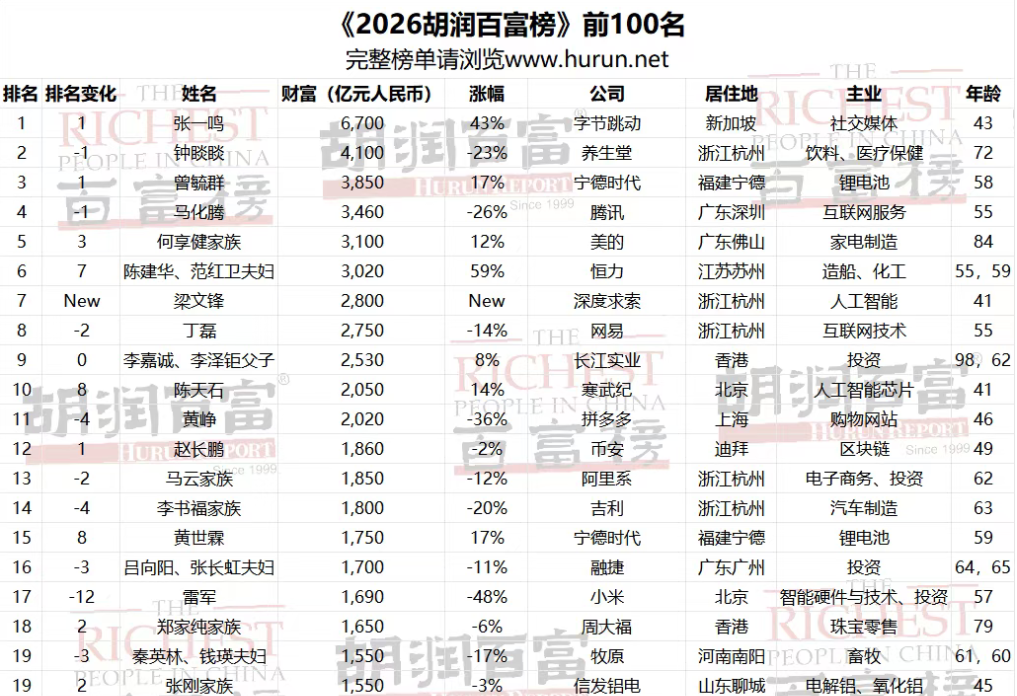
What the outside world sees is the rise in net worth, but the business behind it is more worth studying. ByteDance has already turned content recommendation into a major business and is also investing resources in AI. Today's revenue supports the next round of investment, and new products are striving to capture new users. Zhang Yiming's acumen is reflected in his judgment of shifts in user habits.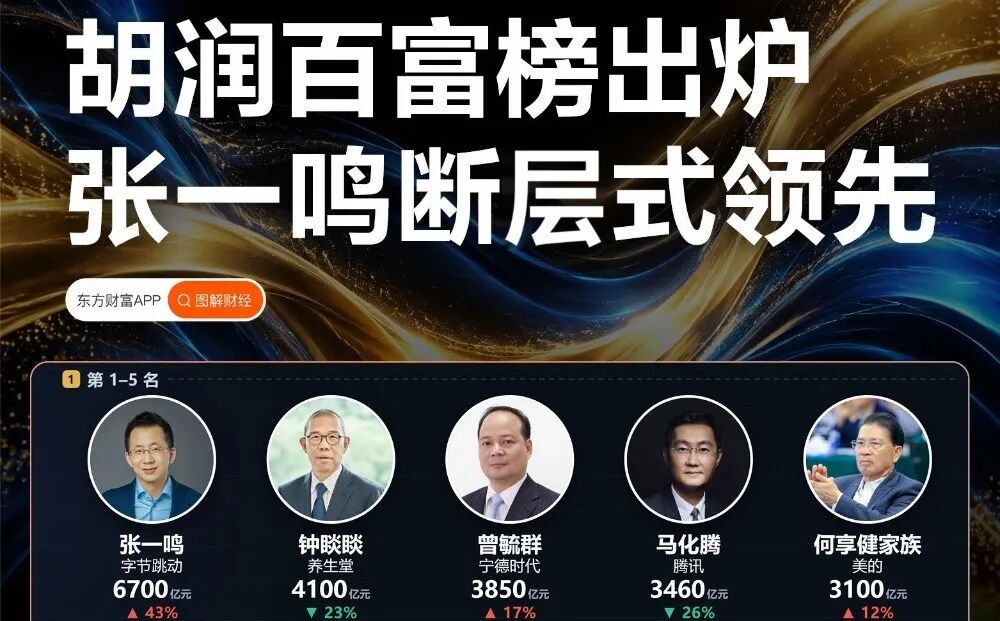 Excerpt from the East Money list image|Original image source see

Four Richest People in Ten Years
From 2017 to 2026, the top spot on the annual Hurun Rich List was held successively by Xu Jiayin, the Ma Yun family, Zhong Shanshan, and Zhang Yiming. The changes over the past decade have left a clear trajectory of business opportunities in real estate, the platform economy, consumer brands, and new technologies.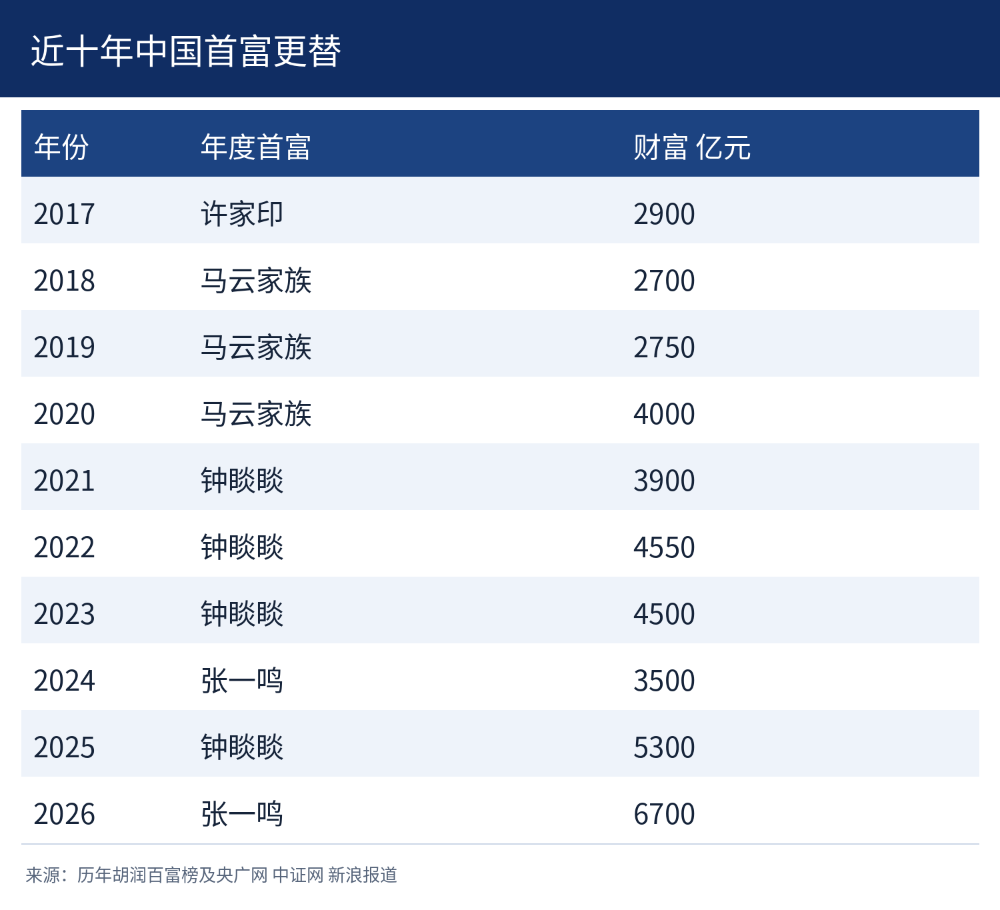
Xu Jiayin topped the list in 2017 with 290 billion yuan, and the Ma Yun family then ranked first for three consecutive years.
From 2021 to 2023, Zhong Shanshan topped the list for three consecutive years. In 2024, Zhang Yiming became the richest person for the first time; in 2025, Zhong Shanshan returned to first place; and this year Zhang Yiming led again. The table uniformly uses the annual rich list, and the names of individuals and families retain the wording used in each year. Changes in the list are affected by business operations as well as factors such as stock prices and valuations of unlisted companies.
The industry rotation among the richest people provides a perspective for observing business opportunities. As for how long a business can last, it still depends on whether it can continuously meet demand and recover its investment.
Zhong Shanshan's repeated top rankings show that brands and channels still carry weight. Zhang Yiming's renewed lead allows the market to see the expansion capability of digital products: the same set of technology and products can serve more users and continue to seek revenue in new scenarios.
Wealth Growth Mainly Relies on ByteDance Equity
Zhang Yiming's wealth mainly comes from ByteDance. To understand this net worth, one must first understand equity valuation: when investors are willing to pay a higher price for a company, the estimated value of the founder's shares increases. The growth on the wealth list and how much cash an individual actually received that year are two different measures.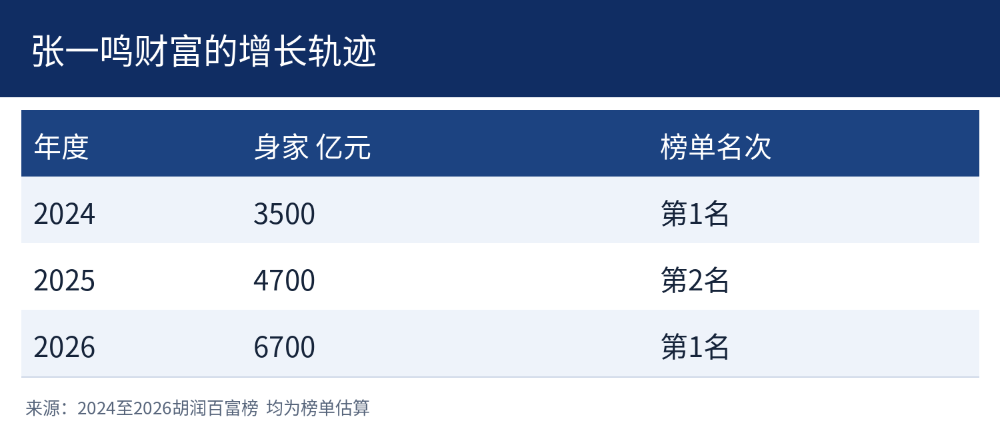
From 2024 to 2026, his wealth on the list was 350 billion yuan, 470 billion yuan, and 670 billion yuan, respectively. An increase of 320 billion yuan over two years; calculated from these figures, the cumulative increase is about 91.4%. The increase from 2025 to 2026 is about 42.6%, which Hurun presents as 43% after rounding.
Old businesses and new expectations jointly support this round of revaluation. Douyin and TikTok give ByteDance a huge user base and commercial scenarios, while AI progress has raised the market's expectations for future businesses. A company's current ability to make money determines how many resources it has to invest; investors' judgment about the future affects the price at which equity is willing to trade.
There is still a lack of complete public disclosure regarding Zhang Yiming's entire personal assets, liabilities, and the exact proportion of each asset, and the final information should be based on authoritative announcements by the individual and relevant departments.
There is also a lack of verifiable breakdown for how much wealth increment each business contributes. In analyzing this wealth, the main line that can be confirmed is the change in ByteDance's equity value, and specific proportions should be based on formal disclosures.
Douyin's Business Continues to Grow
Douyin's commercial capability is built between content distribution and transaction opportunities. Users see products they are interested in, merchants gain potential customers, and the platform earns revenue through advertising and transaction services. E-commerce and local life services let users move from browsing content to placing orders and visiting stores. The key to whether this business can continue to grow lies in the business returns for merchants.
Only when merchants can sell and make the numbers work are they willing to continue investing. The platform also needs to manage the relationship among ad density, product quality, and user experience. Traffic can bring the first order, but long-term operations still depend on trust.
For ByteDance's latest operating scale, refer to a Cailianshe report on September 15: revenue in the first half of 2026 was about 120 billion US dollars, a year-on-year increase of about 30%; net profit fell to about 20 billion US dollars, and the report linked the profit decline to accelerated AI investment. At the time the report was published, ByteDance had not responded. These figures are media relays and have a lower degree of public confirmation than the company's official financial reports.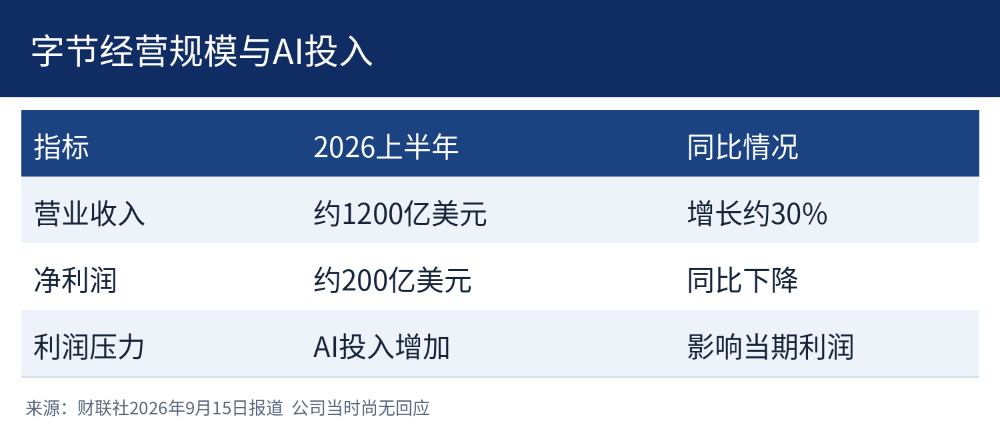
Looking in the direction provided by the report, ByteDance is bearing the cost of expanding AI investment.
After capital is invested, whether products can retain users and whether revenue can cover service costs will affect long-term returns. For a company that already has large-scale businesses, continuous experimentation is both affordable and costly.
TikTok provides overseas growth opportunities. The commercial logic of advertising and e-commerce has similarities, but specific operations must adapt to local merchants, logistics, and user habits.
Regulatory requirements, business arrangements, and related costs will also affect overseas returns.
Doubao May Become the Next Growth Driver
AI demand is expanding.
A report by the China Internet Network Information Center shows that as of the first half of 2026, the number of generative AI users in China exceeded 700 million, with a penetration rate of more than 50%. This provides a broad market for ByteDance's new products and also means that competitors are all competing for the same group of users.
QuestMobile's third-quarter report shows that in September 2026, the monthly active users of the AI-native apps Doubao, Qianwen, and DeepSeek were 419 million, 158 million, and 123 million, respectively. These figures measure active user scale; paying users, revenue, and profit need to be observed separately.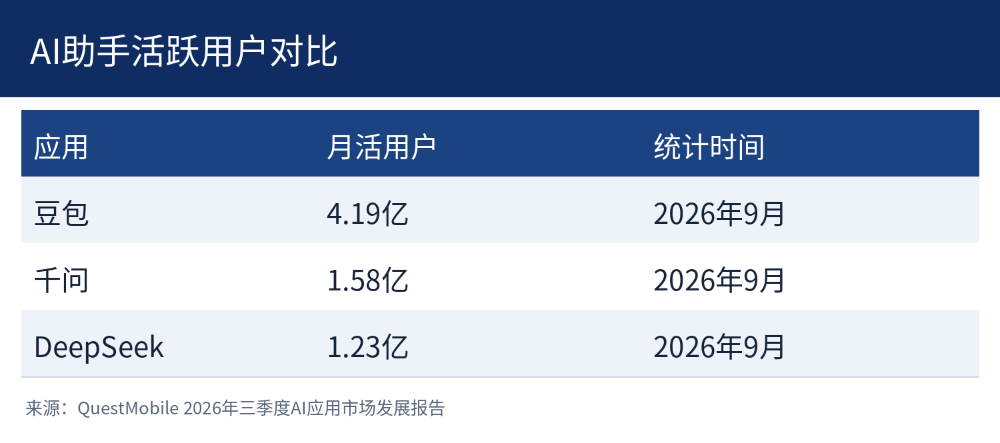
Doubao has already accumulated user scale, and next it needs to give users more stable reasons to use it. Answering questions is only the beginning; organizing materials, handling work, and assisting creation may all increase usage frequency. Every time results are more accurate and operations are more convenient, it helps retain users. The enterprise market provides another way to charge.
Volcano Engine provides cloud and model services to enterprises, Feishu serves enterprise office work, and creation tools connect content production. The value of these products can be measured by how much time is saved and how much output is increased. Only when customers are willing to continue paying can technological investment have a chance to form stable revenue.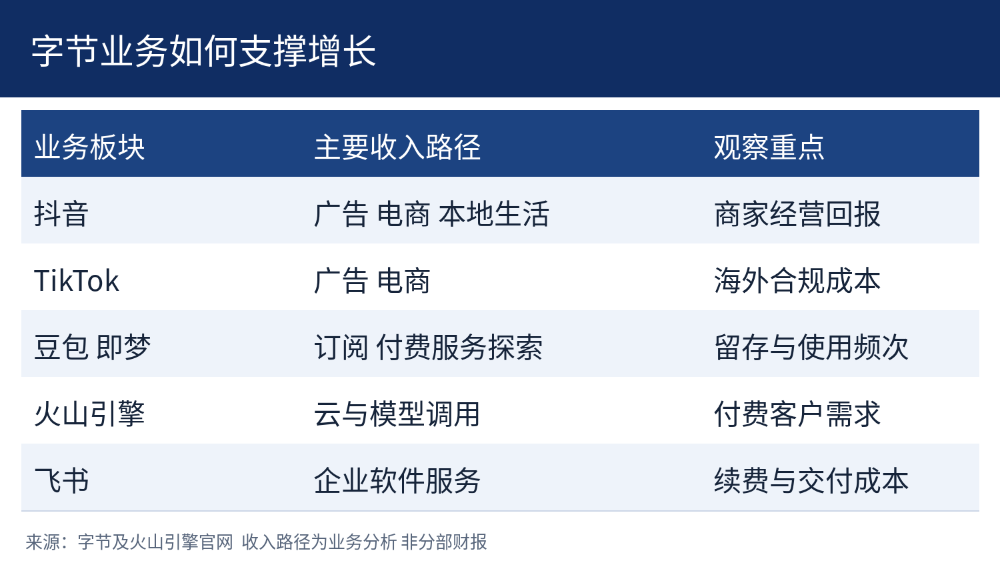
There is also practical room for business synergy. Model capabilities can be used in multiple products, creation tools can help merchants produce materials, and enterprise services can undertake more complex work needs. Whether this room can be realized depends on product reliability, service costs, and customer renewals. Optimistic expectations for ByteDance's future should be built on improvements in these operating indicators.
What Zhang Yiming Makes Us Think About
From Jinri Toutiao to Douyin and TikTok, ByteDance captured changes in people's habits of obtaining information and watching content.
Now AI is changing the way people find answers and complete work, and ByteDance continues to participate. This ability to continuously seek opportunities is an important clue for understanding Zhang Yiming's business judgment. His business sense is worth learning from in concrete matters. Observe how users use products, understand what problems technology can solve, and then turn judgment into verifiable attempts. If feedback is good, continue investing; if problems arise, adjust the method. Whether an idea can become a business ultimately has to be tested by users' choices.
At the same time, ByteDance's current operating results come from the entire organization. The founder's early judgment, the current management team's operations, and employees' continuous product improvements jointly support the company's development. Only by placing achievements back into these concrete efforts can successful experience have reference value. 67 billion yuan records the height of Zhang Yiming's wealth at this moment.
ByteDance's longer-term value still depends on products winning users again and again. Businesses such as Douyin give it the conditions to continue exploring, while AI brings new growth opportunities. Zhang Yiming has already demonstrated acumen in discovering changes, but turning opportunities into a long-lasting business still requires patience, investment, and solid execution. What do you think about the topic of Zhang Yiming's personal wealth continuing to surge? We look forward to your civilized and rational comments in the message area.
Statement: This article is only an analysis of financial hotspots. Data and materials are cited from public queries, company announcements, and Tonghuashun iFinD. The views are for reference only and do not constitute any investment or consumption advice. #FinancialHotspots #InDepthInterpretation #BusinessFinance #InvestmentBankingCircle #PrimaryMarket #IPO #AI #ByteDance #Doubao #ZhangYiming
-
![]()
When Every Company Dons the AI "Hat"
-
![]()
Toy Giant ZURU Moves China HQ to Shenzhen's China Resources Tower with 30,000 sqm Lease
-
![]()
SDD Spec-Driven Development Tutorial — The More Features You Add, the More AI Starts "Making Things Up"
-
![]()
Xpeng MONA's Three Models Overlap in Price Range of 119,800 to 176,800 Yuan, Beginning to Compete with Themselves
-
![]()
Avatr Cancels Launch Event: Carmakers Spend 8.12 Million Yuan on a Grand Show, Yet 87% of New Cars Peak in Their First Month
-
![]()
XPeng Robotaxi Cleared for Full-Area Demonstration Operations in Guangzhou — the Real Test Has Only Just Begun
-
![]()
BYD Enters the Million-Employee Era: The World's Largest Automaker by Headcount
-
![]()
Tesla's Q3 Earnings: Profits Halved, Yet the Stock Rose—Here's Why