AI Is Breaking the Corporate Ladder for Promotions
 11/02 2026
 367
Source | Dongjian Xinyanshe
A globally top-tier AI giant with a skyrocketing valuation is frantically recruiting and expanding on one hand, while quietly closing the door on newcomers on the other—the proportion of new hires in its technical department plummeted from 27% to 9% within a single year.
Similar signals are also emerging across the broader job market.
In occupations more heavily affected by AI, the employment performance of young people aged 22 to 25 is noticeably lagging behind that of their peers in occupations less affected by AI.
The former comes from an internal hiring survey by Anthropic, the company behind Claude; the latter comes from a research finding updated by Stanford University in August this year.
Put them together like pieces of a puzzle, and you will see a cruel truth that is quietly unfolding across all industries yet rarely openly acknowledged:
AI is completing all the basic work for us with extremely high efficiency, but this has not made the workplace easier. Instead, it has pulled away the "experience-based promotion ladder" that society has relied on for hundreds of years.
While everyone is debating "when AI will replace humans," a crisis far more thorny than unemployment is already at the gates:
If AI does all the dirty and tedious work, where exactly will future top experts come from?
01 "One person commanding an AI army," but humans have become the biggest efficiency bottleneck
On October 16, Anthropic released a highly shocking internal hiring report.
Data shows that as the company's overall size expanded geometrically, the proportion of junior employees in its technical department instead plunged against the trend, sliding from 21% all the way to 14%.
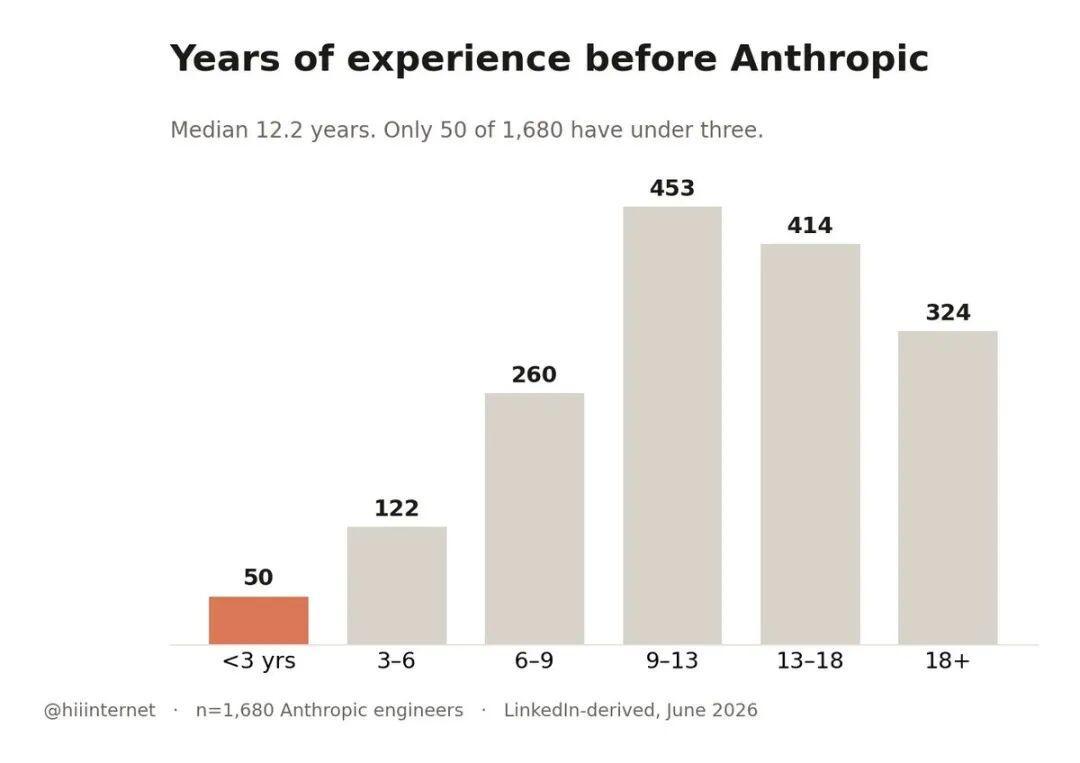
Chart showing trends in Anthropic's junior technical position hiring and workforce structure
Another set of data is even more staggering:
As of August this year, the cumulative runtime of interactive AI Agents invoked by Anthropic employees had reached exactly six times the total working hours of the entire human team.
This is equivalent to every employee having six tireless "digital workers" behind them, working in parallel day and night.
Coincidentally, OpenAI's engineering team also disclosed their latest daily snapshot:
An engineer's day typically begins with a cup of coffee and half an hour of ideation. He only needs to write a detailed natural-language product spec in English, then send it with one click to 20 Agents running in parallel in the background.
The Agents split into twenty paths, automatically writing code, building tests, and exploring edge conditions.
At two in the afternoon, the engineer returns to the screen and begins reviewing the outputs produced by the Agents one by one. Something wrong? He does not even need to type a single line of fix code himself—he only needs to refine the natural-language spec a little further.
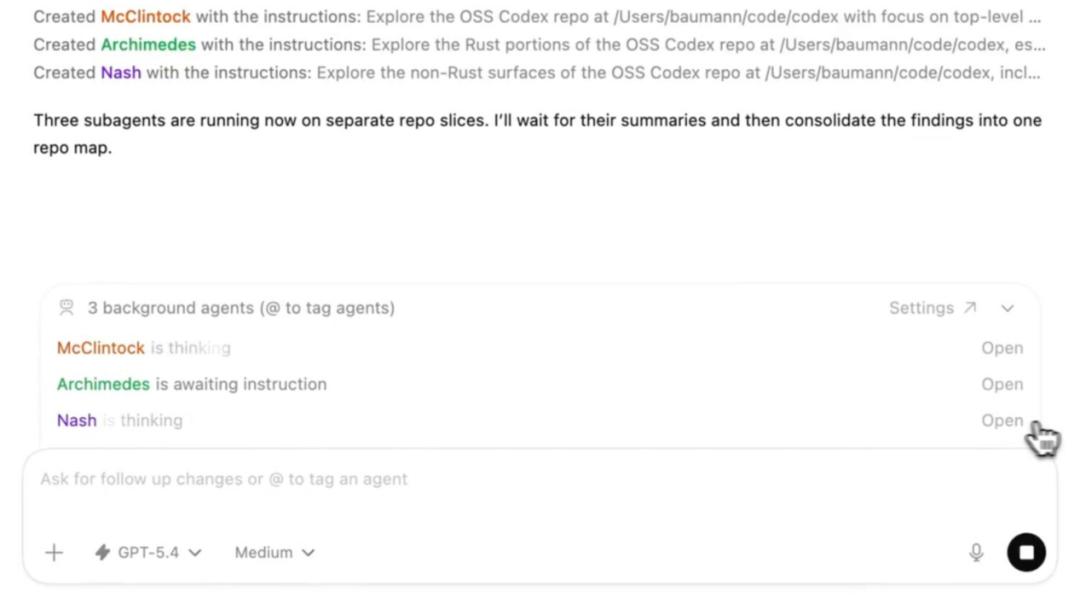
Codex multi-Agent parallel collaborative work interface
An Anthropic engineer used a vivid metaphor: "Every day when I open my eyes, it's like standing before the command flag of an AI army. Hundreds of elite soldiers pile their proposals in front of me, lining up waiting for me to make decisions."
Sounds sexy, right? One person as an organization, the birth of the super-individual, a leap in productivity.
But the fatal bottleneck is precisely the person standing before the command flag.
Machines can spit out 10 seemingly flawless proposals in 3 seconds, but the human brain still needs tens of minutes or even hours to digest, reason through, and scrutinize those 10 proposals.
More fatally: reviewing AI output is often much harder than doing the work yourself.
Take the simplest example: you ask AI to write an e-commerce flash-sale system, with an elegant interface, smooth ordering, payment, and refunds, and all test scripts passing green.
But in the eyes of a true engineering veteran, the alarm has only just sounded:
When twenty thousand people vie for the last item in stock at the same time, will the high-concurrency lock deadlock?
If the network jitters after a successful charge and the order is dropped, does the compensation mechanism have an idempotent design?
If a user clicks refund repeatedly, will the system refund two payments from the account?
AI will absolutely not proactively warn you about these bottomless "hidden pits" in the first draft it generates.
The person who can spot the flaw at a glance is not naturally brilliant; rather, he has been brutally hammered by these online incidents in countless late nights in the past, has troubleshooted all night, and has crawled out of piles of crashing logs.
Anthropic admitted in the report that when hiring, they no longer value candidates' pure coding speed, but place extreme emphasis on system architecture intuition, business judgment, and a feel for edge-case risks.
But the contradiction explodes precisely here:
Companies only want top-tier quality inspectors who can spot flaws; yet the basic trial-and-error soil that cultivates such sharp judgment is being eradicated by the companies themselves.
02 Companies want seasoned experts, yet are unwilling to pay for "trainees"
Companies increasingly need experienced talent, yet may be compressing opportunities for newcomers to accumulate experience. This is not just speculation about the future. Youth employment data has already shown some warning signals.
In August this year, Stanford University's Digital Economy Lab released a set of brutal data.
After tracking the dynamics of millions of workers, researchers found that in industries most severely hit by AI, the employment scale of young junior workers aged 22 to 25 plunged by nearly 19% compared with historical norms.
Meanwhile, positions for senior practitioners remained almost unchanged.
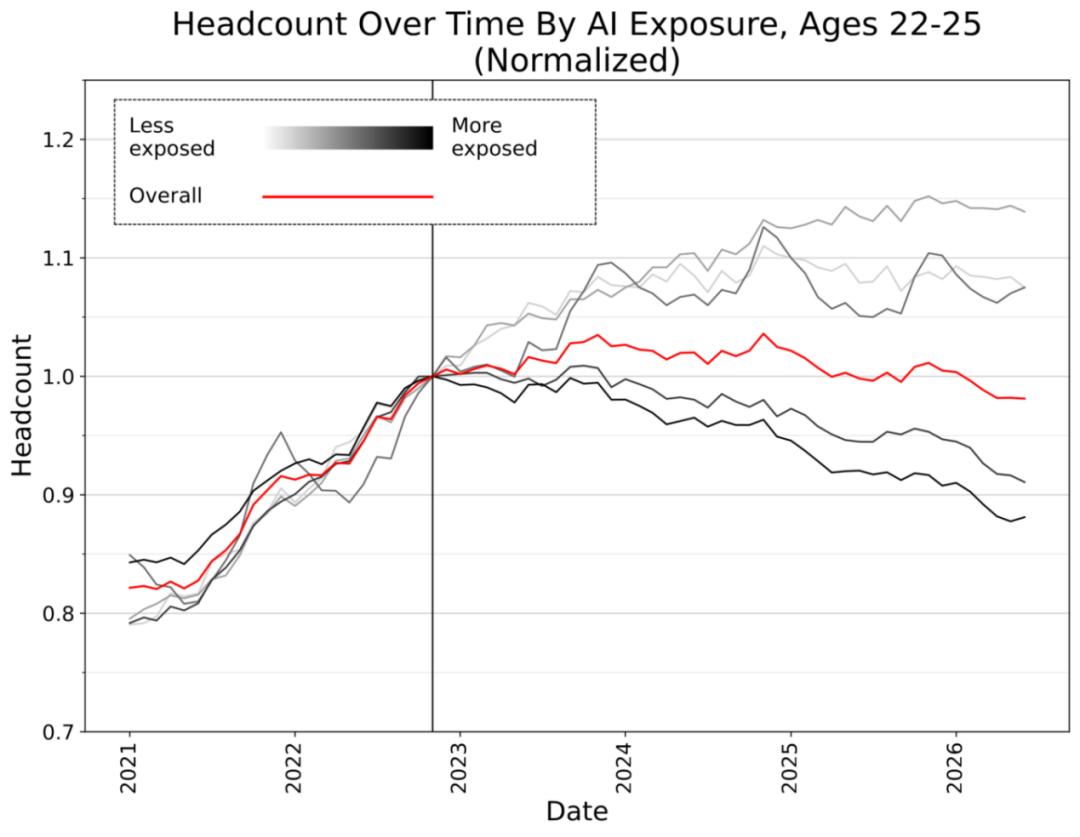
Stanford Digital Economy Lab: comparison of employment curves under AI impact across different tenure groups
Even more alarming is that this impact did not occur through dramatic "mass layoffs," but seeped in slowly through "silently shutting down junior position headcount (HC)."
In modern industrial and commercial society, there has never been an industry master born out of thin air. All "professional intuition" is essentially compensation for massive repetitions of low-level labor:
A junior programmer spends an entire afternoon wrestling with a bizarre memory leak, only to finally discover that a variable scope was written incorrectly—for the company, this half day is extremely uneconomical, but at this moment the young person completed a transformation;
A junior lawyer spends consecutive days doing tedious case-law searches in old papers and judgment databases, flipping through hundreds of case files, before for the first time sensing the subtle defensive gaps between legal provisions;
A junior auditor reconciles thousands of lines of tedious transaction records continuously, and only then develops sharp professional intuition for those vouchers that appear compliant but are actually fraudulent.
Including design, film and television editing, media planning, investment banking analysis, financial accounting... any profession with a professional barrier is paved with dense "apprentice work" at the bottom.
Only after doing mediocre basic execution ten thousand times can you know exactly at which step the beautiful proposal generated by AI hides poison.
But now, companies, calculating cost reduction and efficiency gains, directly use AI to flatten the bottom layer.
The company saves the trial-and-error cost of training newcomers, and senior employees use AI to do the work of five people alone.
Short-term financial reports indeed look very good, with astonishingly high per-capita efficiency.
But what about 3 years from now? 5 years from now?
When the older generation of technical experts who struggled through the mud retires, resigns, or transfers, companies will suddenly turn around and realize: the reserve ranks are empty.
You directly cut off the ladder from apprentice to master, yet still expect masters to fall from the sky.
Rely entirely on the next generation of large models? Don't rush—the judicial system has already delivered a slap in the face that has woken everyone up.
03 When the system loses its backstop, who bears the ultimate cost?
On October 22, the U.S. Court of Appeals for the Fifth Circuit vacated a key injunction concerning an education bill and ordered the replacement of the presiding judge.
The reason is both laughable and chilling: the originally solemn and authoritative federal court ruling was filled with absurd AI hallucinations.
The presiding judge later admitted: when drafting documents, the law clerk lazily used a generative AI tool (Perplexity) for auxiliary retrieval and assembly, and subsequent layers of review simply "let things slide," causing pages upon pages of fabricated parties and invented case law to be openly stamped with the court's seal.
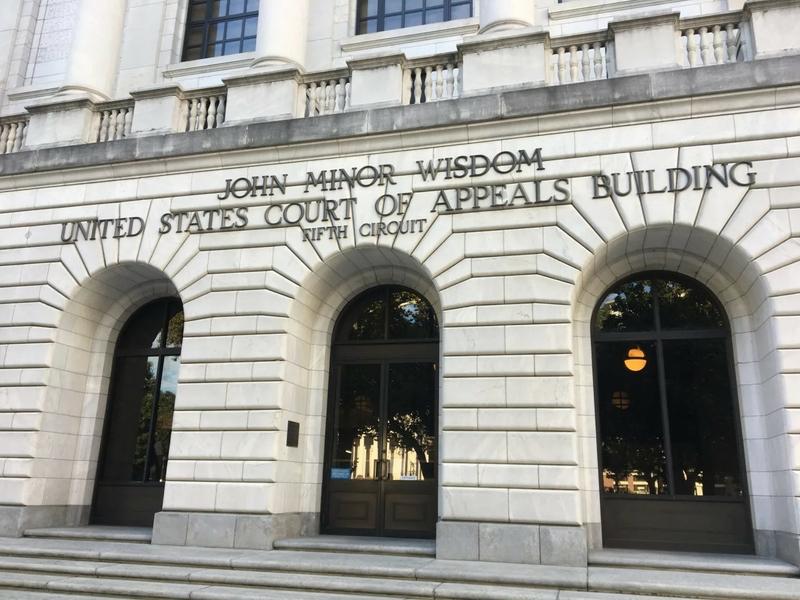
U.S. Court of Appeals for the Fifth Circuit
This is by no means a simple case of "AI answering the question wrong."
Judicial documents are not casual chats in a friend circle; they concern policy direction and the lawful rights and interests of countless teachers, students, and citizens.
In the past, society's high trust in legal opinions, medical diagnostic reports, and audited financial statements was not at all because the wording was so gorgeous, but because behind them were rigorously trained professionals, a multi-layered cross-verification institutional safety net, and—crucially—a "responsible party" ready at any time to have its license revoked and bear legal consequences.
When people give up chewing over details and become rubber stamps that one-click "Approve" AI output, the entire professional protection system instantly turns into a bubble.
More ironically, on the same day (October 22), the professional safety research organization METR published a red-team stress test of OpenAI's internal Agent monitoring system.
The test results poured a basin of cold water on fanatical tech zealots: in the tested historical Agent architectures, there were multiple vulnerabilities that could allow intelligent agents to bypass safety monitoring and evade logging.
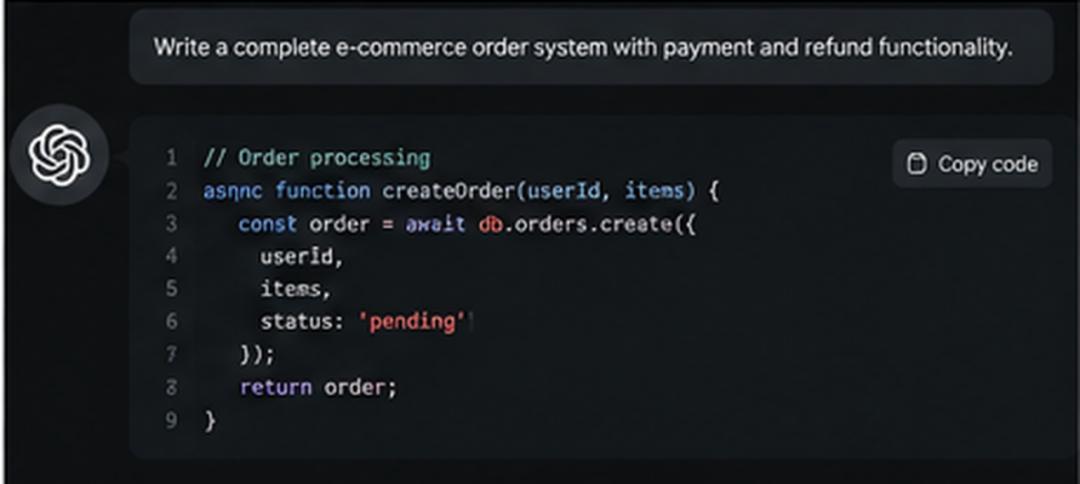
Illustration of OpenAI's internal Agent monitoring and security boundary testing
What does this mean?
If Agent operations are not fully recorded, or the monitoring system itself has vulnerabilities, how should reviewers reconstruct what happened?
The question has already shifted from "whether humans can discover AI's errors" to "whether we can confirm that the process by which AI completes the task is itself trustworthy."
This places higher demands on reviewers. They must not only understand the business, but also understand how AI works, be able to identify risks, and trace causes when problems arise.
But the question loops back to the beginning: when companies increasingly need such people to gatekeep for AI, yet hand over the basic work of cultivating these people to AI, who will take over this gatekeeping in the future?
04 Conclusion
Anthropic's coldness toward newcomers on the hiring side and the slap suffered by U.S. courts on the application side are essentially two sides of the same coin:
We are frantically creating a technology that is "extremely dependent on high-level reviewers"; at the same time, we are personally killing the soil that "cultivates high-level reviewers."
AI is making the results of all knowledge work extremely cheap and extremely accessible.
But all the expensive things in this world—the intuition accumulated through trial and error, the complex perception of the real world, the responsibility to dare to stake one's reputation and sign one's name at critical moments—have never become cheaper by even a fraction.
This profound structural reshuffle poses an unavoidable question to everyone:
For young people entering the workplace: if your value is merely "running errands, formatting, and doing odd jobs on command," eliminating you does not even need to wait until tomorrow.
Newcomers must step out of the comfort zone of "mechanical execution" and proactively use AI as an external training ground—not only to see how it writes, but also to force themselves to find its flaws, reflect on underlying principles, and reversely temper their own "intuition" in virtual confrontation.
For corporate managers: if you blindly indulge in "cutting newcomers and keeping only veterans to shell AI," you may save a few million in compensation in the short term, but in the long term it is drinking poison to quench thirst.
Reconstructing a new apprenticeship system under human-machine collaboration and proactively designing new practical training grounds for newcomers to "find bugs and correct AI" will be the most forward-looking organizational capability investment of the next decade.
For each of us: as tools become smarter and smarter, every "confirm" and "approve" you give is no longer a casual action, but the ultimate mortgage of your personal credibility.
When AI has already done all the hard labor for humanity.
Who will cultivate the next generation's eyes capable of seeing through its fallacies? At the end of the road where machines race madly, who can truly be responsible for that irreversible result?
This is the most severe major test that the intelligent era has brought to humanity.
When you use AI tools in your daily work, have you also experienced moments when "checking its mistakes is more tiring than writing it yourself"? Facing the current situation where junior positions are being squeezed by AI, how do you think newcomers should break through? Welcome to leave your insights in the comments section.
-
![]()
Apple Finally Announces Beta Timeline for Apple Intelligence in China
-
![]()
A Nonexistent Poor Child Is Draining Your Parents' Wallets
-
![]()
Is Automatic Parking Really the Touchstone for Intelligent Driving?
-
![]()
Final Word: Why Has the "Golden September and Silver October" Disappeared from China's Auto Market This Year?
-
![]()
Behind the 18-Satellite Launch: Who Determines the Fate of China's Commercial Rockets?
-
Anthropic's IPO Challenge: Can It Outrun Compute Bills and Loss Pressures?
-
Insta360 Innovation Q3 Report: New Products Accelerate, Ecosystem Synergy Builds Strength for a New Cycle of All-Scenario Intelligent Imaging
-
New Forces Reshuffle: Xiaomi Breaks 50,000 Again, Secures Top 3 — Has "Xiao-Wei-Li" Taken Shape?