Is Automatic Parking Really the Touchstone for Intelligent Driving?
 11/02 2026
 442
Just because a vehicle can handle car-following, lane changes, and complex intersections on urban roads doesn't mean it can slide effortlessly into a tight parking spot.
Once it enters an underground garage, the vehicle's speed drops, yet walls and pillars, adjacent vehicles, curbs, and ground locks all sit uncomfortably close to the body—and the room left for maneuvering actually shrinks.
What automatic parking must handle also shifts: from continuous driving decisions on the road to fine-grained control of local space, vehicle posture, and motion trajectories.
That is why parking, though the lowest-speed scenario in intelligent driving, concentrates the toughest tests of spatial understanding, vehicle state estimation, trajectory planning, and control precision.
01 Spot recognition is only the beginning—the system also has to understand the surrounding space
Automatic parking looks like nothing more than spotting a space, but space detection is only part of the whole process.
The system also has to determine whether there is enough feasible room around the spot, and whether the vehicle's full outline will clip other objects once it drives in from its current position.
Obstacles in underground garages are anything but regular.
Walls and pillars may hug the edge of the space, curbs may rise only partially above the ground, ground locks are low-lying obstacles, and adjacent vehicles may block part of the space's boundary.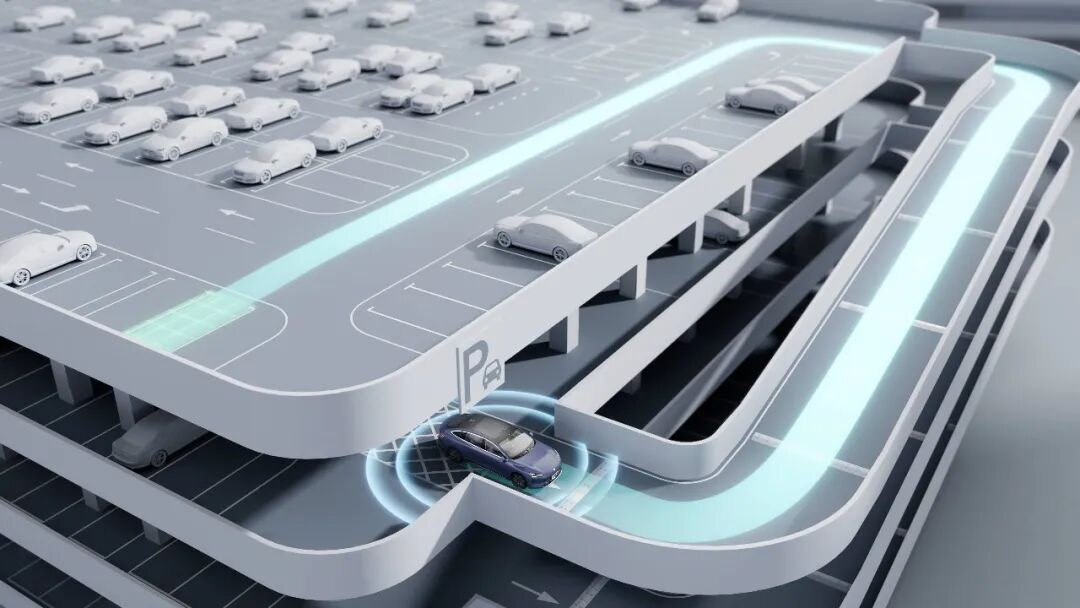
Image source: Internet
For these objects, the system must not only recognize them but also convert them into spatial information that can feed into trajectory planning.
This is also where parking perception differs from ordinary road perception.
In road driving, the system focuses more on whether targets such as vehicles and pedestrians will enter its path; when parking, it must further determine how far obstacles are from the body, and which part of the vehicle's outline would first approach an obstacle if it kept moving with the current steering input.
Li Auto's current VLA parking description notes that the system gathers information about parking spaces, free space, and obstacles around the vehicle through surround-view cameras and ultrasonic radar, then calculates the parking route while controlling steering, gear shifting, acceleration, and braking.
This shows that the perception output automatic parking needs is not simply a target list of space boxes plus obstacle boxes, but a local spatial representation constrained by the ego vehicle's kinematics that can directly serve trajectory planning.
02 Why can a space look big enough yet the vehicle still fail to park in one go?
A car is not a robot that can translate laterally or longitudinally.
When a vehicle turns, different points on the body do not follow the same trajectory. The front-end swing, rear-end movement, and lateral sweep of the body are all governed by the vehicle's geometry and current steering state.
This is especially true when reversing into a space: the motion states of the rear and front of the vehicle differ markedly. Even if the vehicle can make the area near the rear axle move along the direction of the target space, the front-end swing and lateral body sweep may still intrude into the adjacent space.
Therefore, when planning a parking route, it is not enough to check whether a single reference point can enter the space; the system must verify whether the vehicle's outline and swept area along the entire trajectory will interfere with obstacles.
This raises two distinct questions: whether the space can accommodate the vehicle in static dimensions, and whether the vehicle can enter that space from its current position and posture along an actually executable trajectory.
For example, a space may fit the vehicle dimensionally, but if the vehicle is currently too close to it and the entry angle is wrong, there may not be enough steering room to complete the maneuver in one go.
The system first needs to pull forward to adjust its position, then reverse into the space—and may even need to change the vehicle's posture through multiple forward-reverse shifts.
So the goal of automatic parking planning is not simply to find a route from point A to point B, but to find a trajectory the vehicle can actually execute while the overall motion envelope avoids obstacles.
03 The planned route must also be actually trackable by the vehicle
Having a feasible trajectory does not mean the parking process can be completed.
When the vehicle actually moves, it is affected by steering execution error, vehicle state estimation error, and the actual motion state between tires and the ground.
The system must continuously obtain the vehicle's current position, posture, and motion state, then compare them with the planned trajectory and adjust direction and speed.
This involves a core issue in parking control: trajectory tracking error.
If the vehicle deviates from the target trajectory, the control system must decide how to correct the direction based on the vehicle's current position and posture; if continuing along the original route risks the body gradually approaching an obstacle, it must slow down, pause, and replan if necessary.
Automatic parking is therefore not a matter of generating a route once and then steering all the way to the end. During low-speed movement, perception, state estimation, planning, and control still form a continuous closed loop.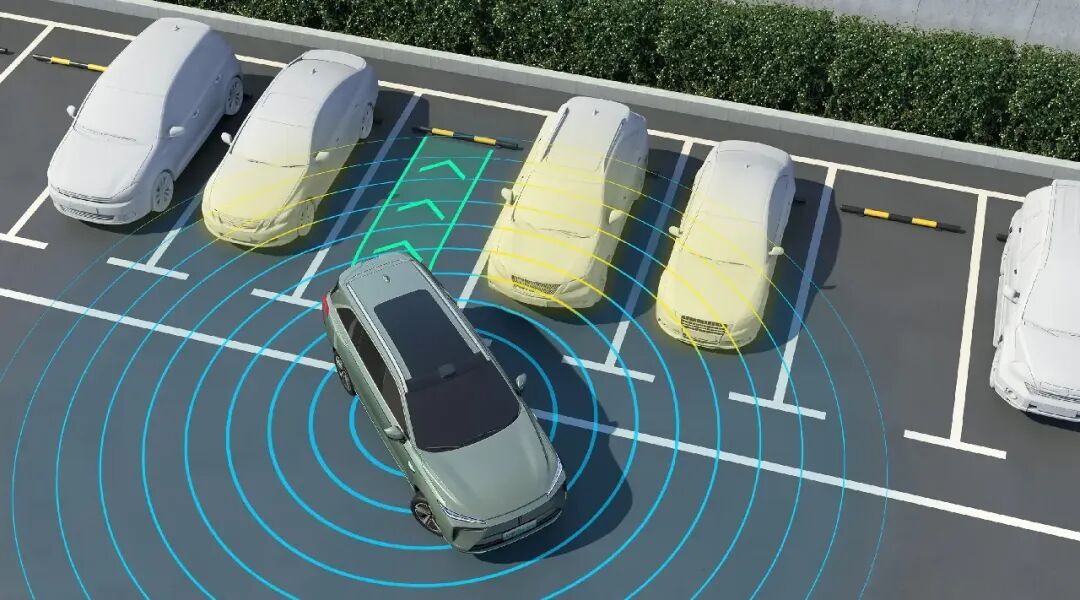
Image source: Internet
Some parking systems use geometric path planning combined with trajectory tracking control.
In recent years, research has also continued to optimize path planning, steering changes, and control precision in confined spaces. A 2026 SAE-related study specifically discussed changes in the instantaneous center of rotation in parking path planning and their impact on path planning and parking performance.
In other words, each time the vehicle moves forward or backward by a certain distance, it must reconfirm its own state and whether the surrounding space still meets the original planning conditions.
Driving slowly only gives the system more control time; it does not eliminate these problems.
04 Production vehicles are pushing parking from standard spaces to non-standard ones
Judging from the parking scenarios automakers have announced in recent years, automatic parking can already handle increasingly complex spaces.
XPeng's currently public AI parking covers extremely narrow spaces and spaces without boundary lines, and offers functions such as exit-and-park and memory parking; its public materials also show that the super intelligent assisted parking supports perpendicular and parallel spaces and includes capabilities such as automatically pausing when encountering obstacles.
Among these, spaces without boundary lines deserve particular attention.
Without clear parking space lines, the system cannot rely solely on the geometry of the lines to determine the target area; it must combine information such as surrounding vehicles and environmental boundaries to determine the parkable space.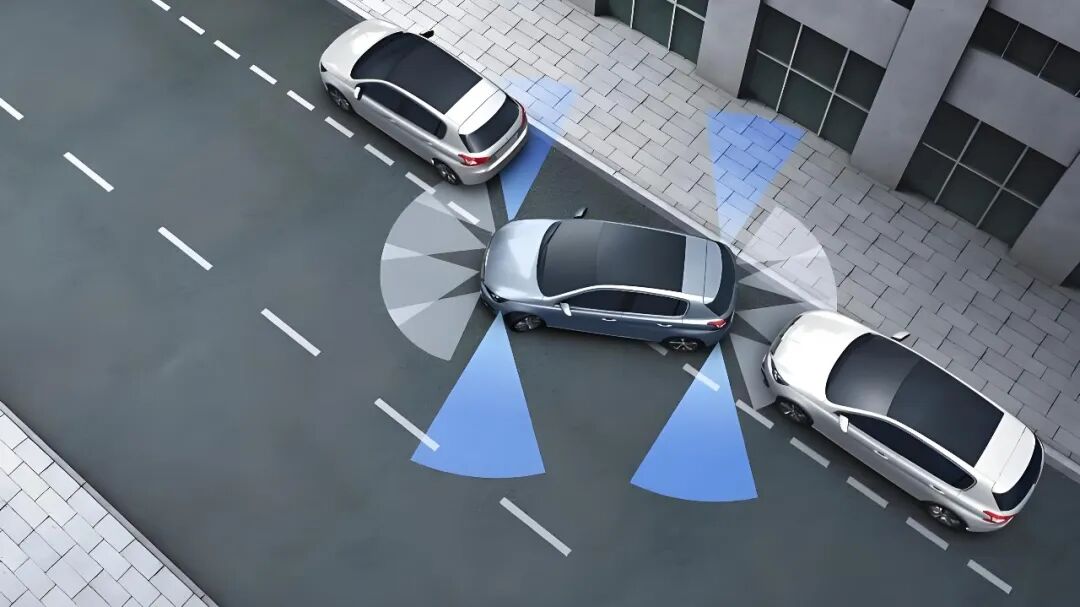
Image source: Internet
XPeng's earlier official Q&A also touched on using reference objects such as adjacent vehicles to determine spaces without boundary lines.
Li Auto, in its OTA upgrades, has also added narrow spaces, dead-end spaces, reverse herringbone spaces, and spaces at larger angles to the vehicle, along with strategies such as dynamic gear shifting and rearview mirror folding.
Behind these functions lies not a single parking-space recognition capability, but the need for the vehicle to recalculate how to enter the target area when faced with different initial positions, different target positions, and different spatial constraints.
Huawei Qiankun has further embedded such capabilities into the complete parking-to-parking link.
The Parking-to-Parking 3.0 released at the 2026 Qiankun Technology Conference already proposed expansion to more non-standard scenarios; its safety report for the first half of 2026 shows that the parking-to-parking function was used more than 54.41 million times.
For automatic parking, there is another easily overlooked issue: being able to avoid obstacles does not mean a good parking job has been done.
After the vehicle finally parks, it still needs an appropriate position and posture.
For example, although the vehicle does not hit walls or pillars when parking, it is clearly biased to one side; or the body has entered the space, but the vehicle angle is off, making subsequent exit difficult and even affecting door opening and the passage of surrounding vehicles.
Li Auto's relevant description also clearly states that VLA parking will adjust the vehicle posture according to the surrounding environment, but cannot guarantee perfect centering every time, and the driver still needs to confirm the final parking state.
Therefore, the parking system must accomplish not only collision avoidance, but also parking at a reasonable position, direction, and posture while satisfying safe distances.
05 Where does the difficulty of parking-to-parking lie?
If a complete automatic parking process is broken down, it actually involves four interrelated capabilities.
The first layer is spatial perception.
The system needs to recognize targets such as parking spaces, vehicles, walls and pillars, curbs, and ground locks, while determining their relative positions to the vehicle.
For low obstacles, occlusions, and areas without obvious parking space lines, the perception results also need to be converted into spatial constraints usable by subsequent planning.
The second layer is vehicle state estimation.
The system must not only know where the parking space is, but also where the vehicle itself is, where the front of the vehicle is facing, whether it is currently moving forward or reversing, and whether the current motion state is consistent with the planned trajectory.
No matter how accurately the target position is determined, if there is a deviation in the estimation of the vehicle's own position and posture, subsequent trajectory planning will also be affected.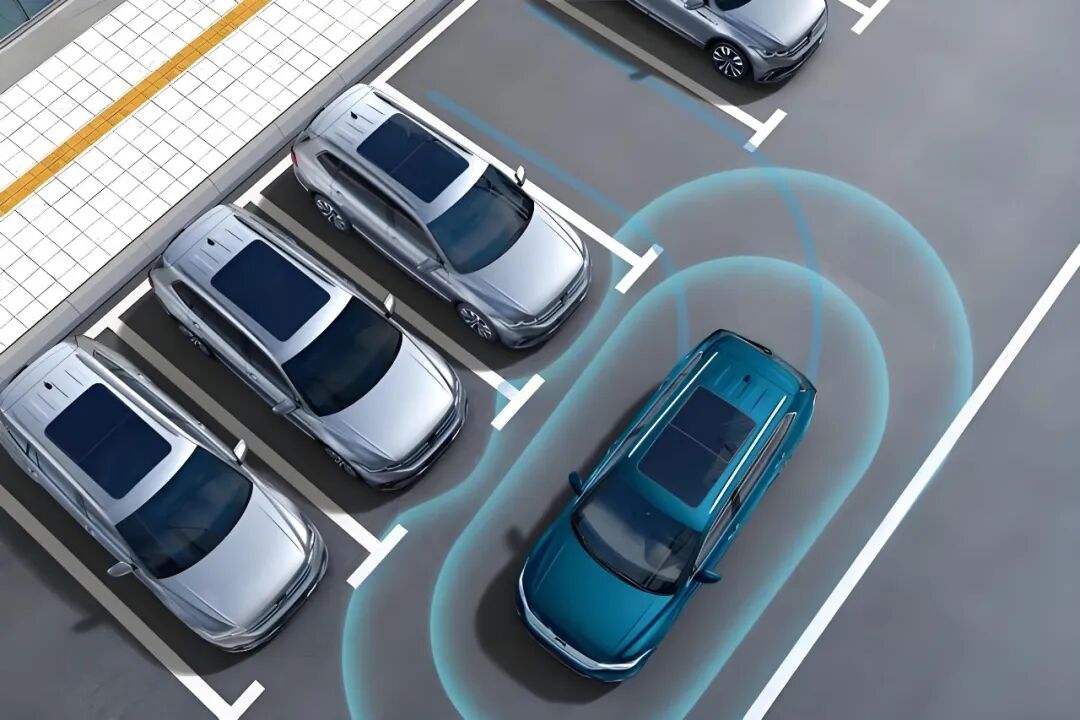
Image source: Internet
The third layer is trajectory planning.
The system needs to comprehensively consider the target position, obstacle distribution, and the vehicle's own kinematic constraints to decide where to enter, when to steer, when to move forward or reverse, and whether multiple adjustments are needed.
What is planned here is not an abstract geometric curve, but a motion trajectory the vehicle can actually execute.
The fourth layer is trajectory tracking and closed-loop correction.
After the vehicle actually starts moving, the actual trajectory cannot always perfectly coincide with the planning result.
The system needs to continuously compare the deviation between the vehicle's actual state and the target trajectory and adjust steering and speed accordingly; if the surrounding space changes or the original trajectory is no longer suitable, it also needs to replan.
Therefore, parking-to-parking is not simply adding an automatic parking module on top of the original assisted driving.
It requires the vehicle to connect continuously from the road driving stage to the low-speed spatial operation stage, and to continuously complete environmental understanding, vehicle state estimation, trajectory planning, and control during this process.
Road driving is more about solving where to go next in a constantly changing open space; parking requires the vehicle to ultimately enter a clear target area with an appropriate position and posture.
When intelligent driving moves from driving the car to the destination to accurately parking the car at the destination position, what the system faces is no longer just driving decisions, but also continuous and fine coordination of the vehicle's own motion and the surrounding local space.
This may also be why automatic parking, although seemingly one of the lowest-speed functions in intelligent driving, has always been an important scenario for testing a system's engineering capability. #AutonomousDriving #AutomaticParking
-
![]()
Apple Finally Announces Beta Timeline for Apple Intelligence in China
-
![]()
A Nonexistent Poor Child Is Draining Your Parents' Wallets
-
![]()
Is Automatic Parking Really the Touchstone for Intelligent Driving?
-
![]()
Final Word: Why Has the "Golden September and Silver October" Disappeared from China's Auto Market This Year?
-
![]()
Behind the 18-Satellite Launch: Who Determines the Fate of China's Commercial Rockets?
-
Anthropic's IPO Challenge: Can It Outrun Compute Bills and Loss Pressures?
-
Insta360 Innovation Q3 Report: New Products Accelerate, Ecosystem Synergy Builds Strength for a New Cycle of All-Scenario Intelligent Imaging
-
New Forces Reshuffle: Xiaomi Breaks 50,000 Again, Secures Top 3 — Has "Xiao-Wei-Li" Taken Shape?