AI Video Generation Has No "Endgame"
 11/02 2026
 371
Original: Shenmou Finance (chutou0325)
Recently, discussions about the AI video generation field have been somewhat intriguing.
What used to spark industry-wide discussion was often version iterations of professional video models like Seedance, Kling, and Jimeng, but now it has become general-purpose large models—a variable that seems unrelated to video generation.
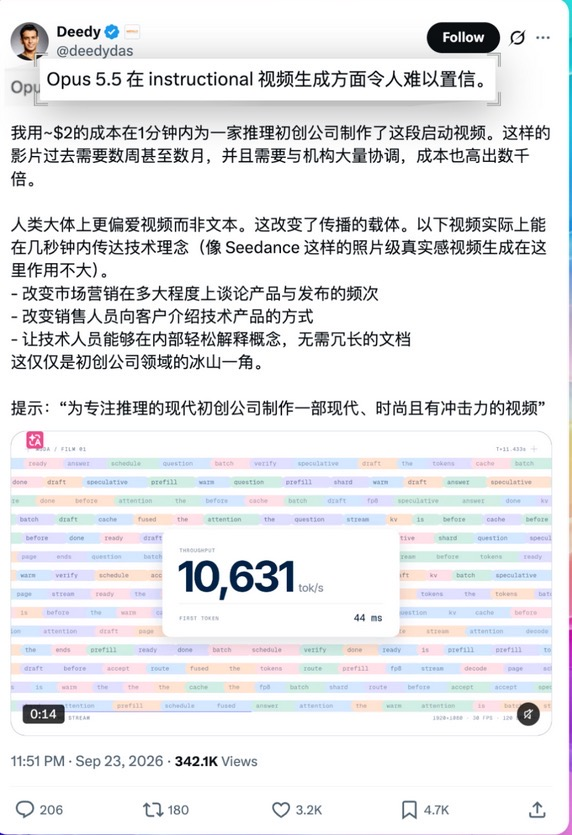
The most striking example is using Claude Opus 5.5 to make videos: you just describe what you want, and it can write code, find materials, do voiceovers, create animations, and finally assemble a complete promotional video on its own. Overseas, some people have already used this to create a modern, stylish, and impactful video for a startup focused on reasoning—at a cost of only $2.
Another example is GPT-6 Astra, which was officially positioned as a new-generation general-purpose agent model upon release, with core capabilities covering computer operation, programming, scientific research, and other fields. With its ability to operate 3D creation software such as Blender and Unreal Engine, Astra can already play the role of "director + producer" in video creation.
Overseas creator Nate Herk conducted an experiment, giving only one open-ended instruction and asking Astra to make a YouTube video about its own launch. Astra was able to independently complete research and scriptwriting, call tools to generate cloned voice narration, even drive an AI digital human to appear on camera, and complete material editing and music and sound effect pairing—ultimately delivering a finished film ready for direct release.
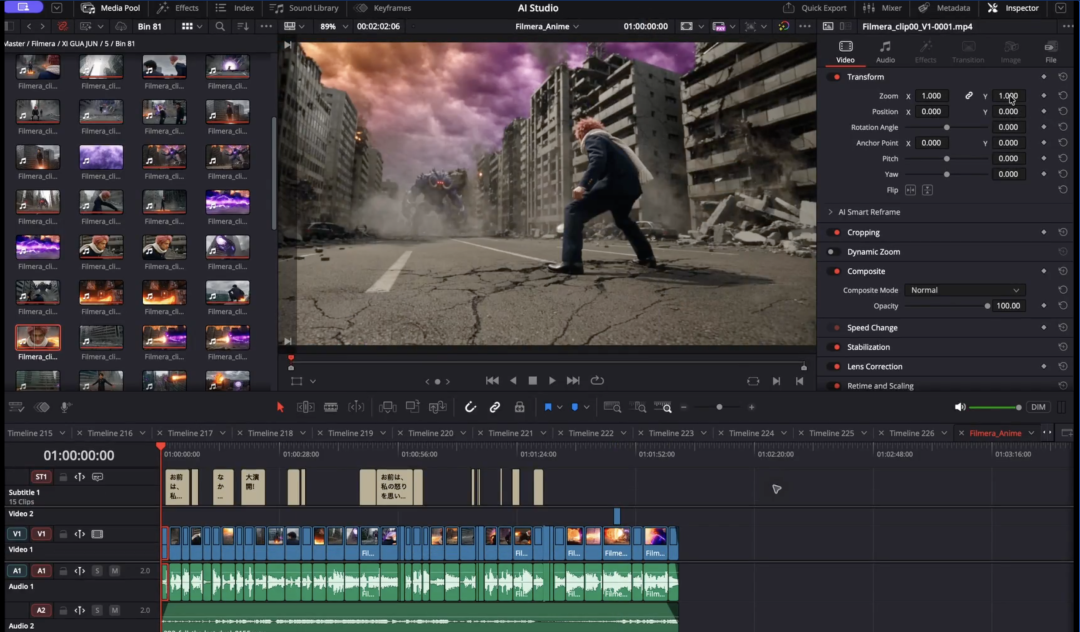
General-purpose large models can already orchestrate a single open-ended request into a complete production chain—from research, scripting, voiceover, on-camera appearance, editing, and sound effects to the finished film. Just as general-purpose models are penetrating upstream processes, the professional video model side is also not calm.
Sora, the text-to-video model once regarded by the outside world as a "world simulator," seems about to be restarted by OpenAI after being shut down for half a year; Kuaishou's Kling AI completed its first independent financing round of nearly $3 billion, with a post-investment valuation surging to $18 billion—setting a global record for a single financing round by a video large model company—while also clarifying a hard timetable to complete an IPO before 2031...
Capital and attention are both abundant, but beneath the excitement, where exactly does the value of AI video—a track that is expanding—settle?
01 Breaking Out of the Linear Competition Logic
Over the past two years, the competition logic in the AI video generation field has been relatively linear. Higher resolution, longer duration, and more realistic effects were almost the entire narrative, but in the second half of 2026, the "crossover" of general-purpose large models pushed competition into an asymmetric dimension.
Take Claude Opus 5.5 as an example. Its advantage lies not in the realism of the images, but in editability and iteration cost. To modify a shot, there is no need for repeated generation attempts and manual rework; you only need to change the corresponding few lines of code. Parameters and style can be precisely controlled, and image elements can also be decomposed by layers.
Vibe Video—this new creation method—quickly took root in content scenarios such as motion graphics, knowledge explanation, and mini-games. It is reported that the case collection site awesome-opus5-5-videos on GitHub has included more than 400 works.
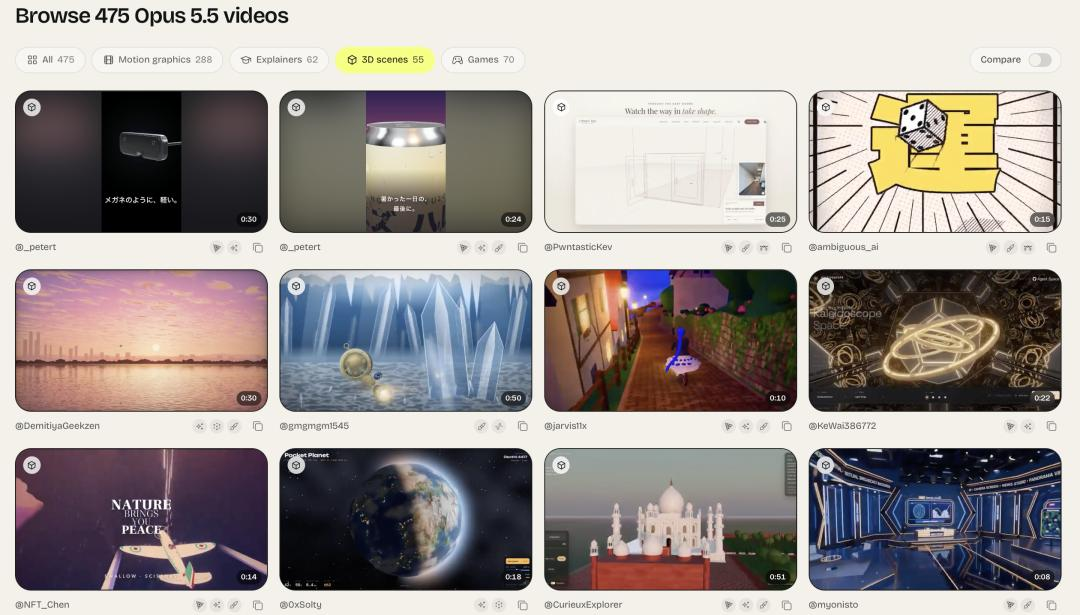
What it taps into is the lightweight, high-iteration market that traditional video models are not good at but where real commercial demand exists. From an economic perspective, it turns video production from "probabilistic generation" into "deterministic programming," greatly reducing the marginal cost of modification—which is undoubtedly hugely attractive for commercial content that requires repeated adjustments to copy, color schemes, and data charts.
Faced with this squeeze from upstream and the side, the response of professional video models is not to confront head-on over image quality, but to accelerate penetration into the entire creation chain.
ByteDance launched the one-stop creation workbench "Jianying Hub" and the intelligent creation Agent "Jianying Assistant." Combined with the previously launched Xiaoyunque Agent and the internally tested "comic drama creation tool," it has built a complete ecosystem of "underlying model + vertical scenario Agent + general creation workbench"; MiniMax chose to launch the creation Agent workbench MiniMax Design, where the main Agent breaks down requirements and dispatches multiple agents in parallel to complete the entire process from script to finished film. As for Kling, based on the All-in-One concept, it integrates video understanding, generation, and editing into a coherent AI workflow...
If general-purpose large models are to be the director, professional models must become the set, camera, and post-production room that the director cannot do without. After all, when generation capability itself tends toward homogenization, the depth of workflow embedding becomes a moat that is harder to replace.
This moat is not reflected in parameter tables, but in the operation path creators follow every day after opening the software. Once model capabilities are embedded into every link of script breakdown, storyboard scheduling, material management, and finished film export, the switching cost will change from "changing a model" to "replacing the entire production line"—and the latter is obviously much heavier.
02 The "Divergence" Paths of Domestic Vendors
Looking back now, Sora's exit and restart may actually be a key footnote for understanding this round of industry divergence.
On March 25, 2026, OpenAI posted on X, "Goodbye, Sora." At the time, according to various estimates, its daily operating cost was in the tens of millions of dollars, and its monthly computing power expenditure exceeded $10 million, making it a giant "money-devouring beast."
The controllability gap was equally fatal. Sora often produced random results that could not be reproduced, which also meant that under the computing power cost structure at the time, it was too far from stable delivery and entering customer budgets.
Now the startup planning to take over was founded by Hollywood producer Jeffrey Katzenberg, former Sora research head Bill Peebles, and former Dropbox CFO Sujay Jaswa. According to the disclosed cooperation concept, the goal of this startup taking over is precisely to transform Sora into a professional film and television tool. Behind this business logic is more the willingness of the professional film and television market to pay for controllable generation capabilities, rather than pure technological confidence.
After all, Hollywood's attitude toward AI has begun to shift from conservative observation to active participation.
Netflix spent $587 million to acquire InterPositive, an AI platform designed specifically for film and television production; renowned director James Cameron also joined the StabilityAI board; Steven Soderbergh even publicly stated that he would "use AI extensively" in his new film...
These actions show that what the film and television industry needs is not random astonishment, but generation tools that can be budgeted, scheduled, and reviewed. If Sora can make up for its shortcomings in controllability and compliance, the imagination space of the enterprise-level market it faces may even be larger than the consumer-level market.
The path divergence of domestic vendors happens to correspond to different solutions to this trend. Among them, Kling takes the revenue-first route, first converting model capabilities into subscription and API revenue.
Kuaishou's Q1 2026 financial report disclosed that Kling AI's single-quarter revenue exceeded 650 million yuan, a year-on-year increase of more than 300%. The annualized revenue run rate (ARR) soared from $100 million in March 2025 to nearly $500 million in March 2026, quadrupling year-on-year. As of June 2026, Kling AI's global users exceeded 100 million, with nearly 50,000 enterprise customers.
Obviously, it anchors scenarios such as advertising, e-commerce, and brand films where "image quality is transaction," and has used subscriptions and APIs as two legs to complete the conversion from generation capability to cash flow—but the other side of revenue growth is loss pressure.
According to a Daily Economic News reporter, Kling AI accumulated losses of more than 2 billion yuan in the full year of 2025 and the first quarter of this year. "It is expected that only by Q4 2028 can single-quarter break-even be achieved." To some extent, this also reflects that the commercialization of video models is not simply "the more you sell, the more you earn," but requires economies of scale to spread inference costs below the critical point.
Different from Kuaishou, Alibaba's solution is to spread capabilities into the ecosystem. Wan3.0 connects video generation capabilities to office and courseware production; HappyHorse takes the flagship arena route, charging into the first tier in the Artificial Analysis visual quality category. With dual-model positioning, it creates a full-chain closure "from Qianwen creation to Alibaba Cloud Bailian."
As for ByteDance's solution, it is to push costs down to an industrialized level. Seedance 2.5, with 30-second native direct output, 50 all-modal references, and second-level timestamp control, pushes video generation into a range affordable for small and medium-sized teams.
Kling bets on the willingness of professional creators and enterprises to pay, Alibaba bets on the ecosystem, and ByteDance bets on the cost advantage brought by industrialization scale. Together, the three have run out three non-overlapping commercialization paths that all point to stable delivery.
03 How Far Is the Commercialization Inflection Point for AI Video?
Whether Kuaishou, Alibaba, or ByteDance, they seem to each go their own way, but ultimately they will all hit the same wall: cost.
The day after Sora was shut down, ByteDance's Jimeng AI directly canceled the 40% discount for premium members. The points required to generate a 15-second video soared from 45 to 120, and after the price adjustment, user costs directly increased 2.6 times.
On April 3, Jimeng launched the Seedance 2.0 exclusive VIP accelerated queue-jumping channel, stacking a second payment on top of the original membership system, with a 15-second video generation requiring 210 points. On April 8, the platform launched a comprehensive price adjustment plan, with both membership benefits and point quotas shrinking. The first-year 50% discount for the three membership tiers originally priced at 659 yuan, 1,899 yuan, and 5,199 yuan was tightened to 60%, and monthly bonus points were also substantially cut.
But also in the same year, Kling AI launched a membership model discount plan for domestic users; the Volcano Ark Experience Center under ByteDance's Volcano Engine officially launched the Seedance 2.0 Mini video generation model, with a generation cost of only about 0.5 yuan per second.
However, the two are not contradictory. Jimeng's price increase is intended to filter out price-sensitive users and leave computing power for those willing to pay for "no queuing" and high-quality output. B-end price cuts are meant to exchange low prices for call volume, allowing model capabilities to sink into more products and workflows.
The upper layer is the effect premium market. Film-level creators, brand advertisers, and professional studios are willing to pay for good films. They are not price-sensitive but extremely sensitive to effects.
The lower layer is the cost-sensitive market. E-commerce short video teams and short drama production companies want cheap and stable finished products. They do not pursue cinematic texture, only batch output and rapid iteration. Tiered pricing is merely each company striving for admission qualification in its respective target market.
However, this price war has an unavoidable physical lower limit: computing power cost. According to reports, ByteDance is increasing investment in AI computing power and infrastructure, and has raised this year's company capital expenditure plan to more than 200 billion yuan, an increase of more than 25% over the 160 billion yuan investment discussed at the end of last year; Kuaishou also plans to invest 26 billion yuan in capital expenditure in 2026.
The inference cost of video generation is far higher than that of text models. Generating a few-second video consumes enough computing power to support ChatGPT in answering thousands of complex questions.
From this point of view, the coexistence of Kling's valuation adjustment and losses precisely shows that the capital market is paying for future expectations and paying a premium for the scarcity of the first AI video stock, but the prospectus ultimately still has to answer unsexy questions such as gross margin, customer concentration, and the computing power cost curve.
Kling is not an isolated case. As computing power bills continue to expand, the entire industry stands at the same crossroads. Revenue is rising, costs are rising faster, and when the commercialization inflection point will come may depend on when the computing power expenditure behind every yuan of revenue first comes down.
This also returns to a more plain judgment: whether a technology can become an industry does not depend on how stunning it is when it appears, but on whether, on its most ordinary day, it can stably complete delivery with predictable quality, acceptable cost, and embeddable processes.
The window for parameter leadership is shortening by the month, while the compound interest of workflow embedding has just begun to accumulate.
* Images are from the internet. Please contact us for removal if there is any infringement.
-
![]()
Tech Stocks Plunge: Is Faith in AI Still There? New Energy Weekly Summary
-
![]()
After the Hundred-Billion-Yuan Financing Closed, DeepSeek Unveiled Its Super-Agent Architecture
-
![]()
October New Energy Vehicle Sales Revealed: Leapmotor Up 51% Year-on-Year, While NIO, Li Auto and Harmony Intelligent Mobility All Decline
-
![]()
Apple Chooses Qwen—and There's More to It Than Meets the Eye
-
![]()
The Battle Against DJI: How Ying Shi Lost 100 Billion Yuan in Market Value
-
![]()
Modern China's Predicament: Hard to Break Through by Merely Changing the General Manager
-
![]()
Cutting Corners or Compliance? iPhone Duo Teardown Reveals China-US Structural Differences — Apple Says Component Variations Are Normal
-
![]()
Leapmotor Retains the Crown as Xpeng and Xiaomi Break 50,000: The New Forces Sales Landscape Gets Another Shake-Up