The Battle Against DJI: How Ying Shi Lost 100 Billion Yuan in Market Value
 11/02 2026
 535
It took Ying Shi nearly five years to get panoramic cameras off the ground—literally.
On July 28, 2025, the company officially announced Yingling, a drone brand it had jointly incubated with a third party. On December 4 of the same year, its first product, the Yingling A1 panoramic drone, was officially released. The device lets users put on a pair of glasses and "sit inside" the aerial footage—a milestone marking Ying Shi's formal entry into the drone market.
Fifteen months later, the capital market's growth expectations have cooled considerably. As of October 30, 2026, Ying Shi's total market value stood at approximately 34.8 billion yuan, with more than 100 billion yuan wiped off its peak. In its 2026 third-quarter report, Ying Shi acknowledged bluntly that new categories such as drones are still in the market-education phase and have yet to achieve economies of scale, dragging down the company's overall performance.
Ying Shi's hundred-billion-yuan pullback reflects the market's reassessment of its multi-line expansion, profitability, and valuation—it cannot be attributed to drones alone. Still, two questions have become unavoidable for Ying Shi: how many new categories can a single imaging technology stack realistically support, and how much profitability and cash flow does each additional product line demand?
 Why Open Fire?
Ying Shi's entry into the drone market was driven by real growth pressure. In the panoramic camera segment, Ying Shi already commands most of the global market. In 2025, the company posted operating revenue of 9.741 billion yuan, up 74.76% year on year, and its global shipment share of panoramic cameras exceeded 65% that year.
IDC's Q2 2026 global panoramic camera market report shows that this figure climbed further to 72.5%, yet global panoramic camera shipments in Q2 2026 grew only 4% year on year. Ying Shi has nearly hit the monopoly ceiling in its niche and urgently needs to find new growth engines.
Over the years, Ying Shi has built deep expertise in panoramic stitching, invisible selfie sticks, and free framing. These technologies can be extended to drones, allowing users to record their full surroundings during flight and then freely choose shooting angles in post-production—lowering the operational threshold for aerial photography.
On July 28, 2025, the consumer drone brand "Yingling Antigravity" and its logo were officially unveiled, entering the consumer drone market with the differentiated positioning of a "panoramic FPV drone." Three days later, DJI launched a counterattack. On July 31, 2025, DJI released its first panoramic camera, the Osmo 360, formally entering the panoramic camera market long dominated by Ying Shi. Less than two months later, DJI launched the wearable camera Osmo Nano, extending the competition into Ying Shi's thumb camera territory.
This means Ying Shi must not only seek new growth space but also commit more resources to defending its original market. The competition between the two sides can hardly be confined to a single product line—it has evolved into cross-category offense and defense.
Although Ying Shi founder Liu Jingkang said the company decided to enter drones about five years ago and even anticipated at the time that the move might prompt DJI to enter the panoramic camera market in turn, cameras and drones are, after all, two very different products. Flight control, obstacle avoidance, image transmission, and after-sales repair all require Ying Shi to rebuild capabilities from scratch. To truly win market share from DJI, imaging technology alone is far from enough.
 Being a Little Better Is Not Enough
The differentiated experience of panoramic immersive flight is not enough to drive brand switching among mature drone users. Ying Shi's Yingling A1, which challenges DJI, is a consumer drone focused on 8K panoramic shooting and immersive flight.
Users need only put on the Vision flight glasses to observe aerial images in different directions by turning their heads; with the Grip motion controller, they can also control flight direction through hand movements. Even when the drone is flying forward, users can turn back to observe the scenery behind them at any time, and flight direction and viewing angle are no longer constrained by each other. Combined with a body weight of about 249 grams under the standard battery configuration, this solution is indeed somewhat appealing for scenarios such as travel recording and outdoor shooting.
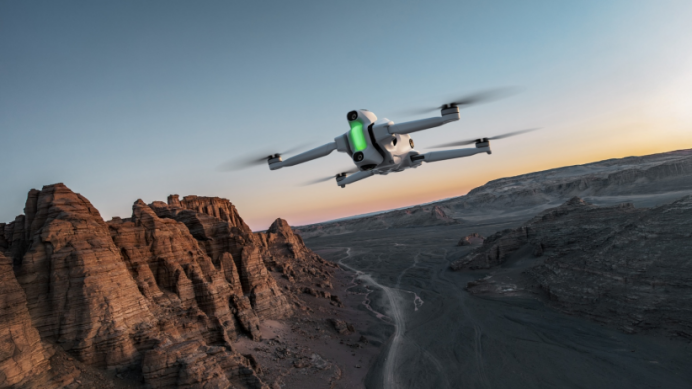
Image source: Yingling official website
But the problem is that novelty alone does not mean consumers are willing to pay for it.
For users already accustomed to traditional aerial photography, what they care about more is whether they can stably and conveniently capture the images they want. Although panoramic shooting increases freedom in post-production creation, whether it can ultimately attract consumers still depends on image quality, output efficiency, and daily usage habits.
Consumers' acceptance threshold for innovative products is far higher than companies generally expect. Harvard Business School professor John Gourville once proposed the famous "9X" theory: companies, due to the innovator's endowment effect, overestimate the value of new products by about 3 times; users, due to loss aversion and status quo bias, overestimate the value of existing products by about 3 times. The two combine to form a 9-fold cognitive gap—only when the comprehensive experience of a new product reaches more than 9 times that of the old product can users be driven to actively complete brand switching. This rule is particularly pronounced in hardware consumer sectors; optimizing and upgrading partial functions can hardly break through users' usage inertia.
For DJI's long-time users, years of usage habits are themselves an advantage. From controllers, flight glasses, batteries, accessories, and repair services, users have already formed a relatively mature usage ecosystem. Some devices can continue to be used across compatible models, further reducing upgrade costs.
If they switch to Yingling, consumers not only need to relearn operating methods but also consider whether original accessories can continue to be used, as well as whether the new brand's flight reliability and after-sales repair are trustworthy. These hidden costs will directly affect final purchase decisions.
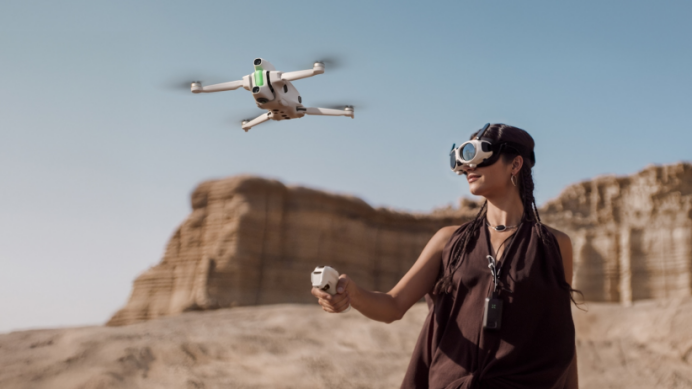
Image source: Yingling official website
Before Yingling had time to fully open up the market, however, DJI quickly followed suit. On March 26, 2026, DJI officially released the Avata 360, which likewise combines panoramic shooting, free post-production framing, and immersive flight, directly entering the panoramic drone niche and forming direct competition with the Yingling A1.
According to official pricing at launch, the Avata 360 motion flight combo including the N3 flight glasses and FPV controller is priced at 5,488 yuan. For users who already own some compatible devices, DJI also offers the option of purchasing the aircraft separately, further lowering the threshold for trying the new product.
Ying Shi's response was a direct price cut. On March 27, the price of the Yingling panoramic drone standard combo was reduced from 6,799 yuan to 5,499 yuan, a drop of 1,300 yuan, but it did not reverse its passive position in the competition. Ying Shi's drone business is small in scale and has higher supply chain costs; following with price cuts directly undermines product gross margin and further compresses space for R&D, after-sales, and channel investment.
When differentiated selling points cannot form a generational experience advantage, challengers fall into the passive situation of "being erased upon follow-up." The panoramic innovation of the Yingling A1 is a "bonus upgrade" rather than a "tenfold solution to a core pain point." Once a giant follows and replicates it, it is hard to retain users through functional differences alone. The outcome of this product-side offense and defense will ultimately be transmitted directly to the company's profitability and valuation.
 Behind the Evaporation of 100 Billion in Market Value
Ying Shi's high valuation in the early days of listing was built on the growth expectation that "imaging technology can be reused across categories." Previously, investors' core pricing logic was to recognize Ying Shi's leading moat in the panoramic camera field while believing it could quickly replicate its imaging algorithms and product definition capabilities into new categories such as gimbal cameras and drones, opening up the long-term growth ceiling. The intensive launch of new categories continuously amplified the market's imagination of the company's business map and supported the valuation premium of a high-growth stock.
When the cost of expansion begins to show up on the income statement, high growth expectations face the test of performance verification. In the first three quarters, Ying Shi achieved operating revenue of 9.436 billion yuan, a clear year-on-year increase from 6.611 billion yuan in the same period last year. But operating costs in the same period also rose from 3.330 billion yuan to 5.830 billion yuan, growing faster, and the comprehensive gross margin fell from 49.61% in the same period last year to 38.21%, down about 11.4 percentage points year on year.
Pressure on the expense side is also considerable. In the first three quarters, Ying Shi's selling expenses increased from 1.130 billion yuan to 1.617 billion yuan, and R&D expenses increased from 1.085 billion yuan to 1.601 billion yuan, with the two combined increasing by about 1 billion yuan. But at a stage when revenue growth has not yet fully translated into profit, expense expansion directly squeezed the profitability buffer and also raised market doubts about the input-output ratio of the new business.
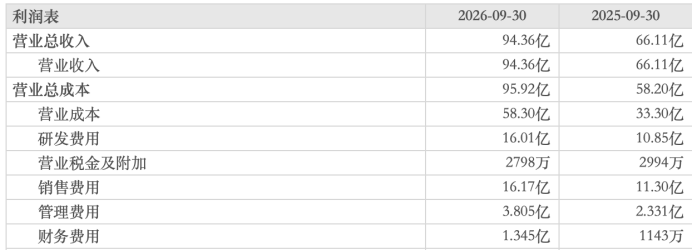
Image source: Company 2026 third-quarter report
Ying Shi's 2026 interim report disclosed that Shenzhen Yingling Technology achieved operating revenue of about 230 million yuan in the first half of the year and a net loss of about 290 million yuan. For Ying Shi, which has just entered the drone market, product R&D, channel building, and market promotion all take time, so short-term profitability pressure is not surprising. What truly deserves attention is when these investments can translate into sustained sales growth and profitability improvement.
High inventory and cash flow pressure further compressed the margin of safety in valuation. As of the end of September 2026, the company's inventory scale reached 7.154 billion yuan, an increase of about 145% from 2.919 billion yuan at the beginning of the year; in the same period, net cash flow from operating activities in the first three quarters was -4.264 billion yuan.
For rapidly expanding consumer electronics companies, purchasing chips and other raw materials in advance and stocking up for new product launches are normal business behaviors. Xinliu believes that if end demand falls short of expectations or product iteration accelerates, companies will face the dual pressure of inventory depreciation and tight cash flow, which is also an important reason for the market's valuation downgrade.
 Xinliu Viewpoint: A War of Attrition with No Clear Winner Yet
For Ying Shi, the cost of attacking DJI far exceeded expectations. A sharp market value pullback, profits near zero, operating cash flow turning from positive to negative, and high inventory hanging overhead have dragged an originally healthy financial structure into a tense state due to multi-line expansion.
For DJI, this is likewise not a zero-cost defensive war. To respond to Ying Shi's cross-sector move, DJI had to enter imaging tracks such as panoramic cameras and thumb cameras, adding R&D and channel investment and being passively drawn into category competition it is not particularly good at.
Category expansion is not simple technology transfer, and user mindshare cannot be moved by a single differentiated product. The essence of cross-sector battles has never been a zero-sum game of "who replaces whom," but an inevitable trial for a niche leader seeking to break outward after growth in its main business peaks. As novelty gradually fades and the price war deepens, what the two sides ultimately compete on will be the ability to sustain profitability. Ying Shi wants to take market share from DJI, while DJI wants to defend its advantage. In the end, who can retain more profit may be more important than who captures more share.
*Header image generated by AI
- XINLIU -
-
![]()
Tech Stocks Plunge: Is Faith in AI Still There? New Energy Weekly Summary
-
![]()
After the Hundred-Billion-Yuan Financing Closed, DeepSeek Unveiled Its Super-Agent Architecture
-
![]()
October New Energy Vehicle Sales Revealed: Leapmotor Up 51% Year-on-Year, While NIO, Li Auto and Harmony Intelligent Mobility All Decline
-
![]()
Apple Chooses Qwen—and There's More to It Than Meets the Eye
-
![]()
The Battle Against DJI: How Ying Shi Lost 100 Billion Yuan in Market Value
-
![]()
Modern China's Predicament: Hard to Break Through by Merely Changing the General Manager
-
![]()
Cutting Corners or Compliance? iPhone Duo Teardown Reveals China-US Structural Differences — Apple Says Component Variations Are Normal
-
![]()
Leapmotor Retains the Crown as Xpeng and Xiaomi Break 50,000: The New Forces Sales Landscape Gets Another Shake-Up