After the Hundred-Billion-Yuan Financing Closed, DeepSeek Unveiled Its Super-Agent Architecture
 11/02 2026
 376
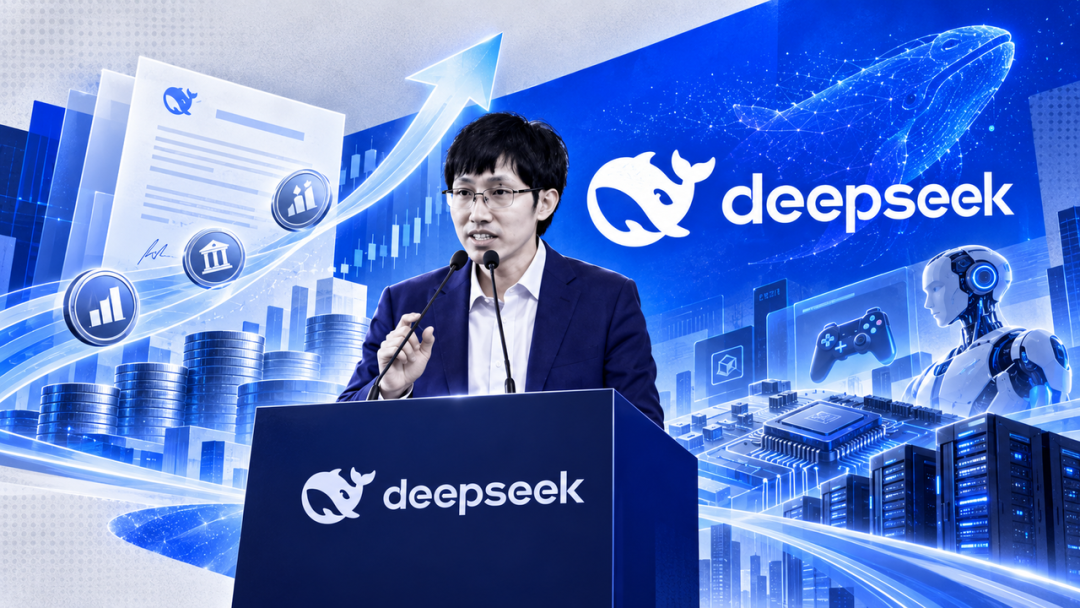

The task paradigm of large models is shifting.
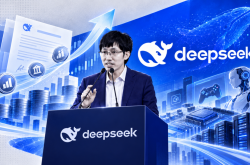
Image source: Internet (contact us for removal if infringing). Partially AI-generated.
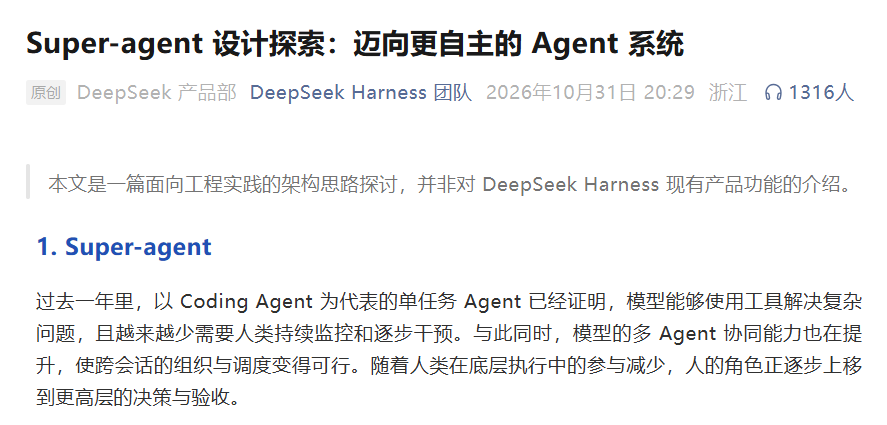
On the evening of October 31, the DeepSeek Harness team published a technical article on its official WeChat account. On that same day, their internal Super-agent instance was quietly at work: no one @-mentioned it, no one started a new session, and no one manually moved a group chat message over to GitHub.
It picked up on a clue about a software issue in the group chat on its own, reproduced the issue in an isolated directory, generated a fix, and then returned to the group chat to deliver a reviewable pull request.
Today, though, what I want to focus on are the invisible judgments behind this: AI's single-task capability has already crossed the "good enough" line. The real bottleneck is not that models aren't strong enough—it's that human attention can only stretch so far.
Meanwhile, a second thread has been advancing in parallel in the capital markets. According to public reports and market news, DeepSeek has completed approximately 100 billion yuan in financing, with Tencent and CATL as the largest investors, maintaining a pre-money valuation of about 500 billion yuan. CITIC Securities is assisting with preparations for a STAR Market IPO, with plans to submit the listing application as early as late 2026 and list in 2027.
However, DeepSeek and related parties such as Tencent and CATL have not publicly responded or made official announcements, and the final amount and transaction details may still change.
The technology narrative and the capital narrative converged this week.

The Super-Agent Admits: "No One Can Manage It All"
Most Agent products tell the same story: "We help you do more." Writing code, looking up information, sending emails, building spreadsheets—the feature list keeps growing.
But there's one number that everyone building Agents knows full well, yet rarely brings up: a person can typically only keep track of 3 to 5 active sessions at the same time.
That means the boom in Agent products over the past year has largely been about "adding sessions" for people.
For every additional Agent, a person gains another window that needs to be created, fed, monitored, and have its output harvested.
The more Agents there are, the more people resemble a low-bandwidth message bus—constantly switching between sessions, forgetting context, and reloading it again.
Model capabilities are rising, but human management bandwidth is not.
The Super-agent's Router/Worker two-layer architecture essentially acknowledges this fact and then takes the burden off people's hands.
The Router stays online permanently, uniformly receiving messages from group chats, GitHub, and email while maintaining global context. Workers isolate their own contexts and operate in parallel, with results delivered through the Router.
What users experience feels like a single Agent, but behind it is a group of Agents working simultaneously.
What's more worth pondering is the team's design philosophy. They explicitly stated that this architecture does not propose a new theory; rather, it brings mature ideas from computer systems—scheduling, caching, compute-storage separation, and watchdog mechanisms—into the Agent system.
It isn't about making the model smarter. It's about making the Agent system "operable."
A system that can only be demonstrated once will always need someone standing beside it as a dispatcher. Only an operable system dares to take on more and more tasks for continuous operation.
Put plainly: in the past, people managed Agents. Now the system is beginning to manage Agents, and people have taken a step back.

From "Comparing Models" to "Comparing Who Can Keep Agents Under Control"
If you look at this one DeepSeek article in isolation, you might think it's a standalone technical exploration. But stretch the timeline a bit longer, and you'll find that this isn't just one company changing direction.
An industry review in the first half of 2026 put it bluntly: the focus of model competition is "no longer just parameter scale and leaderboard rankings, but more comprehensive system capabilities"—namely long context, tool calling, cost control, Agent task execution capability, and so on. These are replacing "whose parameters are bigger" as the new scoreboard.
Another industry observation stated outright that the old decisive factor of "who trains more parameters" is becoming ineffective, and that "VLA + world models + Agent end-to-end engineering closed loop" has become the new decisive factor.
Moves on the other side of the ocean came earlier and more systematically. OpenAI made Sessions, the Agents SDK, Tracing, and Evals first-class development surfaces. Anthropic gradually completed Memory, Compaction, Context Editing, and Managed Agents. Google organized ADK, Agent Runtime, Memory Bank, and Agent Gateway into a complete platform.
All directions point to the same goal: turning an Agent from a "model call" into a "runnable system."
Why is this shift inevitable? Because once an Agent moves from single-turn Q&A to long-chain task execution, token consumption expands rapidly with task decomposition, tool calls, and context accumulation.
Agents bring repeated context calls, and a large number of tokens are wasted. Profits in the industry chain concentrate upstream, while downstream has yet to find stable cash-flow scenarios but has already invested ahead of time.
When the unit price of tokens drops by 99% but Agents amplify consumption dozens of times over, the bill actually becomes more expensive.
"Making models do more work" is no longer free, and system efficiency has become a competition dimension measured in real money.
So the set of experimental data from Super-agent may be worth a serious look: in a test of about 300 messages and 20 work requests, task completion time was p50 12.4 minutes and p95 15.7 minutes, while the single-session solution with Subagent tools under neutral prompts had a p95 of 29.5 minutes.
After removing subscription passthrough, the number of Router decisions increased by about 30%, and read-cache tokens rose from 23.23 million to 31.77 million.
It trades more tokens for time and stability. This precisely shows that the essence of competition at the system layer is not "saving tokens," but rather "using engineering methods to make every bit of computing power more worthwhile."
The comparison between Manus and Coze Space corroborates the same thing. Manus has a 92% success rate on complex tasks, while Coze Space has 81%. The gap widens in scenarios involving multi-step error correction and long-range memory maintenance.
But both sides hit the same wall: once context gets long, they "forget"; when multiple tools are chained, they get stuck; intermediate steps cannot be traced back.
This is not because the model isn't smart enough, but because the system doesn't treat context as infrastructure that needs to be managed.

What the Hundred-Billion Financing Buys Is the Ticket to "Systematization"
Now let's move the lens to the capital side.
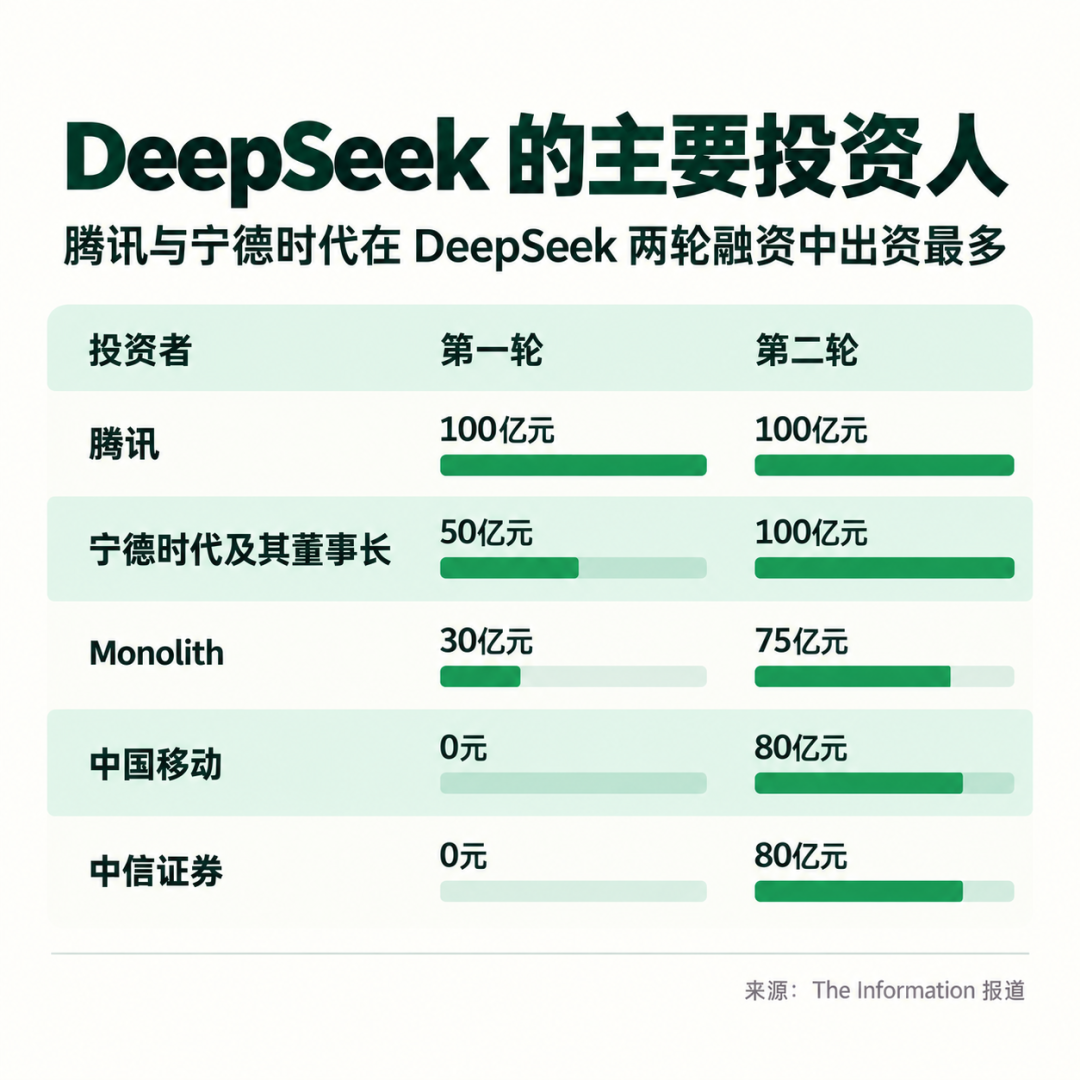
The details of this financing carry more information than the word "record." The fundraising target was initially 50 billion, and after multiple rounds of increases it reached about 100 billion. The pre-money valuation was anchored at 500 billion. Tencent contributed 10 billion in each of two rounds, and the CATL system contributed 10 billion in this round—double the 5 billion in the first round. CITIC Securities came on board to prepare for the STAR Market, and Yan Wentao, former partner at Hillhouse Venture Capital, has become CFO.
The use of funds is clearly stated: model training, computing power construction, and talent recruitment to support global competition.
But what's truly worth breaking down is not the amount, but what the structure of the investors is saying.
Tencent's heavy bets in two consecutive rounds show that the way big tech participates in AI competition is changing—from "only in-house development" to "in-house development + equity stakes in leading systems."
While Hunyuan is catching up, Tencent is using capital to lock in DeepSeek's foundation models and open-source full-stack capabilities, both filling shortcomings and buying a ticket to this table in advance.
CATL's logic is more industrial: when AI systems begin to take over real workflows, constraints on computing power, energy, and data centers will turn from cost items into competitive barriers—and industrial capital smells this layer earlier than purely financial capital.
A more noteworthy signal comes from the entry of telecom operators. According to The Information, China Mobile and China Telecom appear on the list of nearly 30 investors in this round, each with amounts in the several-billion-yuan range.
What the operators hold is exactly what model companies find hardest to fill on their own: nationwide IDCs and power, backbone network bandwidth, intelligent computing clusters, and nationwide government and enterprise channels.
DeepSeek recently open-sourced Ascend adaptation components and is advancing a domestic computing power route, which aligns with the operators' direction of "domestic chips training domestic models." This is no longer "financial investment"; it is computing power infrastructure and the model ecosystem binding together at the capital level.
So this hundred-billion financing is more like the threshold for leading domestic AI competition being raised—from "whether you can train a good model" to "whether you can simultaneously secure computing power, systems, industrial channels, and the capital market."
The analysis quoted by Shanghai Securities News put it bluntly: capital, computing power, deep intelligence, and market progress in the "integration of models and applications" layout are the four key variables that widen the gap. This round of financing is not the endpoint, and continuing to raise funds through listing is an inevitable path.
Laying the groundwork for an IPO is the extension of this logic. The 500 billion pre-money valuation corresponds to the secondary market's pricing expectation for "systematic capability," not for a single model's parameters.
Capital is voting for one thing: the winner in the next stage will be the company that can integrate models, Agent systems, computing power infrastructure, and organizational execution into a sustainably operating whole.

"Acceptance" Is Harder Than "Execution"
Back to the sentence that's easiest to let slide by as a slogan: people move up from execution details to decision-making and acceptance.
The weight of this sentence lies not in "people are more relaxed," but in "people are being asked to do something harder."
In the past, execution and supervision were two sides of the same coin. When you wrote code, you knew why each line was written that way. When you monitored progress, you knew where it was stuck.
Now the system folds execution inside, and what people see is "an already organized result." The premise of acceptance is that you have the ability to judge whether the result is correct—but when the process no longer passes through your hands, where does that judgment come from?
This then becomes an organizational problem. The Super-agent philosophy document writes about "occupying as little human attention as possible," and also designs mechanisms such as "clearly marking unfinished results" and "structured questioning when decisions are needed."
But there is a very narrow gap between "reducing information overload" and "preserving auditability." A system running through 20 requests, and a system running 2,000 concurrent requests without drifting, losing control, and with every result traceable to its basis, are two different levels of difficulty.
The more fundamental tension is this: when the Agent system begins to decompose tasks itself, assign work itself, and push things forward itself, human "decision-making" is no longer "telling AI what to do," but "judging whether the direction AI chose is right and whether what it delivers can be used."
The former is a skill at the execution layer, while the latter is a capability at the judgment layer. Prompts can be learned, but acceptance capability requires domain judgment and a sense of responsibility—and it takes much longer to learn.
So at present, I personally don't quite agree with the saying that some people in the industry keep emphasizing: "AI is liberating humanity." A more accurate statement is: bandwidth at the execution layer is being taken over by systems, and responsibility at the judgment layer is being pushed back onto people.
This shift is precisely leaving the harder things to people.

Only When the Boundaries Are Clear Can the Direction Be Seen Clearly
On the technology side, Super-agent is an architectural exploration oriented toward engineering practice, and the accompanying prototype is open-sourced under the MIT license. But the team itself emphasizes that it is "not a formal product," and the experiments are based on synthetic loads and simplified environments, serving as preliminary reference.
The direction has engineering support, but there is still a distance to go before large-scale, long-cycle mixed operation.
On the capital front, the roughly 100 billion in financing—with Tencent and CATL as the largest investors—and the timetable for an IPO in early 2027 all stem from public reports and market news; the parties involved have neither publicly responded nor made any official announcement.
Trend judgments can stand, but factual claims need room for precision.
Yet the direction is already clear enough: in the next chapter of AI competition, what matters is not whose model sits one point higher on the leaderboard, but whose system can let Agents reliably, continuously, and within real workflows get things done.
The hundreds of billions in financing and the IPO preparations are buying an entry ticket to this systematized competition; the Super-agent's Router/Worker architecture is the first engineering footnote printed on that ticket.
And the question people need to answer is not one found in the architecture diagram: when execution no longer passes through your hands, can you still say "this result is correct"?
-
![]()
Tech Stocks Plunge: Is Faith in AI Still There? New Energy Weekly Summary
-
![]()
After the Hundred-Billion-Yuan Financing Closed, DeepSeek Unveiled Its Super-Agent Architecture
-
![]()
October New Energy Vehicle Sales Revealed: Leapmotor Up 51% Year-on-Year, While NIO, Li Auto and Harmony Intelligent Mobility All Decline
-
![]()
Apple Chooses Qwen—and There's More to It Than Meets the Eye
-
![]()
The Battle Against DJI: How Ying Shi Lost 100 Billion Yuan in Market Value
-
![]()
Modern China's Predicament: Hard to Break Through by Merely Changing the General Manager
-
![]()
Cutting Corners or Compliance? iPhone Duo Teardown Reveals China-US Structural Differences — Apple Says Component Variations Are Normal
-
![]()
Leapmotor Retains the Crown as Xpeng and Xiaomi Break 50,000: The New Forces Sales Landscape Gets Another Shake-Up