Leapmotor Retains the Crown as Xpeng and Xiaomi Break 50,000: The New Forces Sales Landscape Gets Another Shake-Up
 11/02 2026
 433
Competition in China's new energy vehicle sector has officially entered an era where scale production decides the winners.
As the 2026 "Silver October" drew to a close, the domestic new energy passenger vehicle market held onto a high penetration rate but said goodbye to the broad growth dividend of previous years, entering a phase of deep competition marked by structural differentiation.
Judging from the October delivery figures rolled out by major emerging automakers, the once-solid top tier of "NIO, Xpeng, Li Auto" has completely collapsed—the curtain is falling on the old order, and a new hierarchy and competitive logic have taken shape.
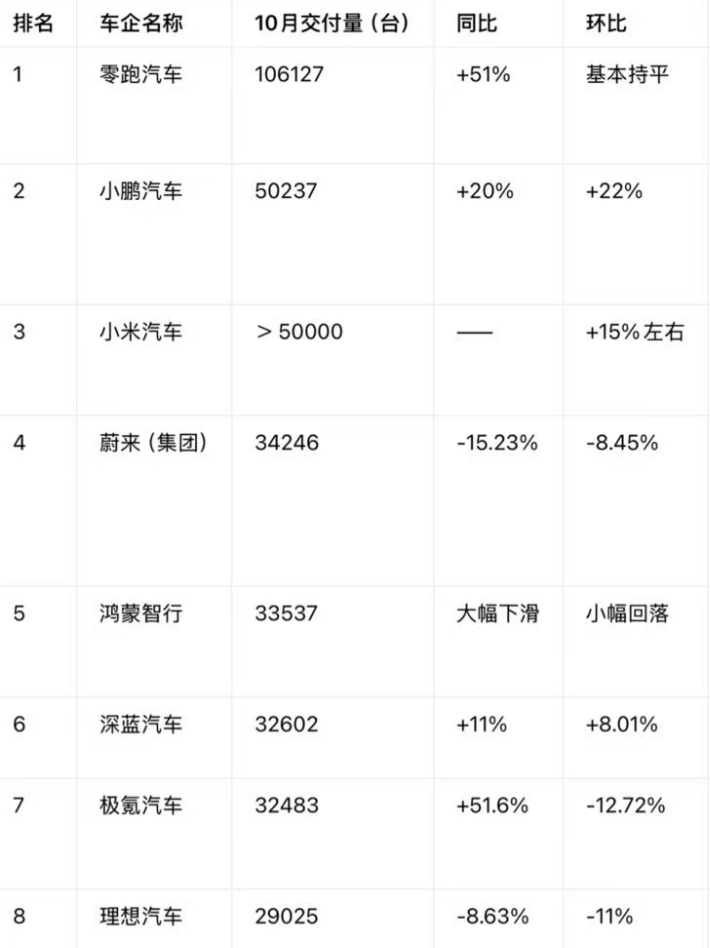
After years of market competition, the first tier of emerging automakers has undergone a disruptive reshuffle. NIO and Li Auto, once firmly at the top, have fallen to the mid-tier. Leapmotor leads by a wide margin on stable sales of 100,000 vehicles, while Xpeng and Xiaomi have together secured a foothold at the 50,000-unit threshold, forming a new top-three matrix of "Leapmotor + Xpeng + Xiaomi." This has completely rewritten the pecking order among the new forces and marks the arrival of an era in which scale production decides the winners.
Value-Focused New Forces Take the Top, and a Twin 50,000-Unit Tier Takes Shape
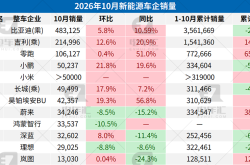
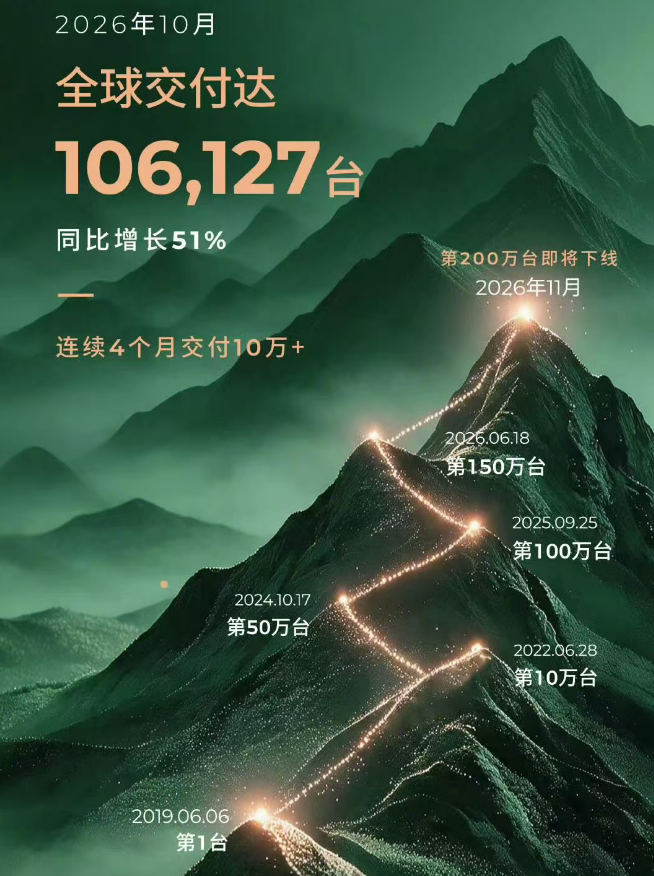
Leapmotor delivered 106,127 vehicles in October, up 51% year-on-year and basically flat month-on-month, marking four consecutive months of deliveries above 100,000 and a firm first place in sales among the new forces. It is the only current new force brand to have reached a stable 100,000-unit scale.
Unlike automakers that lean on a single hit model to drive volume and see sharp monthly swings, Leapmotor's sustained high growth is highly stable and sustainable. On the product side, Leapmotor concentrates on the mainstream mass-market band of RMB 100,000–200,000. Multiple models across the A and D series form a complementary matrix covering the full range of family sedans and SUVs. It precisely captures China's largest mass consumer market and anchors its base with strong value for money, full-scenario intelligent features, and solid range capability—with no obvious sales weak spots or product gaps.
Since last year, Leapmotor has no longer limited itself to domestic involution. Its overseas strategy has continued to be implemented and advanced. Relying on deep cooperation with Stellantis, it has accelerated localized deployment in the European market. Overseas business has become a pillar of sales growth that cannot be ignored—no longer merely a marginal supplement to the domestic market.
Following closely behind, Xpeng and Xiaomi both crossed the 50,000-unit threshold, jointly forming the second tier of new forces.
Xpeng delivered a record best monthly result of 50,237 vehicles, up 22% month-on-month and 20% year-on-year. The most noteworthy aspect of this growth is the explosive performance in overseas markets, with monthly overseas deliveries of 13,326 vehicles, soaring 166% year-on-year. Overseas business is no longer a conceptual story for Xpeng but has become a solid sales base.
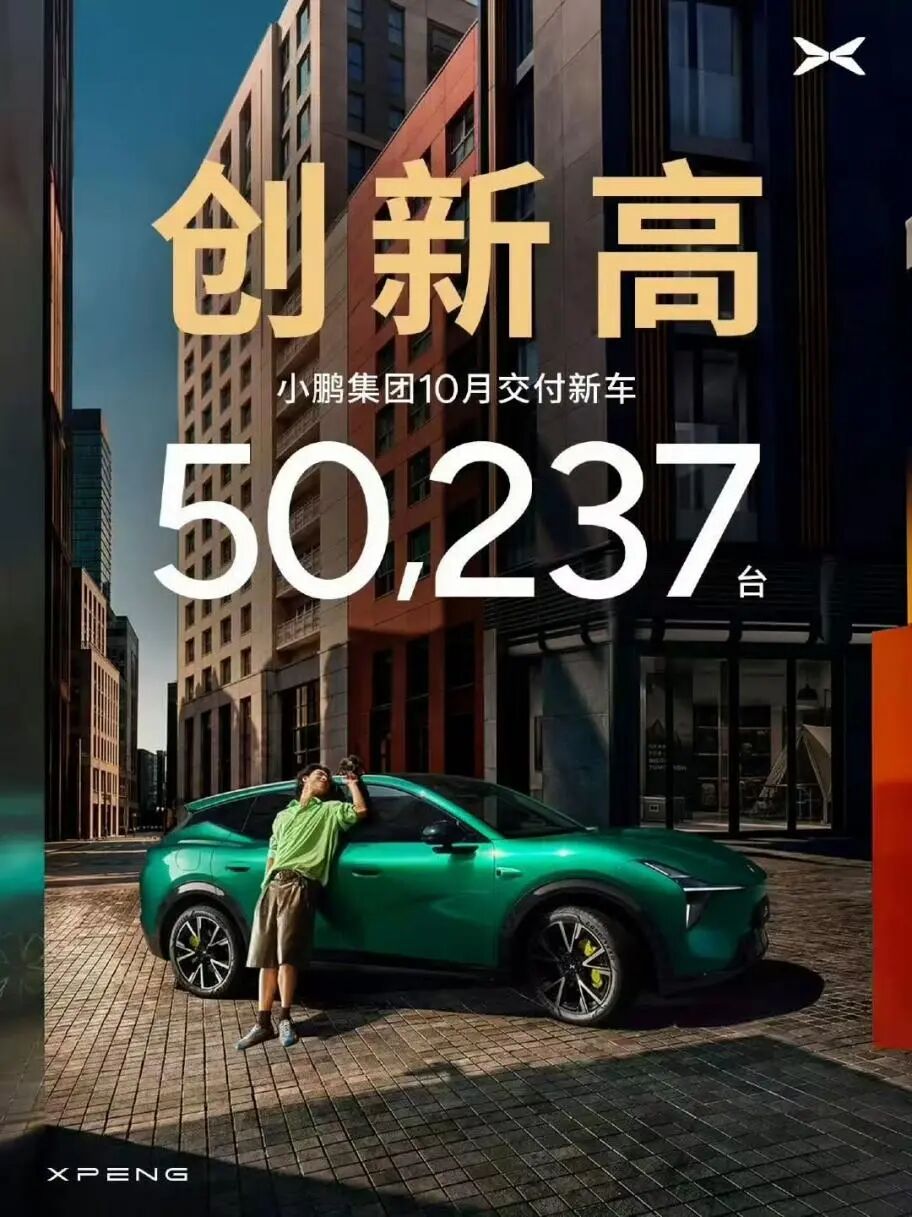
In September and October, Xpeng seemed to be on a roll, signing four overseas distribution agreements in Albania, Nigeria, Oman, and Kuwait. The brand's global distribution network suddenly covered 83 countries and regions, with more than 1,200 overseas stores.
At the localization level, Xpeng's first localized production project in Europe has started at the Magna plant in Graz, Austria, with the G6 and G9 models rolling off the line, and its Munich R&D center in Germany has also been put into use.
After internal organizational adjustments and fluctuating product rhythm over the past two years, Xpeng has now completed a new round of product iteration, stabilized its domestic base, and opened up incremental space in overseas markets. The company's operating condition has clearly recovered.
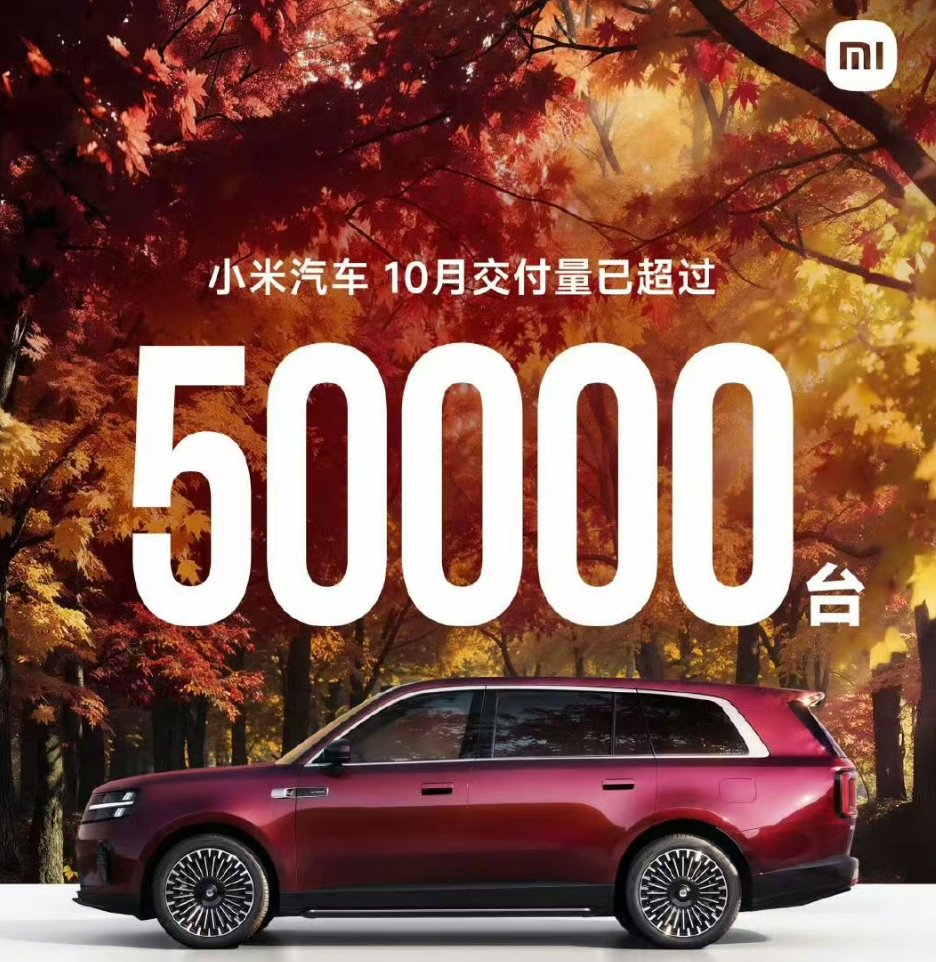
Xiaomi Auto's October deliveries exceeded 50,000 vehicles, achieving a stepped climb from 30,000 to 40,000 and then to 50,000. The arrival of the Pengcheng extended-range series was an important turning point, marking that Xiaomi has officially moved beyond the product structure of its previous two pure electric models, SU7 and YU7, and entered a "pure electric + extended-range" two-line battle mode. It has directly entered the larger family extended-range SUV segment and formed head-on competition with Li Auto and HIMA, completely breaking down the boundaries of the track.
However, behind Xiaomi's continued sales surge, obvious constraints remain. The capacity bottleneck has not yet been fully overcome, and the delivery cycle for core hot-selling models is as long as dozens of weeks. A large number of potential orders cannot be converted into deliveries in time, which to some extent limits further breakthroughs in sales.
Legacy New Forces Come Under Pressure as Mid-Tier Brands Diverge Further
On the other side, the former top players NIO, Li Auto, and HIMA all saw October deliveries fall in the 30,000-unit range, with Li Auto even sliding to 29,025 vehicles. It is not that the products of these companies have completely lost competitiveness, but that the industry environment has undergone fundamental changes.
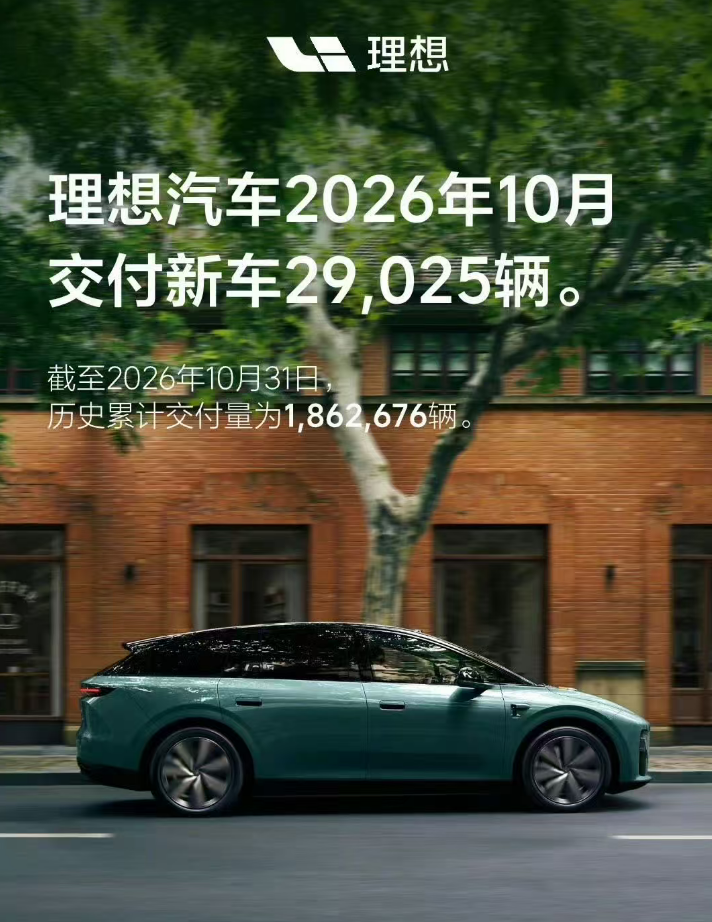
In October this year, Li Auto's sales fell 8.63% year-on-year and 11% month-on-month, remaining in a sustained downward sales channel. The extended-range leader that once firmly stood at the top of the new forces is now seeing its growth momentum continue to fade.
Li Auto's sales pressure stems from the dual impact of a product iteration gap and changes in the segment landscape. On the one hand, the brand's main family SUV products are in a transition between old and new models. Terminal discounts for older models have tightened, and new models have not yet been fully launched. The newly released Li Auto i9 and all-new Li Auto i6 have not yet begun to gain momentum.
On the other hand, the extended-range segment is no longer Li Auto's safe moat. The high-end extended-range segment, once dominated solely by Li Auto, is now flooded with new extended-range products from Xiaomi Pengcheng, HIMA, and major independent automakers. The intensity of market competition has doubled, users have far more choices, and Li Auto's exclusive segment dividend has completely disappeared.
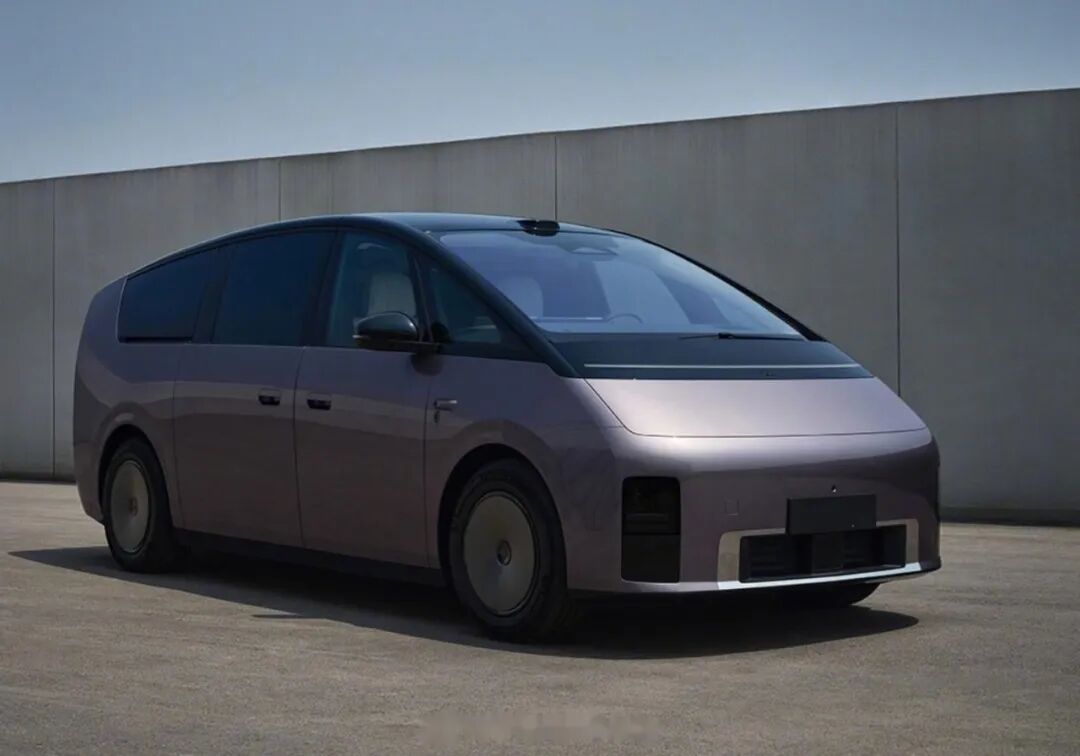
The only bright spot comes from the high-end MPV market. The all-new MEGA delivered more than 3,000 vehicles in October and continued to rank first in the high-end MPV segment above RMB 500,000, consolidating the brand's high-end positioning. However, the MPV segment is limited in size and cannot offset the sales decline pressure of mainstream SUV models.
Overall, Li Auto's previous dividend model relying on "precise family positioning + a single extended-range route" has become ineffective. Against the backdrop of a product iteration gap and comprehensive encirclement by competitors, short-term sales will continue to come under pressure. Suffice it to say that a product matrix covering multiple price bands and multiple powertrain routes is an enterprise's safety cushion during a market downturn. A model that relies on only one or two hit models to conquer the market can rise rapidly during the dividend period, but once it enters a product gap period, it will directly face the risk of sales volatility.
Last week, Li Auto also released the Lianshan electric technology system, preparing to walk on two legs: extended-range and pure electric.
From the perspective of the entire market, the only one currently pursuing a single route is NIO, and it is also the only very pure brand with only a pure electric layout.
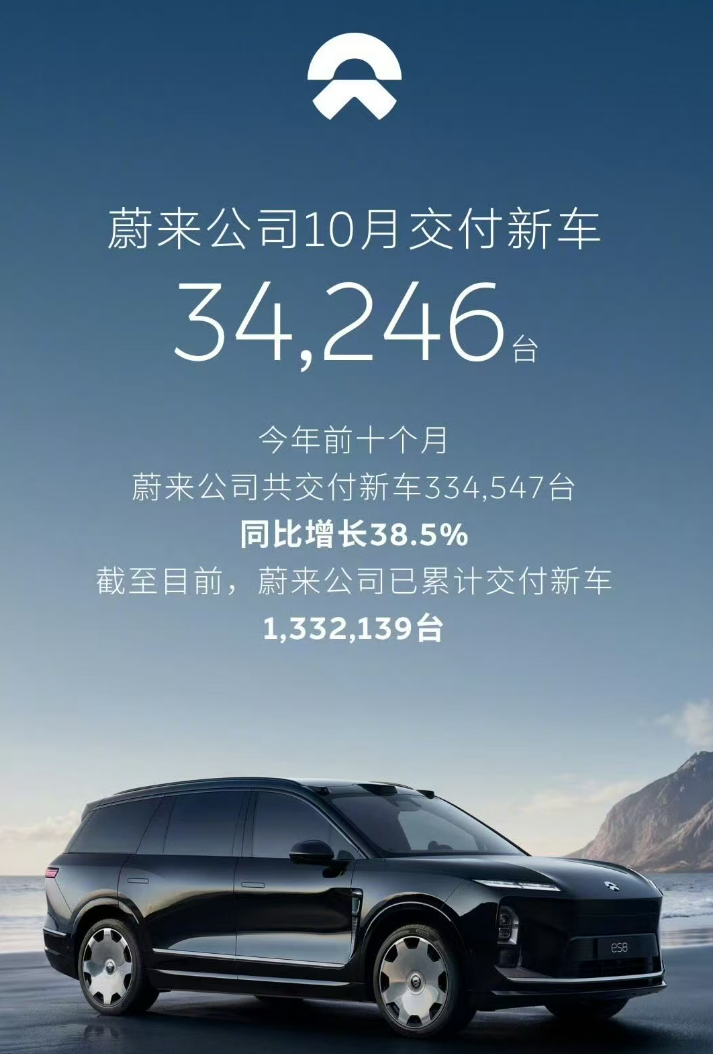
NIO delivered a total of 34,246 vehicles in October this year, with monthly sales beginning to decline. Relying on the three-brand matrix of NIO, ONVO, and Firefly, it covers a broad price range from RMB 150,000 to above RMB 500,000. Although monthly sales declined year-on-year, cumulative deliveries from January to October still maintained a high year-on-year growth rate of 38.5%.
With multiple brands simultaneously building channels and conducting marketing, channel efficiency and cost control have become long-term issues facing NIO. The release of multi-brand dividends takes time, and short-term internal pacing pains will also occur. Similarly, HIMA faces similar problems, coming under pressure from multiple opponents in the high-end segment, with sales showing an obvious decline.
As a high-end new energy brand empowered by Huawei, HIMA has long relied on Huawei's brand influence, intelligent cockpit, and intelligent driving technology advantages to deeply cultivate the high-end market, with an average price firmly above RMB 400,000 and a solid high-end user base.
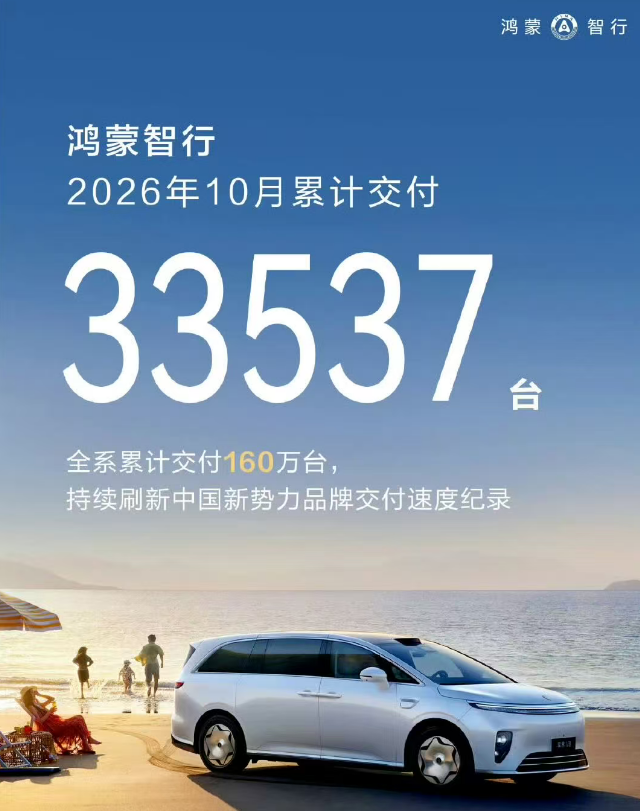
Official October delivery data released by HIMA shows that the "Five Realms" delivered a total of 33,500 vehicles that month, of which the AITO brand still accounted for more than 60%.
It is worth noting that HIMA has several new models about to go on sale, including the new M8 under AITO, which will officially launch on November 13 with a current pre-sale price starting at RMB 389,800. The new MPV under Luxeed, the Luxeed V8, is expected to go on sale in early November with a current pre-sale price starting at RMB 329,800.
The launch of several new products may help it sprint upward again by the end of the year.
Silver October Fades, Peak Season Fails
In addition to the new forces, some new energy brands incubated by state-owned enterprises have also produced standout players and become a mainstay.
Deepal Auto delivered 32,602 vehicles in October, up 11% year-on-year and 8.01% month-on-month, continuing a steady growth trend and demonstrating the strong counter-cyclical capability of new forces incubated by traditional automakers.
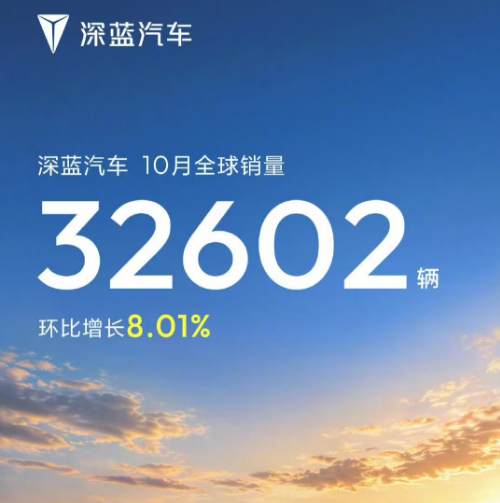
Relying on Changan Automobile's deep supply chain system, manufacturing capabilities, and channel resources, Deepal has always maintained a steady development rhythm without major sales fluctuations. In October, when most brands in the industry saw sales fluctuations and year-on-year declines, Deepal achieved double growth against the trend, fully confirming the rationality of its product layout and the stability of its market base. It is the most stable growth brand among mid-tier new forces.
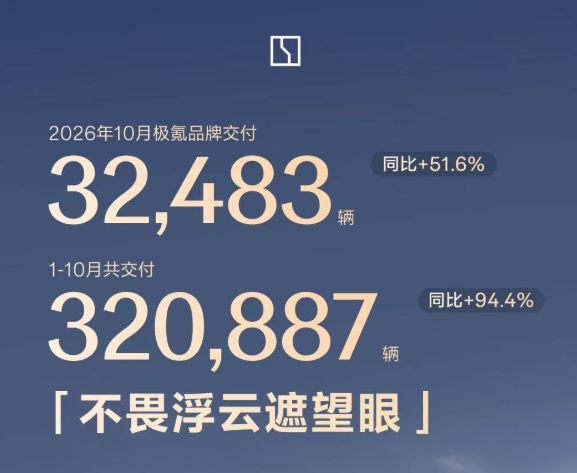
In addition, Zeekr delivered 32,483 vehicles in October, up significantly by 51.6% year-on-year, but down 12.72% month-on-month. From January to October, it delivered more than 320,000 vehicles, up 94.4% year-on-year, completing its full-year sales target of 300,000 vehicles ahead of schedule.
Different from the affordable involution strategy of traditional automakers, Zeekr has carved out a unique high-end growth path and is currently the only successfully incubated independent high-end brand. Although short-term month-on-month sales have declined somewhat, its long-term growth logic has not changed.
Compared with Zeekr's success, some high-end new energy brands grown in the greenhouse of state-owned enterprises are still hovering around the 10,000-unit level.
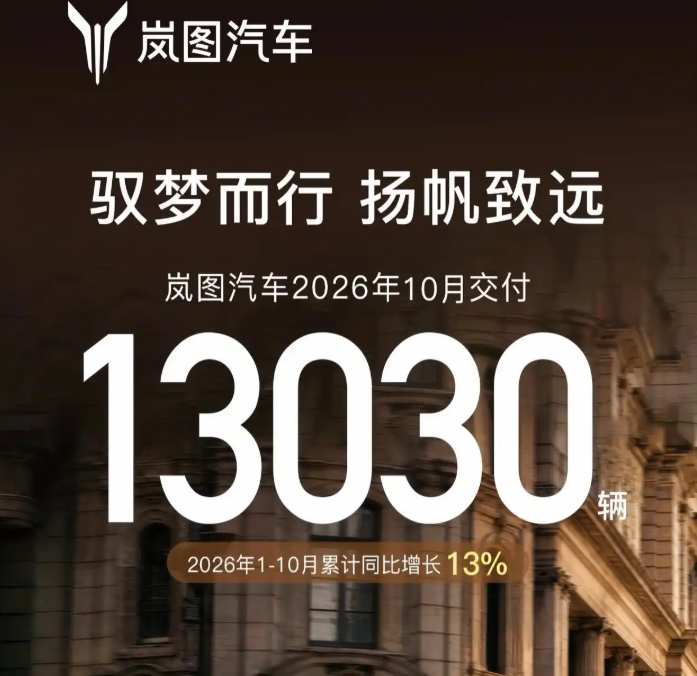
Representing Dongfeng, Voyah delivered 13,030 vehicles in October, basically flat month-on-month, with cumulative deliveries of 128,511 vehicles from January to October, up 13% year-on-year. Representing Changan, Avatr delivered 7,056 vehicles in October, down about 13.8% month-on-month and about 47.7% year-on-year, nearly halving. During the "Silver October" window when most brands rebounded month-on-month, Avatr was one of the few brands to weaken both year-on-year and month-on-month.
Similarly representing SAIC, IM Motors sold only 68,000 vehicles cumulatively from January to October, yet still achieved strong year-on-year growth of 21.2%. Although IM Motors did not specifically announce October sales, SAIC Group's financial report showed that the IM brand sold 60,000 vehicles cumulatively from January to September, implying October deliveries of around 8,000 vehicles, basically at the same level as Avatr.
From an overall perspective, the "Silver October" of 2026 did not stage the booming market conditions that a traditional peak season in the auto market should have. Data from the China Passenger Car Association shows that the domestic passenger vehicle market declined significantly year-on-year in October. Although new energy vehicles still maintained a high penetration rate of nearly 67%, the overall market is no longer in the broad growth dividend era of previous years.
The failure of the peak season has become a very important feature of the 2026 auto market. Consumers are strongly wait-and-see, with a large number of users waiting for the year-end preferential policy window.
In such an environment of a weakening overall market, the sales performance of automakers is no longer simply a competition in new product popularity, but a true test of the underlying strength of enterprises to resist cycles.
Over the next two months, automakers will be pulling out all the stops to hit their annual sales targets. At the same time, the policy windows for purchase tax incentives and trade-in programs are both set to close. It's safe to predict that the market will once again see fierce competition at the end of this year.
Note: Some images are sourced from the internet. If there is any infringement, please contact us for removal.
-END-
-
![]()
Tech Stocks Plunge: Is Faith in AI Still There? New Energy Weekly Summary
-
![]()
After the Hundred-Billion-Yuan Financing Closed, DeepSeek Unveiled Its Super-Agent Architecture
-
![]()
October New Energy Vehicle Sales Revealed: Leapmotor Up 51% Year-on-Year, While NIO, Li Auto and Harmony Intelligent Mobility All Decline
-
![]()
Apple Chooses Qwen—and There's More to It Than Meets the Eye
-
![]()
The Battle Against DJI: How Ying Shi Lost 100 Billion Yuan in Market Value
-
![]()
Modern China's Predicament: Hard to Break Through by Merely Changing the General Manager
-
![]()
Cutting Corners or Compliance? iPhone Duo Teardown Reveals China-US Structural Differences — Apple Says Component Variations Are Normal
-
![]()
Leapmotor Retains the Crown as Xpeng and Xiaomi Break 50,000: The New Forces Sales Landscape Gets Another Shake-Up