Kling 4.0 Hands-On Test: Creating an Exhibition Walkthrough Video with Zero On-Camera Talent — How Far Is AI from Delivering a "One-Stop Finished Video"?
 11/02 2026
 396

The challenge of AI video creation spans everything from the quality of generated images to the faithful execution of creative intent.
Author | Xu Ting
Editor | Dr. Qi
Late at night on October 30, Kuaishou announced on the Hong Kong Stock Exchange that its video generation business Kling had completed its capital increase delivery, receiving the full 19.802 billion yuan (approximately 2.905 billion USD) in capital increase payments. This gives Kling a post-money valuation of approximately 17.9 billion USD — equivalent to over 120 billion yuan, higher than Kuaishou's Hong Kong stock closing market value of approximately 96.8 billion yuan that same day.
"One Kling is worth more than all of Kuaishou" — especially considering that in the first half of 2026, Kling's revenue accounted for only 2.17% of Kuaishou's total revenue. What the capital market is buying is clearly not Kling's current revenue, but its future in the AI video track.
No matter how big the capital story is, it ultimately has to return to the creative scene to be tested. Recently, we used Kling 4.0 to produce an exhibition walkthrough video, handing all live-action on-camera segments entirely to AI, combining real exhibition footage with AI characters, splitting generation into 7 groups of shots, and then completing subsequent production through features such as synchronized audio-video output, video modification, and timeline. Before testing, we prepared approximately 3,000 words of prompts to clarify subject relationships, camera movement, composition, and sound requirements as much as possible, reducing instruction ambiguity.
The test results were mixed: in some shots, character blending, camera movement, and composition were already quite natural, with almost no noticeable incongruity; but in other clips, AI replaced the robot on stage with the host off stage, turned a one-take shot into several hard cuts, and even after modifying the video, turned originally normal audio into a string of unrecognizable garbled text.
AI can already generate many stunning shots, so why does the final video still require repeated trial and error? How far is Kling 4.0 from "one-stop finished video," and what key capabilities is it still missing? Under an 18 billion USD valuation and industry resource restructuring, can stable delivery become the commercial watershed for AI video?
Kling 4.0 Upgrades Again: From Generating Images to Executing Creative Ideas
In the large model competition among domestic internet companies, Kuaishou chose a relatively focused route: it did not bet its main chips on general-purpose chatbots, but continued to invest in video generation. This is closely related to Kuaishou's original business ecosystem. Advertising, e-commerce, short dramas, film and television, and creator content all have massive video production needs, and model capabilities also have the opportunity to convert into revenue through membership subscriptions, enterprise services, and API calls.
This is a business closer to money, and also more money-burning. The paid scenarios for video generation are relatively direct, but training, inference, computing power, and talent are all expensive. Kling thus gradually moved from an internal technical project at Kuaishou to the company's strategic center.
This shift in weight is clearly written in organizational and capital actions. In April 2025, Kuaishou established the Kling AI business unit, with its head reporting directly to Cheng Yixiao. In July, Kling advanced an independent spin-off financing arrangement, with a financing scale of nearly 3 billion USD and a post-money valuation of approximately 18 billion USD. Tencent, Alibaba Cloud, Baidu, as well as multiple local industrial investment funds and cultural and entertainment industry players entered the shareholder list. On September 30, Yu Yue, former head of the community science line, became director and CEO of Kling AI company, responsible for operations and management. On October 30, this round of independent financing officially completed delivery, with actual received capital increase payment of approximately 19.802 billion yuan, equivalent to approximately 2.905 billion USD.
From a first-level business unit to independent financing, and then to a dedicated CEO, Kling is gaining the resource allocation of an independent company and also beginning to face the operating exam of an independent company.
Commercialization data is currently its most weighty bargaining chip. According to data disclosed by Kuaishou, in the first quarter of 2026, Kling AI revenue exceeded 650 million yuan, a year-on-year increase of more than 300%; second-quarter revenue exceeded 850 million yuan, a year-on-year increase of more than 200%, totaling more than 1.5 billion yuan in the first half.
But revenue growth does not mean the business model is already worry-free. As business independence increases, it also needs to answer several more practical questions, such as whether revenue growth can continue, how computing costs will be absorbed, whether enterprise customers are willing to continue renewing, and whether the product can establish sufficiently solid competitive barriers.
Reports that Kling is preparing for a Hong Kong IPO have appeared in the press, but related arrangements are still at an early stage, and both listing timing and scale may be adjusted. Capital has given Kling more room, and also raised its passing line. Next, the market is asking not only what the model can still generate, but also whether technical highlights can turn into sustained returns.
Kling 4.0 arrives precisely against this backdrop, and is also a product node where Kling attempts to take another step toward professional creative workflows.
According to official information from Kuaishou, the Kling 4.0 upgrade focuses on realism, controllability, and professionalism: a single native generation can last up to 30 seconds; reference materials such as images, videos, subjects, and timbres can be flexibly combined, supporting up to 15 reference materials and 10 keyframes; the prompt length limit has also been further raised. Officially, these upgrades are intended to better handle high-dynamic scenes, complex camera movement, and continuous narrative.
These capability changes correspond to a shift in evaluation standards in the AI video industry. Early models first had to prove whether they could convert textual descriptions into a segment of imagery: whether character actions were natural, whether the images were realistic, and whether lighting and shadow approached real photography. As generation quality improved, creators began to make more complex demands: characters must remain consistent across shots, the camera must move according to specified shot size, composition, and rhythm, and multiple clips must maintain basic spatial relationships and narrative continuity.
What the model needs to handle is not only "what is in the image," but also what role each material plays, which elements can be changed, which information must be preserved, and how the creator wants the shot to unfold. Kling 4.0's upgrades to reference materials, camera movement, and generation duration are precisely responding to these needs.
Alongside model capabilities, product form is also evolving. Kling is gradually integrating generation, editing, canvas, and timeline capabilities into the same workspace, hoping to reduce the cost of users switching between different tools. The Seedance series previously launched by ByteDance's Seed team also takes long narrative, multimodal reference, and video editing as important directions for product iteration.
Implementation methods differ among companies, but the competitive goal is gradually becoming clear: what creators expect is no longer just a button that can generate clips, but also a set of tools that can help complete a work.
If the first half of AI video was about generation capability, the second half tests the ability to execute creative intent. But do longer generation duration, more reference materials, and richer editing capabilities mean creators can more accurately control the final result?
Qidian conducted a hands-on test with an exhibition walkthrough video. The exhibition site was real footage, and AI characters needed to enter the existing environment and complete different camera movements; multiple clips also had to maintain character and scene relationships and connect with voiceover, sound, and post-processing.
We wanted to see how much of an exhibition walkthrough video with no real people on camera — from material organization and shot generation to voiceover and music — could actually be handled by AI. (Finished video here)
Kling 4.0 Hands-On Test
Between a Good Shot and a Good Finished Video, How Many "Redos" Are There?
This test used Kling 4.0 throughout. The video adopted a combination of real footage and AI characters, split into 7 groups of shots, with generation, modification, and material organization completed in the canvas. To reduce instruction ambiguity as much as possible, we used an AI assistant and team editing colleagues to organize approximately 3,000 words of prompts, clarifying subject relationships, composition, shot size, camera movement, and sound requirements.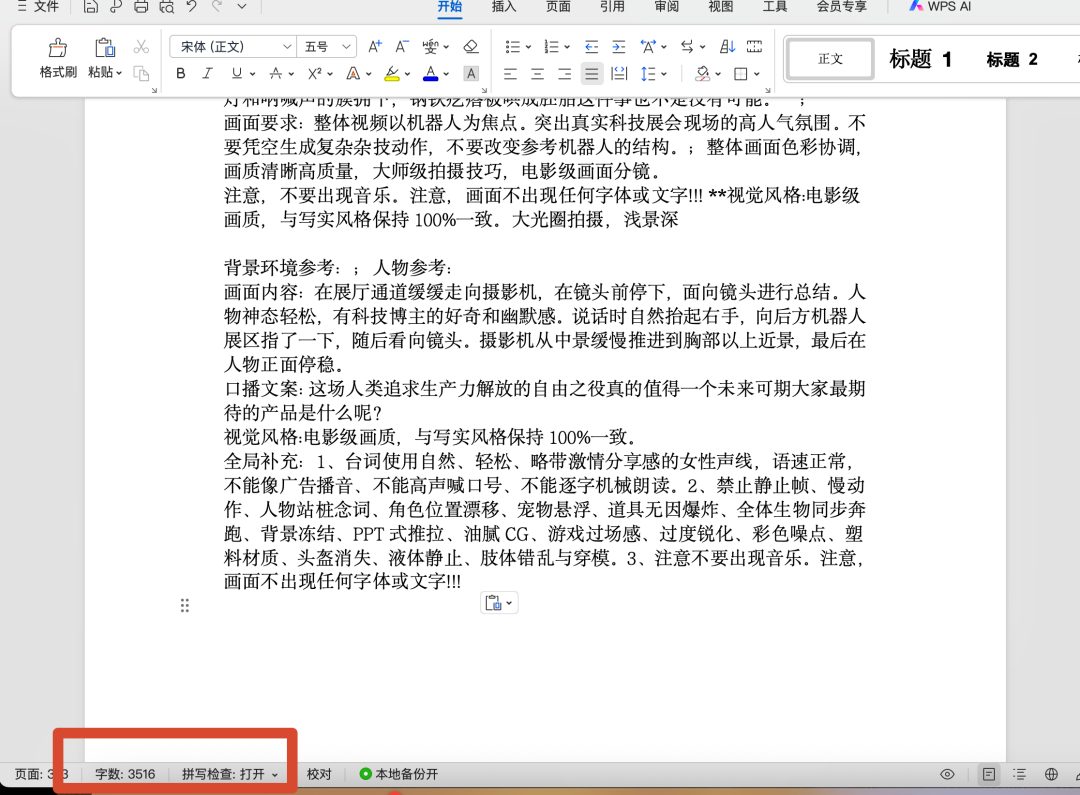
In other words, this was not a random test completely letting the model run free, but a real combat test with professional assistance and a clear delivery goal.
Kling 4.0's upper limit is indeed surprising enough. In the best-performing clips, it could accurately complete the camera push required by the prompts, and composition, shot size, and switching rhythm basically met expectations. Even more rare, the blending of AI characters with the real environment was quite natural; the characters did not obviously feel "pasted" onto the background, and they did not appear abrupt when interacting with the environment.
Such images are already close to a directly deliverable state. It shows that Kling 4.0 is not only capable of generating a few sample clips suitable for demonstration; when conditions are suitable, it can indeed produce content with professional use value.
Sound was also a relatively bright spot in this test. Most ambient sound and voiceover could be used directly, and the overall usability rate was higher than that of images. Synchronized audio-video output reduced the step of dubbing segment by segment, offering clear efficiency value for creators who need to quickly complete short videos.
But highlight performances cannot be reproduced stably. The first reason is that the model's handling of the relationship between subjects and scenes can still deviate. In one generation, the host who should have been standing off stage directly replaced the robot on stage;
in another clip, AI again replaced the host in the background video with a character. Even after adding relational descriptions such as "watching," the result did not improve noticeably. In still other clips, the proportion between characters and scenes was unbalanced, suddenly giving a normal exhibition walkthrough the feel of "accidentally entering Lilliput."
The core of these bugs is not image quality, but whether the model truly understands "who is who, who is where, and who interacts with whom" in the image.
The second issue is long takes and continuous narrative. We specifically designed a set of one-take instructions, but after several attempts, what we got was still hard cuts between different scenes. Although the character kept walking, the camera did not form continuous movement, and the surrounding environment was also substantially modified. The restrictions on material use in the prompts were not stably executed. Increased duration does not naturally equal upgraded narrative capability; the model can generate longer content, but may not be able to continuously maintain spatial, character, and camera relationships.
The last issue is consistency in modification and sound. After some clips were modified, not only did they fail to correct according to instructions, but they also added subtitles without authorization; originally normal audio could also turn into garbled text in subsequent generation, voices preconfigured for the character subject were not stably referenced, and the same character in different clips could have different voice timbres. The canvas and timeline did improve material management, but BGM, transitions, sound effects, and the modification workflow still did not form a sufficiently smooth finished-video loop; if anything went wrong, it all had to be "pushed back and redone."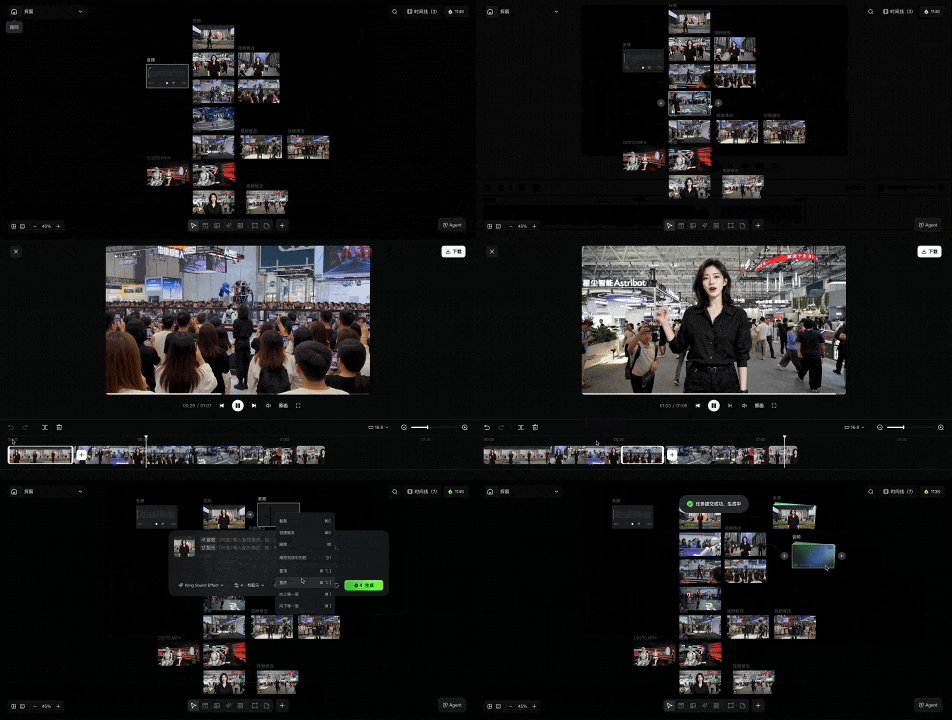
This is also the most direct feeling from this hands-on test: Kling 4.0 has raised the upper limit for generating good shots, but stably delivering a video that meets requirements still requires creators to backstop key links.
The costs generated during this process are easily obscured by the price of a single generation. Prompt debugging, repeated generation, material screening, failed modifications, waiting time, and manual inspection and repair together constitute the real production cost of the video. For individual creators, they consume time and energy; for advertising, short drama, and film and television teams, they also affect schedules, budgets, and delivery acceptance.
Kling Spins Off, Xiaoyunque Merges into Jimeng
The Second Half of AI Video Has Changed Its Playbook
From the test results, Kling 4.0 can already generate images with professional use value in some scenarios, but there is still room for improvement in stably executing complex requirements, preserving effective content during modifications, and smoothly completing the entire production process. These issues also relate to the focus of competition in the next stage of the AI video industry.
Products like Kling, Seedance, Vidu, Hailuo, and Tongyi Wanxiang are in a constant cycle of iteration, focusing on image quality, character consistency, continuous narrative, generation cost, and vertical use cases. Even a single version upgrade can deliver meaningful leaps in capability. As core generation quality keeps improving, judging whether one particular sample clip looks impressive is no longer enough to gauge a product's true value.
Kling's commercialization progress has relatively transparent public data, and its revenue growth has made it a player worth watching in the video generation space. That said, revenue scale, user growth, profitability, and long-term competitiveness are distinct dimensions. Without comparable data from competitors on the same basis, it's hard to claim Kling already leads across the board in commercialization.
Competition is also unfolding in the application ecosystem. ByteDance has products and services spanning multiple links in the chain—Seedance, Jimeng, Jianying, Douyin, and Volcano Engine—while Kuaishou has its own content platforms and Kuaiying. Having gained more independent financing and operating leeway, Kling needs to keep synergizing with its parent company while also building its own product ecosystem for external developers and enterprise customers.
Recently, reports emerged that Xiaoyunque, ByteDance's AI short drama creation platform, was merged into Jimeng. The product retains a standalone entry point, with its short drama capabilities folded into Jimeng. This forms an interesting contrast with Kling's independent financing: one side is carving out independent operating space for a single business, while the other is further integrating similar products' capabilities and operations. These two organizational choices don't prove which path is better, nor do they represent an industry-wide trend, but both point to the same real question: companies need to re-examine which capabilities should be built separately, which products should be integrated, and which links can create lasting commercial value.
As more third-party creation platforms connect to different video models, generation capability alone may no longer be a moat for any given application. Users can compare results, speed, and pricing across tools, and switch models to suit the task. To retain users, an application must offer value beyond the model itself: workflows better tailored to specific creative tasks, more refined editing and collaboration features, more reliable content management, or a direct line to distribution and commercial conversion.
With that in mind, the value of AI video products can be reassessed along three interrelated dimensions.
The first is generation stability. For the same task, can the tool consistently produce results that meet requirements? Do good frames appear by chance, or can they be reproduced reliably under similar conditions? For professional users, a single stunning result is certainly useful, but stability is what determines whether a tool becomes a routine part of the production workflow.
The second is controllability of modifications. When there are deviations in characters, actions, or audio, can the tool make corrections while preserving other valid content? If every edit risks introducing new errors, the model may seem to offer more editing capability while actually creating more rework.
The third is overall delivery cost. Beyond the time and credits needed for model generation, one must also account for prompt preparation, material screening, failed retries, manual fixes, and audio-visual post-production. Only by tallying these costs together can you determine how many resources a usable video actually requires—and only then can you compare the efficiency of different tools in real-world workflows.
These three dimensions tie directly into commercial returns. Stable generation and modification reduce repetitive labor; smoother workflows let models enter professional production scenarios such as advertising, short dramas, and film and television; and predictable unit delivery costs influence whether clients are willing to use the service long term and renew.
For model companies, user scale, ARR, and financing valuation remain important, but enterprise renewals, API usage, computing costs, and ultimate profit also determine whether growth can be sustained.
Along the way, mixed use of multiple models and tools is likely to persist for a long time. Creators may use one model to generate visuals, another tool to process audio, and then professional software to finish editing and post-production. Model vendors must work to embed their capabilities into the production workflows users run over and over.
The $18 billion valuation prices in Kling's technological potential and commercial prospects and leaves room for its future development. The 4.0 capability upgrade shows its push toward professional creation. What needs further verification is whether these technological capabilities can translate into more consistent results, a more controllable modification process, and delivery costs that clients can accept.
Good shots draw people in; stable delivery keeps them coming back.

Editor: Muren
Reviewer: Zhang Wenxin Production: Rui Zong
-
![]()
AI Cannot Cure the CEO's Serious Illness
-
![]()
In the Era of Stock Competition, Why Quality Competition Must Look at Both "How Well It's Built" and "How Long It Lasts"
-
![]()
Kuaishou: The Perennial Runner-Up — Can Kling AI Become Its Second Growth Curve?
-
![]()
Over 6,000 Yuan Profit per Car—Is Geely's Per-Vehicle Profit Inflated?
-
![]()
Kling 4.0 Hands-On Test: Creating an Exhibition Walkthrough Video with Zero On-Camera Talent — How Far Is AI from Delivering a "One-Stop Finished Video"?
-
![]()
AI Code Refactoring in Practice: Assess First, Then Tackle Technical Debt
-
![]()
Fold 5 Times and It Leaks — ¥8,000 Repair Bill: Who Set Up Apple's Foldable Screen Scam?
-
![]()
Xiaomi Spends 1.7 Billion Yuan to De-CATL-ize: Is Lei Jun Content to Be a "Worker" for the Ning King?