Kuaishou: The Perennial Runner-Up — Can Kling AI Become Its Second Growth Curve?
 11/02 2026
 371
In overseas markets, Google Veo and Runway continue to iterate; domestically, ByteDance's Seedance holds a commanding lead, with challengers such as Alibaba's HappyHorse and Shengshu Technology's Vidu close behind. Whoever completes an IPO first will be the first to capture the scarcity premium of being the "first AI video stock." This is the driving force behind Kling AI's IPO push.

On the evening of October 30, Kuaishou announced that its Kling AI video business had completed the closing of this round of capital increase. After the closing, the total capital contribution actually paid by all investors of Beijing Kling amounted to approximately RMB 19.802 billion, corresponding to about US$2.905 billion.
On the same day, Kuaishou's stock price fell intraday to a historic low of HK$25.88; by market close its market value stood at US$14.839 billion. This situation is actually quite "heartburn-inducing," because Kling AI's latest post-investment valuation is US$18 billion, which shows that in the eyes of capital, the subsidiary is now worth more than the parent company.
With the valuation inversion, the logic behind Kuaishou's spin-off of Kling becomes clearer—after all, the high valuation of a pure AI asset makes a future independent listing more convenient. And there was new news this month on Kling AI's IPO progress. In early October, multiple media outlets reported that Kling AI had selected CICC, Goldman Sachs, and UBS as underwriters for its Hong Kong IPO, planning to file in early 2027 and raise at least US$1 billion.
On one side is the high-investment, high-valuation AI business; on the other is the core business whose growth has nearly peaked. Kuaishou is spinning off Kling to sprint toward an IPO, trying to carve out a new path in the AI era. But this new path is destined to be anything but easy.
01 From spin-off financing to executive appointments, why is Kuaishou in such a hurry to take Kling AI public?
This year, Kuaishou has gone through several rounds of personnel appointments across its traditional core business and its AI line. At the end of September, the most critical round of organizational restructuring finally landed.
Yu Yue, former head of the community science line, was reassigned as director and CEO of Kling AI, fully responsible for Kling's operations and management. His taking on this responsibility is not surprising; as a key figure in Kuaishou's AI business line, putting him in this position is a key move toward Kling AI's independent operation.
After Yu Yue's departure, Cheng Yixiao personally took over as head of the community science line, reclaiming direct management authority over the group's AI foundational R&D. On the same day, a cross-business-unit virtual organization, "Enterprise AI Productivity," was established, specifically responsible for building the infrastructure for internal AI office and R&D tools.
Adjustments at the capital level came earlier and more intensively than personnel changes. As early as May this year, the market first heard of the Kling AI spin-off plan; in July-August, Kling AI's independent financing landed, with an external capital increase cap of US$3 billion; Tencent, Alibaba, and Baidu rarely appeared on the same stage as investors, at a post-investment valuation of US$18 billion. After the financing, Kuaishou still held 68.33% equity, and Kling AI continued to be consolidated.
By early October, Bloomberg, citing people familiar with the matter, reported that Kling AI had selected three underwriters—CICC, Goldman Sachs, and UBS—and planned to list in Hong Kong as early as next year, aiming to raise no less than US$1 billion, though the fundraising size and listing timetable were not finalized.
In just a few months, Kling AI completed its spin-off financing and organizational restructuring, and a timetable for its IPO emerged. Why is Kuaishou in such a hurry to take Kling AI public? Lujiu Business Review analyzes two reasons.
First, the AI business is burning cash too fast. Data shows that Kuaishou's capital expenditure in 2026 is expected to be about RMB 26 billion, RMB 11 billion more than in 2025. A Guosen Securities research report shows that about RMB 17-18 billion had already been invested in the first half, mainly to stockpile computing power in advance.
Even so, Kuaishou's investment intensity is actually still slightly inferior. Alibaba's capital expenditure in the second quarter reached RMB 67.7 billion; Tencent's rose 176% year-on-year in the second quarter to RMB 52.8 billion; ByteDance raised its 2026 AI capital expenditure from RMB 160 billion to over RMB 200 billion... If it does not want to fall behind in this round of AI competition, Kuaishou must step up R&D and keep burning cash, and independent financing is the best choice.
Second, Kuaishou's core business is already weak. Rather than continuing to battle in the stock market of the old business, it is better to bet its chips on the new business.
Data shows that in the first half of 2026, the group's revenue was RMB 69.25 billion, of which advertising revenue growth continued to slide, and Q2 livestreaming revenue fell 13.5% year-on-year; adjusted net profit was RMB 7.29 billion, down 28.5% year-on-year; daily active users grew almost zero. By contrast, Kling AI's second-quarter revenue exceeded RMB 850 million, up more than 200% year-on-year, almost the only bright spot in the interim report.
The high valuation of a pure AI asset is clearly more suitable for an independent listing. What fits Kling AI at this stage is a pricing logic anchored in ARR and the scarcity of the track, whereas what Kuaishou gets is a mature internet platform valuation. The essence of the spin-off is to separate the two pricing logics, letting Kling obtain an AI valuation as an AI company.
It is worth noting that behind this round of financing there is also a five-year listing bet: if Kling AI fails to complete an IPO before October 30, 2031, investors have the right to require the company to repurchase all or part of their equity at "investment principal + 8% annual simple interest."
For Kling AI, going public has thus become a "must-answer question" with a countdown. Next comes a more pressing question: can Kling AI really support the US$18 billion high valuation and this IPO that is already on the bowstring?
02 The quality of commercialization is the key test
2026 is regarded by the industry as "the first year of AI commercialization," and AI video is one of the tracks with the clearest commercialization and the most certain profitability. An intuitive signal is the full-scale explosion of AI short dramas and AI comic dramas. Once the demand side is proven, commercialization will naturally accelerate.
Data shows that in the first half of 2026, Kling AI's revenue exceeded RMB 1.5 billion, of which first-quarter revenue exceeded RMB 650 million, up more than 300% year-on-year; the second quarter further accelerated to over RMB 850 million, up more than 200% year-on-year. Looking at growth alone, the momentum is indeed strong.
But on the increasingly competitive AI video tool track, to test the quality of Kling AI's commercialization, one cannot look only at growth; it needs to be compared across multiple dimensions.
The first dimension is revenue structure. According to National Business Daily, in the first quarter of 2026, Kling AI's overseas revenue accounted for nearly 80%, API revenue accounted for 60%, surpassing subscription services for the first time, and among that, revenue from "super large customers" also rose to over 80%; among the top ten customers, eight were overseas enterprises and only two were Chinese enterprises. In June 2026, Kling disclosed that its global users exceeded 100 million, covering 224 countries and regions, with nearly 50,000 enterprise customers.
Commercialization landing more in overseas markets is not a problem in itself. The problem is that over-reliance on overseas markets and super large customers means holding one's lifeline in someone else's hands; once the other party leaves, the impact on revenue is immediate. The aforementioned National Business Daily report mentioned that in April this year, the API-contributed revenue of three overseas super large customers had already declined because competitors offered lower prices.
The second dimension is competitors. On the AI video track, the domestic market already has players such as ByteDance's Seedance, Alibaba's Happy Horse, and Shengshu Technology's Vidu; in overseas markets, Google Veo, Runway, Synthesia, and others each occupy a corner at the model layer and the application layer.
With more competitors, prices naturally became cutthroat. For example, Vidu once launched a first-release promotional price of US$0.014/second, and MiniMax simply open-sourced some components of its general video model MiniMax H3...
An AI video creator told Lujiu Business Review: "Each company's models iterate very quickly, but for users, the technological generation gap is not as obvious as imagined. Plus, the cost of switching models is not high, so we may soon reach the stage where whoever is cheaper is used."
When the technological generation gap narrows and switching costs fall, how much pricing power Kling AI can retain becomes a question worth pondering.
The third dimension is sustained profitability. Although Kling AI's commercialization is accelerating, it had a net loss of RMB 500 million in 2024 and a net loss of RMB 1.9 billion in 2025, still a long way from true break-even.
And market competition is changing rapidly. A Guosen Securities research report estimates Kling's third-quarter revenue at RMB 850 million, zero quarter-on-quarter growth from Q2, with commercialization progress falling short of market expectations.
To put it plainly, Kling has proven at this stage that it can make money, but it still needs to prove whether it can make money continuously. After all, in the end of the AI video battle, only whoever better navigates the path of commercialization is qualified to stay at the table.
03 Old rivals meet again, will Kuaishou once again become second place?
Back to Kuaishou. As the second place among the "short video duo," over the years outsiders have often said of Kuaishou that it started early but arrived late.
This saying is not unfounded. In 2013, Kuaishou shifted from a tool to a short video community, while Douyin only launched in 2016. Kuaishou started earlier, but Douyin overtook it in daily active users in 2018. By 2020, Kuaishou launched the "K3 Campaign," spending RMB 4 billion on red envelopes during the Spring Festival Gala to push daily active users past 300 million, but by then Douyin, including its Huoshan version, already had over 600 million daily active users.
In the livestreaming e-commerce era, Kuaishou launched e-commerce in 2018, while Douyin only went all-in in 2020; but in 2025, Douyin e-commerce GMV was about RMB 4.4 trillion, while Kuaishou's was about RMB 1.6 trillion, and the gap is still widening.
Every time, Kuaishou did not start late, yet it was always pushed into the industry's second place. And this pattern has continued into the AI video track.
In terms of monthly active users, in the first quarter of this year, the Jimeng app's monthly active users reached 13.525 million, far surpassing Kling AI. In the first quarter, the Kling app had 1.191 million monthly active users, with an average mobile monthly active user count of 7.8 million in March.
In terms of computing power consumption, according to AI Prism statistics, in mid-to-late May 2026, calculated by daily consumption share, ByteDance's Seedance accounted for over 80% of the AI video generation market, while Kling accounted for about 14%.
In terms of revenue scale, DataEye's "2026 First Half Domestic AI Drama and Comic Drama Data Report" estimates that the domestic AI drama and comic drama market will reach RMB 40 billion in 2026, of which the AI video large model market will exceed RMB 20 billion; the Seedance series of large models leads by a wide margin with a 69% share; Kling ranks second with a 17% share.
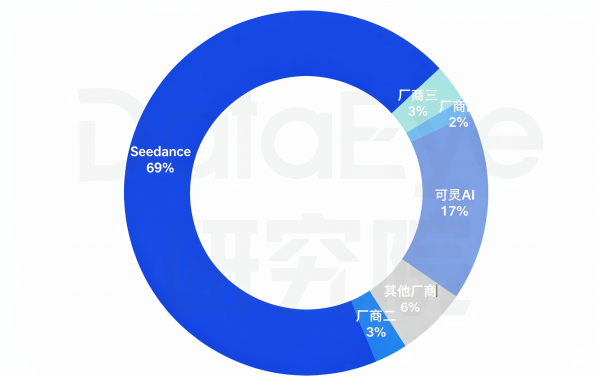
As mentioned earlier, Kling AI's market focus is mainly overseas, but even so, Seedance still seems to hold a leading advantage.
In the Arena image-to-video leaderboard on September 21, Seedance 2.5 and 2.0 ranked fourth and fifth respectively, while Kling 3.0 ranked 19th; on the Artificial Analysis leaderboard, Seedance 2.5 and 2.0 ranked second and sixth respectively, while Kling 3.0's Omni and 1080 pro ranked 17th and 18th—the gap between them does exist.
Since leaderboards lag behind model releases, whether the newly launched Kling 4.0 can rewrite the rankings still needs more evaluations and data for further observation.
And the gap between Kling AI and Seedance has never been just a gap in the models themselves, but also a gap in ecosystems. Behind Seedance, the content source includes Fanqie Novel's massive IP library, the creation process includes AI products such as Jimeng, and after the film is finished it directly connects to Douyin's and Hongguo's ad placement and distribution, with Volcano Engine's computing power underpinning it at the bottom. A story, from being written to generating video to being pushed in front of the audience, can complete the entire process in a closed loop within the ByteDance system.
Kling can of course also rely on Kuaishou's content ecosystem and commercial scenarios, but putting both sides' chips on the same scale, from computing power foundation and traffic volume to financial ammunition, there is still an obvious order-of-magnitude gap between Kuaishou and ByteDance.
In the final analysis, Kuaishou is spinning off Kling AI for an IPO betting on the future of AI video, and also wanting to blaze a new path through AI.
In overseas markets, Google Veo and Runway keep iterating; in the domestic market, ByteDance's Seedance leads by a wide margin, with other entrants such as Alibaba's HappyHorse and Shengshu Technology's Vidu. Whoever completes an IPO first will be the first to capture the scarcity premium of being the "first AI video stock."
The card table of the AI era is already set. Whether Kling AI can keep sitting at the table will ultimately have to be answered by market share and commercialization capability.
-
![]()
AI Cannot Cure the CEO's Serious Illness
-
![]()
In the Era of Stock Competition, Why Quality Competition Must Look at Both "How Well It's Built" and "How Long It Lasts"
-
![]()
Kuaishou: The Perennial Runner-Up — Can Kling AI Become Its Second Growth Curve?
-
![]()
Over 6,000 Yuan Profit per Car—Is Geely's Per-Vehicle Profit Inflated?
-
![]()
Kling 4.0 Hands-On Test: Creating an Exhibition Walkthrough Video with Zero On-Camera Talent — How Far Is AI from Delivering a "One-Stop Finished Video"?
-
![]()
AI Code Refactoring in Practice: Assess First, Then Tackle Technical Debt
-
![]()
Fold 5 Times and It Leaks — ¥8,000 Repair Bill: Who Set Up Apple's Foldable Screen Scam?
-
![]()
Xiaomi Spends 1.7 Billion Yuan to De-CATL-ize: Is Lei Jun Content to Be a "Worker" for the Ning King?