Over 6,000 Yuan Profit per Car—Is Geely's Per-Vehicle Profit Inflated?
 11/02 2026
 414
After two years of price wars, the auto market has played out card by card. Discount posters flooded screens in waves, feature competition escalated layer by layer, and consumers watched with satisfaction—yet automakers' financial reports told vastly different stories. Entering the second half of 2026, the once-booming "Golden September and Silver October" quietly cooled, and Geely Auto itself acknowledged in its financial report that industry competition was fiercer than ever.
It is precisely against this backdrop that one figure in Geely's third-quarter report stands out: core net profit attributable to parent per vehicle of 6,664 yuan, up 37% year-on-year. While overall industry sales fell about 6% year-on-year, Geely delivered 2.2355 million vehicles in the first three quarters, raising its overall passenger vehicle market share to 11.1% and its new energy passenger vehicle market share to 11.4%.
Against the headwinds, per-vehicle profitability rose rather than fell—the logic behind this deserves careful scrutiny. But before delving in, it is worth clarifying where the 6,664 yuan figure comes from.
How is the over-6,000-yuan profit per vehicle calculated?
In the same financial report, Geely presents two profit measures, and most people remember the more eye-catching one. One is net profit attributable to parent under Hong Kong Financial Reporting Standards; the other is core net profit attributable to parent as defined by the company itself.
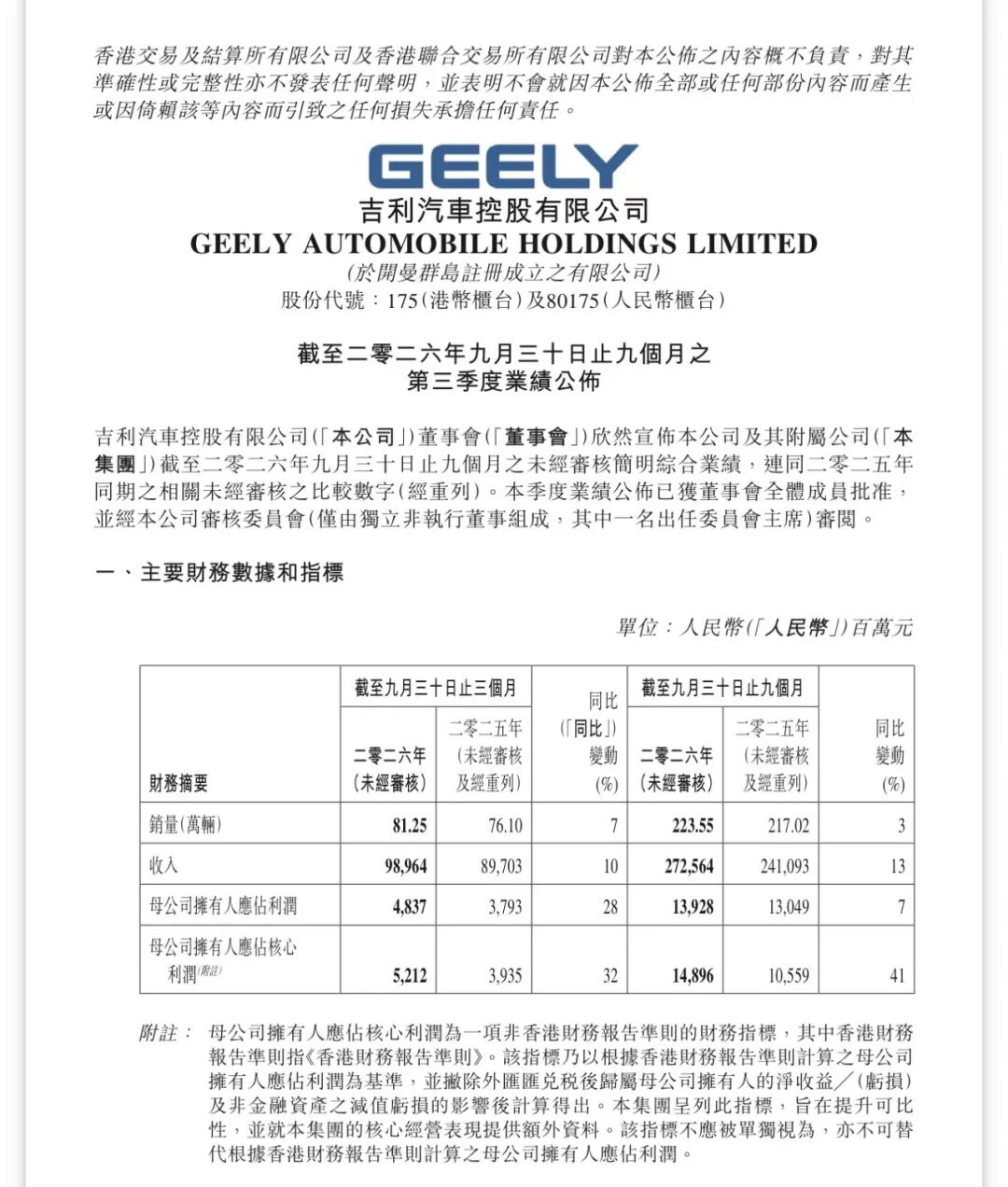
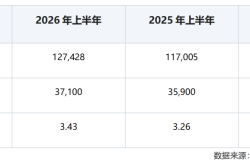
Hong Kong Stock Exchange filings show that in the first three quarters of this year, Geely's reported profit attributable to owners of the parent was 13.93 billion yuan, up 7% year-on-year; core net profit attributable to parent reached 14.9 billion yuan, up 41% year-on-year. The nearly 1 billion yuan gap between the two is mainly due to foreign exchange. The filing states clearly that the core measure excludes foreign exchange gains and losses and impairment of non-financial assets; in the first three quarters of this year, Geely recorded a net foreign exchange loss of approximately 1.126 billion yuan, compared with a net gain of approximately 3.337 billion yuan in the same period last year.
It is thus easy to understand that 6,664 yuan is derived from core profit divided by sales volume. If switched to the stricter reported basis—dividing 13.93 billion yuan by 2.2355 million vehicles—Geely's net profit truly attributable to parent company shareholders was approximately 6,230 yuan per vehicle sold in the first three quarters.
Both figures are defensible, but any cross-company comparison must use the same yardstick. Comparing Geely's core measure against others' reported measures may look favorable on the surface, but the comparison itself lacks rigor—and that is the starting point for the discussion that follows.
How much does each automaker earn per vehicle sold?
Putting the data of four companies with complete figures—Geely, BYD, Chery, and Great Wall—into a unified framework of reported net profit attributable to parent divided by the sales volume of the listed entity, the picture immediately becomes clear.
In the first three quarters of this year, BYD sold 3.1316 million vehicles with net profit attributable to parent of 22.345 billion yuan, or about 7,135 yuan per vehicle; Chery's listed entity sold 2.0769 million vehicles with net profit attributable to parent of 13.963 billion yuan, or about 6,723 yuan per vehicle; Geely sold 2.2355 million vehicles with net profit attributable to parent of 13.93 billion yuan, or about 6,230 yuan per vehicle; Great Wall sold 920,300 vehicles with net profit attributable to parent of 3.826 billion yuan, or about 4,157 yuan per vehicle.

On absolute terms alone, Geely's 6,230 yuan ranks behind BYD and Chery. This ranking may defy many readers' intuition—after all, Geely's press releases are full of new highs and market leadership—but numbers have their own cool logic, and at least on the reported basis, Geely has yet to claim the top spot in per-vehicle profitability.
What is truly intriguing is the trend. BYD's net profit attributable to parent fell 4.24% year-on-year in the first three quarters, Chery edged down about 2.8%, and Great Wall dropped 55.69%—only Geely maintained 7% growth on the reported basis. Rather than who earns more in a given period, Geely's value lies in its consistently upward curve, making it one of the few among the four to maintain positive growth and giving it greater composure in its operating position.
Zooming out across the entire earnings season, the divergence among automakers is even starker. Seres posted third-quarter revenue of 28.08 billion yuan and net profit attributable to parent of 1.42 billion yuan, turning profitable quarter-on-quarter, with its first-three-quarter loss narrowing to 297 million yuan—a clear recovery momentum. Leapmotor delivered 310,052 vehicles globally in the third quarter, up 78.34% year-on-year, and already achieved net profit of 210 million yuan in the first half, with scale effects accelerating into profits.

On the other side, GAC Group posted a net loss attributable to parent of 6.987 billion yuan in the first three quarters, widening 62.04% year-on-year, as its transformation continues to carry weight. Standing side by side, the market contours speak for themselves: there are challengers who have just crossed the profitability threshold, companies still exploring and adjusting—and Geely, whose distinguishing traits are large scale, steady pace, and profitability sustained across multiple cycles. In a market of heightened volatility, this certainty is rare indeed.
One detail is often overlooked. Chery's group exports in the first three quarters reached 1.551 million vehicles, about 70% of total group sales—a higher export ratio than Geely's 798,000 vehicles—yet the two sit in the same tier for per-vehicle profit. This precisely shows that overseas expansion is not the only answer to per-vehicle profitability; product mix, cost control, and expense management all quietly reshape the final outcome.
What does Geely rely on to earn more?
Behind Geely's upward curve stand three forces. The first is product mix. In the first three quarters, Zeekr sold 288,000 vehicles, with both volume and revenue doubling, and the share of high-priced models rose, directly lifting the overall average price; meanwhile, the volume-driving Galaxy brand sold 877,000 vehicles, and after scale expansion, this will also dilute the average price to some extent. How these two forces offset each other will determine the future direction of average prices.
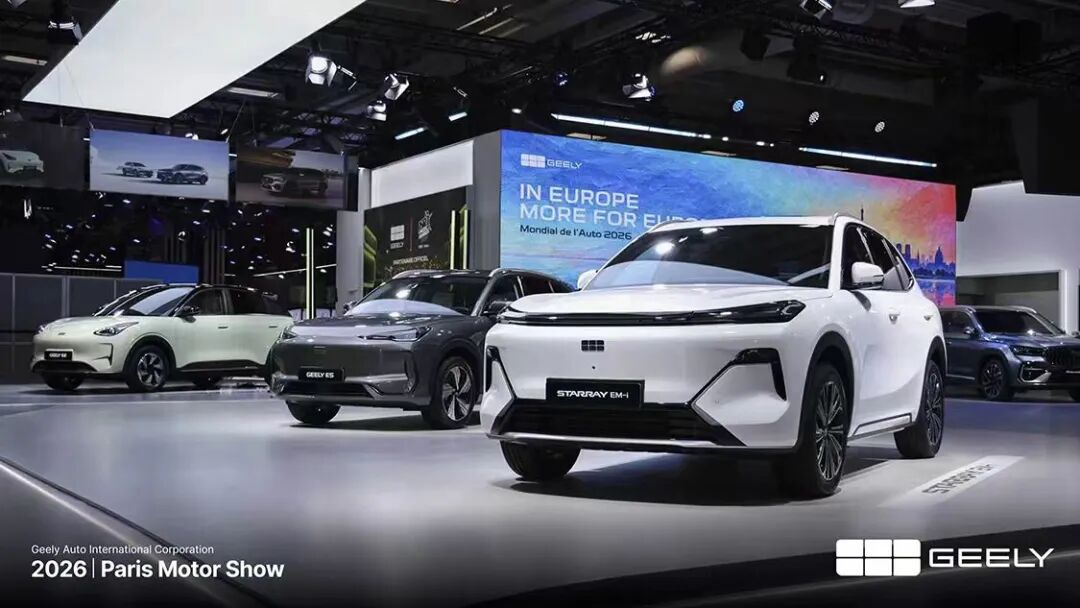
The second is overseas expansion. In the first three quarters of this year, Geely exported 798,000 vehicles, surging 169% year-on-year, and better pricing and gross margins in overseas markets became an important driver of per-vehicle profitability improvement; however, before localized production capacity comes online in Spain, Brazil, and elsewhere, how long this round of export dividends can last still requires continued observation. According to its plan, Geely aims to build an integrated overseas system within 2 to 3 years, establishing a market footprint of 600,000 vehicles in Pan-Europe, 500,000 in ASEAN, 400,000 in Latin America and Africa, 300,000 in Eastern Europe, and 200,000 in Central Asia and the Middle East, with its European channel network expected to reach 1,000 stores by year-end.
The third is expense control. In the first three quarters, the selling expense ratio and administrative expense ratio each fell 0.1 percentage points, and the cost-saving effects of integration are gradually being released.
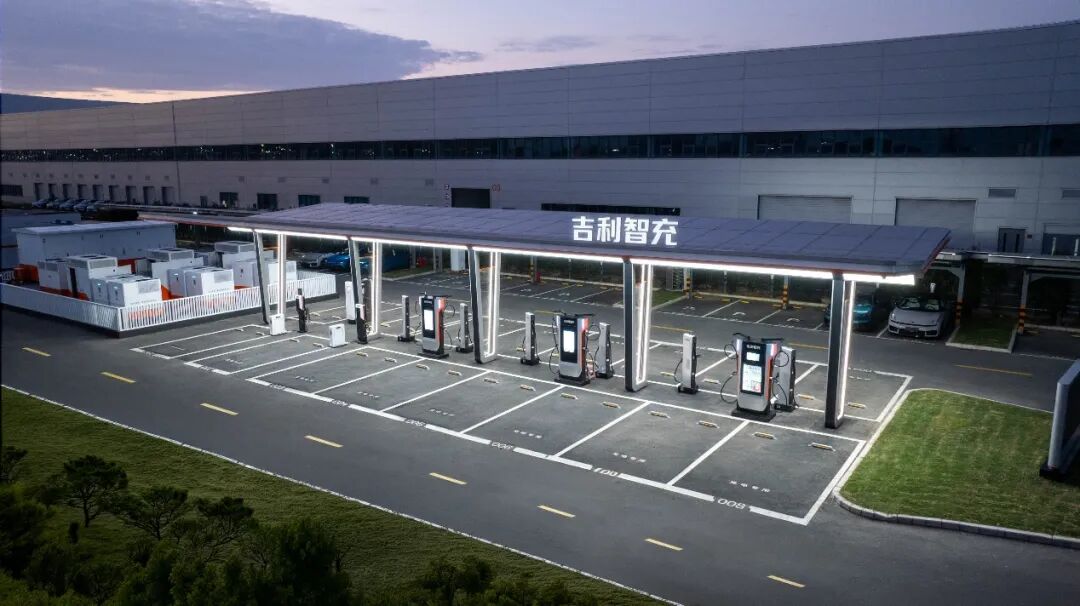
The scaled deployment of technological investment is also adding to this profitability. Geely's disclosed data shows that cumulative users of its Qianli Haohan assisted driving system have exceeded one million, with driving mileage of 3.14 billion kilometers, a function activation rate of 93.9%, and over 12.18 million cumulative hazard avoidances; the FlymeAuto in-vehicle system has been installed in over 1.326 million vehicles, with global users exceeding 3.59 million.
On the energy replenishment side, Geely plans to build 6,000 smart charging stations with over 20,000 charging guns by the end of 2026, further expanding to 22,000 stations and over 100,000 guns by the end of 2027. These figures signal that Geely's technology narrative is gradually settling into quantifiable user scale rather than remaining at the conceptual level of press conferences.

Issues worth noting cannot be ignored either. In the first three quarters, Geely's R&D expenses were approximately 14.438 billion yuan, roughly flat year-on-year, yet R&D investment as a proportion of revenue fell 0.7 percentage points year-on-year. At a stage when intelligent driving and artificial intelligence still require heavy investment, whether flat spending means improved efficiency or a more cautious pace is not yet appropriate to conclude hastily.
Looking at the balance sheet, as of September 30, Geely's net current liabilities were approximately 8.745 billion yuan, an improvement of 42% from approximately 15.042 billion yuan as of June 30, with both operating cash flow and working capital management trending favorably; but the nearly 1 billion yuan gap between the reported and core measures also reminds us that exchange rate fluctuations carry no small weight for a company so heavily reliant on overseas expansion. Chery's experience corroborates this: its net foreign exchange loss in the first three quarters was approximately 3.171 billion yuan—the bigger the overseas pie, the tighter the exchange rate string.
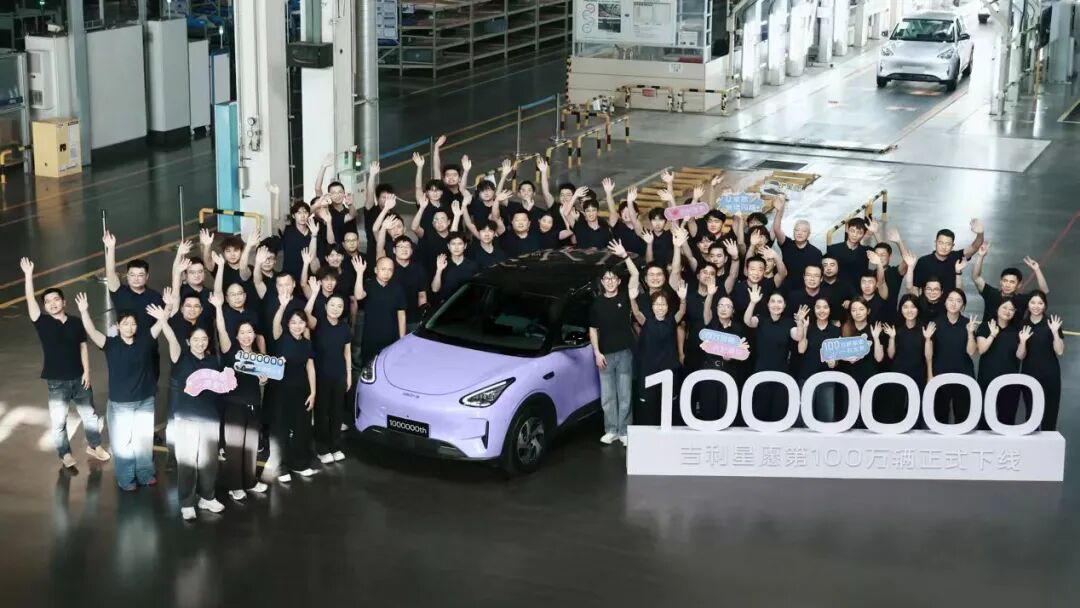
Having traced through it all, Geely's true portrait withstands scrutiny better than official rhetoric. It is not the company with the thickest per-vehicle profit—BYD and Chery both rank ahead—but it is one of the few traditional automakers still steadily lifting its profitability curve amid a broad market downturn, and one of the few in the mainstream camp to preserve positive growth in reported net profit attributable to parent.
The three cards of premiumization, overseas expansion, and integration have now shown results, while intelligentization and energy replenishment layout are building new support—but each card's dividend has its cycle. The 6,664 yuan is less a report card than an open question. In the coming quarters, what the market wants to see most is whether Geely can make its reported 6,230 yuan steadily catch up with the growth story it tells.
-
![]()
AI Cannot Cure the CEO's Serious Illness
-
![]()
In the Era of Stock Competition, Why Quality Competition Must Look at Both "How Well It's Built" and "How Long It Lasts"
-
![]()
Kuaishou: The Perennial Runner-Up — Can Kling AI Become Its Second Growth Curve?
-
![]()
Over 6,000 Yuan Profit per Car—Is Geely's Per-Vehicle Profit Inflated?
-
![]()
Kling 4.0 Hands-On Test: Creating an Exhibition Walkthrough Video with Zero On-Camera Talent — How Far Is AI from Delivering a "One-Stop Finished Video"?
-
![]()
AI Code Refactoring in Practice: Assess First, Then Tackle Technical Debt
-
![]()
Fold 5 Times and It Leaks — ¥8,000 Repair Bill: Who Set Up Apple's Foldable Screen Scam?
-
![]()
Xiaomi Spends 1.7 Billion Yuan to De-CATL-ize: Is Lei Jun Content to Be a "Worker" for the Ning King?