Half of Domestic Tokens Used to Make Wish-Fulfillment Dramas? Large Models Face a Compute Bloat Bubble
 11/02 2026
 455
A year after the price cuts, the first to feast are comeback short dramas about wealthy families; software development gets only 15% of Tokens, and the deep waters of industry are still testing the temperature at the door.
[ Author: Cheng Yiqing | Editor: Hemu ]
Since the landmark price war was ignited in May 2024, domestic large models have fought for more than a year over Token prices, only gradually turning toward competing on application value in the second half of 2025.
Today, the list prices of mainstream models are already cheap enough to be counted in cents, and the average daily call volumes announced by major cloud vendors have surged to the trillion level. But the livelier the numbers, the more uneasy some people feel: the massive compute stimulated by low prices—did it go into factories, or into short dramas?
The topic was ignited by a few lines from a listed company in an institutional exchange.
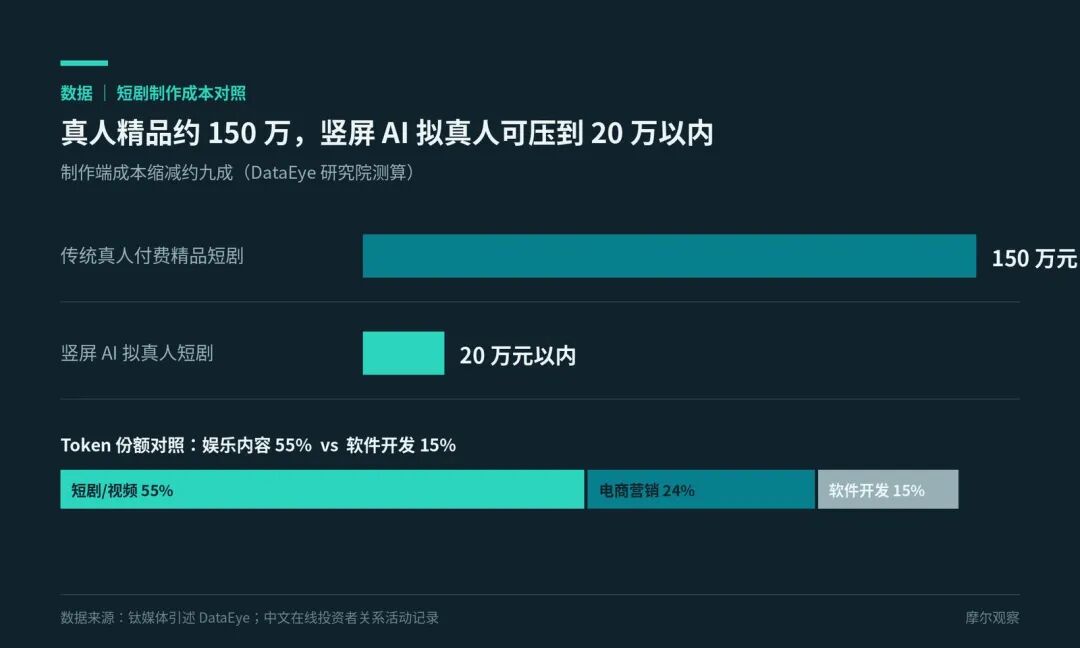
Chinese Online disclosed in its investor relations activity record that among domestic Token consumption, AI short dramas and video generation account for 55%, e-commerce and marketing 24%, while software development, previously highly anticipated, accounts for only 15%.
The claim that more than half of domestic compute is being used to make wish-fulfillment dramas immediately exploded, and even drew a public rebuttal from ByteDance. On October 19, Doubao public relations head Liu Xing said bluntly on social media that the data was unreliable, disclosing that only about 10% of ByteDance's own total compute is used for training and inference of video generation models.
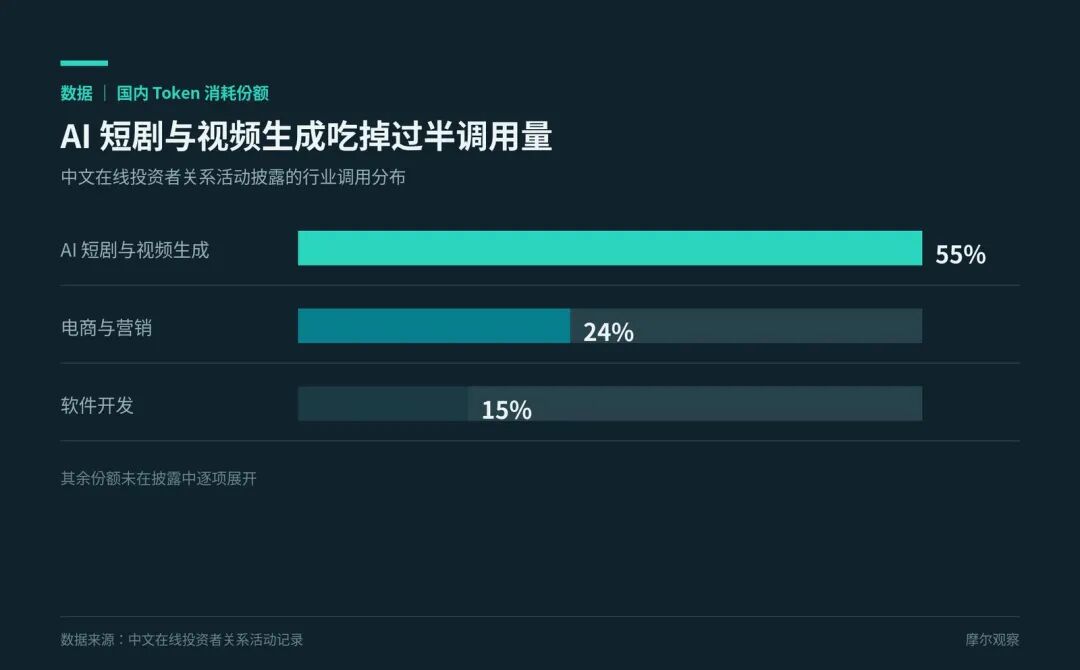
On one side, compute is scarce and scientific research is in full swing; on the other, more than half of call volume is pouring into wealthy-family feuds and comeback son-in-laws. This contrast immediately stirred widespread anxiety about idle compute.
But once the flames are fanned, the facts turn out colder: what short dramas consume is merely a pile of cheap inference Tokens, and they do not need the high-performance training cards that labs fight tooth and nail for at all. The 55% figure sounds scary, but it is burning an entirely different kind of electricity.
What this quarrel really pokes at is the industry's trachea: after a full year of saturation-bombing price cuts, the first to be fed are entertainment fast food piled up through trial-and-error gacha, while serious industrial intelligence lingers outside the door.
>_ section 01 More Tokens does not equal more compute. Short dramas cannot take away training cards at all
A 55% Token share cannot be directly converted into physical compute occupancy. Equating the two easily leads to the misjudgment that data center compute is being massively consumed by entertainment content.
Simply put, text Tokens and video Tokens are not the same currency at all. The former are language components; the latter are feature blocks cut from latent space by video models.
Directly adding up the Tokens of short dramas, marketing, and coding is like combining electricity, water, and data fees into one share of living consumption—it looks complete, but the calibers are a mess.
In fact, the research record that sparked the dispute itself only wrote "from the perspective of industry call data distribution" and did not disclose the specific statistical caliber or sample source. A financial media outlet sought confirmation from the publisher and likewise received no direct response.
What the two sides run in their data centers are fundamentally two unrelated hardware pools. According to a breakdown by the DataEye Research Institute, large-scale generation of short dramas mainly runs on inference clusters built from mid- to low-end compute cards, seeking low per-call cost and the ability to withstand high concurrency.
Frontier scientific exploration and trillion-parameter foundation model training, by contrast, consume ten-thousand-card interconnected clusters built from high-end GPUs or high-performance chips, competing on lossless network bandwidth between nodes and extremely high memory throughput. From server architecture to scheduling logic, the two do not borrow each other's lanes at all.
ByteDance's disclosure that video generation accounts for only 10% of compute speaks to exactly this underlying reality. Most of the applications visible on the front end are video generation, but what consumes R&D investment over the long term in the back end remains the main clusters responsible for pre-training and deep inference.
Short dramas have not slowed the evolution of foundation models; their 55% consumption ratio mainly comes from the high hardware overhead demanded by current video generation technology.
>_ section 02 A single episode burns tens of millions of Tokens, most of it piled up from wasted clips
The reason AI short dramas burn so many Tokens is not that they are sophisticated, but simply that the entire production process still cannot do without repeated trial and error.
According to data disclosed in the "Token Economy Development Research Report (2026)" released by the Cloud Computing and Digitalization Research Institute of the China Academy of Information and Communications Technology, the upgrade of large models toward full-process production systems has driven an explosive increase in Token consumption intensity per unit of business scenario.
In current comic drama and short drama production, AI is deeply involved in scripts, storyboards, motion effects, and voiceover. For an AI short drama with an episode length of only 1.5 minutes, the total Token consumption across the entire process typically ranges from 5 million to 10 million.
The core of this massive consumption lies in the uncontrollability of video generation, commonly known in the industry as gacha.
Although major models such as ByteDance Seedance, Kuaishou Kling, and MiniMax iterate intensively, in actual production scenarios the models still cannot achieve precise control. In an ordinary shot of a protagonist pushing open a door, limb distortion or facial feature drift often appears in the frame.
The industry calls this 8-draws-for-1, or even 10-draws-for-1. To pick out usable shots that meet narrative requirements, production teams can only repeatedly submit the same set of prompts and frame seeds to the model, generating eight to ten times in a row, and then manually select usable clips from the pile of waste.
Discarded shots produced by gacha are also fully billed in compute accounting. Taking the public pricing of ByteDance's Seedance 2.0 model as an example, pure video generation costs about 46 yuan per million Tokens, equivalent to about 1 yuan per second of video.
If a 5-second storyboard shot needs to be generated eight times in a row before selection, the compute cost of a single shot becomes 40 yuan, and the Tokens consumed behind it multiply accordingly.

A considerable portion of the 55% consumption ratio is not effective plot output, but the trial-and-error cost paid to combat generation uncertainty. The deficiencies of video models in physical laws and detail control are ultimately converted into continuous idle running of cloud servers.
>_ section 03 Price cuts hastened content fast food; serious industrial scenarios still dare not use it
In the data disclosed by Chinese Online, the most glaring contrast is software development, previously pinned with high hopes, which accounts for only 15% of Token consumption. Over the past year and more, the industry has been painting a picture of large models reshaping industrial software and core enterprise workflows.
Yet after a full year, the commercialization leaders actually running ahead are still short dramas, comic dramas, and marketing copy.
Adding up the ledgers on both sides, the gap is actually stark. Short dramas and marketing content naturally have extremely high tolerance for AI flaws; an occasional background goof or slight visual flaw in a short drama does not stop viewers from paying or being attracted by ads.
According to calculations by the DataEye Research Institute cited by TMTPost, the average production cost of a traditional live-action paid premium short drama is about 1.5 million yuan, while vertical-screen feed-based AI simulated live-action short dramas can already be controlled within 200,000 yuan, cutting production-side costs by about 90%.
For short drama teams pursuing ultra-fast capital recovery, as long as the comprehensive cost can be directly cut by 90%, they naturally have strong motivation to buy low-priced Tokens by the box and consume them.
But in serious enterprise-level scenarios such as industrial software and financial risk control, clients calculate accounts in a completely different way. Enterprise-level tasks require absolutely reliable output; if an AI-generated business code snippet has a tiny logical flaw, it may cause the entire system to crash.
The context drift problem of large models when handling complex long logic has not been fundamentally solved to this day. Enterprises introducing models not only fail to replace manpower, but instead need senior engineers to spend multiple times the effort verifying results.
Facing low Token prices, enterprises generally remain wait and see and find it difficult to entrust core business to models with a probability of hallucination.
The price war launched by cloud vendors has not quickly lever high-threshold industrial scenarios; it first fed the content segments that are price-sensitive and tolerant of flaws. As for the deep waters of industry, they are still testing the temperature at the door.
>_ section 04 Earning electricity fees cannot solve the foundation of large models' standing
This wave of short drama explosion is not entirely pointless messing around. At least at a stage when large models generally lack the ability to generate their own cash flow, it provides a valuable cash flow pipeline for compute centers.
The continuous influx of video rendering requests keeps compute clusters that would otherwise sit idle during business troughs running.
For compute holders burdened with heavy hardware depreciation and electricity costs, having a batch of customers who settle daily and continuously consume GPU cycles can indeed ease financial pressure and prove that large models can achieve commercial payback in some vertical markets.

But treating this prosperity of contract rendering as a talisman for large models would be celebrating too early.
Polishing the visual details of short dramas is not on the same path as the main battlefield of general intelligence at all.
To make short drama visuals look good and reduce generation costs, R&D teams focus on pose estimation, feature anchoring, lighting rendering, and style fine-tuning. These efforts are essentially optimizations within the existing frameworks of computer vision and multimedia rendering.
The real threshold remains on the other side: whether the model can think through long logic and complete complex tasks.
Earning short-term revenue through gacha can neither accumulate high-value industry-specific data nor drive structural breakthroughs in underlying algorithms. The massive Tokens jumping in the back end are mostly just repeatedly consuming similar visual materials and plot templates.
This kind of peak can sustain a good-looking ledger for a while, but it cannot support the future that large model companies truly want.
>_ section 05 Written at the end
So the real question has never been whether half of domestic Tokens are actually going into making wish-fulfillment dramas, but that after the large model price war has gone on until now, what the industry can most stably sell is still cheap, fast content consumables that allow errors.
Short dramas have not taken away the high-end training cards in laboratories; they have merely made the idle electricity meters in data centers burdened with heavy depreciation run at full speed.
But the more prosperous this business becomes, the more it exposes the bloated nature of large models' current commercialization.
Behind the massive Tokens is a fragile prosperity built on the trial-and-error costs of models that cannot be precisely controlled.
Once the consistency of foundation models achieves a substantive breakthrough and single-shot generation no longer needs eight or ten consecutive draws to pile up wasted clips, the production cost and Token consumption of short dramas will directly plummet, and this seemingly flourishing bubble of call volume will quickly thin out as well.
The more realistic challenge is that the call scale generated by entertainment content tolerant enough of flaws can neither accumulate enterprise-level business logic nor support the general intelligence imagination behind high valuations.
By then, who is merely earning a margin on electricity fees through cheap compute, and who has truly rooted models into the decision-making chain at the core of industry, will be seen far more clearly than any daily call volume ranking today.
>_ Turning complex technology into something you can understand.
>_ Moore Observation · Original Production
Unauthorized reproduction prohibited
Disclaimer
This article offers an in-depth review and business logic analysis based on publicly available materials, including corporate announcements, technical patents, Tianyancha data, and authoritative media reports, with the aim of exploring technology roadmaps and industry trends. All product parameters and performance descriptions cited herein are drawn from official disclosure standards and represent theoretical analysis based on existing data only, rather than definitive feedback from hands-on experience. Given that technology products—particularly new energy vehicles and robots—undergo software and hardware OTA updates, any discrepancies between the relevant data and actual device performance should be resolved by referring to the company's official final release. The views expressed in this article are for reference purposes only and do not constitute a basis for any investment or purchasing decision.
-
![]()
AI Office Track Head-to-Head: After the Battle for Entry Points, the Renewal Period Is the Real Test
-
![]()
Why Is the Eyebox Always "Bright in the Center, Dark at the Edges"? — The Polarization Multiplexing Solution
-
![]()
Why Can't the Smartest Coding Assistant Reply to Your Messages Instantly?
-
![]()
Half of Domestic Tokens Used to Make Wish-Fulfillment Dramas? Large Models Face a Compute Bloat Bubble
-
![]()
Apple Picks Qwen — and There's More to It Than Meets the Eye
-
No Blackening, No Fanning—Xiaomi Auto's Goal of Delivering 550,000 Vehicles This Year Is Easier Said Than Done
-
![]()
Automakers' KPI Collapse
-
![]()
The All-New Xiaomi SU7 Ultra Laps the 'Ring Undisguised — Can Chinese Performance Cars Earn a 'Seat at the Table'?