Apple Picks Qwen — and There's More to It Than Meets the Eye
 11/02 2026
 427

Ecosystem barriers remain the moat between major tech companies.
Image source: Internet (please contact us for deletion if infringing). Partially AI-generated.
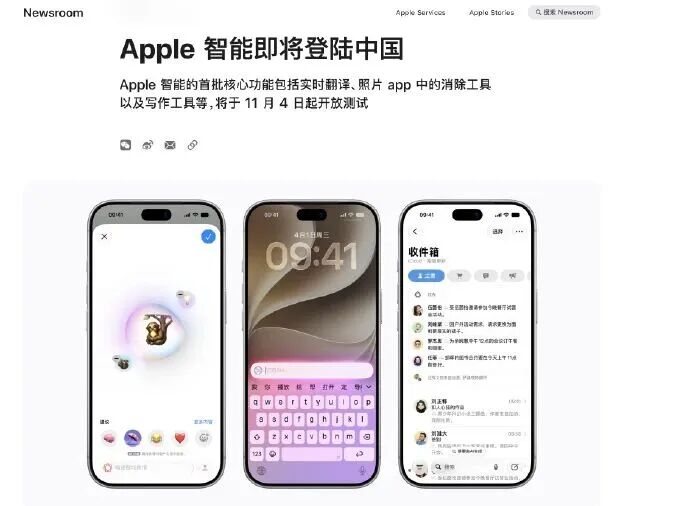
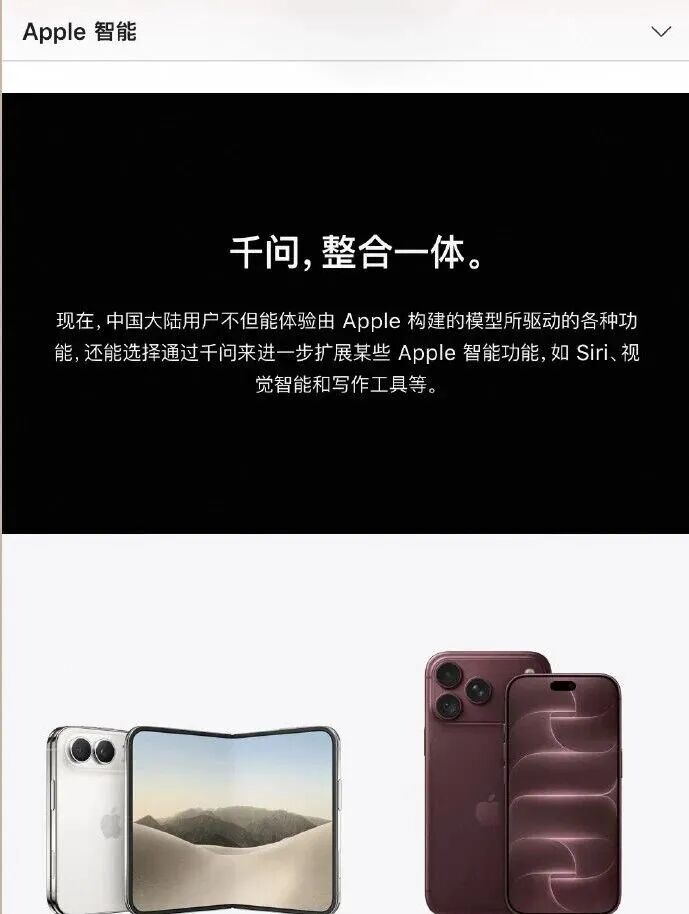
On October 31, the other shoe dropped. Apple officially announced its partnership with Alibaba, with Qwen formally integrated into Apple Intelligence. Chinese users can now directly invoke Qwen's text and image understanding and content-generation capabilities in Siri, writing tools, and visual intelligence.
Developer Beta testing opened on November 4, with an official rollout to Chinese users alongside iOS 27.3 in December.
The news itself is hardly surprising. From Joseph Tsai confirming the partnership in Dubai in February 2025, to Apple Intelligence completing its regulatory filing this July, to Reuters reporting in August that the two sides were jointly training a China-exclusive model — this thread has been in the works for nearly two years.
What's truly worth dissecting isn't the outcome of "finally settled," but a hidden thread running behind it:
What Apple has always picked is never the model with the most parameters. It picks the foundation that causes it the least trouble.
The impact of this development on the competitive logic of domestic large models runs far deeper than a system-level feature launch.

Eight Candidates, One Winner — and the Winning Edge Was "Not Looking Like a Competitor"
According to cross-verification by multiple media outlets, Apple approached eight vendors over three years: Baidu, Alibaba, ByteDance, Tencent, DeepSeek, Baichuan, Moonshot AI, and Zhipu.
Ranked by benchmark scores and technical buzz, Alibaba might not top the list. DeepSeek's impact on the open-source community and inference costs is plain for all to see; ByteDance's Doubao leads by a mile in C-end user scale; and Baidu was the first major tech company in China to proclaim "All in AI."
But the one that ultimately took the foundation seat was Qwen.
The real criteria of the elimination round are hidden in that list of "reasons for elimination." Baidu was initially viewed with high expectations, but its development progress did not meet Apple's standards, and the two sides disagreed over the boundaries of user data usage.
ByteDance and Tencent hold super-entrances like Douyin and WeChat, creating a natural competitive tension with the system-level AI capabilities Apple wanted to build.
DeepSeek and Zhipu, as startups, have impressive model capabilities but find it hard to match Apple's resource requirements for sustained delivery and support for hundreds of millions of concurrent users.
So where did Alibaba win? In one sentence: it is the one among the eight least "like a competitor." It doesn't make phones, doesn't make short videos, doesn't rely on search advertising for revenue, and there's no structural conflict between Alibaba's core e-commerce business and Apple's hardware ecosystem.
What Apple wants is a quiet background capability provider, not an ambitious player using Siri to funnel traffic to its own apps. Alibaba's business portfolio naturally fits that role.
But that's only the first layer.
If this partnership is understood merely as "Apple chose Qwen's model capabilities," then the most critical part is missed.
The problem Apple faces in the Chinese market has never been finding a sufficiently smart large model, but finding a partner that can simultaneously solve three things: compliance, privacy, and engineering delivery.
Compliance is a hard threshold. User data on China-market devices must be processed within a domestic closed loop; overseas models cannot be directly deployed; and the model providing services must itself complete generative AI filing.
Alibaba Cloud's domestic cloud qualifications, independently isolated computing clusters, and data-not-leaving-the-country architecture are Qwen's admission ticket.
A more critical step is hidden in the details: in the network access licenses for the iPhone 18 Pro and other models updated by the Ministry of Industry and Information Technology in October, the approved AI systems explicitly listed "Apple Intelligence, Alibaba Tongyi Qianwen, Tongyi Wanxiang."
The moment the model was written into the network access license, the first wave of partners was already a foregone conclusion at the regulatory level.
Privacy is Apple's red line. Apple's hard requirements are: user interaction data cannot be used by partners to train their own models, cannot be retained long-term, and cannot be used for user profiling.
Alibaba's commitment is that Qwen user requests do not flow into the public model training pool, that physically isolated independent tenant clusters are opened for Apple, and that the data link is closed-loop.
The line in the official announcement — "user requests and generated responses will not be used by Alibaba for model training" — is not a PR talking point but more like the bottom-line clause of the entire deal.
Engineering delivery is the final hurdle, and the most easily overlooked one. Apple has hundreds of millions of existing devices in China, and the peak concurrency of system-level AI features is a "Double 11"-scale problem.
Alibaba Cloud's long-standing capabilities in elastic scaling for traffic surges and fault redundancy are a hard card that goes beyond model benchmark scores.
Looking at these three layers together, the conclusion is obvious: Qwen's victory is essentially the victory of "compliance infrastructure capability" over "pure model capability."
Apple is not choosing the smartest AI; it is choosing the solution least likely to delay Apple Intelligence in the Chinese market for another two years.

Apple Can't Wait, and Alibaba's Timing Is Just Right
The precise alignment of timing is the most underestimated variable in this deal.
Apple's situation in the Chinese market no longer allows it to treat AI features as an option to "deal with later." In 2025, Huawei reclaimed the top spot in China's smartphone market with a 16.4% share, pushing Apple to second at 16.2%.
In the first quarter of 2026, iPhone sales in China fell 19% year-over-year, with market share dropping from 19.7% to 15.7%, ranking down to third.
When Huawei's Mate series can already tell stories with call summaries and AI photo editing, and Xiaomi and vivo have stuffed large models into photo albums and system tools, the "Apple Intelligence" section in China-market iPhone settings pages is still grayed out. This gap's damage to premium phone sales is more direct than any spec comparison.
Apple needs an AI selling point that can land before the year-end new phone sales window, and the compliance process rhythm happens to be stuck at this node.
This July, Apple Intelligence completed filing; on September 29, it obtained regulatory approval; in October, the network access license was settled; on October 31, the official announcement; in December, official rollout.
This is not a leisurely strategic choice but a precise positioning driven jointly by competitive pressure and the regulatory window.
On Alibaba's side, the motivation is equally clear.
Qwen doesn't lack technical buzz; what it lacks is a scenario where "users don't need to actively open the app."
In June 2026, the Qwen app had approximately 167 million monthly active users, compared to Doubao's 382 million and DeepSeek's 129 million during the same period.
In the standalone AI application track, Alibaba has not established an overwhelming advantage over ByteDance.
But after integrating into Apple Intelligence, the nature completely changes: Qwen transforms from a product that needs to be downloaded and opened into a system-level default capability.
Every Siri invocation, every writing assistance, every camera recognition by hundreds of millions of iPhone users is zero-cost reach.
What Alibaba is fighting for is not an app ranking but the distribution path for next-generation AI services.
The official announcement narrative easily leads people to think Qwen has taken over everything in China-market Apple Intelligence. But code analysis and supply chain information point to a more refined structure: Alibaba assumes the "brain" role, providing core model capabilities for text and image understanding and content generation, covering iOS, iPadOS, macOS, and visionOS.
Baidu, meanwhile, is deeply embedded in Siri voice interaction and visual search modules, with "Baidu Visual Search" code identifiers already appearing in firmware.
Reports suggest Qwen leads approximately 65% of tasks, while Baidu's Ernie handles the remaining approximately 35% of interaction and retrieval functions.
The significance of this division is not who has more or less, but that it reveals Apple's true strategy: don't put all eggs in one basket, and don't let any single supplier have the ability to "choke the entrance."
Alibaba gets the model foundation, Baidu gets the interaction entrance, and the two are deliberately separated in the tech stack.
For Qwen, this is a victory of the "foundation"; but for the entire industry, it shows that system-level AI partnerships are not a winner-take-all game but an engineering process of precise bidding by capability module.
A more noteworthy deep signal comes from Reuters' August report: Apple is not simply calling Qwen's existing API but, with Alibaba's support, has specifically trained a customized model for the Chinese market. The depth of cooperation far exceeds "integrating a third-party model."
This means Alibaba's involvement is not just inference calls but also support for the training phase.
Once this binding is formed, switching costs are extremely high. Every subsequent iteration of Apple's AI features in China will advance along this already-laid technical pipeline.

From "Grabbing Entrances" to "Grabbing Foundations"
The strongest signal that Qwen's partnership with Apple sends to the domestic large model card table is not "Alibaba won," but that the main battlefield of competition is shifting from user contention at the application layer to default capability positioning at the system layer.
On iAnalysys's August 2026 annualized Token revenue ranking, ByteDance leads with approximately 30 billion yuan, Alibaba ranks second at 16 billion yuan, Zhipu third at 11 billion yuan, DeepSeek and Kimi are in the 5 billion range, and Baidu and Tencent bottom out in the 3 billion range.
ByteDance's lead in Token revenue is overwhelming, and Doubao's monthly active user scale is far higher than Qwen's.
But Apple's partnership choice illustrates a cruel fact: Token revenue scale and C-end user volume do not automatically translate into qualification for a system-level foundation seat.
What Apple looks at is compliance depth, identity neutrality, and engineering delivery certainty — none of which can be made up in the short term through benchmark scores and DAU.
The implications differ for different players. ByteDance's Doubao remains the strongest presence at the application layer, but the "super app + AI assistant" model directly competes with Apple's system-level AI for user time, which determines that ByteDance is unlikely to become the preferred foundation-type partner for hardware manufacturers like Apple.
Baidu has obtained the interaction entrance for Siri and visual search, seemingly regaining ground, but losing the primary position means its bargaining power at the model capability level is compressed, with its role downgraded from "AI brain" to "feature module."
What DeepSeek and Kimi face is a more structural problem: model capabilities can be caught up through open source and algorithm iteration, but the time cost of compliance filing, the capital expenditure of cloud infrastructure, and the organizational capability for delivering to major clients cannot be solved by a single round of financing.
Zhipu has already squeezed into the 10-billion-yuan club in Token revenue, but the risk discount that Apple-level clients apply to "startups" is hard to eliminate in the short term.
More broadly, this marks a watershed: the first stage of large model competition was "whose model is better to use," and the second stage is "who gets written into the operating system's default path."
The former compares benchmark scores and costs; the latter compares compliance, trust, and system-level delivery. The value of the ticket Qwen has obtained is not how much API call revenue it can bring in the short term, but that it has nailed the perception "Alibaba = Apple's AI foundation in China" into the procurement lists of all hardware manufacturers.
Going forward, whenever any phone manufacturer, PC manufacturer, or car infotainment manufacturer chooses a China-market AI partner, Apple's choice will become an unavoidable reference point.
Apple chose Alibaba mainly because it believes that in the face of the three thresholds — compliance, privacy, and engineering delivery — Qwen is the choice least likely to make Apple Intelligence late in China once again.
Perhaps in the future business modules of large models: the standard of competition has been permanently raised by one notch from this moment on.
-
![]()
AI Office Track Head-to-Head: After the Battle for Entry Points, the Renewal Period Is the Real Test
-
![]()
Why Is the Eyebox Always "Bright in the Center, Dark at the Edges"? — The Polarization Multiplexing Solution
-
![]()
Why Can't the Smartest Coding Assistant Reply to Your Messages Instantly?
-
![]()
Half of Domestic Tokens Used to Make Wish-Fulfillment Dramas? Large Models Face a Compute Bloat Bubble
-
![]()
Apple Picks Qwen — and There's More to It Than Meets the Eye
-
No Blackening, No Fanning—Xiaomi Auto's Goal of Delivering 550,000 Vehicles This Year Is Easier Said Than Done
-
![]()
Automakers' KPI Collapse
-
![]()
The All-New Xiaomi SU7 Ultra Laps the 'Ring Undisguised — Can Chinese Performance Cars Earn a 'Seat at the Table'?