Automakers' KPI Collapse
 11/02 2026
 338

Let Go of the Sales Obsession
”
Author | Qin Zhangyong
"The peak season didn't peak—and that's the deadliest part."
October had barely ended when automakers began rolling out their rankings. Before we get into the specific numbers, let's look at the big picture.
In October, narrow passenger vehicle retail sales came in at about 1.6 million units—down 1.1% month-on-month from 1.618 million in September, and down 28% year-on-year. For two consecutive months, the year-on-year decline has hovered around 28%. The Passenger Car Association branch forecasts 2026 passenger vehicle retail sales at 18.5 million units, down 22% year-on-year.
This marks the first time the Chinese auto market has posted a double-digit annual decline.
As for automakers' sales targets, they were originally designed to pull one wave during the golden September and silver October, then push another at year-end. The first wave never grew, so the second lost its foundation.
With those numbers in mind, the first-ten-month efficiency completion rates read even more like an arithmetic verdict.
Geely: 2.5457 million units against a target of 3.45 million—a completion rate of 73.8%. Chery Group's completion rate stands at 78.2%, already the most respectable among traditional automakers, but its October exports accounted for more than two-thirds of total sales.
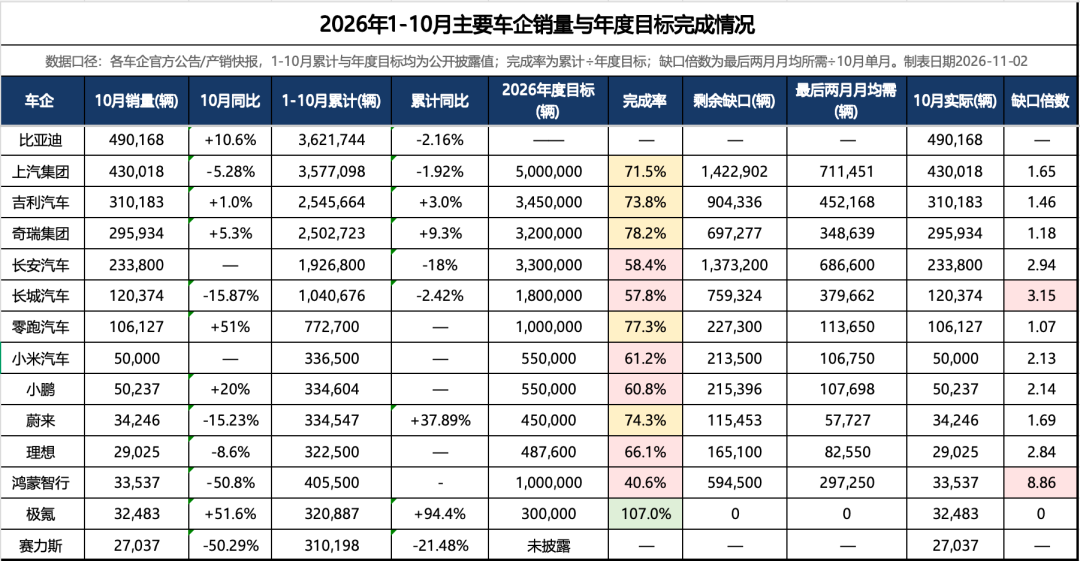
Chart: Super Electric Lab
Among the new forces, Zeekr is the only automaker this year that can close its books early: 320,887 units delivered from January to October against an annual target of 300,000—a completion rate of 107%. Leapmotor ranks second with a completion rate of 77.27%, but it is still 227,300 units short of 1 million, requiring average monthly deliveries of 113,700 in November and December—higher than its October record of 106,127.
October retail sales fell nearly 30% year-on-year. The golden September and silver October simply vanished in this way for the first time. With only two months left, completing KPIs is a distant dream for most companies.
01 Missing KPIs Is Not Shameful
According to industry common sense, only by hitting more than 80% of the annual target in the first 10 months can there be room to maneuver in the last two.
In 2026, only Zeekr crossed that line.
Among the new forces, XPeng delivered 50,237 units—a record monthly high—with 13,326 overseas deliveries, up 166% year-on-year. Xiaomi exceeded 50,000 units, climbing from 30,000 in August to 40,000 in September and now to this level—three steps in three months. On the other side, NIO delivered 34,246 units, Li Auto 29,025 units, and HIMA 33,537 units, with a year-on-year decline of 50.8%.
Leapmotor is the most aggressive among the new forces, firmly holding the TOP 1 position. Of the six that were still battling in the same tier last year, this month's first place is 3.7 times the last place.
BYD sold 490,200 units in October alone—already a historic high—up 11% year-on-year, with 170,000 exports more than doubling. But calculated against the 5 million target, that means the remaining 1,378,300 units must be squeezed into two months, averaging 689,000 per month.
Geely sold 2.5457 million units from January to October against a target of 3.45 million, leaving 904,300 units to be divided by two months—averaging 452,000 per month. Geely just exceeded 310,000 units in a single month for the first time in October and would need to jump nearly another 46%.
SAIC sold 3.5771 million units from January to October against a 5 million target—a gap of 1,422,900 units, requiring an average of 711,000 per month. Great Wall sold 1.0407 million units from January to October against a 1.8 million target—a gap of 759,300 units, requiring average monthly sales of 379,700, while it sold 120,400 in October.
A simple division tells the result: the target line is completely out of range.
At the beginning of 2026, mainstream automakers generally set targets of "growing 20% to 50% on the basis of 2025." This was the standard move of the past decade: the market was growing, so targets were set slightly faster than the market to force themselves to seize share.
But the 2026 market is heading downward. On one side, targets are set on "20% growth"; on the other, the market is moving at "22% decline"—a gap of 40 to 70 percentage points in between.
Suppose an automaker sold 1 million units in 2025 and targets 1.2 million in 2026, while the market falls from about 23.7 million to 18.5 million. To meet the target, its market share would have to rise from 4.2% to 6.5%—a 55% increase.
This cannot be solved by "selling a bit more." It means wresting an additional 55% share from others' mouths.

With only two months left in the fourth quarter, even changing targets cannot fill the gap. So there is only one conclusion: it is not that automakers are not working hard; it is that the denominator of the target and the numerator of the market are moving in opposite directions. This is the simplest math problem.
02 Why Did This Happen
The target list from the beginning of the year, in hindsight, reads like an optimistic memo.
SAIC 5 million, BYD 5 million, Changan 3.3 million, Leapmotor 1 million, HIMA 1 million to 1.3 million. In a year when full-year retail sales are expected to show double-digit negative growth, these numbers imply growth expectations generally in the double digits or even above 30%.
Those who set the targets are not unaware that the market is heading downward. Some industry analysts judge that automakers are aware of the difficulties, but their targets are anchored not to end demand but to not falling behind. In a market where penetration has exceeded half and growth has become stock, targets have changed from a navigation device into a posture written for capital markets and supply chains.
More critically, in 2026 even the tools for pushing volume have been taken away.
On January 1, 2026, the new energy purchase tax switched from full exemption to half collection, with the per-vehicle tax reduction cap dropping from 30,000 to 15,000 yuan. The rush buying at the end of 2025 front-loaded demand from early 2026, and the expected year-end tail-lift did not appear.
In February, the Guidelines for Compliance of Price Behavior in the Automotive Industry took effect, explicitly defining below-cost sales as a major compliance risk. The price war toolbox narrowed at the legal level. In the past, when KPIs could not be met, there was one last move—cut prices, stuff dealers, and push volume. In 2026, the cost of this move has become too high for most players to afford.
Dealers gave the answer first: the average gross margin on new cars was -21.4%, nearly 80% of dealers had price inversion, and the inventory coefficient was 1.58, far above the warning line. In the first half of 2026, more than 1,800 authorized dealer stores closed or withdrew from the network—averaging 10 closures per day, the fastest withdrawal speed in nearly five years.
Under this channel condition, using inventory stuffing to inflate wholesale numbers in the last two months would destroy dealers' cash flow and brand residual value.
The profit statement also does not support a sprint. From January to September 2026, the automotive industry's sales profit margin was 3.3%, and in September alone it was only 1.4%—a four-year low. Changan's per-vehicle profit was between 619 and 811 yuan, and Leapmotor's was 589 yuan. The money earned from selling one car is not enough for a decent meal.
03 Scale Is No Longer the Most Important Thing
So we find that "setting KPIs" failed for the first time in 2026.
In this process, what failed was not a certain set of numbers but a systemic adjustment. Some companies turned around early and converted sales targets into revenue targets that better represent operating quality.
For example, Dongfeng lowered its full-year target from 3.25 million to 2.6 million, and Great Wall lowered its sales assessment target from 2.49 million to 1.8 million while keeping its assessment target of no less than 10 billion yuan in net profit unchanged.
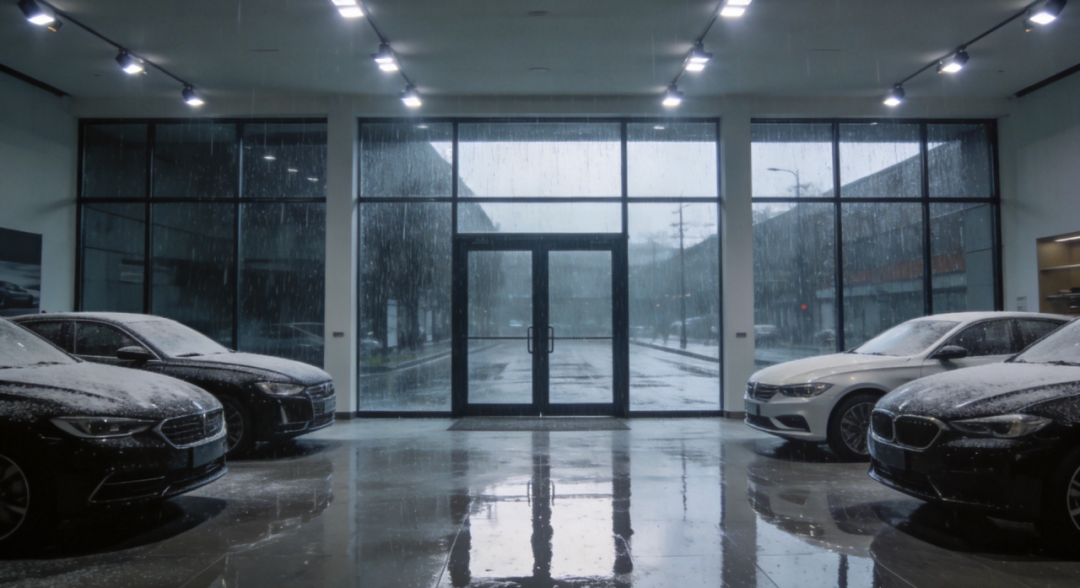
These moves are often read as surrender, but a more accurate reading is that when scale no longer automatically converts into profit and cash flow, continuing to enshrine sales KPIs at the center of business logic is itself a dereliction of duty. Great Wall's choice is especially clear—sacrifice part of sales to protect profitability indicators.
Looking again at the good-looking completion rates from January to October, water content and quality are separate.
Leapmotor's 77.27% relies on extreme cost control and product rhythm. Its per-vehicle profit is only 589 yuan, but it is using real products to exchange for real orders, not wholesale numbers inflated by inventory stuffing. XPeng exceeded 50,000 units in a single month for the first time in October, with 13,000 overseas deliveries up 166% year-on-year. Growth came from new space opened by exports, not from forcibly seizing share from the overall market. Xiaomi's first 50,000-unit month relied on the first full delivery month of the Pengcheng series, not year-end volume pushing.
Chery Group's 78.2% completion rate looks relatively high, but its structure is telling: October exports were 201,000 units—the third time this year that monthly exports exceeded 200,000—and exports accounted for the vast majority of total sales. BYD's October exports were 170,000 units, up 103% year-on-year; Geely's exports were 107,000 units, up 158% year-on-year.
These increases are not products of completing KPIs; they are the second curve of exports cushioning the involution of domestic stock.
On the other side, HIMA halved year-on-year in October—its fifth consecutive month of year-on-year decline. Dongfeng Honda kept falling, and GAC Toyota fell nearly 25% year-on-year. Japanese brands' share in China has long fallen below 11%. The divergence in completion rates from January to October is essentially a divergence between "who is still using real products to exchange for real demand" and "who is still relying on inertia to prop up numbers."
The real signal from 2026 is not simply that targets should be set lower. It is that when the vast majority of players in an industry cannot complete the targets they wrote at the beginning of the year, the problem is not whether targets are high or low, but that target-setting itself has become disconnected from business reality.
With the industry profit margin at only 3.3%, cash flow determines survival more than ranking. So it is time to take sales down from the altar of KPIs and put profit, cash flow, per-vehicle value, and real demand back.
This is not regression, but a loosening of the industry from the worship of scale—a belated correction finally beginning.
-
![]()
AI Office Track Head-to-Head: After the Battle for Entry Points, the Renewal Period Is the Real Test
-
![]()
Why Is the Eyebox Always "Bright in the Center, Dark at the Edges"? — The Polarization Multiplexing Solution
-
![]()
Why Can't the Smartest Coding Assistant Reply to Your Messages Instantly?
-
![]()
Half of Domestic Tokens Used to Make Wish-Fulfillment Dramas? Large Models Face a Compute Bloat Bubble
-
![]()
Apple Picks Qwen — and There's More to It Than Meets the Eye
-
No Blackening, No Fanning—Xiaomi Auto's Goal of Delivering 550,000 Vehicles This Year Is Easier Said Than Done
-
![]()
Automakers' KPI Collapse
-
![]()
The All-New Xiaomi SU7 Ultra Laps the 'Ring Undisguised — Can Chinese Performance Cars Earn a 'Seat at the Table'?