Wang's Conjecture Fully Solved in All Dimensions: Is OpenAI Ending the "Heroic Era" of Scientific Research?
 11/03 2026
 412
Qingping Chuiguo | Author
star Jiekong | Editor
Wuxinliuliu Chengzhi | Visual
Liu Chao | Producer
Three "academic nuclear bombs" dropped in less than a month—is AI moving a bit too fast for academia?
On October 6, OpenAI released 722 AI-generated mathematics manuscripts on GitHub.
The day after the release, three of them were withdrawn due to sign errors.
At the time, Cornell University mathematician Alex Townsend remarked that, given the mathematics community's skepticism toward AI, OpenAI should have first released the parts verified through Lean.
In less than a month, OpenAI "made a comeback."
This time, OpenAI delivered one result each in mathematics, computer science, and physics:
In mathematics, it claims to have pushed the "local smoothing conjecture" to all dimensions—and with it, the "Kakeya conjecture," the main field of Fields Medalist Professor Wang Hong, has also been solved in all dimensions;
In physics, it has obtained rigorous mathematical proofs for the existence of four-dimensional quantum chromodynamics (QCD) and pure Yang-Mills theory;
In computer science, it has disproved the Exponential Time Hypothesis (ETH), which the global computer science community has unanimously assumed to be true and has relied on for nearly thirty years.
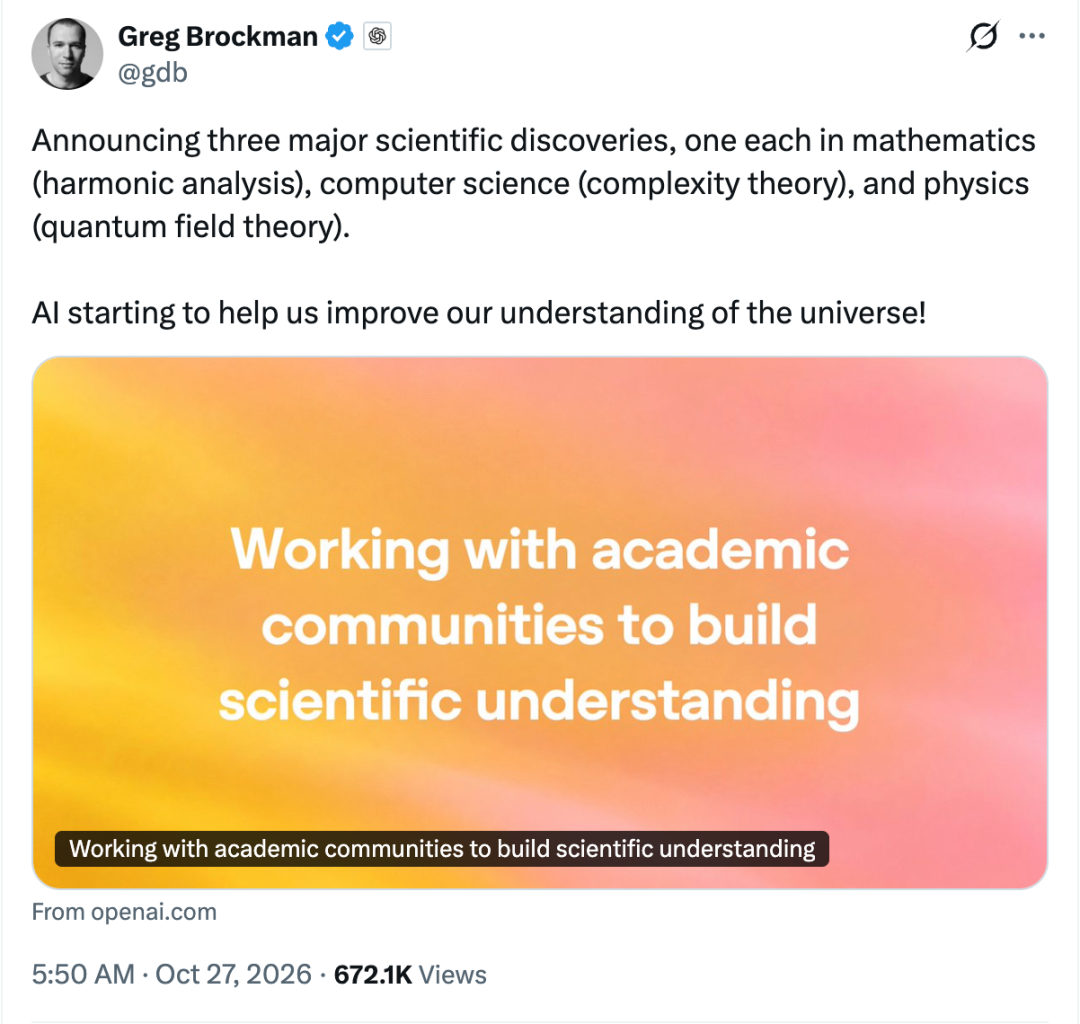
Each of these, taken individually, is heavyweight enough to warrant an academic press conference.
And this time, OpenAI also learned from the previous experience, with a distribution approach that can be described as "three question types, three ways of submitting answers":
Mathematical results were simply posted to a public repository, letting researchers organize themselves; for computer science results, Impagliazzo and Paturi, the original proposers of ETH, were invited to lead the review; physics results were simply not made public, waiting until Nobel laureate David Gross led a five-person group to digest them first.
Whether AI can do scientific research is no longer the question, because AI submits answers a bit too fast—so fast that human experts' grading speed can hardly keep up.
What follows is a more fundamental question: how is AI rewriting the history of scientific research? Is the very way humans participate in scientific research being reorganized?

Mathematics Made Public, Physics Held Back: Two Ways of Submitting Answers
First, mathematics.
The local smoothing conjecture proved by OpenAI this time describes the behavior of waves when focusing: focusing at typical moments is not as extreme as in the worst case, and the most extreme focusing must be brief.
Under the corresponding settings, the local smoothing conjecture implies important conclusions such as the Stein restriction conjecture and the Kakeya conjecture.
Yes, that is the three-dimensional Kakeya conjecture previously proved by Fields Medalist Professor Wang Hong and Joshua Zahl!
OpenAI's model this time claims to have given a proof of the local smoothing conjecture in all dimensions, and completed Lean formalization the next day. If this proof holds up, it will mean that the Kakeya conjecture, Professor Wang Hong's main field, will also be "fully solved in all dimensions."
In addition, OpenAI directly uploaded the natural language proof and Lean formalization of the conjecture to a public repository, without designating an advance review group, handing the power of interpretation and verification to community researchers.
Anyone who wants to look can look.
On the surface, this is continuous with the handling of the manuscripts uploaded on October 6, but in essence it is somewhat different.
Last time it was "go all in" and release first; this time it first communicated with academic intermediaries before deciding what to release and how to release it.
Now physics.
The keyword in the physics part is Yang-Mills existence. Yang-Mills theory is the core framework of the Standard Model of particle physics and has been used in physics calculations for decades, but whether it rigorously exists mathematically has always been the core gap in the Clay Mathematics Institute Millennium Prize Problem "Yang-Mills Existence and Mass Gap."
On September 9, OpenAI generated a natural language proof of the existence of pure Yang-Mills theory; on September 18, it generated a proof of four-dimensional quantum chromodynamics (QCD); and on October 16, it completed Lean formalization.
As a subproblem, Yang-Mills existence is covered; as a whole, it claims to have rigorously constructed a four-dimensional interacting quantum field theory including gauge fields and fermions, including QCD and a unified complete version of the Standard Model.
But the handling of physics results is not the same as that of mathematics.
OpenAI waited until Lean formalization was completed on October 16 before handing the materials to the five-person group led by David Gross, and decided not to publicly release the original AI-generated proof for the time being, letting the expert team first organize, understand, and write their own manuscript.
And the composition of this group is highly prestigious: Gross won the Nobel Prize for asymptotic freedom, and Arthur Jaffe, together with Witten, wrote the official formulation of the Yang-Mills Millennium Prize Problem.
One person laid the foundation of the theory, and one person defined the problem; now they must together judge what the existence proof handed over by the machine actually means.
This lineup is equivalent to the "founding ancestors" of theoretical physics forming a group to review homework.
So why can mathematics choose direct public release, while physics chooses temporary non-disclosure?
This is precisely OpenAI's distribution strategy: different disciplines have different trust infrastructures for "reviewability."
Mathematics has Lean; formal verification can be run at the syntactic level, and the community can get started in parallel. Physics is different: constructive proofs of four-dimensional quantum field theory do not have an equally mature machine verification ecosystem. Throwing out a several-hundred-page AI manuscript directly would, apart from creating information asymmetry and anxiety, hardly produce effective peer review.
The information density is very high, and the number of people who can understand it is almost zero.
So OpenAI choosing to have the physics group first "translate" before publishing is in fact an acknowledgment that in some fields, AI can write proofs, but humans still cannot understand them. Experts must first turn them into a language their peers can understand before they can enter scientific discussion.
They call this group of external experts "shepherds," that is, they lead the process of understanding and publishing the results, are responsible for reading and verifying the AI-generated proofs, writing explanations that humans can understand, and deciding how the materials should be made public.
Of course, this model itself is also controversial; it inevitably creates problems such as information asymmetry, unequal access, and selection bias. The academic community is also dissatisfied with this.
One researcher interviewed by The Verge said: "At first letting only a few outstanding scientists see these results makes no sense at all."
But this dissatisfaction itself precisely shows that OpenAI's distribution strategy is being treated as an object that needs to be examined, and that is exactly the effect it wants:
once a company begins to design the "distribution protocol" for scientific results, it is no longer merely a tool provider; it is participating in defining the rules of the scientific research ecosystem.

Computer Science: ETH Disproved, the Problem Setter Invited Back to Review the Exam
Over there, mathematics and physics are still choosing between "public" and "custodial," but in computer science, OpenAI directly handed over the organizational power to review the disproof.
Before discussing the computer science result, let us first understand what the "Exponential Time Hypothesis" says.
In the late 1990s, Impagliazzo, Paturi, and Zane proposed that there is no general subexponential-time algorithm for 3-SAT-type problems, and the worst case cannot avoid computational cost on the order of 2 to the cn.
This is the Exponential Time Hypothesis (ETH).
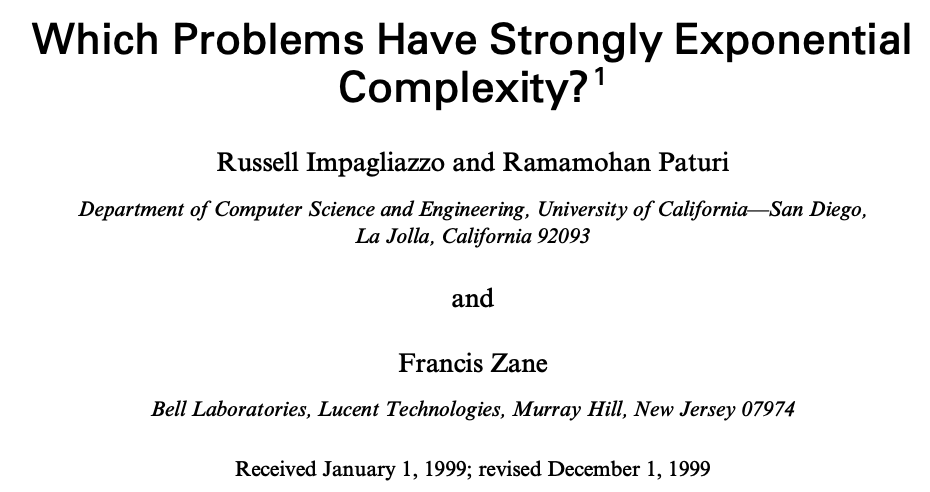
For nearly thirty years, hundreds of papers in graph theory, databases, and computational biology have used this hypothesis as a foundation, building conditional lower bounds on top of it.
And OpenAI's model claimed on October 16 to have generated a disproof, completed Lean formalization the next day, and given an algorithm claimed to reduce the solving of certain fixed-width CNF formulas to subexponential level.
If it were merely "AI overturned a hypothesis," the story would end here.
But OpenAI invited back the very people who wrote down this hypothesis.
Impagliazzo and Paturi, plus MIT's Ryan Williams, formed an external group to review this disproof.
What is this equivalent to?
It is equivalent to the problem setters being caught and made to grade the answer sheet, and the content of the answer sheet happens to prove that the problem was set wrong back then.
Of course, these three also publicly stated that participation in review does not equal endorsement. Whether ETH has really been overturned requires time to verify; whether the algorithm details and formalized theorems accurately correspond to the original conjecture are matters for later.
But OpenAI choosing to let the proposers organize the review itself shows that it does not intend to let these results remain at the level of a "company announcement."
It handed over the power to initiate review, while clearly telling the outside world who should review these results.
OpenAI is well aware that at present, the cost of models solving problems is dropping sharply, so the "reviewability" of proofs and "the ownership of review authority" have instead become "limited editions."

Three Laboratories, Three Paths for AI4S
OpenAI's post-publication anxiety is not an isolated case.
Broadening the view a little, AI laboratories such as DeepMind and Anthropic are also "stepping into science," only along different paths.
DeepMind bets on a "formalized closed loop."
AlphaProof Nexus binds large language models together with the Lean compiler: the model generates proof sketches, the compiler checks and gives feedback, and iteration corrects them. The whole process can run systematically on large-scale problem sets.
Its strength is verifiability and controllable cost; its weakness is that capability is limited to fields where the Lean mathematics library is relatively mature.
That is, this route first solves whether AI can do mathematics "correctly," and only then discusses the question of "how big" it can be.
It is worth mentioning that AlphaProof Nexus has already solved 9 Erdos problems and 44 OEIS conjectures within the Lean system, among which the earliest problem had remained unresolved for 56 years, and the related paper was published in Science.
On the other side, Anthropic has taken a different path, and deliberately avoided the frontal battlefields of mathematics and physics.

In the spring of 2026, it formed a life science research group and built a physical laboratory in the San Francisco Bay Area, letting Claude directly read DNA sequence databases, generate hypotheses, and then return to wet experiments for verification.
The early results announced in September were: after searching about 950 agents and 210 million tokens, Claude discovered a new enzyme system associated with RNA repeat sequences, whose characteristics are reminiscent of the early moments of CRISPR.
CRISPR pioneer Feng Zhang commented that it is an "exciting example," while emphasizing that further research is needed. Anthropic's bet lands on the closed loop of "discovery—experiment—rediscovery."
It does not need to compete with OpenAI for headlines on ETH or the Kakeya conjecture; it is establishing in life science a set of operating paradigms for AI participation in experimental science. Avoiding hardcore proofs and plunging into wet experiments—is this another, more sustainable form of embedding?
Overall, the differences among the three routes are thought-provoking.
OpenAI pursues public visibility in the "hardcore proofs" of mathematics and physics, DeepMind digs deep into the engineering efficiency of formal verification, and Anthropic accumulates data and processes in the closed loop of experimental science.
The competition in AI4S is shifting from "whether models can do science" to "in what way models are embedded into the workflows of the scientific community."
Whoever can define this embedding method defines the form of scientific research infrastructure in the next stage.

Written at the End
Terence Tao once said in an interview on Numberphile: "We are witnessing the end of the romantic era, the heroic era, of mathematics."
Mathematics is moving from a "heroic assault" in which one person ponders for years and has a flash of inspiration, toward an "industrial era" in which proofs can be mass-produced while understanding lags far behind.
But this does not mean mathematicians, or even scientists, will lose their jobs.
As AI has advanced, the pace at which answers are produced has begun to outstrip the grading capacity of human experts. The first thing to change, therefore, is the way scientific research is organized; problem-solving ability itself has been relegated to second place.
The divergence of the three paths described above already shows that the focus of competition in AI4S is converging on one question: in what capacity should models be embedded into the scientific community?
Public distributor, formalization engine, participant in experimental workflows—these three identities correspond to three sets of infrastructure, and the choice among them is itself reshaping the way scientific research is organized.
OpenAI hands mathematical proofs to the community for parallel digestion, and hands physics proofs first to "academic shepherds" for translation; DeepMind uses Lean to compress verification into an engineering step that can be run in batches; Anthropic accumulates a closed loop of discovery and verification through wet experiments.
What they are contending over has already gone beyond the attribution of single-point results and touched on a more practical question: through whose screening, at what pace, and to which people should machine-produced knowledge be opened before it can be considered as entering scientific discussion?
The "end" that Terence Tao speaks of is the end of a research imagination whose default setting is individual heroism; people themselves have not exited the stage. On the contrary, after machines submit papers in bulk, the work that people need to do becomes even more important.
Human scientists need to resist the rise in information entropy brought about by AI and to identify, among tens of thousands of outputs, the one that truly has structure, insight, and extended value; they need to articulate clearly the "why" that machines have left unstated, so that a verifiable proof can regain comprehensible meaning;
they need, in an environment of proof overload, to re-identify which questions are still worth asking, which directions are merely lively and gimmicky, and which are truly scientific questions worthy of the human community's investment of attention.
The exit of the hero era does not mean twilight of the gods. What it opens is the door to a new scientific era that needs more organizers, translators, and questioners.

-
Beijing Hyundai’s New Energy Transition Slams on the Brakes
-
![]()
Will AI Also 'Take Over' Airport Bookstores?
-
![]()
Haval H6 Held Wei Jianjun Back? The Topic Trends Online
-
![]()
Nebius: The New Cloud Sector's "Magic Pill"—Solid Gold or Just a Bubble?
-
![]()
FAW Vice President Moved to Dongfeng: A Merger in the Making?
-
![]()
Handing the Reins to the Chinese Side: Can Joint Ventures Rest Easy?
-
![]()
Is It a True Data Closed Loop, or Are Many Autonomous Driving Companies Just Stockpiling Data?
-
How Embarrassing! Only One of the New Forces May Hit Its Annual Target This Year — Even Lei Jun Can't Save the Day