Will AI Also 'Take Over' Airport Bookstores?
 11/03 2026
 361
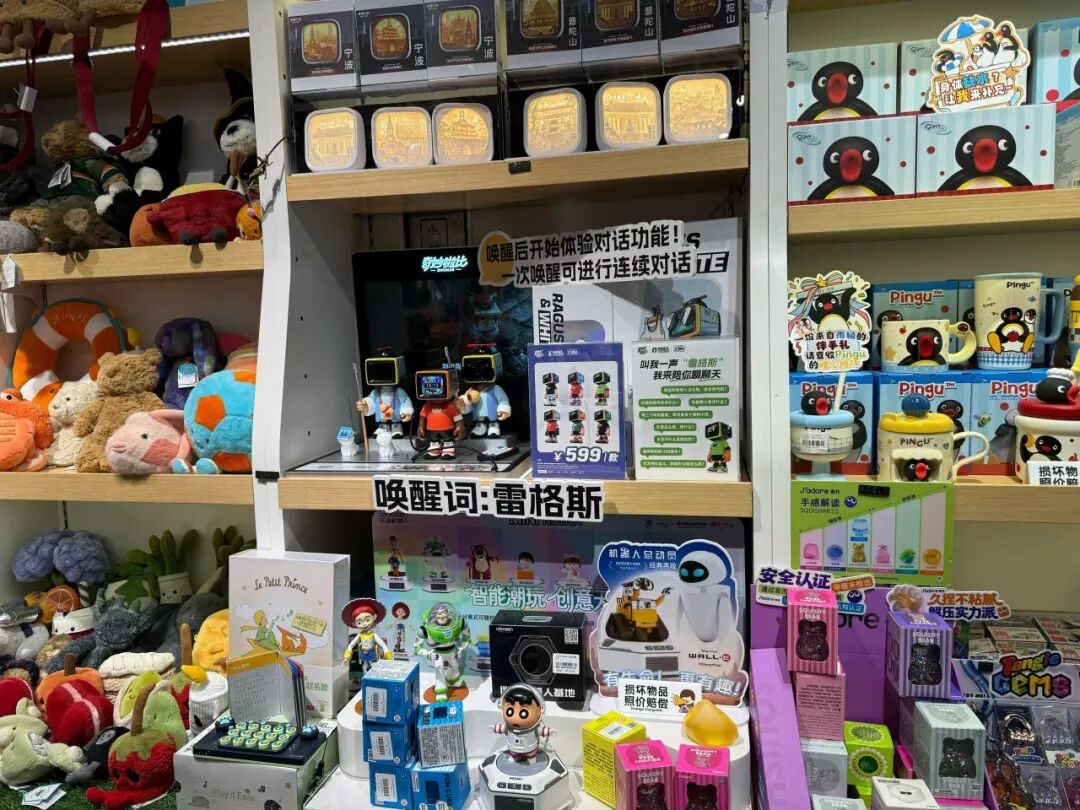
Airport bookstores, too, have been 'captured' by AI.
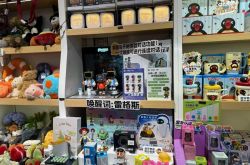
On November 1, while waiting for a flight at Ningbo Lishe Airport, I habitually wandered into a bookstore. The store, located in Terminal 2, is not small. The most eye-catching wall was fully lined with adorable AI companion toys, alongside children's learning devices, earphones, and other electronics, as well as cultural and creative items such as fridge magnets. There were not many books.
I browsed for about ten minutes. Few customers entered, and those who did merely glanced around before hurrying out.
Earlier, at Terminal 3 of Beijing Capital Airport, I noticed that several of the most prominent billboards on the departure floor had been claimed by AI office applications such as Doubao Work, Qianwen Office, and Baidu Dazi.
36Kr once reported that during the 'cloud vendor channel battle' in July 2025, Alibaba Cloud's round of airport advertising reached the level of over 100 million yuan, while Baidu Cloud secured the most expensive billboard on the arrival floor of Capital Airport Terminal 3, starting at tens of millions of yuan a year. The previous buyer was Dior.
Hangzhou Xiaoshan Airport has been one of the airports with the densest concentration of AI advertising in the past two years. In March 2025, City Express noted that its advertising spaces had shifted from consumer goods to competition among large-model applications and cloud computing.
It took large-model vendors less than two years to buy up airport billboards. So, are the prime locations in airport bookstores also being 'occupied' by AI?
In fact, airport bookstores are not a profitable business.
I could not find relevant data on the rent of this bookstore at Ningbo Airport. As a reference, the official website of Shanghai Airport published a leasing announcement in July last year: a 236-square-meter bookstore space at Hongqiao Terminal 2 is charged under a 'rent + operating rights transfer fee' model, which works out to an annual cost of 2.57 million yuan, or more than 7,000 yuan per day.
If a bookstore only sells books, a 59-yuan book is purchased from the publisher at a 40% to 35% discount, earning 20 to 24 yuan per copy sold. At a 35% discount, it would need to sell 350 books a day—translating to just over 20,000 yuan in revenue—to cover the cost of the space for that day. Labor, utilities, and decoration are not even included.
Besides rent, airport bookstores have clear requirements for their business scope. For example, the book and periodical section at Chengdu Shuangliu Airport explicitly states that books and periodicals, audio-visual products, stationery, toys, electronic products, craft souvenirs, and travel supplies may be sold, and books and periodicals must account for no less than 30% of merchandise.
Some airports are even stricter. The book bar section at Yantai Airport Terminal 2 allows cultural and creative products and tea, but explicitly prohibits the sale of electronic products and children's toys.
Airport bookstores naturally have to sell books, but what actually sells are mostly success-related titles. What truly supports revenue are still non-book products with high gross margins, such as cultural and creative products, U-shaped pillows, learning devices, and earphones.
Moreover, the airport bookstore business has been shrinking. Take CITIC Books as an example: in 2013, it entered 17 domestic airports in one go and opened 137 bookstores.
CITIC Press's 2025 annual report shows that as of June 2025, it had only 28 stores left nationwide; by August 2026, CITIC Books' airport stores were operating in only five locations: Hangzhou, Shenzhen, Chongqing, Shanghai, and Guangzhou. In an internal speech in early 2025, Chen Wei, chairman of CITIC Press, said bluntly that bookstores are not a very profitable business. But he also stressed that CITIC Press would continue to make bookstores its main responsibility and core business.
Since it is difficult, why don't bookstores simply withdraw from airports? CITIC Press's 2025 annual report assigned different roles to several types of stores: business stores deepen enterprise services, community stores expand government-enterprise cooperation, and airport stores are tasked with 'leveraging brand display effectiveness.'
To put it bluntly, the main task of airport bookstores is not selling books. As long as the people passing through the terminal every day see this sign, the store has not been opened in vain.
It should be noted that airports gather mostly business travelers—precise users willing to pay for large models and AI products, including enterprise and government decision-makers. This is a form unmatched by any outdoor advertising.
This value has also been noticed by AI toy and learning device brands. They mostly enter through joint operations: the brand provides the goods, the bookstore provides the counter, and after sales, a commission is taken based on revenue. Unsold goods are returned to the brand, so the bookstore does not need to advance money or bear inventory.
For bookstores, the money left from selling a 399-yuan toy or a 1,999-yuan learning device is far more than from selling a book priced at fifty or sixty yuan—and they do not need to advance money or hold inventory themselves.
AI products such as AI toys and learning devices are also willing to spend on airport bookstores. On the one hand, the effectiveness of online channels is not ideal. The Hangzhou Consumer Protection Commission disclosed in May this year that the 7-day no-reason return rate for some AI companion trendy toy products reached 30%, and was even higher in livestream rooms.
In addition, selling online requires buying traffic first. A landing manual circulating among AI toy channel distributors calls pure e-commerce advertising a 'meat grinder.' What is more troublesome is price comparison: the same product is priced differently, and no one orders if the price is not lowered, but profit disappears if it is lowered.
On the other hand, offline airport bookstores have two differentiated advantages: first, no one compares prices; travelers pick up the item and leave, and will not stand at the counter searching for the same model. Second, they can set higher offline prices. The manual mentioned earlier even ranked offline channels: online e-commerce, shopping mall counters, and finally stores at airports and high-speed rail stations.
Among them, CITIC Books in airport bookstores can be called 'the main force at national airport and high-speed rail hubs,' while digital collection stores in terminals are designated as 'high-premium gift nodes,' where 399-yuan products can sell for 599 to 899 yuan.
On one side, books do not sell; on the other side, higher commissions can be offered, and the business scope is not exceeded. So AI products such as AI toys and learning devices rapidly occupying airport bookstores is simply a natural progression.
However, whether AI products can sell once they are placed on the shelves is another matter. During those ten minutes, I did not see a single child stop at the counter; this kind of product needs to be turned on, connected to the internet, tested with a couple of conversational exchanges, or explained by a staff member before it can be understood—far less appealing to children than opening two blind boxes.
A more accurate way to describe airport bookstores being 'occupied' by AI is that the counters are indeed AI, but they have also been occupied by higher-gross-margin 'tenants.' In this context, airport bookstores are more like 'sublandlords.'
Therefore, how long fashionable AI items such as AI toys and learning devices can stay in stores is still unknown.
In the past two years, companies building large models and AI hardware mainly spent money on making people see them—that is, large-scale expansion to capture users' attention. The airport screen costs tens of millions a year, and what is bought is a passing person's glance upward.
This round of expansion is basically over. Next, they value conversion more—that is, after acquiring user traffic, whether anyone actually pays.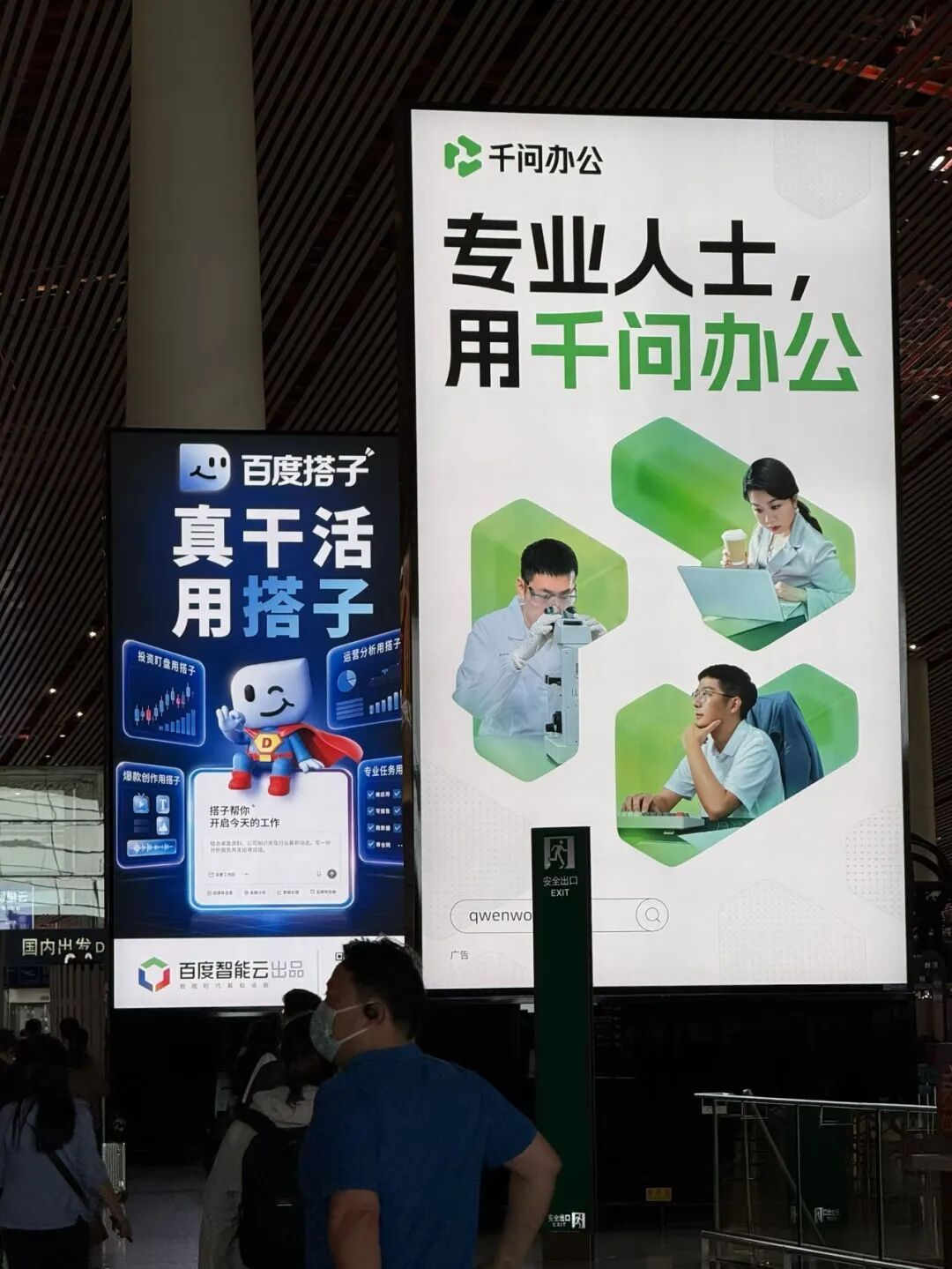
Battle for AI office billboards on the departure floor of Capital Airport Terminal 3. Image source: photographed by Tang Chen
Following this trend, what will be the next AI item to appear in airport bookstores?
One possibility is robots. They have already appeared at Shenzhen Airport. In the unmanned convenience store in the ride-hailing Area A waiting zone of that airport, the store manager is a humanoid robot. Travelers select products on the screen and pay by scanning codes, and the robot moves through the shelves itself and delivers the items to the pickup port. In August this year, Daxing Airport opened 19 robot application scenarios at once, from bird-driving patrols to passenger guidance.
However, this already involves an upgrade of the form of airport bookstores; what it needs to 'swallow' is the entire store. Shelf spacing, customer flow routes, and power supplies all have to change accordingly.
At present, the only thing about airport bookstores that has not changed color is still those few bestselling success books.
References:
City Express · Chengshi Interactive, 'Has Xiaoshan Airport Been "Surrounded" by AI Large Models?'
36Kr Smart Emergence, 'AI Battle Rages in Airport Advertising'
Civil Aviation News of China, 'When "Cyber Travel" Becomes Reality'
-
![]()
Commentary: The "Li Fenggang Phenomenon" — An Unfinished Experiment in Talent Localization
-
![]()
Apple Bows, Alibaba Goes Bottom-Fishing: The AI Ticket for the China-Market iPhone
-
US Sales Drop 4%, Japan Plummets 27%—Are Only Chinese Consumers Obsessed with Face? iPhone 18 Pro Surges 29%
-
![]()
BYD Reports 566.3 Billion Yuan, Geely 272.6 Billion Yuan: A Recap of Revenue and Profit for Ten Automakers in the First Three Quarters
-
![]()
After the Big Price Cut, Is the MONA L05 Still Overpriced?
-
![]()
Mercedes' Anchor Is Adrift
-
Beijing Hyundai’s New Energy Transition Slams on the Brakes
-
![]()
Will AI Also 'Take Over' Airport Bookstores?