Apple "Wins by Default" Against Nvidia
 11/04 2026
 528
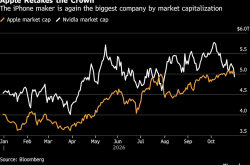
On October 30, during intraday trading, Apple's market cap hit $5 trillion, knocking Nvidia off its throne.
By the next day's close, the dust had settled: Apple at $5.03 trillion, Nvidia at $4.93 trillion. Nvidia shed $217 billion in a single day—roughly 1.4 trillion yuan—wiping out more value in one session than PetroChina is worth.
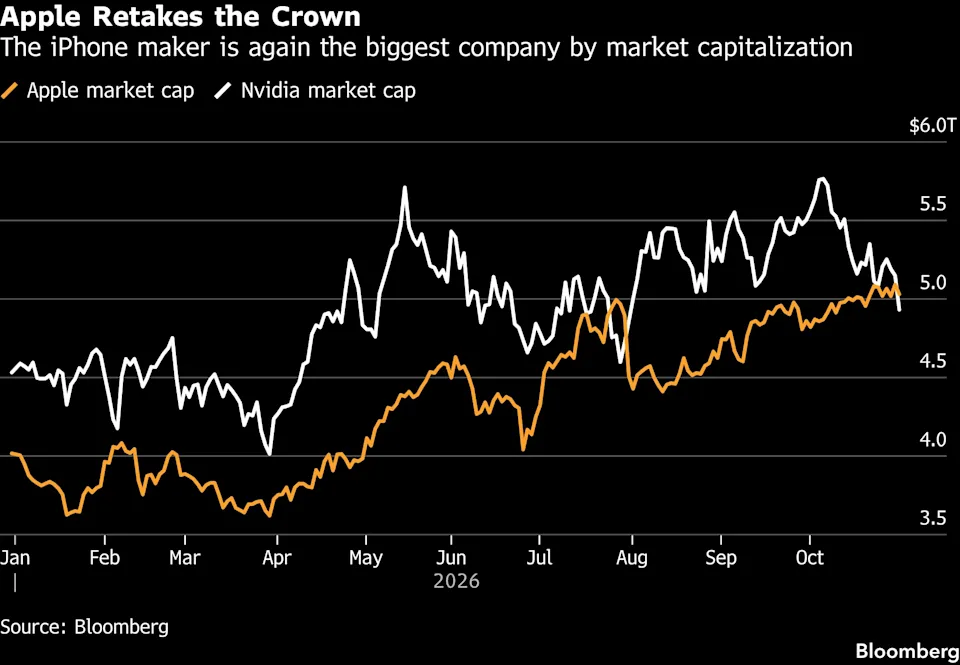
Image source: Bloomberg
This is not the first time Apple has overtaken Nvidia. Back on July 17 this year, Apple had already edged past Nvidia intraday, and on July 27 it led again—but both times it failed to hold the top spot. Since mid-2025, Nvidia had dominated this ranking for more than 260 trading days.
So how long this latest ascent to the top will last remains anyone's guess.
But what is truly worth pondering is something else: the company that seized the crown of the biggest AI winner is the one that looks least like an AI player of all.
Apple is up 27% this year, the top gainer among the Magnificent Seven and more than double the second-place Nvidia. A company that has been criticized for two years as "behind in AI" outperformed every AI company in the hottest year for AI.
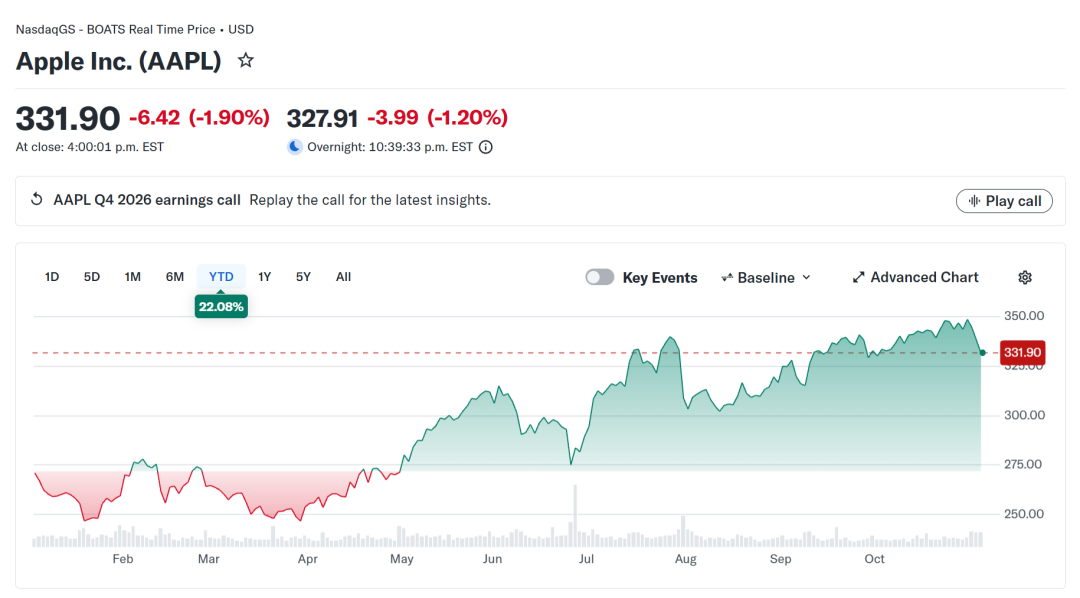
Image source: Internet
This is illogical—unless our understanding of "how AI makes money" was wrong from the very beginning.
It's not that Apple got stronger; it's that AI got too expensive
Let's be clear: in this round of throne-changing, Apple did not get stronger; AI got more expensive.
The market narrative is shifting from "who has the biggest investment number" to "who can turn investment into profit."
One set of comparisons is enough. HSBC estimates that for Apple's forecast 2026 sales, capital expenditure on AI data centers accounts for about 2.5%. For Meta, Google, Amazon, and Microsoft, that number is 39%.
Microsoft, Google, Amazon, and Meta each have capital expenditure at the hundred-billion-dollar level. Apple's AI-related spending in 2026 is about $11 billion to $13 billion—a fraction of theirs.
Image source: Internet
Spending the money is easy to say, but the bills are hard to pay. Free cash flow at Alphabet and Amazon has turned negative, forcing them to increasingly turn to bond market financing. Interest rates are still rising, and borrowing costs are being pushed up accordingly. S&P directly downgraded Meta's outlook to negative, citing "significant uncertainty over capital expenditure and free operating cash flow."
Of course, the most intuitive example is the "collective discount on U.S. tech stocks" on the last trading day of October. Intel fell 28.58% in a single day, its biggest one-day drop in more than forty years; the Philadelphia Semiconductor Index fell 7.2%, its biggest drop since June; CoreWeave and Nebius, which provide computing power leasing for AI, both fell more than 30% in October.
The Nasdaq 100 fell 6.7% in October, its worst month since March 2025.
On Apple's side, free cash flow is expected to grow 38% in fiscal 2026 to $142 billion. It holds about $146 billion in cash and securities; its stock is up 27% year to date, first among the Magnificent Seven.
Image source: Internet
On one side, money is being burned to the point of issuing debt; on the other, cash is piling up into mountains. Capital is flowing from the computing power narrative to the cash flow narrative—a shift from preferring stories to returning to basic business logic.
Without heavy AI bets, why is it being repriced
The premium the market gives Apple mainly comes from three layers of logic.
The first layer is its safe-haven attribute. Among the Magnificent Seven, Apple is the only "quasi-utility" company. Its revenue does not depend on who wins a certain technology cycle—only on the 2.5 billion devices still in users' hands. When everyone is betting on the payback period of AI, predictability itself becomes scarce. Tony Meadows, head of investment at BRI in the UK, put it bluntly: Apple has lower exposure to capital-expenditure-intensive models, and this round of repricing reflects confidence in earnings sustainability rather than speculation on AI prospects.
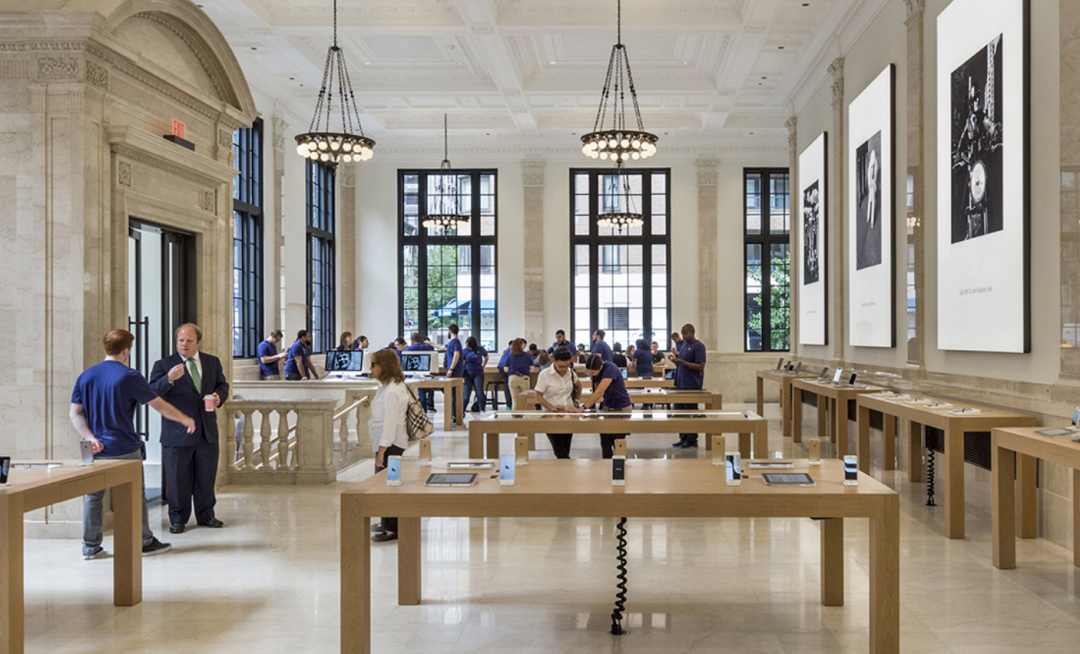
Image source: Internet
The second layer is indirect monetization. Apple is a rare "low-input beneficiary." No matter whether OpenAI, Google, or Alibaba ultimately wins, AI must pass through Apple's gateway to reach users. It does not compete, but it is the track itself.
The third layer is its financial structure. The gross margin of the services business is 75.6%, while product gross margin is about 40%. Hardware brings people in the door, and services collect the money. This structure makes Apple's AI investment naturally "light": on-device models run on chips users have already bought, and computing costs have long been paid for by hardware.
But don't rush to be bullish; Apple itself has many problems.
First, the valuation is not cheap. The TTM P/E ratio is in the 30 to 36 range, close to 36 times based on expected earnings over the next 12 months—the highest level since 2008 and in the 99th percentile of its historical valuation distribution. It has become the only stock among the Magnificent Seven with negative implied return over the next 12 months. Since its earnings report at the end of July, at least six analysts have downgraded it, and the proportion of buy recommendations is below 60%, while Microsoft, Amazon, and Meta all exceed 90%.
Siri is no longer delayed, but rolling it out globally is not easy. The new Siri AI launched in Beta with iOS 27 on September 14, 2026, supporting 16 languages including Simplified Chinese, but mainland Chinese users did not get access to a Beta version of some AI features until November 4; the full experience with true cross-app autonomous invocation capabilities will still have to wait until next month.
Apple's much-hyped "Visual Intelligence" is powered behind the scenes by Google Gemini. Apple pays about $1 billion a year to license a 1.2-trillion-parameter model, with complex computing hosted on Google Cloud, while the Chinese version switches to Alibaba's Qwen.
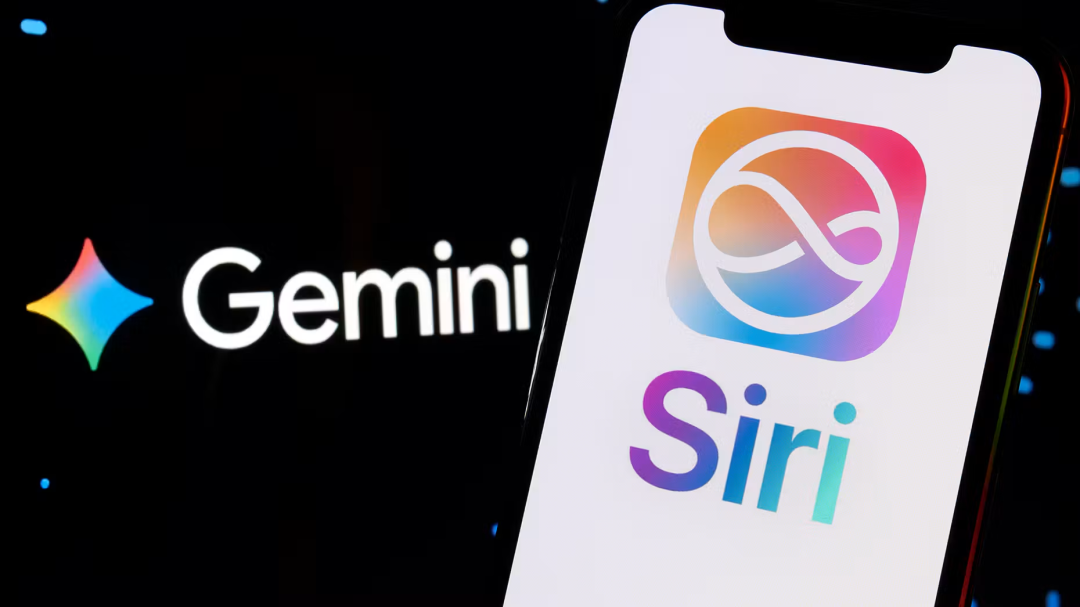
Image source: Internet
Some AI capabilities are essentially "outsourced." In January 2026, Google and Apple officially announced a multi-year strategic partnership, with the next generation of Apple foundation models built directly on Gemini's model architecture and cloud infrastructure, while Apple's self-developed trillion-parameter model is still on the way.
So the core judgment is just one sentence: the market is buying Apple not because it does AI best, but because it does not have to burn money for AI. These two things have completely different valuation implications.
Can Apple carve out a money-making path independent of AI?
Yes—and it has already done so three times.
This playbook has a name: the "toll-booth model"—don't build the road, just set up the checkpoint.
During the cloud computing boom, Apple did not build its own; it bought Amazon AWS and resold it to users, earning the spread. In the search era, it did not develop its own; it signed a pre-installation agreement with Google and collected tens of billions of dollars a year. Now that AI has arrived, it outsources models to OpenAI, Google, and Alibaba while guarding the gateway itself.
Three times, not one failure.
Institutional forecasts are not bad either: FY2028 revenue of $534.1 billion, with services CAGR of 12.4%—the fastest-growing and highest-quality profit segment in the revenue structure.
But the ceiling is equally clear.
First, this model is strongly tied to the iPhone replacement cycle. If phones don't sell, no cars pass through the toll booth. Second, antitrust pressure on App Store commissions is ongoing, and regulators in Europe and the U.S. have no intention of letting go.

Image source: Internet
So this path can work, but it is "steady-state rent collection," not a "high-growth story."
What does that mean? It means that looking at Apple through the valuation framework of a tech stock, it will always seem "not sexy enough"; looking at it through the framework of a consumer stock, it is instead one of the highest-quality cash flow assets in the world. This round of market repricing is essentially a switch in valuation coordinates.
Global market strong, China market weaker
Apple tops the world, yet in China a most contradictory set of readings has emerged: revenue growth is first globally, but its market share in China is relatively weak.
In the third quarter this year, Apple shipped 11.6 million units in China, up 15% year on year, for a 20% share. Huawei reached 12.4 million units in the third quarter, up 18%, with its share at 21%. The two together took 41% of the market, about 10 percentage points higher than a year earlier. The market is concentrating toward a duopoly, and Apple has gone from the sole king to one of two strong players.
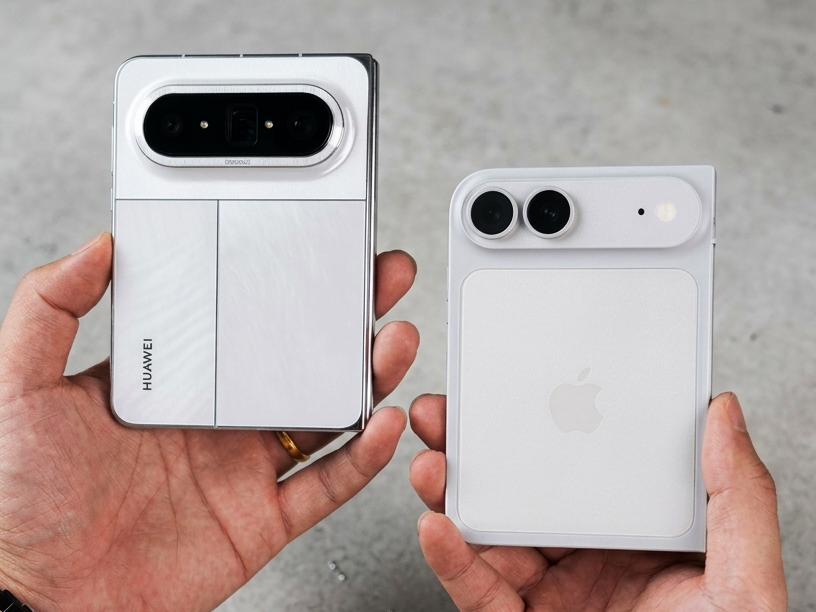
Image source: Internet
According to authoritative IDC data, iPhone shipments in the quarter were about 10.33 million units, down 4.3% year on year, while share rose from 15.8% to 17.8%. Volume is shrinking while share is rising, indicating the overall pie is shrinking even faster.
Moreover, Apple's price bands are beginning to fall. In the mainstream high-end segment of 5,000 to 6,000 yuan, Huawei has overtaken Apple to take first place; above 8,000 yuan, Huawei's share exceeded 30% for the first time—a record high. Apple still holds the large market above 6,000 yuan and an absolute 73.5% advantage above 8,000 yuan, but it is losing the middle.
Revenue is rising, share is being conceded; Apple can only use price to trade for volume.
During 618, the iPhone 17 Pro series was cut by 1,000 yuan outright, with subsidies saving up to 2,000 yuan, and the standard version fell below 4,500 yuan for the first time. Huawei responded the same day, cutting the Mate X6 by 3,000 yuan. By September this year, the iPhone 18 Pro/Pro Max each rose by $100, and the base model was postponed to next spring. Only two high-end phones are on sale in autumn; volume cannot rise, but average selling price has.
In China, Apple is not unable to sell—it is selling expensively and defending with fatigue. In the past it stood and sold on brand premium; now it must rely on price cuts and subsidies to move volume. Volume has returned, but the quality is lower than two years ago.
Incoming CEO Ternus said at the earnings call that he is satisfied with performance in the Chinese market, with growth mainly from iPhone, followed by Mac. That is correct, but the market reaction was a post-market drop of more than 3%; investors care about the $18.75 billion expected shortfall next quarter, not the $17.5 billion year-on-year increase.

Image source: Internet
In China, the difference between a 20% and 21% share is not one percentage point, but who sets the rules. Apple still holds high-end pricing power, but it is no longer the Apple that does not need to explain, does not need to cut prices, and does not need to hurry.
Final thoughts
Based on hands-on testing of Apple Intelligence from the beta already obtained, the China-market Apple Intelligence looks more like a prudent trial run by Apple in the domestic AI phone race. Its on-device native features focus on practical capabilities such as translation, transcription, and photo processing, while complex creation and deep Q&A are left to Qwen to fill in. But the AI phone battlefield in China has been fiercely competitive for years, and real-time translation, photo erasure, AI summaries, and intelligent creation are long no longer novel selling points.
Complex creation and deep Q&A are handed to Qwen, and the short-term experience gap can be filled quickly. But there is a long-term concern: once users get used to "AI capability = Qwen," the perceived value of Apple's own models will be diluted, and this part of the experience is constrained by cooperation terms and data compliance, so it is not a moat Apple fully controls. Domestic manufacturers' agents use their own foundation plus their own orchestration, while Apple uses "its own framework + someone else's brain"; the routes have different value.
Apple still has a chance to catch up in the window where domestic manufacturers are competing on agents, but the window is narrowing.
References:
First-hand test of Apple's China AI Source: Zhidongxi
Everything about Apple is getting more expensive, all because of AI Source: ifanr
- END -
-
![]()
Nut Pandownload Ownership Change: The Logic of Large-Screen Projectors Replacing TVs Is Failing
-
Thanks to Chinese Support, Apple's China Revenue Surges 21%, with Revenue and Profit Hitting New Highs Again
-
![]()
Two-Trillion Sprint Tier: Benchmarking Analysis of Industries in Nanjing, Ningbo, Tianjin, and Qingdao
-
![]()
Cloud Computing in the AI Era: Prosperity for the Few | Juchao
-
![]()
Smartphone Specs Slashed Across the Board: Hardware Downgrades Leave Users in a Bind
-
![]()
Apple "Wins by Default" Against Nvidia
-
AI Comic Dramas: The 10 Fastest-Growing and Most Profitable Companies
-
Apple Earnings: Revenue Tops Forecasts, but Growth Cools and Greater China Falls Short