Cloud Computing in the AI Era: Prosperity for the Few | Juchao
 11/04 2026
 513
Editor | Yang Xuran
"The biggest super-application of the AI era is the AI cloud platform built around AI computing power."
Alibaba CEO Wu Yongming made this point on the company's fiscal 2027 Q1 earnings call. His reasoning: over the long run, most enterprise AI workloads — from large-scale training and inference to customized inference and the development and operation of enterprise agents — will require the support of a full-stack AI cloud platform.
If the AI cloud is a super-city, then training, inference, and agents are the "residents" who live inside it. The more complete the cloud infrastructure, the more new customers it can attract, while also improving retention among existing ones — a virtuous cycle.
In the past, what the cloud gave enterprises and individuals was a tool for doing work. Today, the AI cloud delivers "the ability to do work." Cloud services completed their first revolution through virtualization; in the AI era, they are undergoing a second — upgrading from supplying resources to outputting intelligence.
With the arrival of the AI era, the cloud service landscape is being reshaped. Competition has shifted entirely from "a contest of scale and price" to "a contest of comprehensive intelligence capabilities," which places extremely high demands on the technical capabilities and capital strength of market participants.
A profound transformation of the cloud industry is under way, but very few players are qualified to sit at the table.
This article is an in-depth value piece from the "Juchao WAVE" content team. You are welcome to follow us on multiple platforms.

A Game for the Few
Without cloud support, AI is just an expensive fireworks display.
In 2006, after Amazon launched cloud services usable by both enterprises and individuals, public cloud began its commercial practice in China. Starting in 2017, however, Alibaba Cloud and Tencent Cloud drove the price war to its peak, directly hastening the decline of traditional CDN giant Wangsu Technology.
What is more, Tencent Cloud once won the Xiamen government cloud project with a bid of 1 cent. In the highly homogenized IaaS market, low price became the only means of competition.
The disruption AI has brought to the cloud computing industry since 2026 is a world away from the past.
Today, when enterprises move to the cloud, the first question has shifted from "how much cheaper can it be" to "can it run my model." The cloud's positioning has changed from "an IT alternative" to "the production soil for AI."
In the AI "five-layer cake" framework proposed by Jensen Huang (energy, chips, infrastructure, models, applications), cloud computing is the main delivery form of the "infrastructure layer" and the core participant responsible for vertical integration across the five layers.
Today, competition among cloud players has shifted to a contest of comprehensive capabilities — computing power supply, model performance, platform engineering, ecosystem collaboration, and industry implementation — and industry barriers have risen significantly.
Moreover, cloud computing vendors are becoming "power + chip + model + cloud" conglomerates. They are being forced to extend upstream along the industrial chain and to become all-around players integrating self-developed chips, self-built power facilities, model platforms, and cloud services.
As a result, competition among cloud vendors has become a veritable super-capital war.
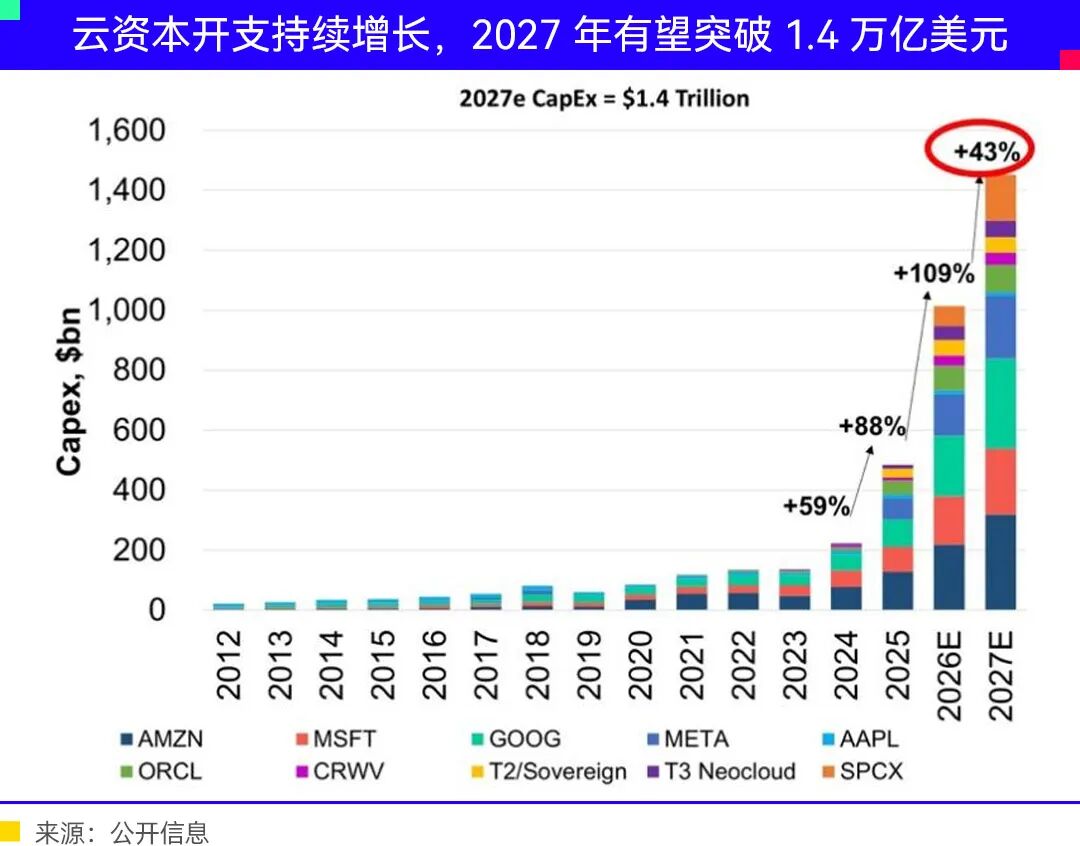
The giants' capital expenditures are astronomical. The five major North American cloud vendors spent a combined $411.5 billion in 2025; the consensus expectation for 2026 is as high as $773.9 billion, with 2027 projected to reach $1.02 trillion.
Investment of this magnitude means that only a very small number of players can stay at the table. In China, Alibaba plans to invest at least 380 billion yuan over the three years from 2026 to 2028 in cloud computing and AI infrastructure — a figure exceeding the sum of the previous ten years.
Massive capital ammunition creates a "monopoly dividend," causing small and medium-sized vendors to shrink back in the AI race and widening the gap with the leaders.
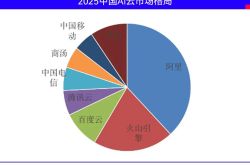
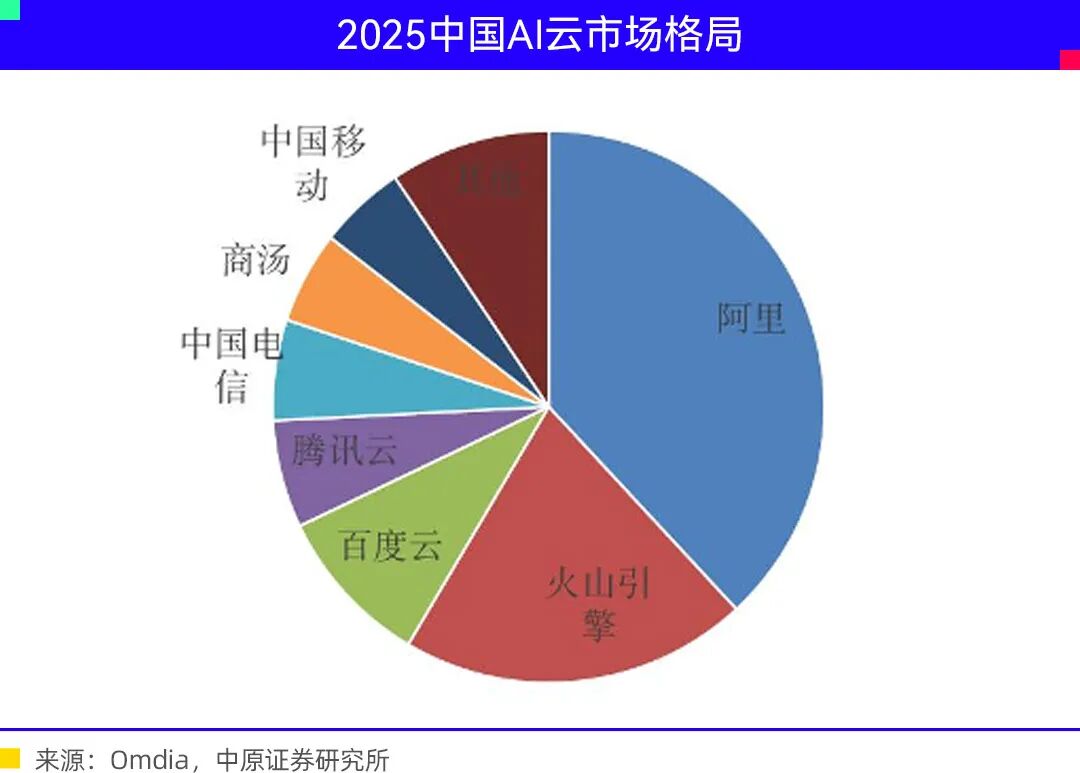
In 2025, China's AI cloud market reached 68.4 billion yuan, with Alibaba, ByteDance, Baidu, Tencent, and China Telecom Cloud ranking in the top five. Alibaba Cloud led with a 38.1% share.
But scale alone cannot secure a foothold in the AGI race. Cloud vendors' full-stack self-research capabilities have become the key market test. Buying chips alone means that no matter how large the computing cluster, it is only "paper wealth." Therefore, top cloud vendors are all racing to develop their own chips.
Globally, Google, Microsoft, Amazon, Alibaba, Huawei, and Baidu all have deployments in both cloud computing and AI chips, and some have also developed their own large models.
As these self-developed chips scale up, the gross margin of cloud businesses will recover significantly — an advantage that vendors simply purchasing Nvidia GPUs cannot match.
Currently, "Model as a Service" (MaaS) has become a new service layer after IaaS, PaaS, and SaaS, constituting the fourth barrier to business models.
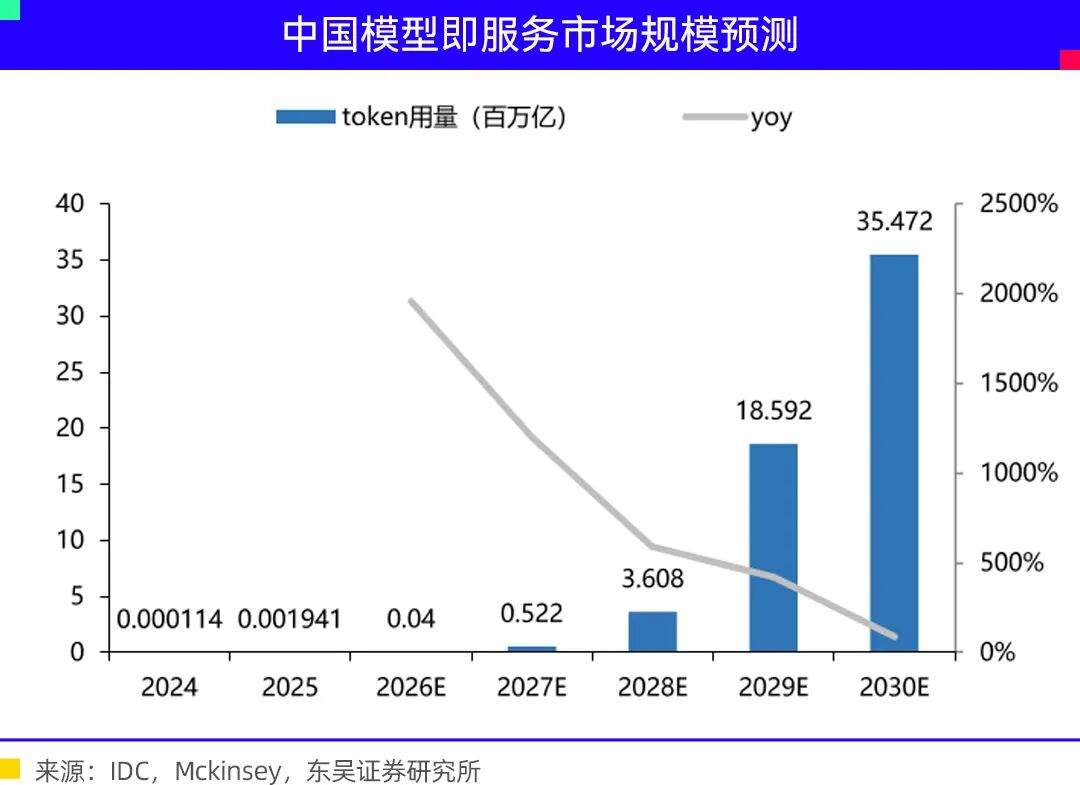
In the early stage of MaaS, charges are based on token consumption. The invocation volume of large models on China's public cloud exploded nearly 17-fold within a year, soaring from 114.2 trillion in 2024 to 1,944 trillion in 2025.
With the popularity of AI agents and personal agents, the billing unit will further evolve to charging by "task" or "business result," and the economic boundaries of cloud computing are undergoing a historic reconstruction.

Two Titans Competing
Among domestic enterprises, Alibaba Cloud, Tencent Cloud, China Telecom Cloud, and Baidu AI Cloud represent different paradigms: the internet platform type, the ecosystem scenario type, the national strategy type, and the technology-intensive type. Their competitiveness and characteristics unfold along their respective genes and strategic depth.
As a pathfinder of China's cloud industry, Alibaba Cloud is the largest in China and a leader in full-stack self-research. Its strategic layout is similar to that of Google across the ocean. It is dominant in both the IaaS market and the incremental AI cloud track. In 2025, Alibaba's public cloud growth for large-model training and inference reached 116%, and its market share reached 42.2%.
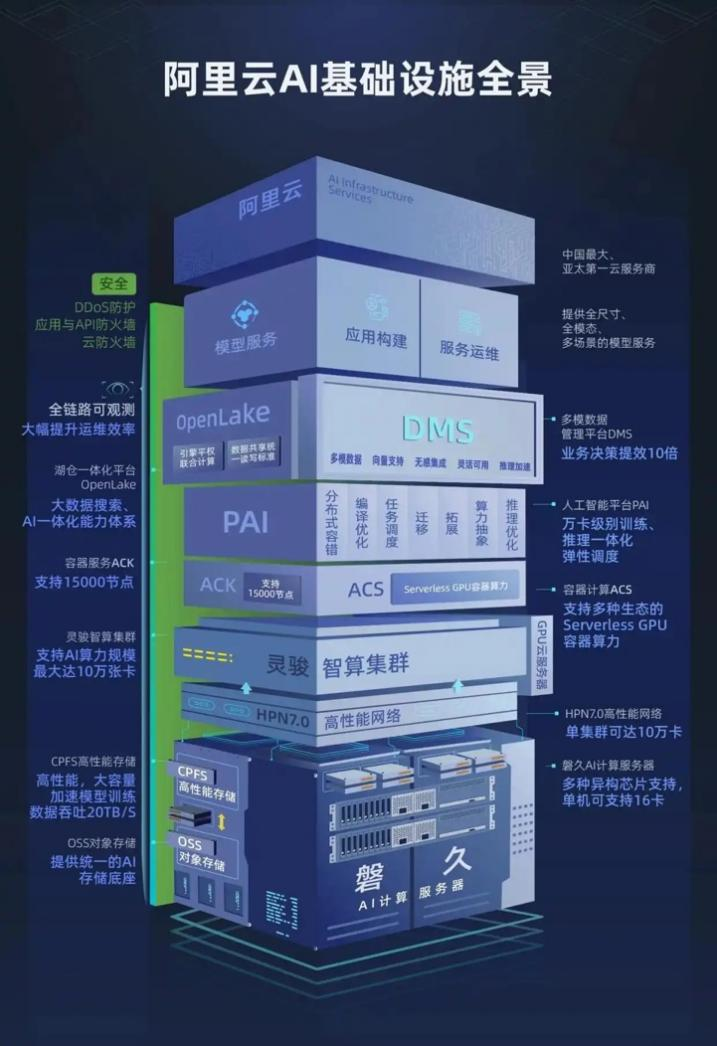
Alibaba's strength lies in its full-stack investment in "large language models + chips + cloud." Pingtouge's AI chip Zhenwu has already been deployed at scale on Alibaba Cloud, and its self-developed AI super node supports efficient inference of large models with over 2 trillion parameters. The performance ranking of Qwen3.8 has once again approached domestic SOTA levels such as Kimi K3 and GLM 5.3.
In the latest fiscal quarter, as AI & cloud revenue grew, the profit margin continued to rise. Alibaba Cloud's overall and external revenue growth rates were both 45%, with AI-related revenue reaching 12.4 billion yuan, up more than 150% year-on-year and accounting for nearly 26% of the segment's total revenue; the profit margin also reached double digits, close to 12%.
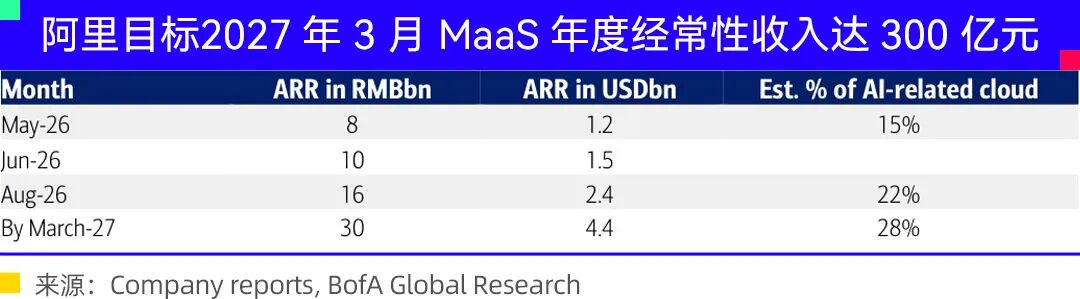
At the fiscal year 2026 exchange meeting, Wu Yongming stated that AI ARR had exceeded 8 billion yuan and would exceed 30 billion yuan by the end of the year. "The advantage of high profit margin is gradually becoming prominent and will be the pillar of Alibaba's healthy, high-quality revenue growth in the future."
In March, Alibaba Cloud also announced price increases of 5%–34% for some AI computing products, breaking the industry convention that cloud services "only go down, never up." This reflects the convergence of explosive Token-invocation growth driven by surging AI demand and rising upstream hardware prices — but at a deeper level, it marks the return of pricing power for leading cloud vendors as they shift from scale-and-cost competition to technology-and-value-driven competition.
This endowment of "full-stack AI capabilities," combined with being a dual-strong vendor in "computing power + large models," keeps Alibaba Cloud among the biggest beneficiaries of the AI era.
Another giant, Tencent Cloud, still relies on its incomparable ecosystem advantage. Its competitiveness in the AI era does not lie in head-to-head competition over the scale of cloud infrastructure, but in its unique multiplier effect of "C-end ecosystem × scenario applications."
The WeChat ecosystem is a natural digestion pool for AI computing power. WeChat has a huge ecosystem depth of 1.4 billion users and an extremely rich and diverse set of embedded businesses, all of which provide vast soil for the AI cloud.
After a period of cash burning and slimming down, Pony Ma confirmed at the earnings call that the cloud business achieved large-scale profitability in 2025 — still rare among domestic cloud vendors. Tencent Cloud's approach is to "not pursue the number one share," but to focus on scenario applications.
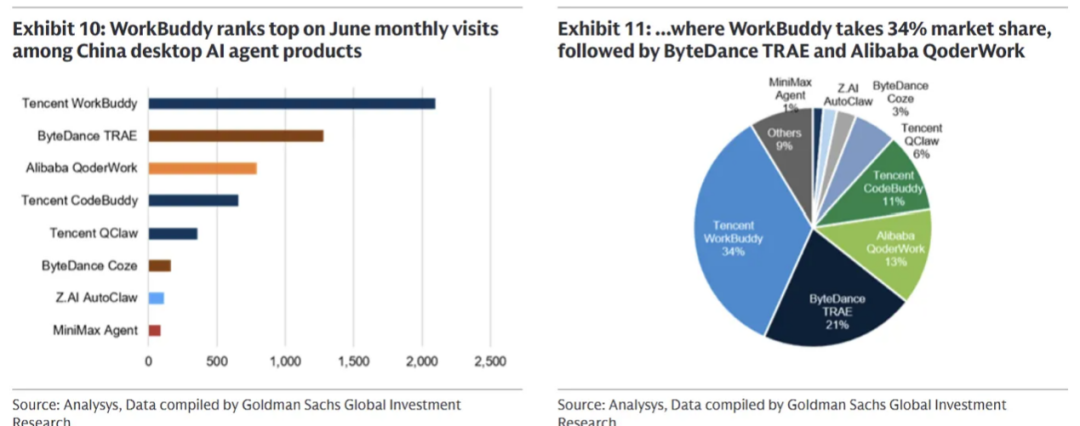
For example, Tencent dominates AI office scenarios. The AI office agent WorkBuddy had 20.97 million monthly visits (June), ranking first, and the AI coding agent CodeBuddy ranks among the top. Moreover, the gross margin of WorkBuddy's paying users is already comparable to that of Tencent Cloud as a whole.
The AI assistant Xiaowei focuses on the AI-driven reshaping of WeChat's internal ecosystem. Liu Chiping positioned it as the key carrier for the WeChat ecosystem to enter the "AI era," comparing the potential of this leap to WeChat's "10x value amplification" relative to QQ.
Compared with companies such as Alibaba and Google, Tencent is still viewed by the market with concern regarding large-model capabilities. To this end, Tencent has gone full throttle, spending 52.8 billion yuan (actual capital expenditure) in the second quarter, plus a prepayment of 51.4 billion yuan for computing power procurement — totaling more than 100 billion. Following this trend, full-year CapEx could reach 200 billion.
At present, pushing Tencent Hunyuan toward SOTA is a clear strategic priority, and the internal task is that "Hunyuan 5 must become a SOTA model."

Differentiated Competition
Beyond the two internet giants, China Telecom Cloud and Baidu AI Cloud are also important players in the current AI cloud market.
China Telecom's China Telecom Cloud can be seen as the national cloud team, shouldering the important task of information security. The barriers it has built in tracks such as government affairs, central state-owned enterprises, and the information technology application innovation sector are difficult for internet cloud vendors to replicate in the short term. The deep integration of state-owned identity, network resources, localized services, and full-stack domestic innovation capabilities enables China Telecom Cloud to shoulder the mission of "national infrastructure."
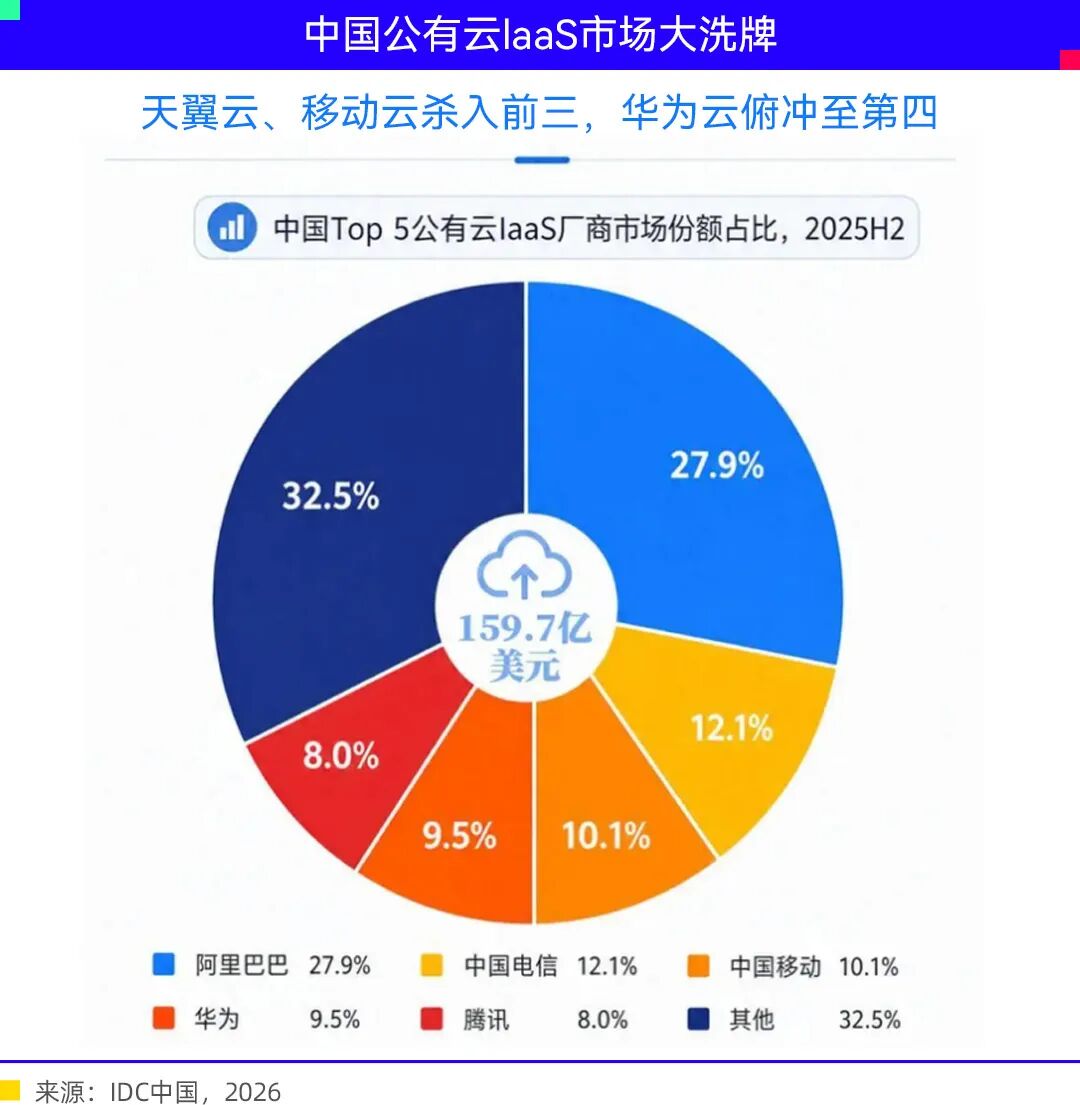
IDC data shows that China Telecom Cloud continues to lead China's government public cloud market with a 26.1% share and has ranked first for four consecutive years (2021–2024). In the second half of 2025, China Telecom Cloud broke into the top three in public cloud IaaS, ranking second with a 12.1% share, ahead of Huawei Cloud and Mobile Cloud.
In the first half of 2026, China Telecom Cloud's revenue reached 61.8 billion yuan, up 7.8% year-on-year. The company continues to deepen construction of its "five-in-one" intelligent cloud system, reshaping its business development model around Token as the main line. The total computing power of the "Xirang" computing platform has exceeded 118.8 EFLOPS, with self-owned capabilities reaching 70.8 EFLOPS.
China Telecom Cloud builds differentiated barriers with "national cloud + national chips + national models." From Zijinshan servers, Zijin DPU, and the CTyunOS operating system to the TeleDB database, China Telecom Cloud has opened up a full-stack domestic innovation matrix of software and hardware. This advantage gives it differentiated characteristics that distinguish it from internet cloud vendors in government-enterprise and information technology application innovation scenarios.
Moreover, as a large operator, its cloud services have the innate advantage of "computing-network integration," with localized service capabilities across the country, network systems, and barriers in the government-enterprise track, allowing it to bind deeply with customers that have extremely high requirements for security and compliance.
However, the incremental space in the current government-enterprise market is narrowing. In the AI cloud market, China Telecom Cloud's share gap with cloud vendors such as Alibaba is obvious. Whether it can close shortcomings at the PaaS and SaaS levels and move from "general computing" to "intelligent computing" is the key to determining China Telecom Cloud's competitiveness in the next stage.
Baidu AI Cloud is the "full-stack self-research" vendor of the AI-native faction.
In the traditional public cloud IaaS market, it cannot rank in the first tier, but in the AI cloud market, it has entered the top three thanks to its full-stack in-house research capabilities. So it is not "the largest cloud," but it may well be "the most AI-driven cloud."
It has built a four-layer full stack of "chip-cloud-model-agent," which is almost unique in China: "chip (Kunlun Chip)-cloud (Baidu AI Cloud)-model (Ernie large model)-agent (super agent)."
Alibaba has chips and cloud, but its model layer coexists with multiple open-source models; Tencent Cloud relies on its ecosystem, but its underlying chips must be purchased externally; Baidu is one of the few players with in-house research across the entire chain from chips to applications.
This layout can solve the efficiency loss caused by the fragmentation among chips, frameworks, models, and applications in traditional cloud computing. Shen Dou likened this "native alignment at the instruction set level" to Baidu AI Cloud's "new full-stack" technical architecture in the Agent era.
In engineering terms, it comes down to one sentence: let the model understand the strengths of the chip, let the cloud understand the shape of the model, let the Agent understand the boundaries of the cloud, and all four layers share the same optimization language. Only this kind of native alignment can push the computational efficiency of Tokens to the extreme.
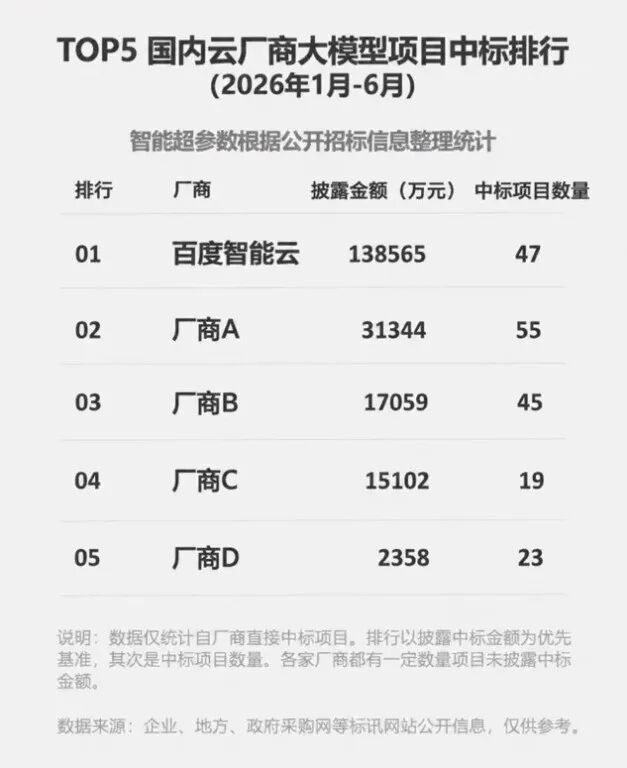
In the core track of AI public cloud services, Baidu AI Cloud is a long-term leader and even the "king of winning bids" for large model deployment. In the first half of the year, the disclosed winning bid amount for Baidu AI Cloud's large model projects reached 1.386 billion yuan, several times that of other cloud vendors.
In the second quarter of this year, AI-related revenue reached 12.4 billion yuan, accounting for more than half for two consecutive quarters. AI cloud infrastructure continued its strong momentum, with GPU cloud growing 283% year-on-year.
The vertical integration from Kunlun chips to the ERNIE large model enables Baidu to achieve considerable cost advantages. The Kunlun P800 has already enabled ERNIE 5.1 training on a 30,000-card cluster and has migrated the vast majority of inference tasks to its self-developed chip system.
But Baidu's shortcomings are equally clear: its overall scale and ecosystem depth are somewhat insufficient, its general IaaS foundation is relatively weak, its traditional cloud ecosystem shortcomings are obvious, and it has failed to enter the top five in the traditional public cloud IaaS market. The leap from "AI cloud" to "the strongest comprehensive cloud" is a difficult problem that Baidu AI Cloud must face. This is even a key question for Baidu's ecosystem to prosper again in the AI era.

Written at the end
In the AI era, the cloud is no longer just an upgraded data center, nor will it be a wholesaler of computing power.
It is the infrastructure Jensen Huang speaks of, and also the super app that Wu Yongming views seriously. It can be said that almost all AI application costs are determined by it, and all intelligentization progress is constrained by its delivery capability.
Models iterate every three months, chips update every year, and Agent inference traffic surges like tides. In the face of the dramatic uncertainty of the AI world, the cloud is the only buffer carrier for computing power.
Undoubtedly, for some time to come, Chinese cloud vendors will experience years in which fierce competition, thriving business forms, and development anxiety coexist.
-
![]()
Nut Pandownload Ownership Change: The Logic of Large-Screen Projectors Replacing TVs Is Failing
-
Thanks to Chinese Support, Apple's China Revenue Surges 21%, with Revenue and Profit Hitting New Highs Again
-
![]()
Two-Trillion Sprint Tier: Benchmarking Analysis of Industries in Nanjing, Ningbo, Tianjin, and Qingdao
-
![]()
Cloud Computing in the AI Era: Prosperity for the Few | Juchao
-
![]()
Smartphone Specs Slashed Across the Board: Hardware Downgrades Leave Users in a Bind
-
![]()
Apple "Wins by Default" Against Nvidia
-
AI Comic Dramas: The 10 Fastest-Growing and Most Profitable Companies
-
Apple Earnings: Revenue Tops Forecasts, but Growth Cools and Greater China Falls Short