Two-Trillion Sprint Tier: Benchmarking Analysis of Industries in Nanjing, Ningbo, Tianjin, and Qingdao
 11/04 2026
 459
Two trillion yuan is becoming the dividing line in the competition among China's leading cities.
In the first three quarters of 2026, Nanjing, Ningbo, Tianjin, and Qingdao all fell within the 1.4–1.5 trillion yuan range, locking in 10th to 13th place nationwide and forming the two-trillion sprint tier. Who will hit the two-trillion mark? Who will ultimately rewrite the rankings? Drawing on the desktop version of the Huoshi Xinglan Industrial Intelligence Agent, this article benchmarks the four cities one by one across dimensions such as GDP totals and growth rates, emerging industry structure, total social R&D investment, and development zone level, providing a reference for industrial investment promotion and industrial layout.
01 Two Competition Paths
In terms of GDP totals, the four cities have split from close competition into two paths. Nanjing and Ningbo are competing for 10th/11th place and the timing of hitting the two-trillion mark, while Qingdao and Tianjin are competing over which is the second city in the north. The causes of the two sets of contradictions differ: the former depends on whether investment and the service sector can fill the industrial gap, while the latter depends on whether the pace of emerging industry realization can offset the transformation lag of traditional heavy chemical industries.
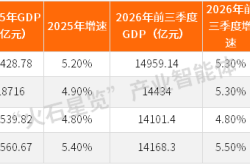
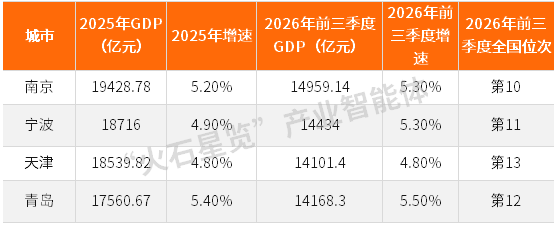
Specifically, Nanjing's GDP in the first three quarters was 1,495.914 billion yuan, with a growth rate of 5.3%, and above-designated-size high-tech manufacturing grew by 12.6%, almost covering the entire gap left in 2025. Hitting the two-trillion mark and maintaining 10th place are almost certain. Although Ningbo's growth rate in the first three quarters was also 5.3%, fixed asset investment fell by 6.7% and retail sales of consumer goods grew by only 2.3%, with weak domestic demand dragging down its pace of catching up.
Table: GDP growth rates of the four cities
Source: Huoshi Xinglan Industrial Intelligence Agent
Tianjin's growth rate was 4.8%, and above-designated-size industrial value added was 4.6%, significantly lower than Qingdao's 7.3%, exposing the transformation lag of traditional heavy chemical industries. Qingdao ranked first among the four cities with a growth rate of 5.5%, expanding its lead over Tianjin to 6.690 billion yuan, but this advantage is less than 0.5% of its total, so the full-year ranking remains uncertain.
02 Emerging Industry Structure
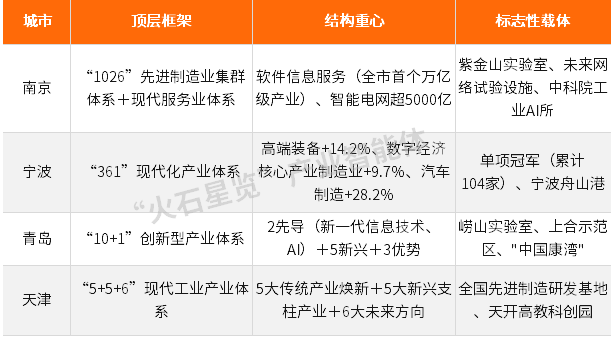
The characteristic of Nanjing's "1026" system is that it has both large players and a reserve force: value added in software and information technology services grew by 9.8% year on year, and producer services contributed 87.6% to above-designated-size services, with the industry not relying on a single track. The underlying logic of Ningbo's "361" system is to rely on its existing manufacturing base for outward expansion. In 2025, value added in core digital economy industries was 159.9 billion yuan, up 12.1%, and high-tech manufacturing grew by 11.9%, but the traditional industrial structure is relatively heavy and dependence on foreign trade paths is obvious.
Table: Modern industrial systems of the four cities
 Source: Huoshi Xinglan Industrial Intelligence Agent
Qingdao's "10+1" innovative industrial system already has the framework of an annual delivery list: in 2025, revenue from leading and emerging industries both grew by more than 10%, revenue from the 2 major leading industries exceeded 250 billion yuan, and the 5 major emerging industries totaled nearly 600 billion yuan; production of new energy vehicles was 422,000 units, up 2.4 times, accounting for more than 40% of total vehicle production for the first time; installed capacity of new energy and renewable energy reached 8.1 million kilowatts, with its share exceeding 60%. In contrast, Tianjin's "5+5+6" industrial system is more of a "15th Five-Year Plan" direction, leaning more toward future restructuring than current momentum. The difference in the pace of industrial delivery is a major reason for the change in ranking between the two cities.
03 R&D Investment Intensity
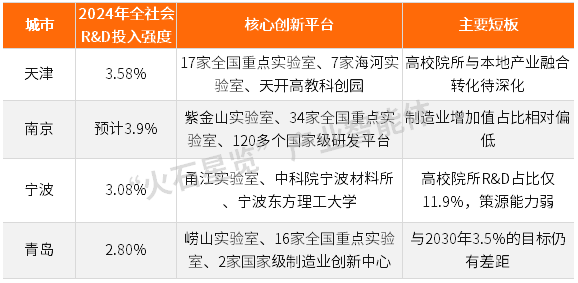
Nanjing has the highest R&D investment intensity among the four cities. In 2024, total social R&D expenditure as a share of GDP is expected to reach 3.9%. It ranks fifth globally in the "Nature Index-Science Cities" and ninth among global science and technology clusters. Its 54 universities and 34 national key laboratories form the source base for "from 0 to 1" innovation.
Tianjin follows closely at 3.44% (according to the National Bureau of Statistics bulletin, with the municipal preliminary estimate at 3.58%), backed by Nankai University and Tianjin University, 29 national key laboratories, and 7 Haihe laboratories, while Tiankai Higher Education Science and Technology Innovation Park has attracted and cultivated more than 2,600 enterprises cumulatively. Overall R&D investment across the four cities shows a "two high, two low" pattern: Nanjing and Tianjin are significantly higher than Ningbo (3.08%) and Qingdao (2.80%).
Table: R&D investment intensity of the four cities
 Source: Huoshi Xinglan Industrial Intelligence Agent
04 Development Zone Level
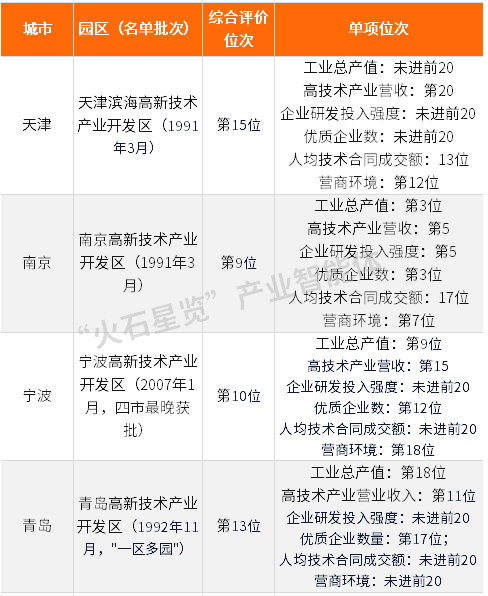
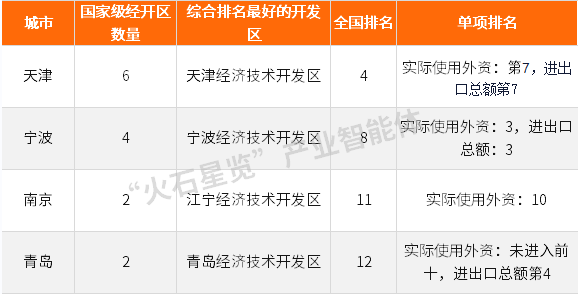
At the development zone level, each of the four cities has one national-level high-tech zone, while for national-level economic and technological development zones, Tianjin has 6, Ningbo 4, Nanjing 2, and Qingdao 2.
According to the 2024 comprehensive evaluation results of national-level high-tech zones, the rankings of the four cities' high-tech zones are Nanjing (9th) > Ningbo (10th) > Qingdao (13th) > Tianjin (15th). Nanjing High-tech Zone is the only "all-around player" among the four cities: it ranks among the top 5 in all four individual indicators—total industrial output value (3rd), number of high-quality enterprises (3rd), high-tech industry revenue (5th), and enterprise R&D investment intensity (5th)—and 7th in business environment. It is also the only high-tech zone among the four cities to enter the top 20 in the individual indicator of enterprise R&D investment intensity, mutually corroborating the city's 3.9% R&D intensity.
Table: Comprehensive evaluation results of national-level high-tech zones in the four cities
Source: Huoshi Xinglan Industrial Intelligence Agent
According to the 2024 comprehensive evaluation results of national-level economic and technological development zones, Tianjin Economic-Technological Development Area ranks high overall, at 3rd nationwide, with actual use of foreign capital and total imports and exports both ranking 7th; Ningbo Economic and Technological Development Zone ranks 8th nationwide overall, with actual use of foreign capital and total imports and exports both ranking 3rd, making it the sharpest performer in openness performance.
Table: Comprehensive evaluation results of national-level economic and technological development zones in the four cities
 Source: Huoshi Xinglan Industrial Intelligence Agent
Overall, the "first sprint to two trillion" duel between Nanjing and Ningbo has temporarily shown a difference in pace; the contest between Qingdao and Tianjin for the second city in the north has entered a stalemate. The top-level design of all four cities has moved beyond the thinking of traditional industry catalogs, but the paths are clearly diverging—Nanjing on AI and hard-tech source innovation, Ningbo on scenario opening and upgrading single-item champions, Qingdao on breakthroughs in marine and leading industries, and Tianjin on Beijing-Tianjin-Hebei coordination and advanced manufacturing R&D. Whichever city can, from 2026 to 2030, truly transform R&D intensity, industrial systems, and development zone level into supporting relationships driven by leading enterprises and cluster explosive power will be the first to secure a foothold and even reshape the ranking landscape.
-
![]()
Nut Pandownload Ownership Change: The Logic of Large-Screen Projectors Replacing TVs Is Failing
-
Thanks to Chinese Support, Apple's China Revenue Surges 21%, with Revenue and Profit Hitting New Highs Again
-
![]()
Two-Trillion Sprint Tier: Benchmarking Analysis of Industries in Nanjing, Ningbo, Tianjin, and Qingdao
-
![]()
Cloud Computing in the AI Era: Prosperity for the Few | Juchao
-
![]()
Smartphone Specs Slashed Across the Board: Hardware Downgrades Leave Users in a Bind
-
![]()
Apple "Wins by Default" Against Nvidia
-
AI Comic Dramas: The 10 Fastest-Growing and Most Profitable Companies
-
Apple Earnings: Revenue Tops Forecasts, but Growth Cools and Greater China Falls Short