Doubao Overtaken? Qwen Tops the Growth Chart — But the Full Story Is More Complicated
 11/05 2026
 385
 Image source: Xiaohongshu
On November 3, QuestMobile's autumn internet report dropped, and the internet immediately erupted in debate.
Many people saw one sentence and jumped to conclusions: Doubao has been overtaken, and Qwen is on fire.
But let's be honest — reading only the headlines makes it easy to be misled. There are actually three separate ledgers being conflated here: the AI assistant ranking, ByteDance's own app rankings, and the growth rate ranking. These are entirely different things. Let's break it down so we don't get dizzy from the numbers.
The overall market has already plateaued, and short dramas are the real traffic monster this year
First, the big picture: China's mobile internet has essentially hit its ceiling.
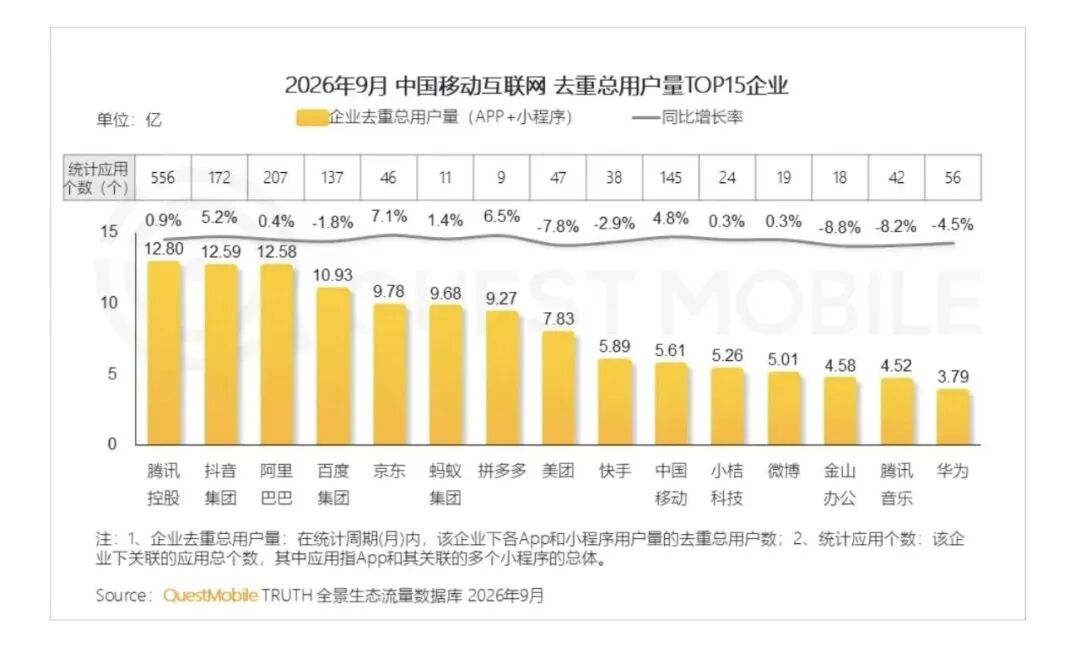
As of September, total monthly active users across the internet stood at 1.281 billion, up only 0.9% year on year, and new users are hard to come by. The cake is only so big — so-called growth is essentially stealing time from others.
The report contains a striking figure: short dramas plus short videos accounted for almost all newly added time, with the two tracks together contributing 111.5% of growth. Put plainly, the extra phone time people accumulate is basically all going into short dramas and short videos, while other tracks are being squeezed.
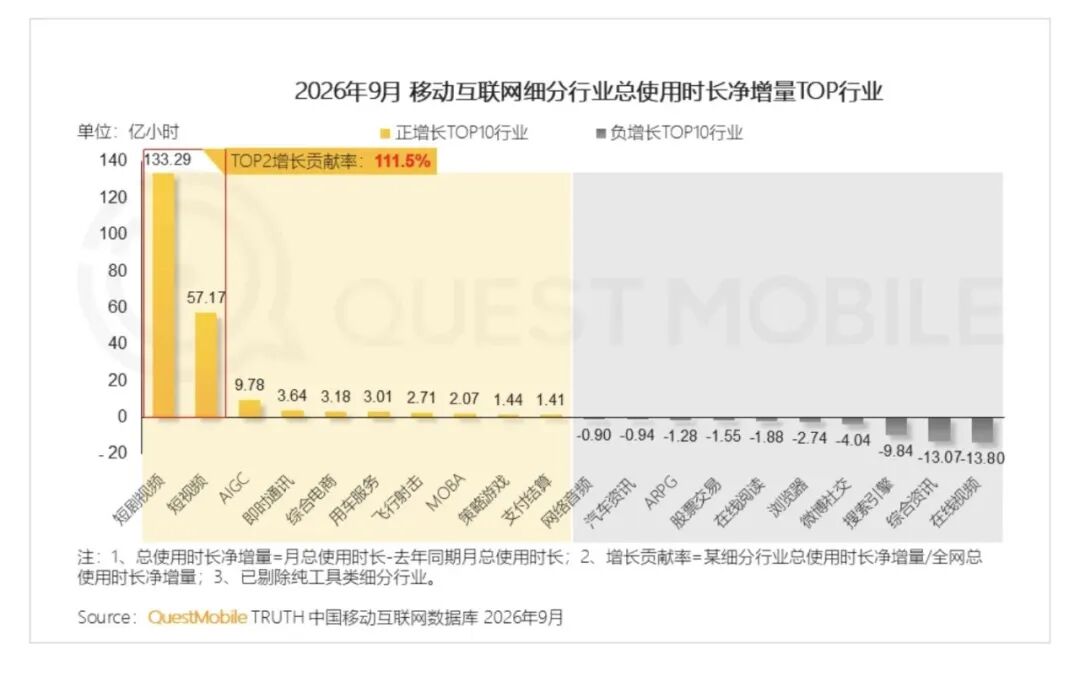
The breakdown is even more striking: short dramas added a net 13.329 billion hours in a single month, while short videos added 5.717 billion hours. AIGC, ranked third, added only 978 million hours — a gap that is absurdly large. On the other side, traditional long video continues to lose volume, down 1.38 billion hours.
Put plainly, long-video traffic is continuously flowing into short dramas. People used to go home after work and open Youku, iQiyi, or Tencent Video; now they casually open short dramas — a few minutes per episode with constant twists — and they get hooked much faster. Short dramas are no longer a niche sideshow; they are the internet's strongest pump right now.
The gap among the big platforms can no longer be widened. Tencent, ByteDance, and Alibaba had 1.280 billion, 1.259 billion, and 1.258 billion deduplicated total users respectively. The first tier is neck and neck, and no one can shake off the competition. The battlefield has already moved inside their own app matrices.
The change first appeared at ByteDance.
At this time last year, Douyin Group's top apps were still Douyin, Toutiao, and Douyin Lite. A year later, the list has completely changed: Douyin at 1.029 billion, Hongguo Free Short Dramas at 430 million, Doubao at 419 million.
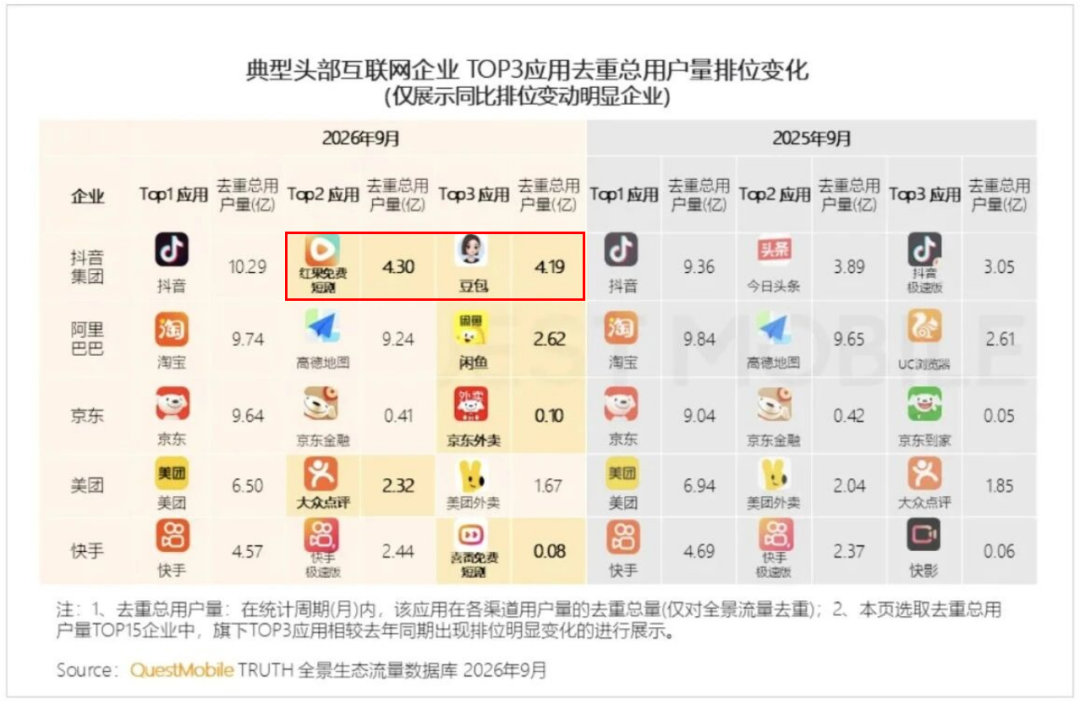
See that? This is the source of the online claim that "Doubao has been overtaken."
But here's the key point: the one that beat Doubao is not Qwen — it's ByteDance's own Hongguo short dramas.
The two differ by only 11 million MAU, a margin as thin as paper. If next month's data shifts, their rankings could swap at any time.
The short drama track is a textbook get-rich-quick track — and a high-risk one. QuestMobile statistics show short drama users surged from 10 million to 400 million in less than three years, a compound annual growth rate of 443.1%. It rises fast and cools fast. Most short drama mini-programs and small apps vanish after a few months of popularity, and the banner on the city wall changes hands constantly.
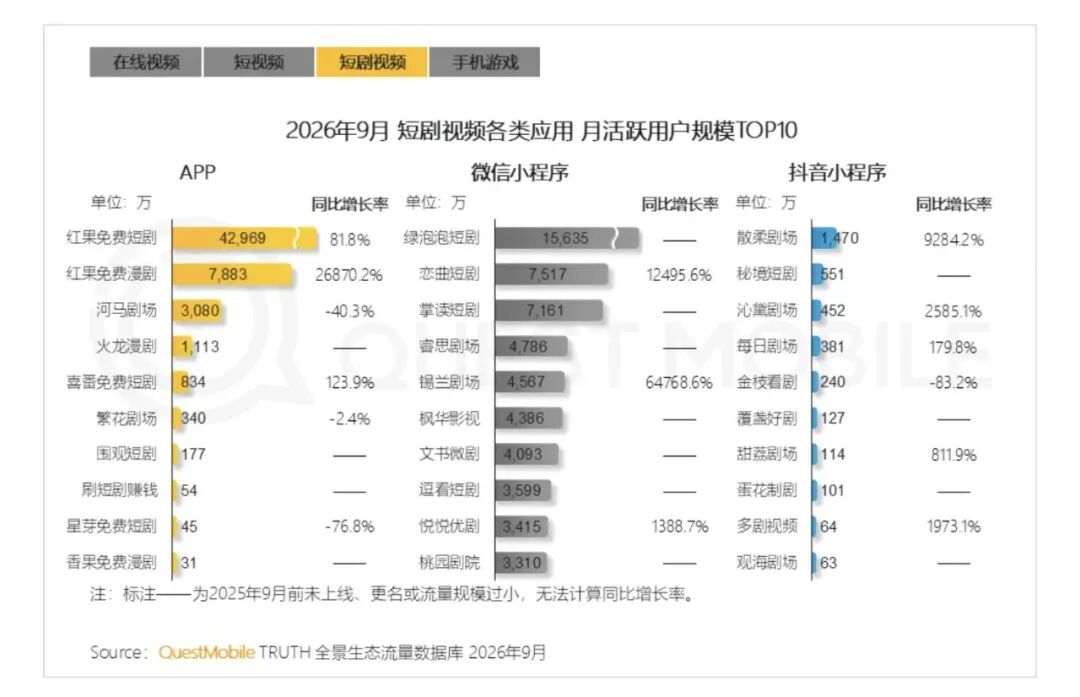
Hema Theater, once as famous as Hongguo, had 30.8 million MAU in September, down 40% year on year.
Meanwhile Hongguo keeps spawning new accounts like crazy: Hongguo Free Comic Dramas launched only at the end of 2025 and now has 78.83 million MAU, up 26,870.2% year on year; Green Bubble Short Dramas, hurriedly launched at the end of September, directly reached 156 million MAU and firmly secured second place in short dramas.
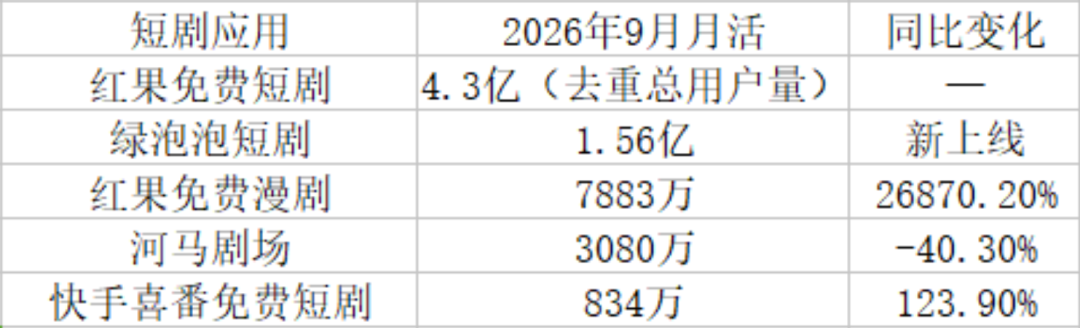

Kuaishou is also quietly making moves: Xifan Free Short Dramas has 8.34 million MAU, up 123.9% year on year. The scale is modest, but the ambition is obvious — it wants to ride the short drama wave for incremental growth.
In one sentence, the current state of the short drama world: the top players eat meat, newcomers break through like crazy, and old players fall behind the moment they slip.
Traffic comes with a bang and leaves quietly. Users who binge short dramas arrive quickly, but most are generic traffic and leave after watching. Whether this group can be retained and turned into stable users willing to reopen the app repeatedly is the next test. Hit dramas alone cannot sustain a long-term business.
Don't get it wrong: in the AI track, Doubao is still the leader
Many netizens directly conflate the growth ranking with the AI ranking — and that is the biggest misunderstanding.
Looking at the AI native app ranking alone, the order is crystal clear:
Doubao ranks first with 419 million MAU
Qwen ranks second with 158 million
DeepSeek ranks third with 123 million
Doubao's scale is roughly 2.6 times Qwen's — the advantage is obvious.
What Qwen ranked first in is the growth rate ranking for apps with 100 million-level users.
A low base, plus multiple boosts including the Apple partnership, livestream commerce, and red packet traffic diversion, pushed its year-on-year growth rate straight to 5,077% — which looks explosive. Doubao already has a large base and still maintained 144% growth. It is steady, but visually it does not have the same impact as Qwen.
When the hype stacks up, it is easy to create the illusion that Qwen has already caught up with Doubao.
Two major events here directly fueled the public discussion.
First, the new Chinese version of Siri is confirmed to integrate Qwen, giving it a system-level ticket into Apple's ecosystem. The value of this entrance is very high, and Doubao does not have it yet;
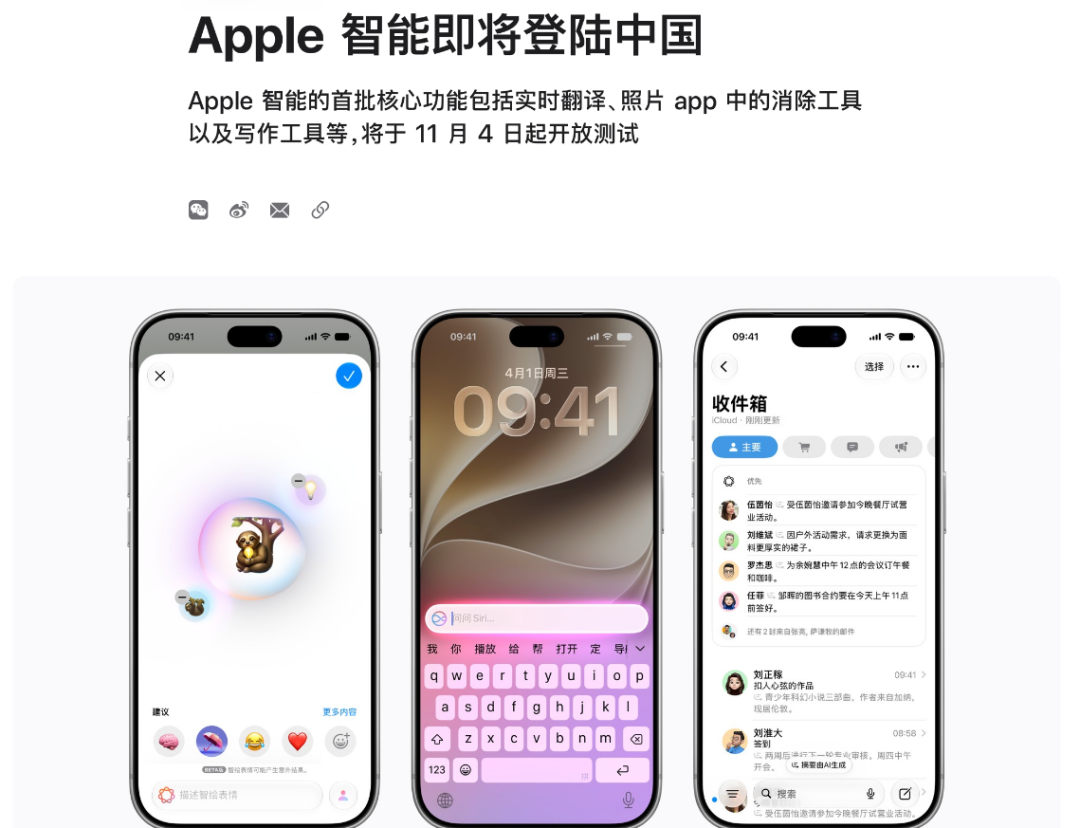 Image source: Apple official website
Second, just one day before the report came out, Qwen Office went straight into Li Jiaqi's livestream room and put Tokens on the shopping cart. In half an hour, 100,000 memberships were sold — equivalent to 2 trillion Tokens.

Computing power — something once discussed only in tech circles — directly became a livestream hit, and online hype went through the roof.
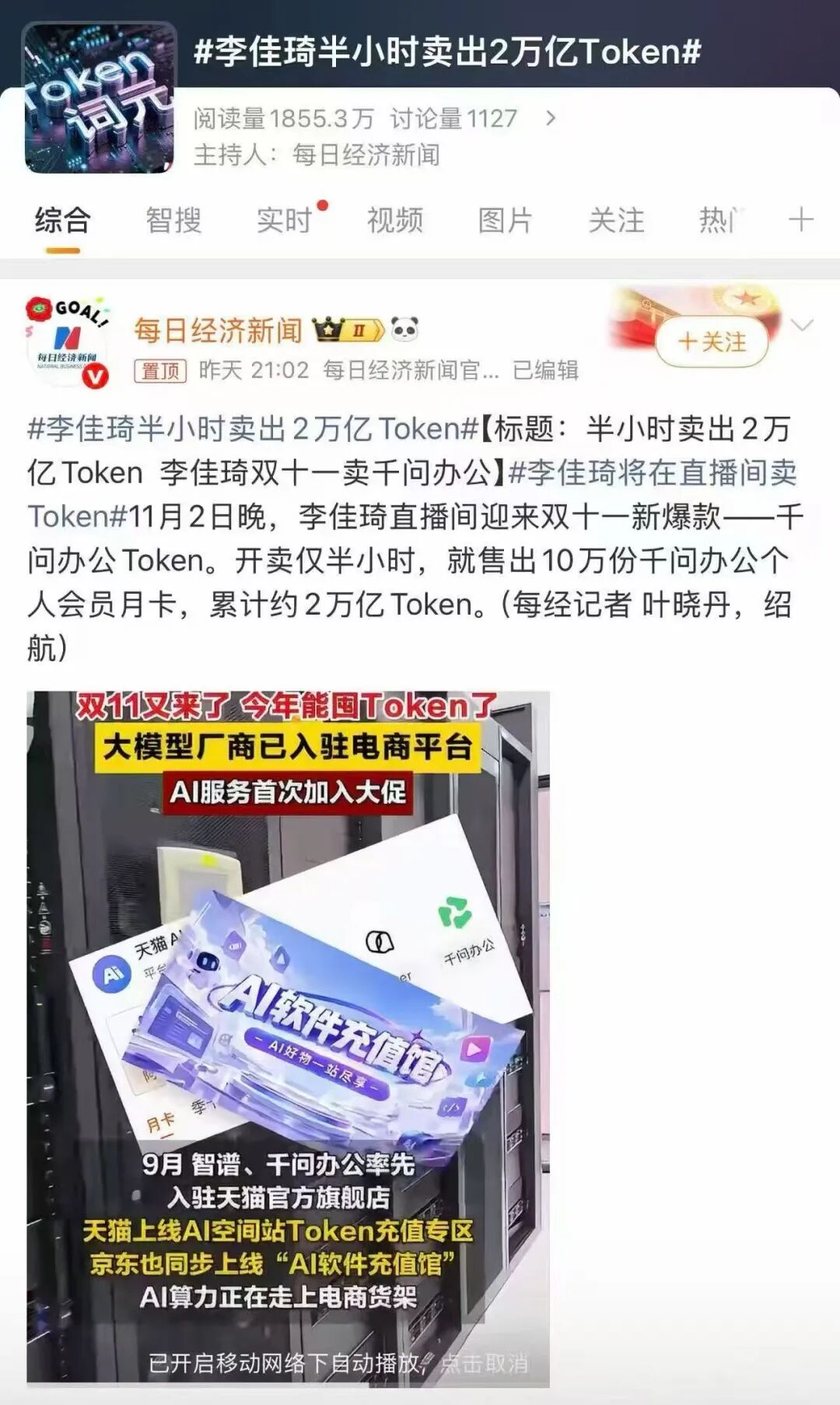
Image source: Weibo
Now let's look at stickiness — not just how many people installed it.
Doubao averages 72 opens per user per month, with cumulative usage of 132.5 minutes; DeepSeek follows closely behind. These two are in the first tier of user stickiness among AI apps, far ahead of other competitors.
Of course, Doubao's shortcomings cannot be hidden.
It is strong on mobile: casual chat, copywriting, and search are all readily available; but office productivity is clearly weak, with only just over 2 million MAU on PC and work Agents, basically failing to open up the market. More than 400 million users looks intimidating, but payment has not yet been figured out. The 68-yuan monthly membership is still being tested, and most people are just playing for free without developing the habit of paying.
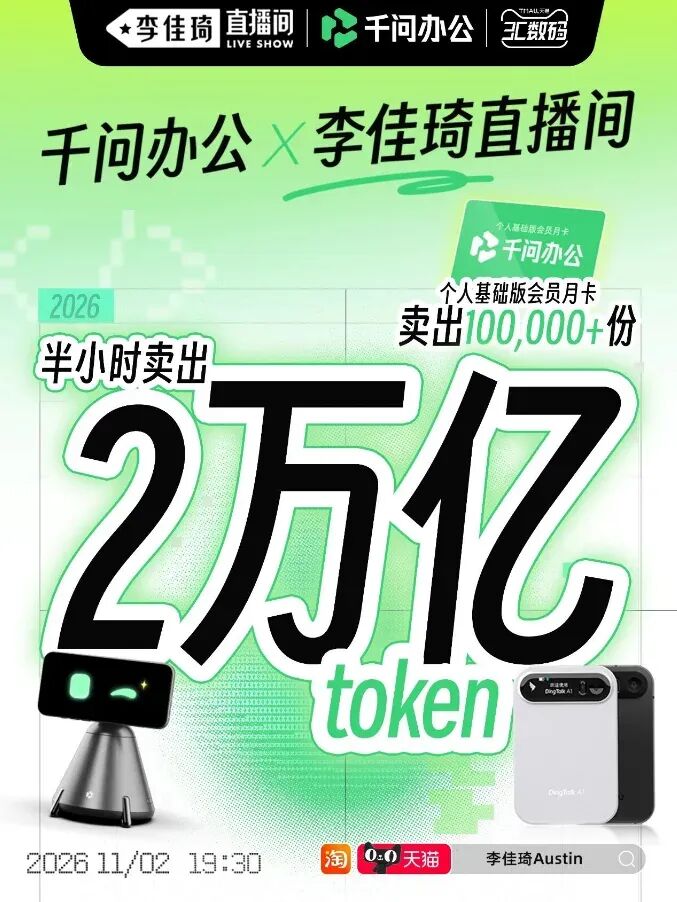
Image source: Qwen Office official account
Qwen's approach is different: it does not chase generic traffic, but focuses hard on productivity
Li Jiaqi's livestream was quite symbolic.
In the past, livestream rooms sold lipstick, skincare products, and home appliances; this time they directly sold AI computing power Tokens. Chen Yusen, head of Qwen Office and Alibaba's youngest vice president, born in 1992, did not pile up incomprehensible jargon for the audience and focused on scenarios ordinary people can use:
Parents take a photo of a test paper and drop it in to organize knowledge points and generate practice questions; livestream operators drop in a replay and automatically get a review report; fishing enthusiasts say a few casual words and can generate a shared fishing map for multiple people.

Image source: Weibo
His answer was very likable: AI will not replace Li Jiaqi; it helps everyone handle trivial matters and save time to live well.
No anxious rhetoric about AI overturning the world — just a down-to-earth approach. On the same day, Tmall released 70 AI computers preinstalled with Qwen Office, bundled with recording cards and desktop robots, selling software and hardware together.
Combined with the Apple partnership and Citi's rating upgrade on Alibaba, multiple positives collided, and Alibaba's stock price rose sharply that day.
You can see Qwen's thinking is very clear: do not compete with Doubao for casual generic users, but prioritize winning system-level entrances and office productivity scenarios. The goal has been payment from the very beginning. It does not matter if user scale temporarily lags behind; first capture high-value groups.
Doubao is no longer ByteDance's only star, and the traffic chessboard has changed
This report actually declares one thing: Doubao is no longer the only star of ByteDance's AI.
In the previous two years, ByteDance went all in on Doubao and, relying on Douyin's continuous traffic funnel, quickly rushed to 400 million MAU, becoming the face of domestic AI. Now ByteDance's traffic approach has changed. Short dramas have grown into a new growth engine, and Douyin, Hongguo short dramas, and Doubao have become three carriages.
The three products have completely different divisions of labor: Douyin is the base, absorbing generic traffic from across the internet; Hongguo short dramas focus on killing time and capturing users' fragmented entertainment time; Doubao handles tools, Q&A, and creation.
Hongguo surpassing Doubao is not a loss in an AI battle — it simply reflects ByteDance shifting internal traffic resources toward the high-time-spent short drama track.
The track attributes are different to begin with. Short dramas focus on emotional gratification, with an extremely low threshold to open, casually browsed during slacking off or before bed; AI assistants are task tools, and users open them because there is something to solve. This also explains why short drama time increments are in the tens of billions of hours, while the entire AIGC track adds up to less than 1 billion hours. A person only has 24 hours a day, and entertainment naturally captures attention more easily.
In the second half of AI, the competition is no longer about who has more users
In the first half of AI, the competition was about downloads, MAU, and who spread wider. Doubao won that round.
But the rules are gradually changing now, and pure user numbers are worth less and less. Whether a product can occupy real scenarios, retain people, and make them willing to pay is the hard currency.
These are the points worth continuing to watch:
Who will reach 500 million MAU first — Hongguo short dramas or Doubao? Short dramas rise fast, but the risk of collapse is also high;
Can Doubao rely on Feishu to fill its PC office shortcomings and make up for the weak productivity segment;
Can Qwen rely on Apple's system entrance to steadily capture a continuous stream of AI search demand;
How many paying users can eventually be generated from the two huge user pools, and whether AI memberships can become as routine a purchase as topping up phone credit.
"Doubao surpassed by Hongguo" is a catchy headline, but it is not the whole truth.
In the AI track, Doubao still holds the user base; in ByteDance's internal app rankings, short dramas have come from behind and taken the traffic center stage.
The industry logic has quietly shifted: it is no longer about who is installed on more people's phones, but who truly penetrates everyone's work and life processes, making people unable to do without them and willing to pay.
Short dramas grab slacking and entertainment time, while AI grabs the productivity entrance. The story of traffic dividends is almost over; the hard battle over scenarios and commercialization has just begun.
Disclaimer: This article is only a financial commentary on big tech companies and does not constitute any investment advice. The company data and regulatory events mentioned are all from public information and are for reference only; the official release shall prevail. Images are from the internet. If there is any copyright issue, please contact us for deletion.
-
![]()
496.22 km/h: BYD Claims the Global Automotive Top-Speed Crown, Xiaomi Executive Shares in Tribute
-
![]()
Doubao Overtaken? Qwen Tops the Growth Chart — But the Full Story Is More Complicated
-
![]()
Two Months, Three Core Executives Depart: Chery Tightens Its Grip on Exeed to Rebuild an "Audi"
-
US Automakers Push Congress to Ban Chinese Cars: Why Isn't China Retaliating in Kind Against American Cars?
-
Can Layoffs Save BMW Brilliance? Only Cars That Make Consumers Open Their Wallets Can
-
![]()
Intel Stock Crashes, AMD Diverges Sharply: AI Servers Are Flying Off the Shelves—Where Do Ordinary PCs Go from Here?
-
![]()
Huawei's Wide-Screen Straight Phone Is Selling Like Hotcakes: 1 Million Units in 50 Days! How Much Longer for the iPhone KUO?
-
![]()
Qualcomm Renews Long-Term Technology Licensing Agreement with Huawei, Reports Earnings as Declining Phone Sales Weigh on Revenue