496.22 km/h: BYD Claims the Global Automotive Top-Speed Crown, Xiaomi Executive Shares in Tribute
 11/05 2026
 515
On November 2, BYD's Yangwang officially announced that it would restart its top-speed challenge, with the U9X heading to Abu Dhabi, UAE, to aim for an even higher speed on open roads.
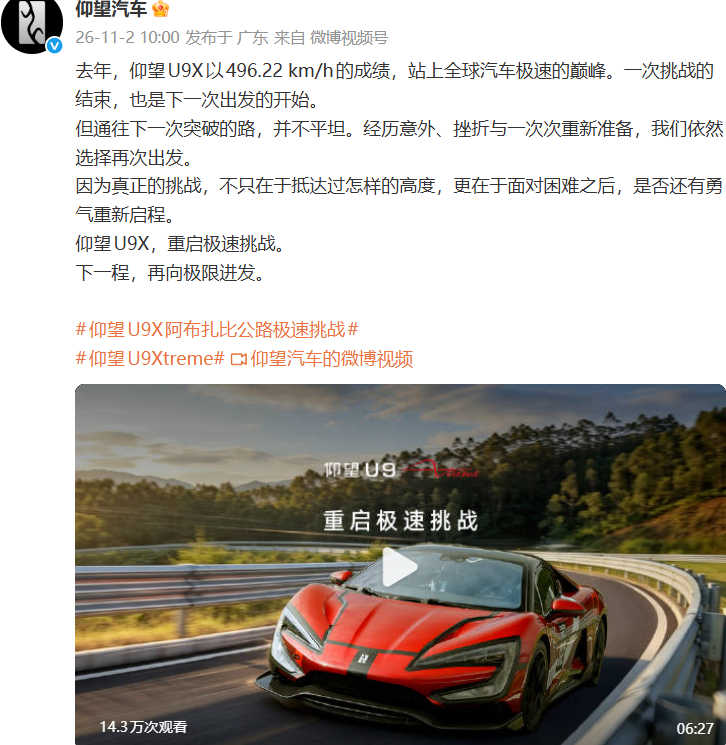
Image source: Weibo
That same day, Hu Zhengnan, vice president of Xiaomi Group and CTO of its automotive division, reposted the Weibo post. He opened with four words—"Deeply moved, I feel it keenly"—and closed with "salute to all the pioneers and fellow travelers who are still committed to doing real work."
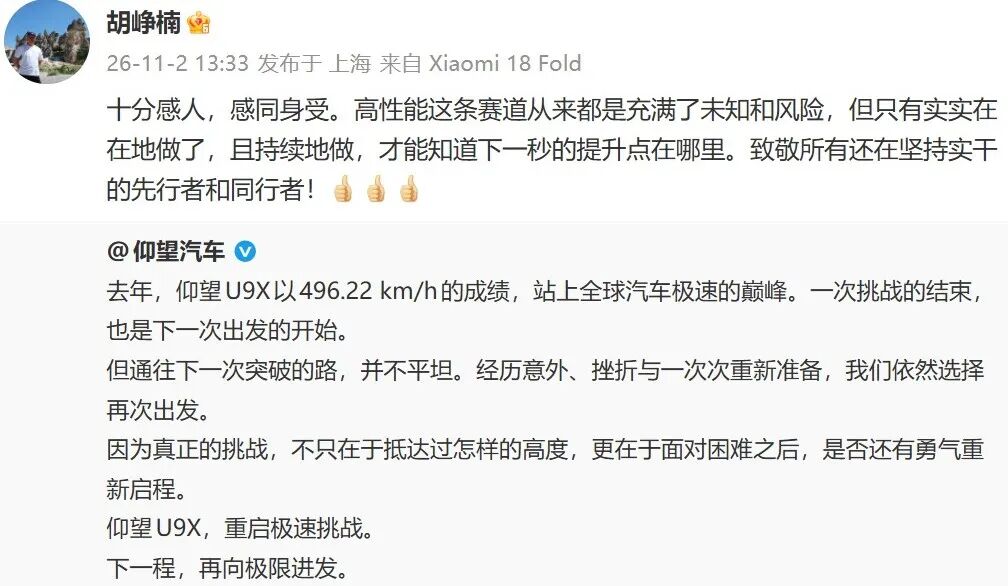
Image source: Weibo
In the 200,000-yuan segment, where the two are direct rivals, it is a rare sight in China's auto circle for one side's technical chief to publicly applaud the other's high-end project.
Yangwang's starting point this time is no low bar. Last September, the U9X hit 496.22 km/h at Germany's ATP test track, topping the world's production-car speed charts and surpassing the Bugatti Chiron Super Sport 300+'s 490.48 km/h. Around the same period, it lapped the Nürburgring Nordschleife in 6:59.157, becoming the first all-electric production car to break the 7-minute mark.
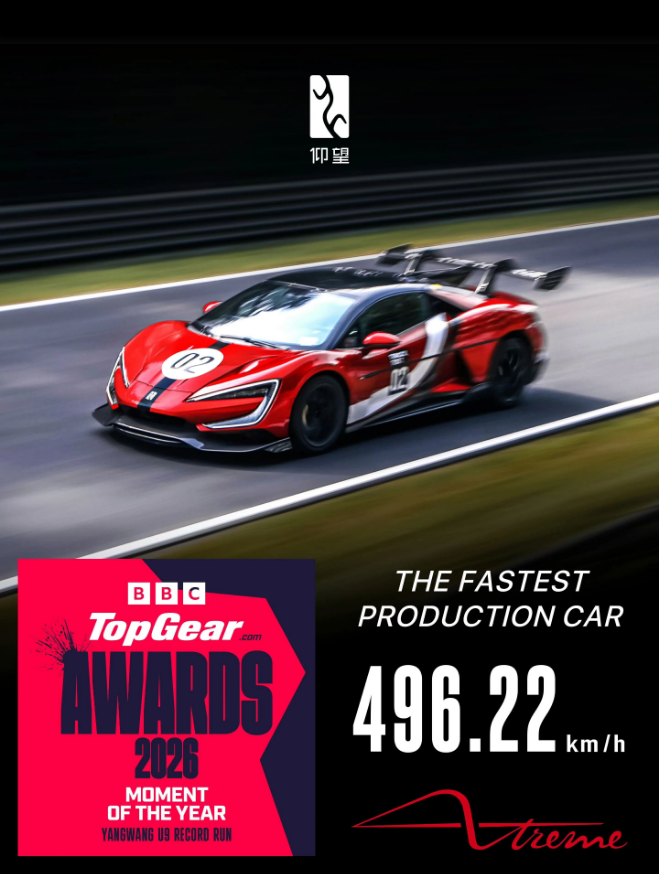
Image source: Weibo
What is even more remarkable is that this is a pure EV—for the first time, the pinnacle of global top speed has been claimed by a Chinese electric car.
The only suspense now is: can it push to 500 km/h?
This is worth discussing, and there are really just two points. First, the record: the top-speed leaderboard has long been dominated by European automakers, and now the No. 1 spot is held by a Chinese car—a from-zero-to-one breakthrough. Second, the attitude: the two companies in direct competition did not shy away from the rival's result, but publicly praised it. Being able to acknowledge each other at this level of competition is truly rare in the industry.
Last time, where exactly was the gap?
The math is easy. From 496.22 to 500, the difference is only 3.78 km/h, which does not look far.
But Yangwang knows clearly: the bottleneck is not the car, but the venue. At the Goodwood Festival of Speed in July this year, BYD executive vice president Li Ke revealed that telemetry showed about 1.5 seconds of full throttle remained unused when it crossed 496.22 km/h—what held it back was not power, but the runway not being long enough. The team was already looking for a straight about 15 kilometers long.
So this time, moving from a closed test track to an open road in Abu Dhabi, the target is aimed directly at 500 km/h.
From 496.22 to 500, those 3.78 km/h are worth a dedicated trip to the Middle East.
It is worth it. At this speed range, every bit higher comes at an exponential cost: aerodynamic drag is proportional to the square of speed, and the power needed to overcome it is roughly proportional to the cube of speed. From 400 to 500, vehicle speed rises only 25%, but the required power in theory nearly doubles.
When these numbers land in engineering, every additional kilometer per hour is a new trade-off.
Put plainly: the faster the car, the more expensive and difficult each additional kilometer per hour becomes.
Take the marathon as an example. Wu Xiangdong ran 2:08:04 in Osaka in 2024 and 2:07:55 in Berlin in 2026—after two years of training, his best result improved by only 8 to 9 seconds. The same principle applies to cars chasing top speed: the closer to the limit, the harder it is to gain even a tiny bit more.
By commercial logic, 496.22 is already a result Yangwang could talk about for years. But it did not stop there; instead, it announced restarting the challenge and heading to Abu Dhabi to push for 500.
There is another variable to add: an open road is not a test track. Abu Dhabi's high temperatures, crosswinds, and sand/dust will all test the vehicle's stability, tire durability, and battery thermal management. If any link falters, all the prior work could be wasted—and that is exactly the hard bone the engineers must chew on next.
By the way, why Yangwang can reach this speed is rooted in its pure-electric architecture: the world's first mass-produced 1200V ultra-high-voltage platform, four independently driven motors, each with peak power exceeding 500 kW, no gearshift delay, and power delivered directly to the tires. This is also why what stepped up this time is a pure EV rather than a large-displacement fuel supercar—records used to rely on stacking cylinders and turbos, but now they rely on the physical characteristics of electric drive to push the limit.
How did a crash also reveal value?
Before the restart, a crash video circulated online: the U9X was doing a baseline test at a closed venue in China, and when it reached the 420–450 km/h range, it first hit the left guardrail, then lost control and slammed hard into the right guardrail. The front and rear were destroyed, parts were scattered everywhere, and the rear axle was even torn off. Looking only at that clip, many would frown: after crashing like this, can it still count as technological progress?
But the details are more worth examining. Yangwang general manager Hu Xiaoqing revealed in the video that the driver, Jiang Wen, said the speed at the moment of impact was 360 km/h. The result? The carbon-fiber cockpit remained basically intact, the A-pillar did not break, the windshield did not shatter, the battery did not catch fire or smoke, and the driver was checked and found to be largely unharmed, walking out of the cockpit himself.
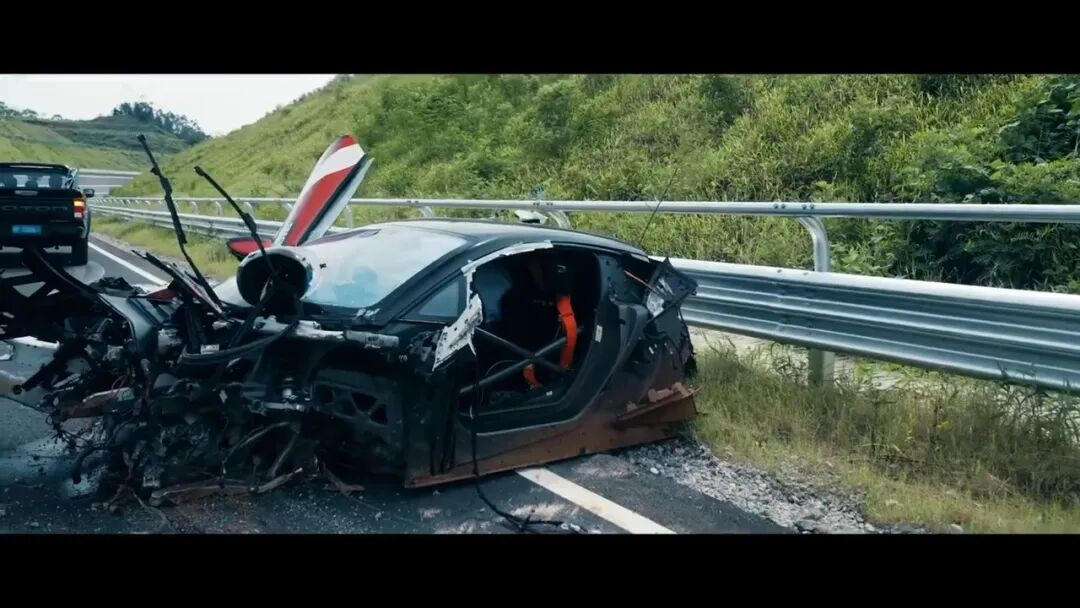
Image source: Weibo
For an EV on a 1200V platform, no battery thermal runaway after a crash is itself the toughest safety card.
There is another detail that hits hard: after getting out of the car, Jiang Wen did not go to the hospital first, but stayed at the scene to review the crash trajectory.
Crash tests for passenger cars follow speeds and conditions stipulated by regulations. A supercar losing control and hitting the barrier at over 360 km/h is a question of another magnitude—one that family cars will never encounter.
The front and rear were wrecked, yet the occupant compartment still retained survival space—behind this is a whole passive safety engineering system: crash energy absorption, occupant compartment strength, battery pack protection, and carbon-fiber materials.

Image source: Weibo
Losing control for real once at extreme speed validated the protection mechanisms to a degree family cars cannot be tested for—such real-world data cannot be bought with money. More critical is what happened afterward: after reviewing the accident, the team switched to another car and continued testing, eventually running 457.89 km/h at a domestic venue and setting a new domestic top-speed record.
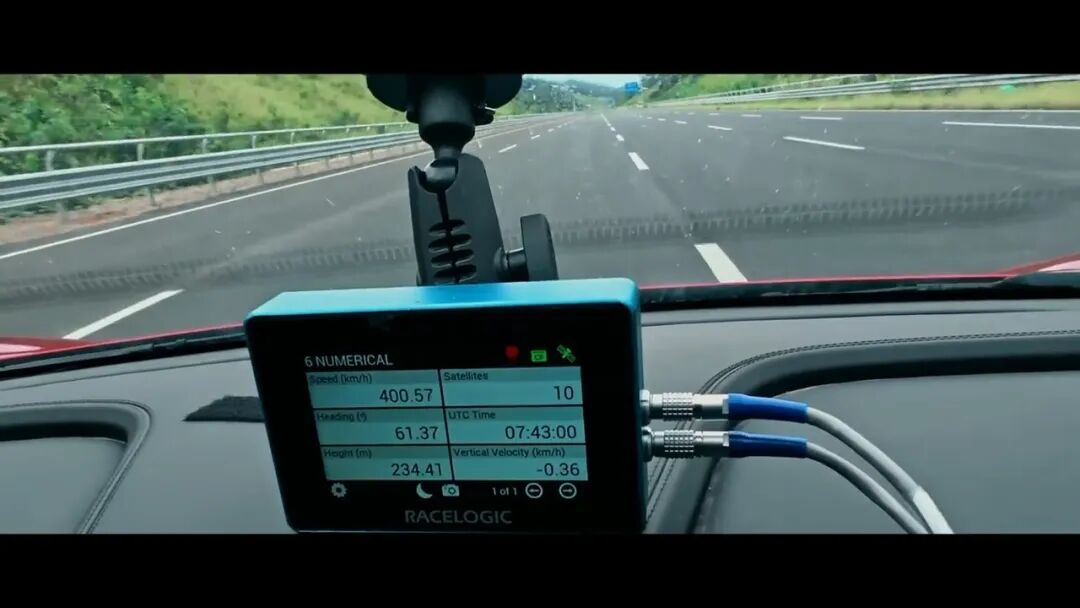
Image source: Weibo
For an automaker aiming for 500, this kind of "lesson" is precisely the confidence to move forward: in extreme scenarios like loss of control, the protection system can hold the bottom line; and after a crash, the goal can still be completed. Yangwang's official announcement also said—"After accidents, setbacks, and repeated preparations, we still choose to set off again."
Why the Xiaomi executive reposted
Back to that interaction that flooded the screen. When reposting, Hu Zhengnan wrote: "Very moving, I feel it deeply. The high-performance track has always been full of unknowns and risks, but only by truly doing it, and continuing to do it, can you know where the next improvement point lies. Salute to all the pioneers and fellow travelers who are still persisting in doing real work!"
This passage did not mention any brand, and its focus was not on a particular result, but on the four words "continuing to do it." Hu Zhengnan became vice president of Xiaomi Group and the first CTO of its automotive division in April 2026, overseeing automotive technology planning and R&D and reporting directly to Lei Jun; before joining Xiaomi, he worked in technology at Geely for nearly a decade. Xiaomi itself has the SU7 Ultra and has repeatedly set times at the Nürburgring. The four words "feel it deeply" are read in the industry as genuine resonance from engineers about the cost and risk of extreme testing, not courtesy.
In recent years, Chinese automakers have competed over sales, prices, and technological discourse, while public expressions of respect between peers have been rare. Some netizens commented on this repost: it broke the stereotype that "automakers only tear each other down."
Top-speed records used to be the domain of European automakers, and now a Chinese car appears in that position for the first time. Whoever pushes the engineering boundary forward one step raises the ceiling of China's entire auto industry.
More broadly, this is also a microcosm of Chinese automakers going global: they used to go out relying on cost-effectiveness and supply chains, and now more and more brands are competing for position in high-end markets with hardcore technical metrics. Top speed, lap times, and electric drive systems—narratives that once belonged to established European automakers—are being rewritten one by one by Chinese engineering teams. This challenge in Abu Dhabi is, to some extent, also an external display of Chinese automakers' technological confidence.
In closing
Will the Yangwang U9X still push for 500 km/h? Of course it will.
From 496.22 to 500, what is missing has never been just those 3.78 km/h. Behind it is the re-validation of an entire engineering chain—power, tires, chassis, and aerodynamics—and a leap for Chinese supercars from "running fast" to "staying stable."
Some people keep pushing the performance boundary of vehicles, and some, as peers, recognize that investment. Putting these two things together itself shows that the industry is moving toward healthier competition.
When people used to talk about the world's top supercars, they thought of Bugatti and Koenigsegg; now Yangwang has already driven a production car to 496.22 km/h, and every next step can stand on this result and reach further.
Wu Xiangdong improved by only 8 seconds in two years and still keeps training; Yangwang is the same this time—even if it is only 3.78 km/h away, it still wants to run this stretch again.
Of course, no one can say for sure now what final result this challenge will achieve. Open roads have far more variables than closed test tracks—crosswinds, high temperatures, and sand/dust could each affect the result, and how far it can push will depend on the actual conditions in Abu Dhabi that day.
But one thing is certain: whether or not it reaches 500 km/h, Chinese brands are no longer spectators on the top-speed track.
Disclaimer: This article is solely a financial commentary from a big-company perspective and does not constitute any investment advice. The corporate data and regulatory events mentioned in the article are all from public information and are for reference only; specifics should be subject to official releases. Image sources are from the internet; if there is any copyright issue, please contact us for deletion.
-
![]()
496.22 km/h: BYD Claims the Global Automotive Top-Speed Crown, Xiaomi Executive Shares in Tribute
-
![]()
Doubao Overtaken? Qwen Tops the Growth Chart — But the Full Story Is More Complicated
-
![]()
Two Months, Three Core Executives Depart: Chery Tightens Its Grip on Exeed to Rebuild an "Audi"
-
US Automakers Push Congress to Ban Chinese Cars: Why Isn't China Retaliating in Kind Against American Cars?
-
Can Layoffs Save BMW Brilliance? Only Cars That Make Consumers Open Their Wallets Can
-
![]()
Intel Stock Crashes, AMD Diverges Sharply: AI Servers Are Flying Off the Shelves—Where Do Ordinary PCs Go from Here?
-
![]()
Huawei's Wide-Screen Straight Phone Is Selling Like Hotcakes: 1 Million Units in 50 Days! How Much Longer for the iPhone KUO?
-
![]()
Qualcomm Renews Long-Term Technology Licensing Agreement with Huawei, Reports Earnings as Declining Phone Sales Weigh on Revenue