Hong Kong Stocks Bull Run: Hang Seng Tech Soars 5.55%
 11/06 2026
 405
LAIKA
2026/11/05
A Valuation Recovery Triggered by Washington
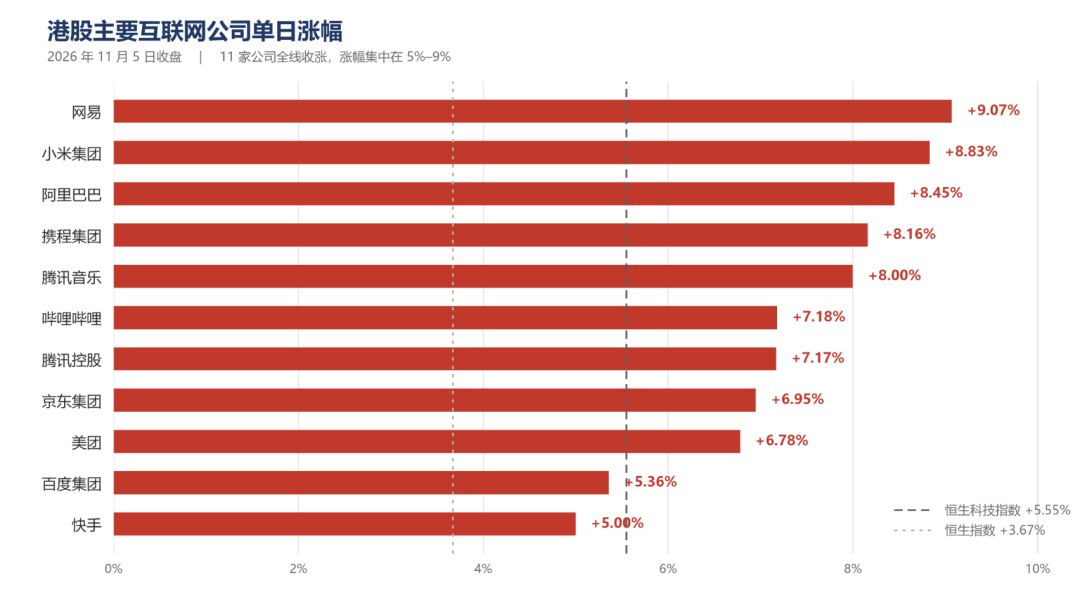
On November 5, the Hang Seng Tech Index closed up 5.55% at 4,154.29 points, marking the largest single-day gain of the year and the biggest since late February 2025. The Hang Seng Index rose 3.67%, or 877.48 points, to 24,796.98 points, reclaiming the 24,000 level. Hong Kong stock turnover for the day reached HK$356.667 billion, markedly higher than the previous trading day's HK$236.896 billion.
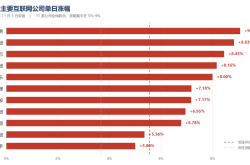
Yet a glance at the gainers list reveals that none of the biggest movers had released earnings that day. NetEase rose 9.07%, Xiaomi rose 8.83%, Alibaba rose 8.45%, Tencent rose 7.17%, and Meituan rose 6.78%.
The real protagonist is in Washington. U.S. midterm elections were held on November 3 local time, and the vote count showed the Democratic Party winning a majority in both the Senate and the House—at least 54 seats to 44 in the Senate and more than 245 seats in the House. From Texas to Kansas to South Carolina, multiple deep-red states that had not turned blue in decades were breached, and Texas even elected a Democratic senator for the first time since 1988.
Once the results landed, three lines loosened simultaneously. The dollar index fell as much as 0.6% intraday to 101.25, the lowest since September 30; it closed down 0.33% at 101.53, the largest single-day drop in three weeks. The 10-year U.S. Treasury yield fell from around 4.95% to 4.88%. Brent crude closed down 9.43% at $94.01, and WTI fell 8.66% to $87.49, both marking the lowest closes since August 31.
For Hong Kong stocks, an offshore market, this is the most direct form of easing. Overnight, the Nasdaq Golden Dragon China Index had already risen 3.48%, and the VIX panic index plunged 20% to 16.61; Hong Kong stocks merely amplified that sentiment.
01
How Cheap Is It?
Percentiles Under Three Different Measures All at the Bottom
After the 5.55% gain, many people's first reaction is "should I chase it?" Before answering, look clearly at the starting point.
From October 30 to November 2, the Hang Seng Tech Index's trailing price-to-earnings ratio stood at 20.01 times, in the 8.85th percentile of the past five years. According to Guoyuan International, as of October 30, the Hong Kong software and services sector had a price-to-earnings ratio of 19.18 times and a price-to-sales ratio of 2.69 times, both in the 0.81st percentile of the past year; under the same measure, the Hang Seng Tech Index itself had an even lower one-year percentile, at only 0.41%. The Hong Kong Stock Connect Internet Index was around the 6.7th percentile of the past decade.
It should be noted that the 20 times here is the trailing price-to-earnings ratio (PE-TTM). CITIC Securities' 2027 Hong Kong stock strategy, released on November 4, uses the forward price-to-earnings measure, with Hang Seng Tech at 13.1 times, in the 2.4th historical percentile since listing; the Hang Seng Index stood at 9.7 times. The two measures produce different numbers but point to the same conclusion—valuations are in the historical bottom range.
More important is how low the starting point was. From the beginning of 2026 to November 5, the Hang Seng Tech Index fell from 5,515.98 points to 4,154.29 points, a cumulative decline of 24.69% during the year, with a maximum range amplitude of 41.6%, and the lowest point at 3,706.30 on October 30. Today's bullish candle is the third day of the rebound from that October 30 low.
So its nature is a valuation recovery after an oversold decline, not a confirmation of a trend.
02
The Real Dividing Line:
AI Hardware Is Falling, AI Applications Are Rising
There is a detail in today's market that is more informative than percentiles.
AI hardware concepts such as storage, optical communications, and PCBs sold off collectively: Yangtze Optical Fibre and Cable fell 12.48%, Kingboard Laminates fell 12.43%, Zhongji Innolight fell 6.45%, Montage Technology fell 6.63%, GigaDevice fell 5.06%, and ASMPT fell 10.30%. Overnight, the Philadelphia Semiconductor Index fell 3.13%, hitting a six-month low.
At the same time, Microsoft rose 6.6%, Amazon rose 6%, and Apple rose more than 5%, while Hong Kong's software and platform stocks surged across the board: Mobvista rose 12.18%, Kingdee International rose 15.38%, and Kingsoft Cloud rose 8.81%.
Capital is doing one thing: switching from "who is building computing power" to "who can turn computing power into revenue." Huatai Securities' explanation is straightforward—after the Democratic landslide, the market began to worry that AI data center construction will face tighter regulation, a variable not priced into the pre-election consensus, and in the short term it must trade the risk of downward revisions to capital expenditure in 2027–2028.
This shift has real earnings samples in Hong Kong stocks. Kingdee International's third-quarter report showed that in the first three quarters, the contracted amount for AI-native products was RMB 1.002 billion, subscription ARR at the end of September was about RMB 4.604 billion, up 19.3% year-on-year, and net new ARR in the third quarter grew 46.9% year-on-year. Mobvista's catalyst is its overseas comparable: AppLovin's third-quarter revenue was $2.185 billion, up 55% year-on-year, and net profit was $1.439 billion, up 72%.
The large-model side is also active. On November 4, Tencent Hunyuan released the official version of Hy4, with total parameters of 770B (MoE architecture, 49B activated), context exceeding 1 million tokens, and the first introduction of visual understanding and computer operation capabilities. The official positioning was "entering the ranks of the strongest open-source models for the first time," with weights to be open-sourced soon; the previous generation Hy3 had fewer than 300B parameters. On the same day, Apple Intelligence in China opened with the iOS 27.3 developer beta, with Siri, writing tools, and visual intelligence deeply integrated with Alibaba's Qwen, and the official version is planned for release in December.
03
The Overlooked Number:
Southbound Net Sold HK$21.3 Billion Amid the Rally
If you look only at the index, today was jubilant. But at the same time, southbound capital saw a full-day net sell of HK$21.326 billion, the largest single-day net sell since April 9 and the largest single-day sell in nearly seven months.
The structure is even more interesting on closer inspection. The three ETFs Tracker Fund, CSOP Hang Seng Tech, and Hang Seng China Enterprises were net sold HK$7.664 billion, HK$4.391 billion, and HK$1.672 billion, respectively; on individual stocks, Xiaomi saw a net outflow of HK$3.169 billion, Tencent HK$2.549 billion, Alibaba HK$837 million, and Meituan HK$804 million—the biggest gainers were exactly the ones southbound sold the most.
On the same day, southbound turnover was HK$141.192 billion, about HK$43.661 billion higher than the previous day, accounting for 39.59% of Hang Seng Index turnover. So today's buyers were mainly not mainland capital, but more likely foreign capital and short covering. This is exactly the opposite of October: in October, southbound cumulative net selling was about HK$27.951 billion, the largest monthly net outflow since August 2021.
In other words, today was foreign capital buying and southbound selling. How far this structurally driven rebound can go depends on whether foreign allocation willingness can persist, not on mainland capital enthusiasm.
04
Mid-to-Late November Is the Real Test
What rose today is valuation, not earnings.
Internet leaders will densely disclose third-quarter results starting in mid-to-late November. Whether AI investment can translate into actual improvement in revenue, gross profit, and cash flow is the key to whether this recovery can hold.
CITIC's judgment for 2027 is also layered: Hong Kong stock earnings will grow moderately, with the Hang Seng Index and Hang Seng Composite Index expected to grow 7.4% and 9.9%, respectively, and Hang Seng Tech accelerating to 24.8% on a low base; only if the United States pursues fiscal consolidation and the Federal Reserve begins cutting rates in the second half of 2027 can Hong Kong stocks' composite discount rate be expected to decline systematically.
CICC's reminder is that Hang Seng Tech sentiment indicators have fallen below the dynamic panic line, the price-to-earnings ratio is at an extremely low historical percentile, and a technical rebound after overshooting is not surprising, but low valuations cannot guarantee the sustainability of a medium-term rebound. A medium-term reversal depends on whether fiscal policy directs more support toward households.
- END -
-
![]()
Hong Kong Stocks Bull Run: Hang Seng Tech Soars 5.55%
-
![]()
Xiao Zhan and Sun Yingsha's "First Stock of Massage Devices" Under Scrutiny: Actual Controller Ousted
-
![]()
Why Can Longgang's Cross-Border E-Commerce Keep Its Lead Steady Despite Industry-Wide Headwinds?
-
10 Years On: Chip Performance Has Grown 40-Fold and Memory 8-Fold—So Why Do Phones Still Lag?
-
![]()
B2B Buyer's Guide: Waveguide Supplier Directory and Technology Roadmap Comparison
-
![]()
Will Automotive Chips Keep Getting More Expensive in 2027? How Much Will Cars Cost Across Four Price Tiers?
-
![]()
Gree Electric: Draining the Reservoir
-
Volkswagen Is Feeling the Pain—Badly