Will Automotive Chips Keep Getting More Expensive in 2027? How Much Will Cars Cost Across Four Price Tiers?
 11/06 2026
 533
Produced by Zhineng Zhixin
Starting in 2026, automotive chips will enter a new cycle of rising costs, and the most clear-cut impact will come from automotive-grade DRAM.
Wu Yongqiao, President of Bosch Intelligent Driving Control Division (XC) China, made this prediction at the 2026 World Intelligent Connected Vehicles Conference, noting that rising semiconductor prices are putting enormous pressure on the automotive industry.
The rapid growth of the AI industry is crowding out chip demand from the automotive sector. Next year, the average price of DDR (the technical specification for automotive-grade memory chips) may more than double compared with this year.
Both PCBs (printed circuit boards) and MLCCs (multilayer ceramic capacitors) face supply shortfalls—exceeding 20% and 30% respectively—and will also see relatively large price increases.
Take a pure fuel vehicle equipped with only basic ADAS lane-keeping assist and the most basic cockpit functions: next year, DDR memory chips plus PCB price increases together will raise costs by at least 2,000 yuan or more per vehicle.
For models priced above 150,000 yuan and in the 200,000-yuan range that come standard with advanced combined assisted driving functions, plus intelligent cockpits and AI cockpits, prices may rise by more than 10,000 yuan per vehicle.
For many models, the computing power of combined assisted driving may exceed 500 TOPS, 1,000 TOPS, or even 2,000 TOPS, while intelligent cockpits may exceed 300 TOPS. For such models, DDR price increases alone will push prices up by at least 12,000 yuan per vehicle next year.
Next year, the average price increase per vehicle will be 4,000–6,000 yuan.
Part 1 Where the Increases Are Coming From: From Memory to the Entire Automotive Electronics Supply Chain
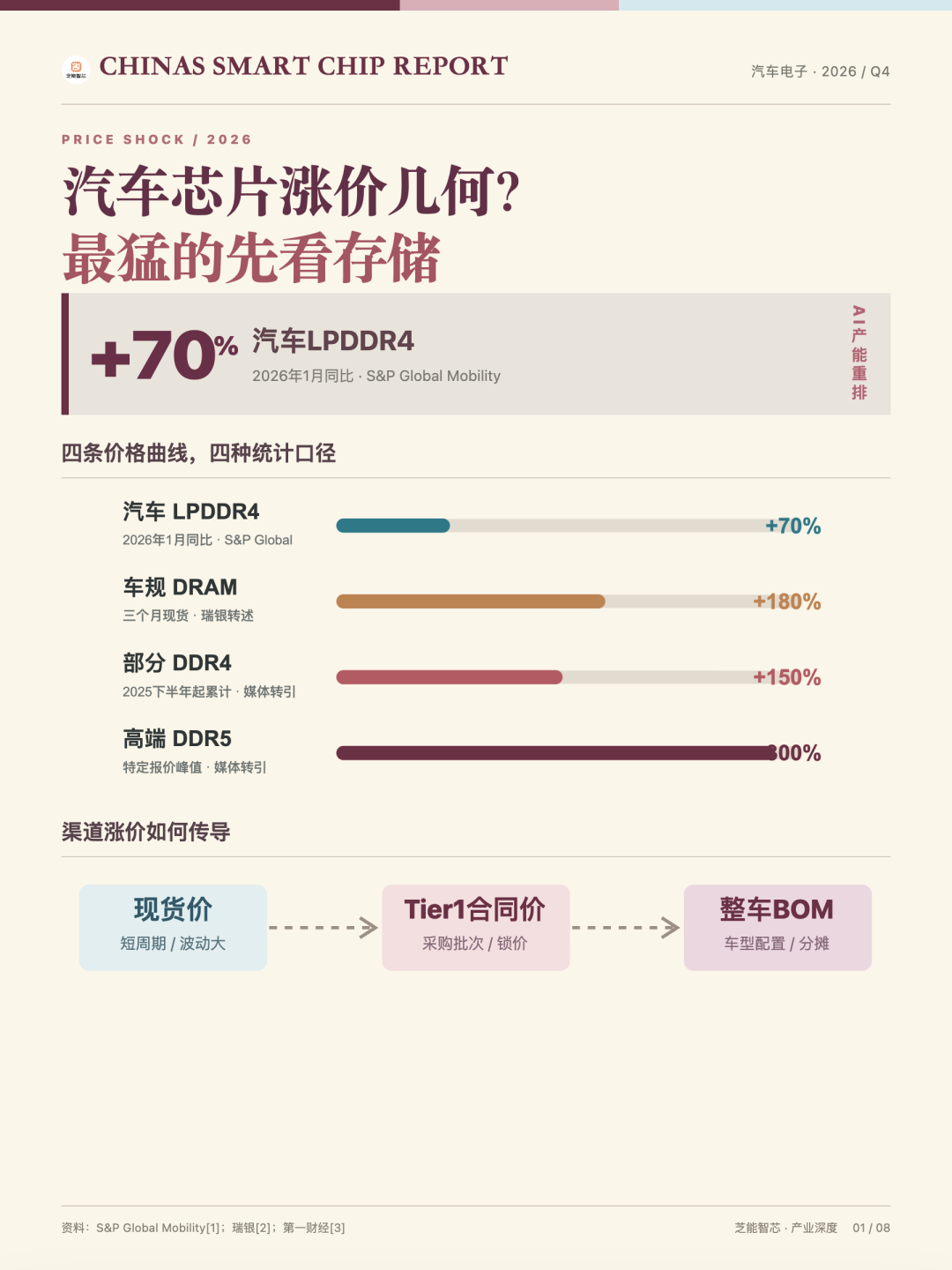
As Mr. Wu said, S&P Global Mobility disclosed that the price of automotive LPDDR4 in January 2026 rose by about 70% year on year, and UBS observed that automotive-grade DRAM rose by about 180% within three months. The question is whether it will rise further in 2027.
Automotive chip price increases include long-term procurement prices agreed between original manufacturers and automakers or Tier 1 suppliers, immediate transaction prices in distribution channels, and price indices compiled by research institutions for specified part numbers and time windows.
If a DDR4 chip rises 150% in the channels, the vehicle's memory bill will not rise by the same proportion; 70%, 180%, and 300% are statistics from different institutions on different part numbers and different time windows.
A May 2026 report by S&P Global Mobility pointed out that automotive LPDDR4 rose by about 70% year on year in January 2026. This mature generation is still widely used in existing intelligent cockpit and assisted driving platforms, and models usually remain in production for many years, so the memory model cannot be changed at will.
UBS, based on industry interviews at the beginning of the year, said that automotive-grade DRAM spot prices rose by about 180% within three months.
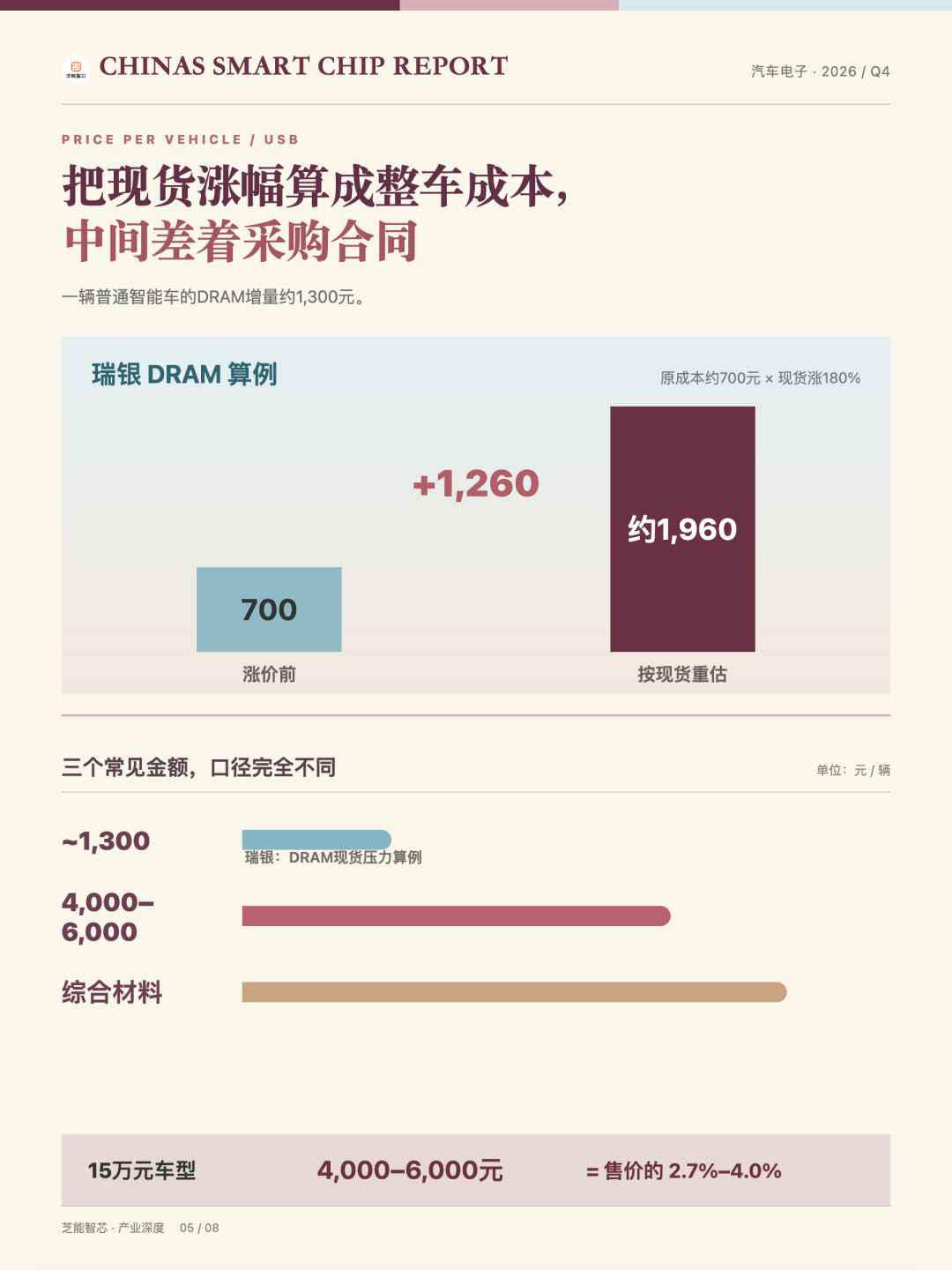
In its example, the original procurement cost of DRAM for an ordinary smart car was about 700 yuan, and after the increase it was about 2,000 yuan—an increase of about 1,300 yuan (covering only memory spot prices)—while whole-vehicle chip procurement mostly goes through long-term agreements, with different implementation timing.
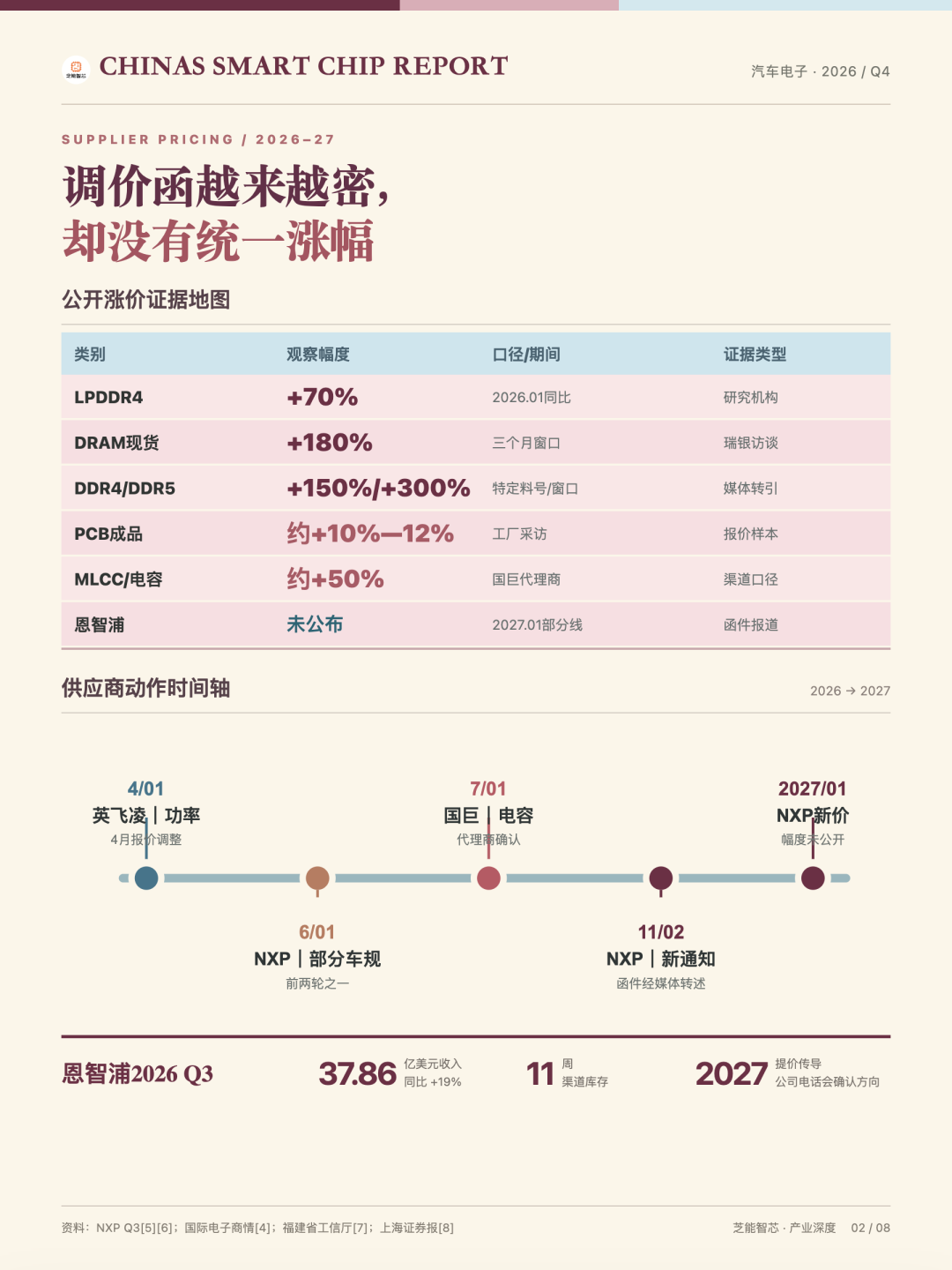
Since the second half of 2025, some automotive-grade DDR4 products have accumulated increases of more than 150%, and high-end DDR5 quotes may rise by up to 300%. High-growth automotive AI functions are indeed driving up memory capacity.
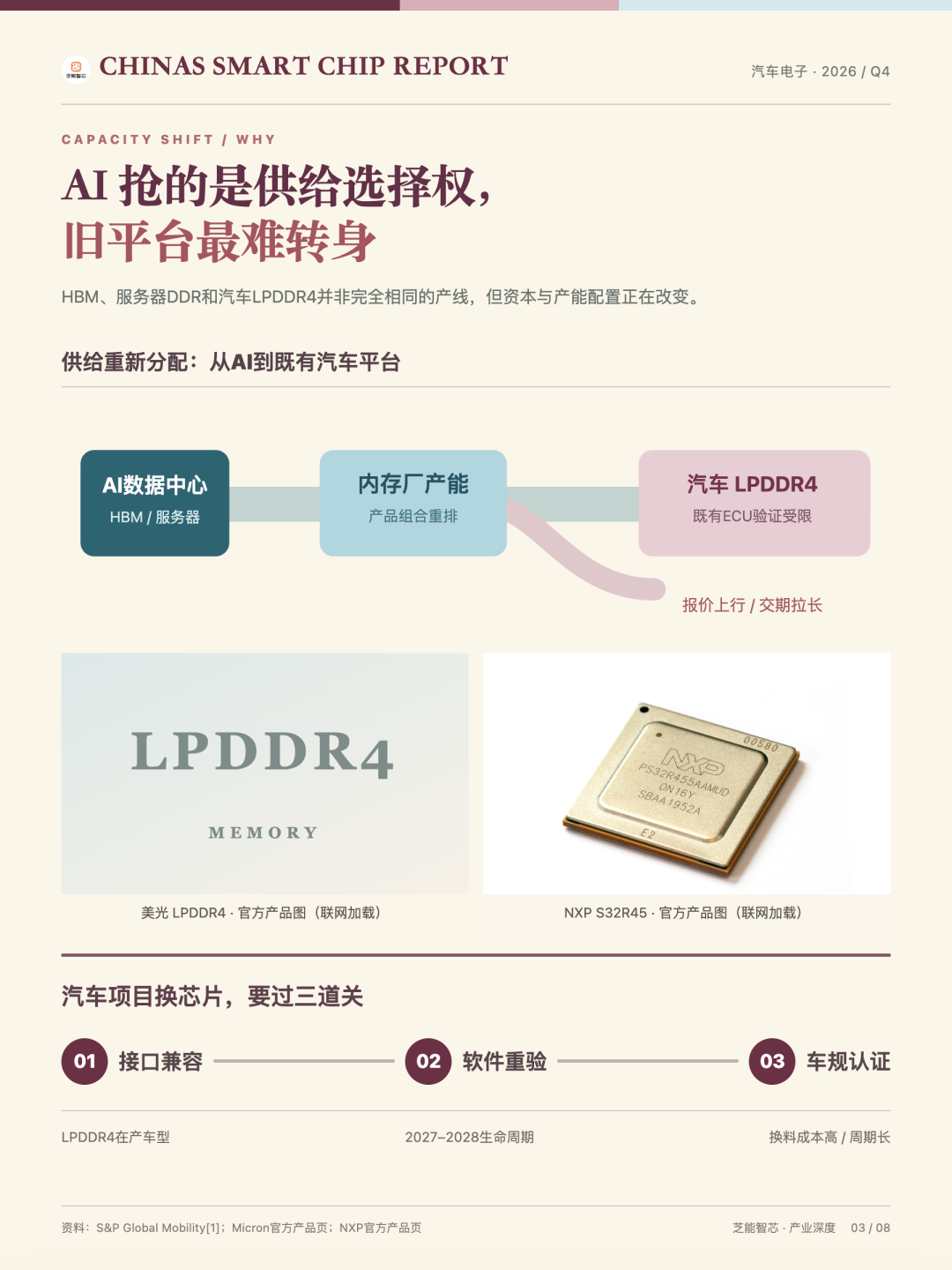
The more realistic constraint is that old platforms still rely on LPDDR4/DDR4, while memory manufacturers prioritize investment in HBM and high-value-added server products.
Increasing computing power will not automatically make already mass-produced ECUs compatible with new memory chips.
PCB is being squeezed not only in high-end board capacity by AI server demand, but also by the costs of electronic cloth, copper-clad laminates, copper foil, and resin.
Board manufacturers say the comprehensive price adjustment for finished PCB products is about 10% to 12%, while some upstream PP and copper-clad laminates have separate round changes of about 15%, so the increase for finished boards is lower than that for materials.
Regarding MLCCs and capacitors, in July Yageo adjusted prices for its capacitor product line, and some distributors said original manufacturer price adjustments were about 50%; automotive-grade high-temperature and high-reliability specifications are harder to replace temporarily.
Regarding MCUs and power devices, Infineon, STMicroelectronics, and others have adjusted prices multiple times, and industry disclosures point to about 15% to 20% for domestic MCU products, reflecting simultaneous upward movement in mature process, packaging and testing, and metal costs.
The prices of SiC power modules are more determined by vehicle model demand, domestic capacity expansion, and contract pricing, and are two separate forces from AI crowding out capacity.
This round is different from the scenario in 2021 when the automotive industry suddenly lacked MCUs and factories were forced to stop production lines: supply has not completely broken down, but the configuration capability of older-generation DRAM and the quote elasticity of key materials are declining.
Price increases first appear in the secondary market, and then are reflected in whole-vehicle procurement costs during long-term agreement renewals, component sourcing decisions, and model facelifts.
Part 2 How Much More Does a Car Cost: Electronic Material Estimates for Four Vehicle Tiers
Intelligent driving domain controllers often simultaneously procure SoCs, DRAM, Flash, PCBs, MLCCs, and power management devices; intelligent cockpits also have memory and storage requirements for displays, multiple screens, voice, and on-device AI inference.
High-end vehicles may be equipped with two high-computing-power controllers and add board-level power requirements for cameras, radars, gateways, and zone controllers.
The impact of automotive memory price increases on intelligent driving domain controllers and cockpits is usually higher than on models equipped only with basic head units.
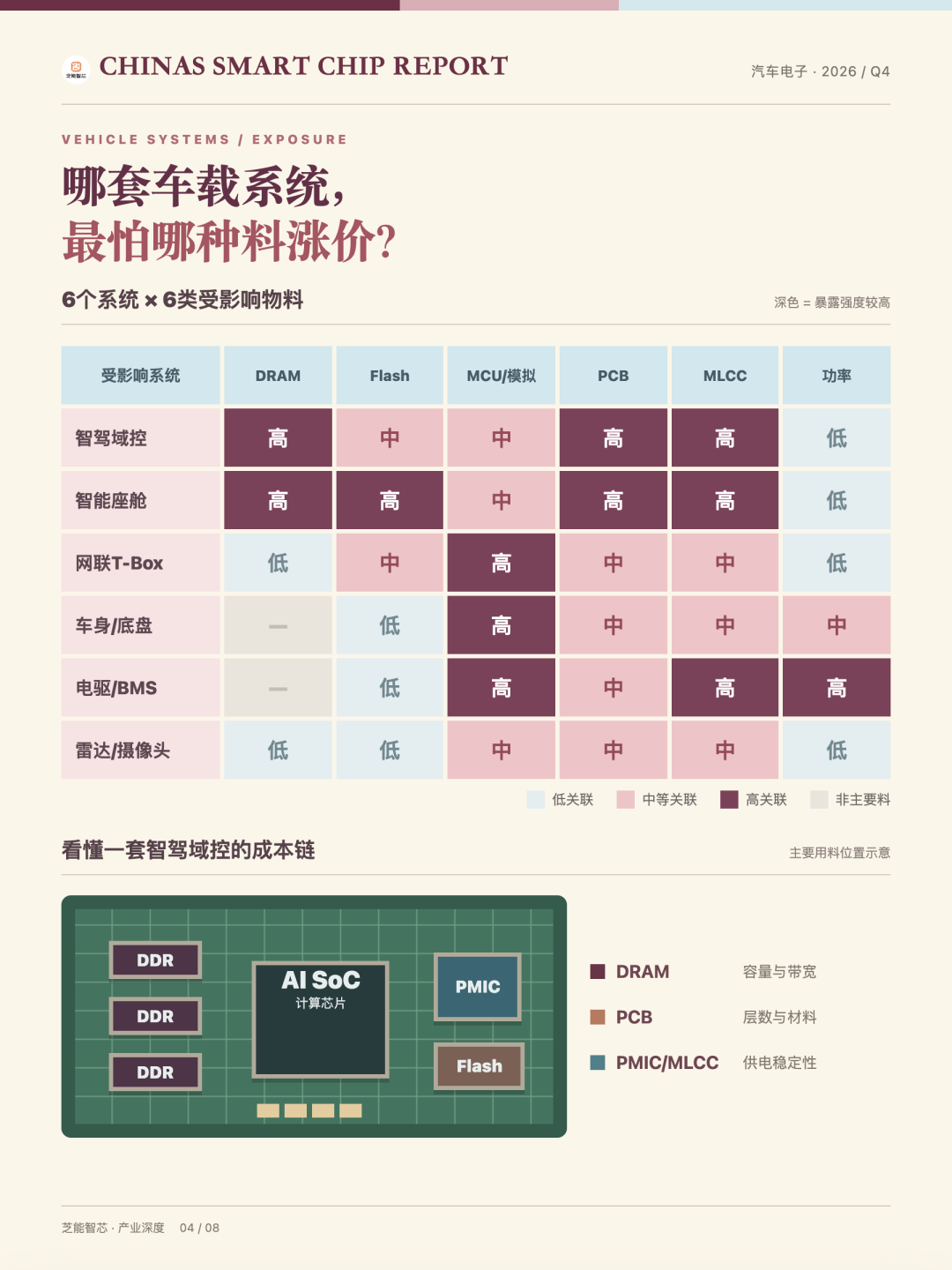
Body, chassis, powertrain, and BMS are another matter: a single MCU or analog chip may be cheap, but there are many of them, verification is strict, and the cost of changing materials is high.
Pure electric vehicles also need to consider MOSFETs, IGBTs, or SiC devices in the main drive inverter, OBC, and DC-DC; price changes in this part are more related to power materials and automotive orders.
Connected T-Boxes, radars, and camera modules will also be affected by price transmission from PCBs, MCUs, and some memory.
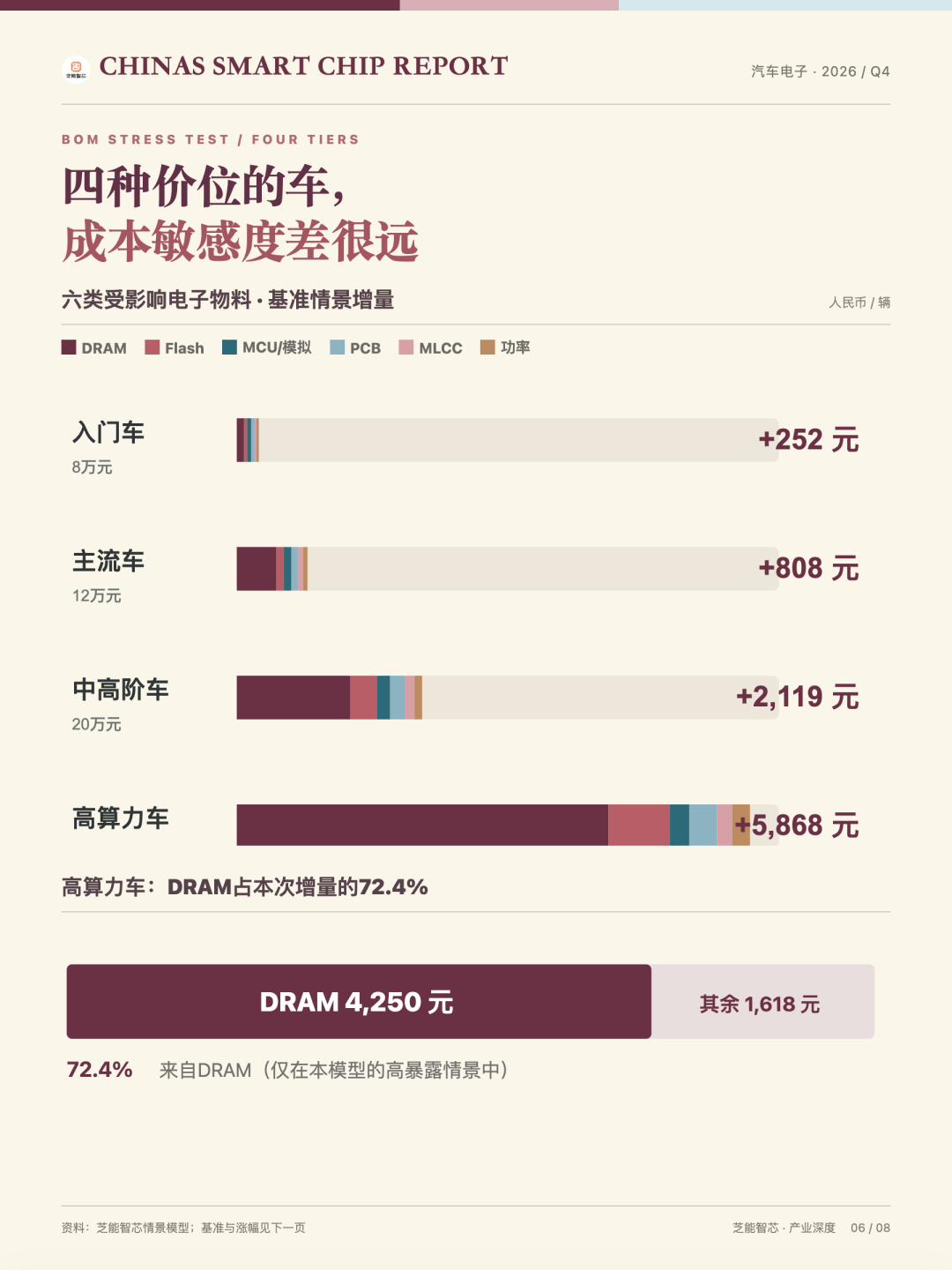
Four hypothetical vehicle types: an 80,000-yuan entry-level car, a 120,000-yuan mainstream smart car, a 200,000-yuan mid-to-high-end car, and a 350,000-yuan high-computing-power car.
First assume the procurement baseline before the 2025 price increase for each vehicle across six categories of affected electronic materials: DRAM, Flash, MCU/analog, PCB, MLCC, and electric drive/power, then multiply item by item according to different assumed price increase rates.
Based on the six categories of electronic materials, the increments for the four vehicle tiers are estimated as follows:
◎ The 80,000-yuan entry-level car increases by 84 yuan, 35 yuan, 45 yuan, 38 yuan, 24 yuan, and 26 yuan respectively, totaling 252 yuan;
◎ The 120,000-yuan mainstream smart car increases by 450 yuan, 90 yuan, 84 yuan, 78 yuan, 56 yuan, and 50 yuan, totaling 808 yuan;
◎ The 200,000-yuan mid-to-high-end car increases by 1,300 yuan, 304 yuan, 150 yuan, 165 yuan, 115 yuan, and 85 yuan, totaling 2,119 yuan;
◎ The 350,000-yuan high-computing-power car increases by 4,250 yuan, 700 yuan, 225 yuan, 315 yuan, 175 yuan, and 203 yuan, totaling 5,868 yuan.
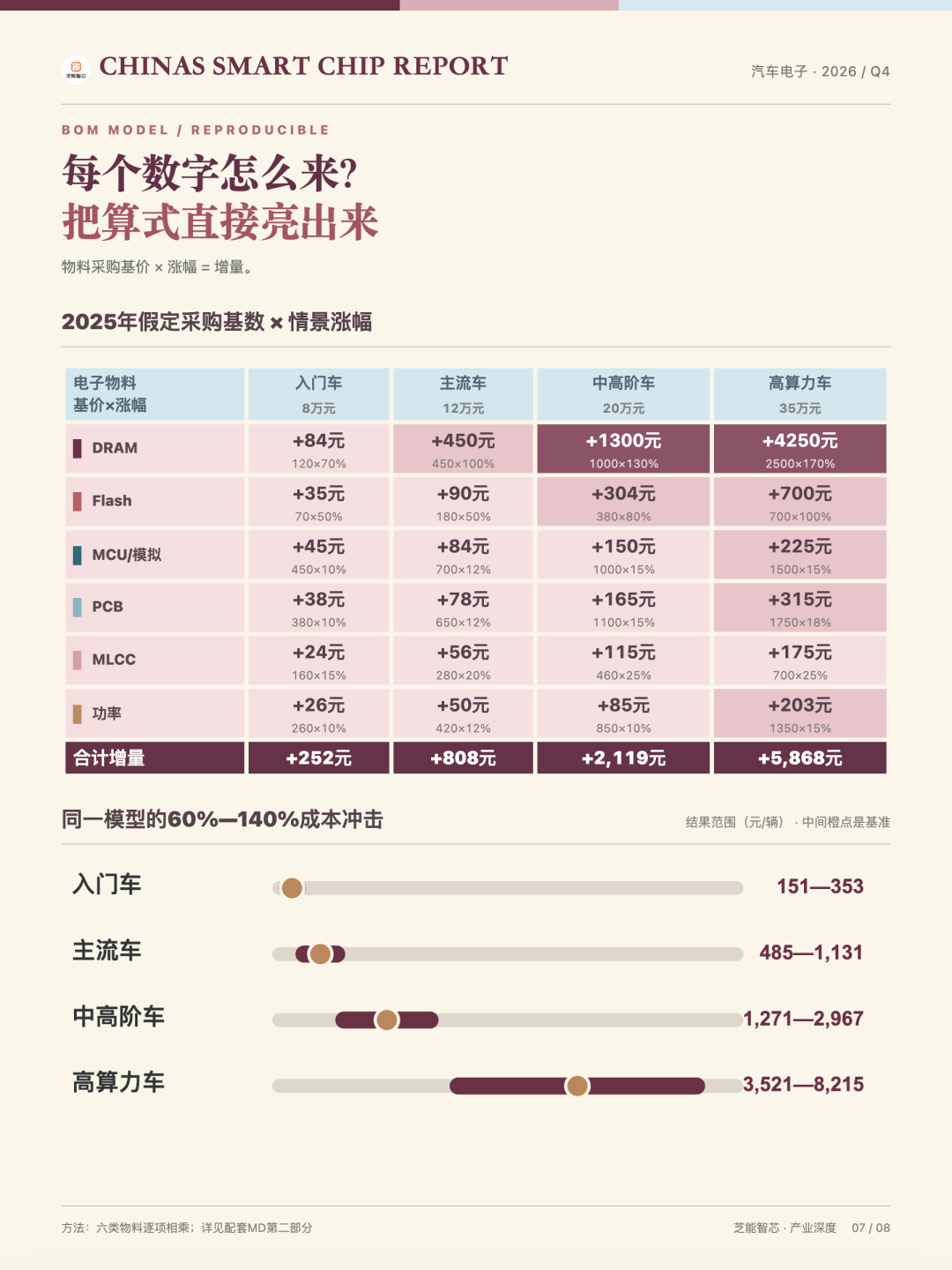
Another calculation example from UBS: 700 yuan of DRAM multiplied by 180% gives an increment of about 1,260 yuan, close to the approximately 1,300 yuan it disclosed.
If a certain vehicle model really increases by 4,000 to 6,000 yuan in the future, its share of a 150,000-yuan selling price would be 2.7% to 4.0%—enough to reshape per-vehicle gross profit. And memory is only one item of automotive cost pressure in 2026 to 2027.
Summary
Pressure in 2027 is indeed not small, and chip price increases will further intensify the real pressure on automakers.
-
![]()
Why Can Longgang's Cross-Border E-Commerce Keep Its Lead Steady Despite Industry-Wide Headwinds?
-
10 Years On: Chip Performance Has Grown 40-Fold and Memory 8-Fold—So Why Do Phones Still Lag?
-
![]()
B2B Buyer's Guide: Waveguide Supplier Directory and Technology Roadmap Comparison
-
![]()
Will Automotive Chips Keep Getting More Expensive in 2027? How Much Will Cars Cost Across Four Price Tiers?
-
![]()
Gree Electric: Draining the Reservoir
-
Volkswagen Is Feeling the Pain—Badly
-
![]()
Five-Meter Body and Magnetorheological Suspension: Can the Second-Generation Seal 07 Max Out Driving Control?
-
![]()
Global Automotive Glass Leader with a Strong Dividend Track Record