Xiao Zhan and Sun Yingsha's "First Stock of Massage Devices" Under Scrutiny: Actual Controller Ousted
 11/06 2026
 430
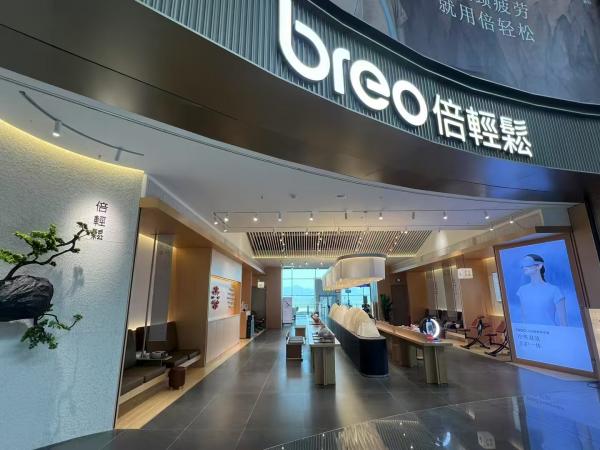
On the evening of November 4, Breo, the "first stock of portable massage devices" on the STAR Market, issued two announcements in quick succession. The company's controlling shareholder and actual controller, Ma Xuejun, formally received the "Administrative Penalty Decision" issued by the China Securities Regulatory Commission (CSRC) and was hit with severe penalties for colluding with multiple parties to manipulate his own company's stock. That same day, Ma Xuejun submitted a written resignation report, stepping down from all positions at the company and making a clean break from management.
The sword that had been hanging over Breo's head for most of the year finally fell.
The investigation into this market manipulation case began in February 2026. On June 18 this year, the CSRC issued a prior notice of administrative penalty. After Ma Xuejun and others applied for a hearing, the final penalty decision was officially finalized on November 3.
The CSRC found that from September 21, 2023 to October 24, 2024, Ma Xuejun and seven others, including Hu Wen, formed a group, concentrated their capital and shareholding advantages to trade continuously, and conducted wash trades among accounts under their own control, jointly manipulating the stock price of "Breo."
Ultimately, the CSRC handed down the maximum penalty to the seven parties involved: confiscation of illegal gains totaling 10.1183 million yuan and a fine of 30.3548 million yuan—three times the amount—bringing total fines and confiscations to 40.4731 million yuan, with orders to remit the money directly to the state treasury within 15 days of receiving the decision. Citing the seriousness of the violations, the CSRC imposed a "double ban" on Ma Xuejun: a 5-year ban from the securities market plus a 5-year ban on securities trading.
Two Penalties in Half a Year: The 55-Year-Old Founder's Swift "Naked Exit"
Counting this stock price manipulation case, this is already the second penalty the 55-year-old Ma Xuejun has received in just four months.
Ma Xuejun is a classic grassroots salesperson made good. In 1996, Ma Xuejun and partners went into business and founded Shenzhen Breo Health Products Industrial Co., Ltd., earning his first pot of gold by acting as an agent for imported massage equipment. In 2000, he officially founded the "Breo" brand, entered the portable massage hardware track starting with eye massagers, and in July 2021 pushed the company onto the STAR Market, becoming a billionaire worth billions.
Yet this helmsman who single-handedly founded Breo treated the company as his own private cash machine between 2023 and 2024.
In a separate case—for which a notice was issued on June 12 this year and which officially landed in July—the Shenzhen Securities Regulatory Bureau found that during the same period as the stock price manipulation case, Ma Xuejun used means such as arranging grandchild companies and related parties to transfer out funds, organizing employees to apply for reserve fund loans, and making advance payments to suppliers for procurement, to non-operationally occupy Breo's funds totaling 85.9329 million yuan, accounting for 21.22% of the company's audited net assets. As of the end of 2024, 25.3329 million yuan of the occupied funds had still not been returned, yet Breo concealed this and disclosed the occupied balance as 0 yuan in its 2024 annual report.
Not only that, but from July 2024 to January 2025, Ma Xuejun also instructed Breo on three occasions to transfer funds to grandchild companies to open time deposits, and used these time deposits as pledges to illegally provide guarantees for bank acceptance bills and working capital loans of external third-party companies, with total guarantees amounting to 90.5775 million yuan. The money extracted through these pledge guarantees ultimately all flowed into Ma Xuejun's pocket.
Because of the fund occupation and illegal guarantees, Breo was fined 2.5 million yuan, and Ma Xuejun personally was fined 6.3 million yuan. With the two cases combined, Ma Xuejun accumulated a hefty 18.1419 million yuan in fines within half a year.
Behind the actual controller's reckless behavior was an internal control defense line at Breo that had long since failed. The most abnormal signal appeared in the key position of chief financial officer. Since 2022, Breo's CFO position has changed hands six times in four years, with an average tenure of less than 8 months—the shortest being a mere 48 days before a hasty resignation. In October this year, former CFO Zhang Chunli once again resigned for "personal reasons" and was reassigned as deputy director of sales finance. With no one stepping in, Ma Xuejun himself—who at that point was already saddled with two filed investigations and had already received a prior notice of a 5-year market ban—personally took on the duties of acting CFO.
Now, with the delivery of the penalty decision, Ma Xuejun—who simultaneously held the roles of chairman, general manager, legal representative, and acting CFO—had no choice but to abruptly resign from all positions for "personal reasons."
With no leader at the helm, who will take over this mess? On November 4, Breo's board of directors urgently nominated director Ms. Liu Zhihua to temporarily perform the duties of chairman, general manager, and relevant committee members, and stated that it would promptly select and appoint a new chairman, general manager, and CFO.
Although Ma Xuejun has exited management, the equity in his hands has become a problem. As of the end of September 2026, Ma Xuejun personally directly held about 32.23 million shares of Breo, and together with shares indirectly held through three platforms including Ningbo Heting, he controlled a total of 47.77% of the listed company's equity. In the next five years, Ma Xuejun can neither reduce his holdings nor participate in the company's operations, while the interim team led by Liu Zhihua lacks sufficient equity to wield real authority. This misalignment—"those in power not holding shares, and those holding shares unable to manage affairs"—has cast a shadow over Breo's future strategic financing, mergers and acquisitions, and even executive incentives.
Main Business Has Never Turned a Profit in Five Years Since Listing
The reason Ma Xuejun took the risk between the end of 2023 and 2024 to manipulate his own company's stock price and occupy company funds stems from the "collapse" of Breo's fundamentals.
When it landed on the STAR Market in July 2021, Breo's issue price was 27.40 yuan per share. On the first day of listing, it surged intraday to a high of 185.58 yuan per share (unadjusted), and total market value once broke the 10 billion yuan mark. However, the first year of listing became the performance peak that Breo has still been unable to surpass.
In the year of listing in 2021, the company achieved net profit attributable to the parent company of 91.86 million yuan. In 2022 and 2023, it directly suffered huge losses of 124 million yuan and 50.8654 million yuan. Although in 2024 it recorded a slight book profit of 10.2532 million yuan relying on non-recurring gains and losses, in 2025 full-year net profit attributable to the parent company once again suffered a huge loss of 97.2622 million yuan.
If non-recurring gains and losses such as government subsidies are excluded, Breo recorded losses of 130 million yuan, 55.99 million yuan, 3.28 million yuan, and 88.64 million yuan in the four years from 2022 to 2025 respectively. In the first three quarters of 2026, Breo's net profit attributable to the parent company lost 85.5195 million yuan, further widening from the loss of 65.628 million yuan in the same period last year. Among them, the single-quarter net loss in the third quarter was 38.3711 million yuan.
In other words, for the entire five years since Breo's listing in 2021, its main business has actually not made money in any single year. Why have eye and neck massagers—often priced at over a thousand yuan each with gross margins as high as about 60%—become a business that loses money year after year in Breo's hands?
The number one black hole eating up the company's profits is abnormally high selling expenses.
Breo's rise was highly tied to densely laying out high-rent directly operated experience stores in major airports, high-speed rail stations, and high-end shopping malls across the country, as well as spending heavily online to hire top stars for promotional bombardment. Before and after listing, Breo successively signed top stars such as Xiao Zhan, Jackson Yee, and Sun Yingsha as global brand ambassadors. The achievement of online revenue exceeding 100 million yuan within four days after officially announcing Xiao Zhan as spokesperson made Ma Xuejun firmly believe in the path of "traffic plus high-profile, high-spending campaigns."
From 2022 to 2024, Breo's selling expenses as a proportion of total revenue reached 53.84%, 53.94%, and 50.16% respectively. In the first three quarters of 2025, the selling expense ratio further rose to 57.32%. This means that for every 100 yuan a consumer spends on a Breo massager, nearly 60 yuan goes to airports and shopping malls, celebrity endorsement fees, and e-commerce platform promotion fees.
By contrast, as a STAR Market company, Breo's annual R&D expense ratio only hovers around 5% to 7%—less than one-tenth of selling expenses. The unbalanced structure of "heavy marketing, light R&D" has left its products lacking a sufficient technological moat when facing encirclement by peers such as SKG and white-label alternatives.
With five consecutive years of losses, combined with a chain of scandals involving the actual controller, the secondary market has long voted with its feet. Calculated from the high of 185.58 yuan per share on the first day of listing in 2021, Breo has fallen for five consecutive years. As of the close on November 5, Breo's stock price stood at 15.08 yuan per share, down nearly 90% from the first-day listing price, with the latest total market value remaining at only 1.282 billion yuan—nearly 9 billion yuan of market value wiped out.
-
![]()
Hong Kong Stocks Bull Run: Hang Seng Tech Soars 5.55%
-
![]()
Xiao Zhan and Sun Yingsha's "First Stock of Massage Devices" Under Scrutiny: Actual Controller Ousted
-
![]()
Why Can Longgang's Cross-Border E-Commerce Keep Its Lead Steady Despite Industry-Wide Headwinds?
-
10 Years On: Chip Performance Has Grown 40-Fold and Memory 8-Fold—So Why Do Phones Still Lag?
-
![]()
B2B Buyer's Guide: Waveguide Supplier Directory and Technology Roadmap Comparison
-
![]()
Will Automotive Chips Keep Getting More Expensive in 2027? How Much Will Cars Cost Across Four Price Tiers?
-
![]()
Gree Electric: Draining the Reservoir
-
Volkswagen Is Feeling the Pain—Badly