In-Depth Discussion of "Byte Time"
 11/09 2026
 494

| Users need genuine choice.
Reactor Channel
Author | Fang Tang
Editor | Nanmu
Cover: The movie "One Second"
The term "Byte Time" has recently stirred up the entire internet circle.
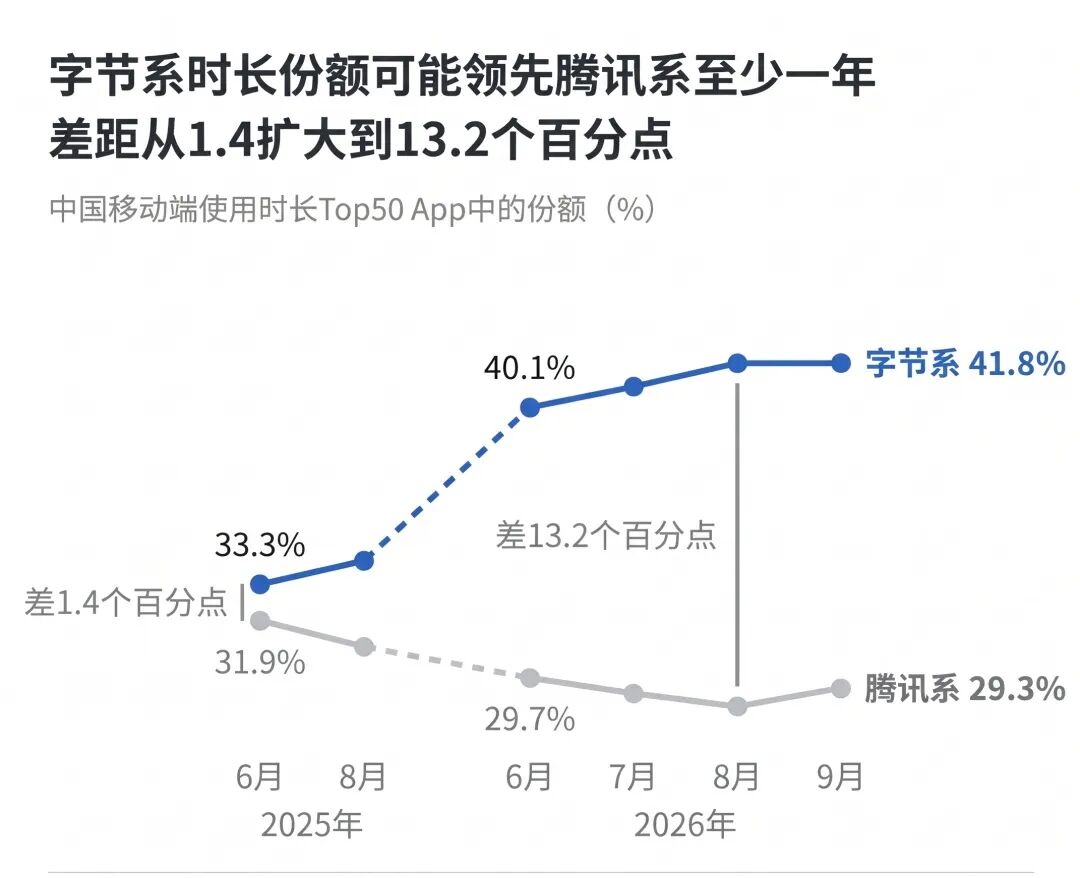
The trigger was an article by Qin Shuo, citing QuestMobile data relayed in a Nomura report: among the top 50 apps by monthly usage time in China's mobile internet, the entire ByteDance ecosystem's share of time reached 40.9%, while Tencent's fell back to 29.1%.
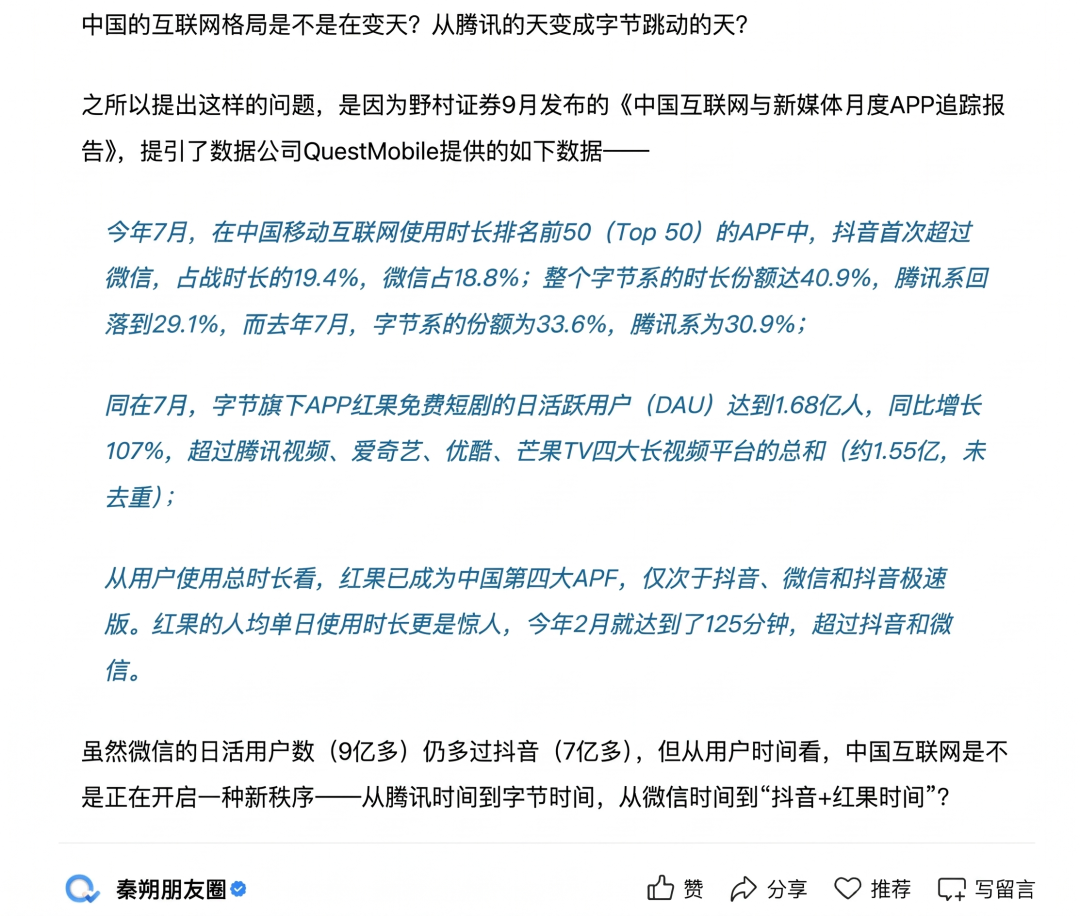
Image source: Qin Shuo's WeChat Moments
Based on this set of numbers, he coined the term "Byte Time" to summarize the shift in the center of gravity of attention toward short videos and short dramas, and accordingly proposed:
Platforms that capture so much time should bear social responsibilities commensurate with it.
Douyin Group Vice President Li Liang quickly responded publicly. He retorted: Top50 is a filtered sample; a large number of long-tail applications, mini-program services, PC and car-machine scenarios are not included in the scope. Using such a set of data to define the entire industry is "extremely imprecise" and "pure nonsense."

Image source: Li Liang's Weibo
At this point, the debate still revolved around statistical methods. After several rounds of long-distance exchanges, the wording escalated to "either bad or stupid," pointing at the other party's commercial stance. Further on, lawyers entered: Qin Shuo filed a lawsuit for infringement of reputation rights, and Li Liang stated he would actively respond to the lawsuit.
A discussion that could have produced cognitive gains thus entered judicial proceedings.
The reason the debate became increasingly chaotic, summed up, comes down to three different levels of issues:
Data layer: whether the 41.8% figure is reported accurately and whether the scope holds up—this is a verifiable technical issue.
Legal layer: whether occupying 40% of time constitutes a dominant market position under the Anti-Monopoly Law—this is a judicial issue requiring definition of the relevant market and assessment of entry barriers and substitutability.
Value layer: what responsibility a platform holding massive attention should bear—this is a public discussion issue.
Mixing the three layers together results in: the data layer answered with emotion, the legal layer answered with share, and the value layer answered with stance. No one could convince anyone else, but each side felt it had won.
1 What does ByteDance really care about?
In fact, the time share metric is inherently unsuitable to be used as market share, for three reasons:
Without defining the relevant market, share is meaningless
The first step in antitrust judgment is always to define the relevant market. Short videos, graphic information, instant messaging, e-commerce, and local life have completely different substitution relationships for users and belong to different relevant markets. Adding up the usage time of Top50 apps into one big pool and then looking at one company's proportion in this pool is equivalent to first squeezing several markets into one and then claiming to have calculated share. This figure has no direct probative force in regulatory practice.
The denominator is filtered
Top50 is a ranking, not the entire network. Long-tail applications, services within WeChat mini-programs, and PC and car-machine terminals are not included in the statistics. There is also a more hidden gap here: background playback and autoplay. When a person leaves the phone, playback continues—this time is counted as "user usage," but it is no longer the same thing as "attention."
Chinese users' migration costs are very low
Multi-homing is the norm. The same person installs two or three short video apps, compares prices and places orders on three platforms, and jumps back and forth between content and e-commerce. A high degree of multi-homing means that a single time advantage is difficult to convert into the ability to "exclude competition." What truly determines dominance is entry barriers and switching costs. Data scale, algorithm accumulation, creator ecosystem, and fulfillment networks are closer to the essence of the problem than time.
Therefore, using time share to argue monopoly lacks an entire chain of evidence in between.
But being untenable on data does not prevent the term from spreading. On the contrary, "Byte Time" is a very successful naming.
It compresses a complex industrial structure into a three-character metaphor. Once accepted by public opinion, the coordinate system of discussion is shifted. The previously repeatedly examined "Tencent monopoly narrative" is released within this framework, and ByteDance is placed in the narrative position of "possibly forming a monopoly."
Offense and defense switch positions—this is the part Li Liang really cares about. What he corrects is not a percentage but a redistribution of narrative position.
This is also a new form emerging in stock competition: what is contested is not only users but also the right to define. Whoever has the right to name an era gains the initiative in discourse first.
The communication chain is also worth noting: labeling, taking sides, emotionalizing, litigation. After these four steps, the intermediate layer that should exist in public discussion—scope, metrics, methods, verifiable evidence—is all skipped.
Pulling apart this war of words, there is indeed one thing truly happening underneath.
2 Why does distribution power migrate?
The nature of traffic rights has changed. Users' time is the hard currency.

In the incremental era, the competition was for user acquisition—whoever grabbed people not yet online won. In the stock era, the competition is for the same group of people's 24 hours a day.
What platforms compete for has also changed. In the incremental era, they competed for "entry"—where users come in from. In the stock era, they hold "distribution"—in what order and with what probability content, goods, and services reach users.
Entry can be bypassed—just switch apps. Distribution power cannot be bypassed. Creators and merchants must adapt to the rules, or they get no exposure.
So the question arises: why does distribution power migrate? Behind this are three hard mechanisms:
The curves of distribution cost are different
Relationship-chain distribution—follows, subscriptions, social recommendations—has marginal costs that rise with scale. The more users there are, the more complex the social graph, and the more content supply depends on creators' production capacity. Platforms must constantly maintain relationship density.
The marginal cost of algorithmic distribution approaches zero. One training session, infinite distributions. The same model can simultaneously distribute content, goods, services, and local life. Once the cost structure changes, cross-category expansion becomes inevitable.
Data, algorithms, and traffic form a positive feedback loop
More users bring more behavioral data; more data trains more accurate models; more accurate models bring higher retention; higher retention in turn feeds the models. This closed loop is called economies of data scale. It is the hardest wall for new entrants to cross. It cannot be smashed open with money in the short term; it relies on time and sample size.
The monetization loop moves forward
Content is the shelf. Short videos compress "seeing, seeding desire, comparing prices, and placing orders" into the same interface, and distribution power directly becomes transaction power. This is the root cause of the substantial impact of Douyin e-commerce and local life on traditional e-commerce and in-store businesses. It is not just an additional channel; more importantly, it shortens the decision chain.
The cost of concentrated distribution power is not shared evenly.
The first to feel it are creators. Traffic is priced by completion rate, interaction rate, and conversion rate. Content value and traffic value begin to decouple. A seriously produced in-depth topic may not outperform a thirty-second emotional clip. Paid traffic promotion gradually becomes a quasi-entry threshold, raising customer acquisition costs for small and medium creators, and content increasingly resembles piecework.
Then comes the industry side. Attention is absorbed in large quantities by low-cost entertainment. The bargaining power of long-form content, professional content, and public information declines. Advertising budgets shift from brand advertising to performance advertising. The business model of traditional media is restructured from the bottom up. This change is not dramatic, but it has lasted seven or eight years, and the cumulative effect is already clear.
Finally, users. After time is fragmented, the tolerance threshold is recalibrated: accustomed to a reversal every fifteen seconds, one loses focus when watching content that needs five minutes of buildup. This is the most basic habituation mechanism in behavioral psychology. Platforms did not invent it; they merely maximized its efficiency.
You might think, "Users do so voluntarily."
The problem is that users make choices within the choice set given by the platform, and this choice set itself has been designed. Recommendation systems do not only predict preferences; they also shape preferences: whatever you clicked once, you will see more of next.

This is the least conspicuous and hardest-to-refute part of platform power, and it is precisely the true origin of the term "time sovereignty."
3 Does "Byte Time" really hold?
So, does "Byte Time" really hold?
Break this question into three layers, and the answers differ.
Fact layer: holds
The trend of attention concentrating toward short videos and short dramas is real, supported by data, and not an illusion.
Legal layer: does not hold
Time share is not equal to market dominance. It requires a complete body of evidence on relevant market definition, entry barriers, degree of multi-homing, and exclusionary conduct. Based on currently public materials, directly deriving a monopoly conclusion from a Top50 time share skips too many steps.
Structural layer: half holds
Algorithmic distribution has become the dominant distribution paradigm. This is a structural change and will not reverse in the short term, but "permanent dominance" does not hold. Share moves. Product iteration, competitor counterattacks, regulatory policy, and user fatigue—any one of them can rewrite the curve.
Tencent, Alibaba, and Baidu are all counterattacking within their own ecosystems. AI tools, embodied intelligence, and offline scenarios are also continuously opening new attention outlets.
So a more accurate statement is:
We have entered a stage dominated by algorithmic distribution, not the "era" of any one company.
What is truly solidified is not anyone's position but this distribution mechanism whose objective function is dwell time.
Acknowledging the existence of the mechanism, the next question is rules. The redistribution of traffic in the stock era must change at least four places:
First, on the user side: turn "time sovereignty" from a slogan into a product feature.
The Provisions on the Administration of Algorithmic Recommendation for Internet Information Services already require platforms to provide options to turn off algorithmic recommendations, explain recommendation rules, and provide corresponding modes for minors. In the years since implementation, not many platforms have truly made these switches easy to find and use. Being explainable, intervenable, and exitable—only when these three things are achieved is the user no longer a predicted variable.
Second, between platforms: interconnection must become substantive.
Blocking external links, closed payments, and incompatible accounts essentially lock public traffic into private closed loops. The Ministry of Industry and Information Technology's campaign against blocking website links, advanced since 2021, is directionally correct. The difficulty lies ahead: to what extent interfaces are opened, to whom, and at what cost. This determines whether traffic can flow across ecosystems.
Third, within platforms: rules must be visible, and interests must be shareable.
How traffic is distributed, why throttling occurs, and whom to appeal to—these are basically black boxes today. Algorithm filing and transparency reports are a starting point. Public disclosure mechanisms for creator revenue-sharing ratios and traffic allocation are a more substantial step.
Fourth, on the regulatory side: shift from "watching share" to "watching behavior."
The anti-monopoly guidelines in the platform economy field have already brought "choose one of two," "big data price discrimination," and "self-preferencing" into view. This approach is more effective than watching a time percentage. Share changes; exclusionary behavior has clear evidence. At the same time, a set of public indicators for attention quality is needed: not only how long users stayed, but also information diversity, content quality, and the actual effects of minor protection.
Worth mentioning is the reservation of traffic for public value. If the entire incentive mechanism only rewards high-stickiness, high-conversion content, knowledge-based and public-interest content will continue to shrink.
Requiring the distribution system to reserve a stable channel for content with "low immediate feedback, high long-term value" is difficult to accomplish through platform self-discipline and usually requires external setting.
4 AI rewrites traffic rules
The last variable may be more important than all the previous debates.
Today's traffic distribution model assumes that the platform sits in the middle: users come in, and the platform decides what to serve them.
AI Agents are dismantling this premise. Users hand their intent to an assistant, which aggregates information, compares prices, and completes tasks on their behalf. At this point, the core competitive metric will shift from "dwell time" to "task completion rate."
Once the unit of measurement changes, the entire power structure must be recalculated. Platforms are no longer the mandatory entry point but retreat to becoming service providers that are called upon when needed. The layer that masters model capabilities, data interfaces, and fulfillment loops will become the new hub.
This is also why everyone is racing to build Agent platforms. What they are competing for is not a product but the center position of the next generation.
In the AI era, the most likely way for "Byte Time" to end is to be replaced by another measurement method.
When the metric changes from "how long you watched" to "whether your task got done," the ceiling of attention arbitrage will lower itself.
Back to this debate. Having escalated to litigation, winning or losing no longer matters.
Its real value is that it pushed a real question onto the table:
User growth has stopped, and attention has become the scarcest resource—according to what rules will it be distributed next?
The author's view has two points:
Platforms can be efficient distributors, but they cannot be privatizers of attention. Traffic has never been a platform's asset; it is the sum of the irreplaceable time of hundreds of millions of users.
Regulation can ignore market share, but it cannot ignore behavior. Watching for exclusion, watching for self-preferencing, and watching for data blocking is more useful than watching a percentage.
What users need is genuine choice: recommendations that can be turned off, rules that can be understood, and data that can be taken away.
A healthy internet should not forever spin in the cycle of "one company occupies the traffic high ground while others passively follow."
The so-called "Byte Time" is a reminder: as attention becomes increasingly concentrated, we must answer according to what order this scarce public resource should be distributed.
Copyright of the Reactor, unauthorized reproduction is prohibited without permission.
-
![]()
Global Buzz: Is Huawei's Pangu LLM—the One Yu Chengdong Vowed Would "Become World No. 1"—About to Get a Refresh?
-
![]()
Alibaba Leads Investment in Its Former Intern: UniPat AI, the "Examiner" for Large Models, Completes $300 Million Financing
-
![]()
Phone Storage Full Again? What You're Clearing Might Not Be What's Actually Taking Up Space
-
![]()
In-Depth Discussion of "Byte Time"
-
![]()
One-Person Company Goes Viral: AI Agents as Employees—Has the Era of Solo Entrepreneurship Truly Arrived?
-
Report | 2026 China AI Listed Enterprise Development Insights
-
Trends | Gartner's Top 10 Technology Trends for 2027: Three Phases Clarify Enterprise Technology Priorities
-
Two Governance Paradigms: The U.S. Ban on Artificial Superintelligence Act and the Wuzhen Summit