Alibaba Leads Investment in Its Former Intern: UniPat AI, the "Examiner" for Large Models, Completes $300 Million Financing
 11/09 2026
 343

ChaoYong AI Editorial Department
On November 6, AI training and evaluation company UniPat AI completed a new round of $300 million in financing at a pre-money valuation of $2.5 billion, led by Alibaba, with Tencent and existing shareholder Sequoia China participating.
The company's previous shareholders also included Monolith Management and Jinqiu Fund. Founder Li Kuan was born in 1995.
As recently as August 2025, he was still an intern at Alibaba's Tongyi Lab, serving as a member of the DeepResearch project team and listed as the first author on the paper for the open-source agent WebSailor.
At that time, he was already a second-year doctoral student at the Hong Kong University of Science and Technology, holding a bachelor's degree from Beihang University and a master's degree from the Institute of Computing Technology, Chinese Academy of Sciences. His research focuses on LLM Agents and trustworthy machine learning.
At the end of 2025, Li Kuan left Tongyi and registered UniPat in Shanghai. The company's full name is Model Galaxy (Beijing) Technology Co., Ltd. From intern to founder of a company valued at $2.5 billion, the interval was less than a year and a half.
UniPat does not build models; it serves as an "examiner" and "private tutor" for models.
The company generates training and evaluation data based on real-world usage scenarios and sells it to AI research institutions and enterprises. Its benchmarks cover the software engineering capabilities of coding agents, the web operation capabilities of browser agents, and the visual reasoning capabilities of multimodal models.
In January this year, UniPat and xbench, under Sequoia China, jointly released BabyVision, using 388 questions to test models' pure visual understanding capabilities. The human baseline accuracy was 94.1%, while Gemini 3 Pro-Preview scored only 49.7%.
Terminal-X, released in May, tests the performance of coding agents on complex engineering tasks, while ExpertEval covers the three domains of healthcare, finance, and law, with an average of more than 21 scoring criteria set for each case. It not only judges right from wrong but also checks evidence and reasoning processes.
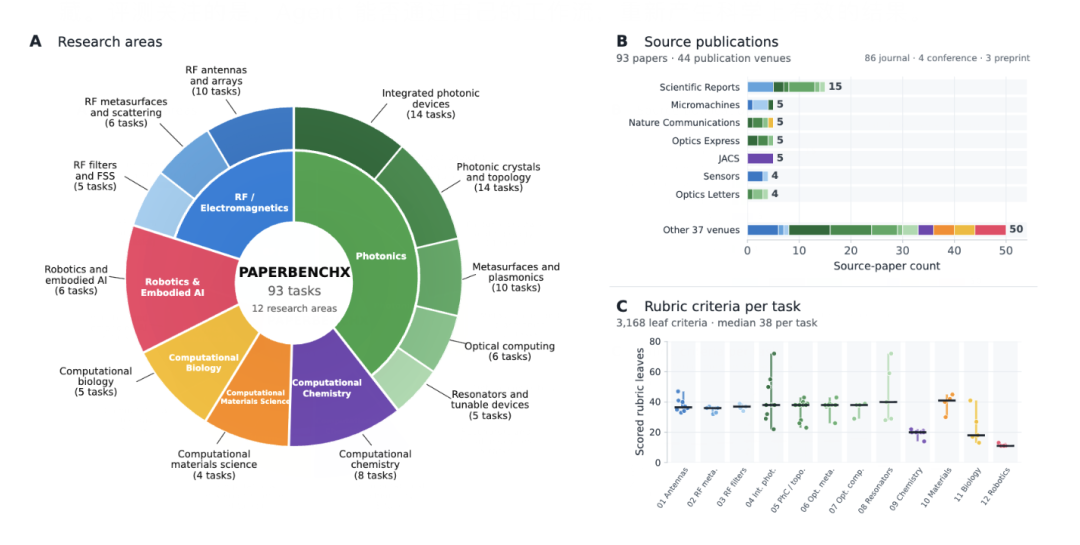
Task distribution, source papers, and scoring item composition of PaperBenchX
Alibaba's lead in this financing round is equivalent to using $300 million to vote for a former intern's judgment.
People familiar with the matter said the deal was close to completion in September, and the participation of Tencent and Sequoia brings together in this round the three domestic institutions with the deepest layout in AI infrastructure.
The value of the AI evaluation track lies in the fact that as model capabilities converge, the standard for "defining good" itself becomes scarce.
Less than a year after its founding, BabyVision has already been cited in model reports by U.S. laboratories, indicating that its evaluation framework is beginning to gain industry-level recognition.
However, the $2.5 billion pre-money valuation corresponds to an early-stage company whose revenue structure has not yet been disclosed. The scalability of the evaluation business depends on whether large model vendors are willing to continue paying for the "grading rights" rather than making one-time purchases.
Li Kuan's case also points to a more specific signal: the talent spillover from Chinese large model companies is extending from core technical staff to the intern level, and capital is willing to pay an unprecedented premium for this spillover.
-
![]()
Global Buzz: Is Huawei's Pangu LLM—the One Yu Chengdong Vowed Would "Become World No. 1"—About to Get a Refresh?
-
![]()
Alibaba Leads Investment in Its Former Intern: UniPat AI, the "Examiner" for Large Models, Completes $300 Million Financing
-
![]()
Phone Storage Full Again? What You're Clearing Might Not Be What's Actually Taking Up Space
-
![]()
In-Depth Discussion of "Byte Time"
-
![]()
One-Person Company Goes Viral: AI Agents as Employees—Has the Era of Solo Entrepreneurship Truly Arrived?
-
Report | 2026 China AI Listed Enterprise Development Insights
-
Trends | Gartner's Top 10 Technology Trends for 2027: Three Phases Clarify Enterprise Technology Priorities
-
Two Governance Paradigms: The U.S. Ban on Artificial Superintelligence Act and the Wuzhen Summit